


Entering the market as a new venture involves navigating a complex web of competitive dynamics. For founders, understanding the structural forces that shape industry profitability is not just an academic exercise; it is a survival necessity. One of the most enduring frameworks for this analysis is Porter’s Five Forces. Originally developed by Michael Porter, this model helps businesses evaluate the intensity of competition and the attractiveness of a market.
For startups, the goal is to identify where the pressure points lie before committing significant capital. This guide breaks down how to apply this framework specifically to the unique constraints and opportunities of early-stage ventures. We will explore each force, provide actionable questions to ask, and discuss how to translate findings into strategy.
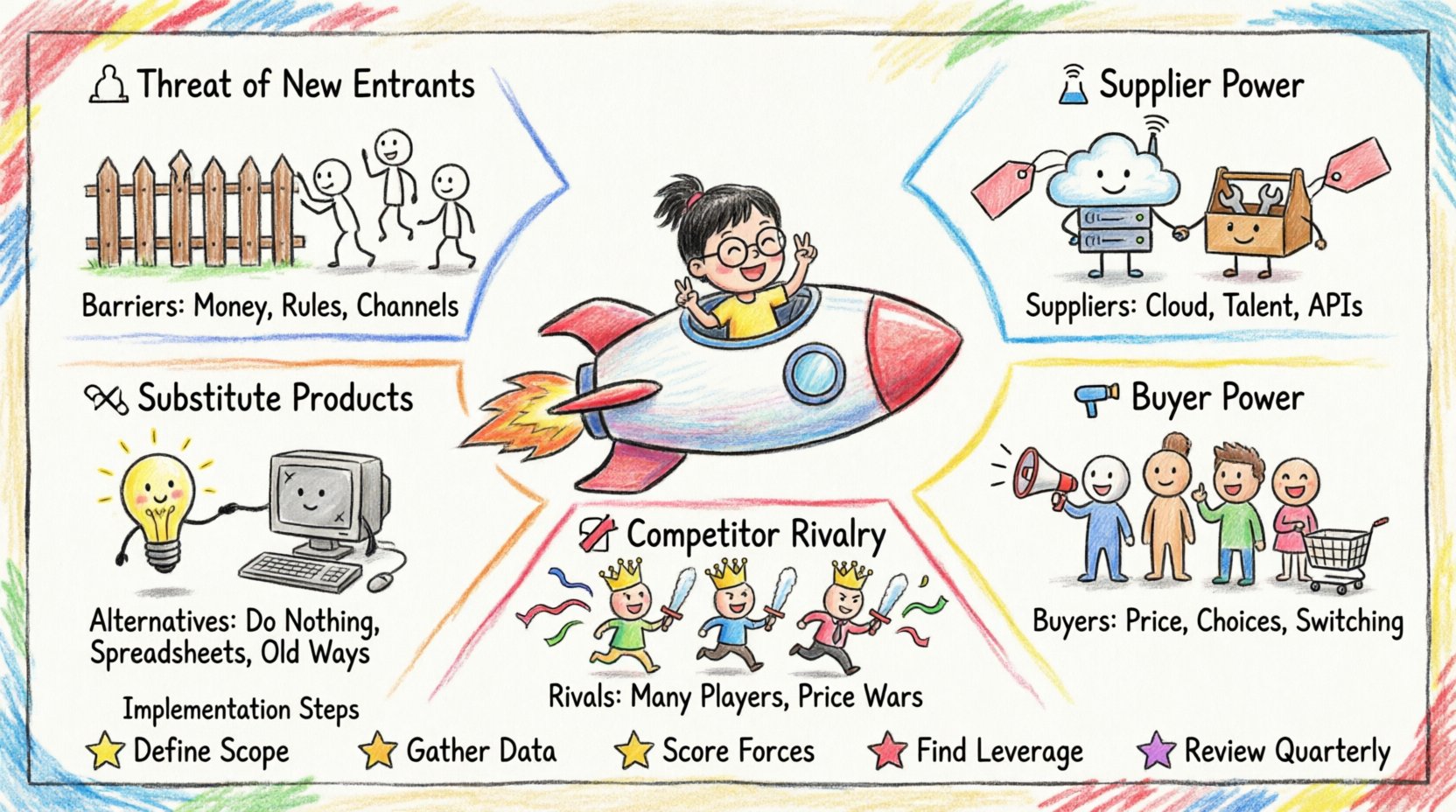
Why Startups Need Competitive Analysis 🧠
Many founders assume that a great product will naturally find success. While product-market fit is critical, ignoring the structural environment can lead to failure even with a superior offering. Competitors may have entrenched distribution channels, regulatory advantages, or loyal customer bases that are difficult to displace.
Using a structured framework helps avoid blind spots. It forces you to look beyond direct rivals and consider suppliers, buyers, substitutes, and potential new entrants. This holistic view prevents the common error of focusing solely on a single competitor while ignoring broader industry trends.
- Strategic Clarity: Understands where value is captured in the ecosystem.
- Risk Identification: Highlights threats before they become critical failures.
- Resource Allocation: Helps decide where to invest time and money.
1. Threat of New Entrants 🚧
This force examines how easy or difficult it is for other companies to enter your space. If barriers to entry are low, your market share can be eroded quickly by well-funded copycats or agile disruptors.
For startups, the threat of new entrants is often a double-edged sword. You might be a new entrant yourself, but you must also anticipate who will follow you. High barriers protect profitability. Low barriers invite saturation.
Key Barriers to Evaluate
- Capital Requirements: How much money is needed to build a minimum viable product and acquire customers? Heavy infrastructure needs create a high barrier.
- Regulatory Hurdles: Are there licenses, compliance standards, or certifications required? Healthcare and fintech often have high regulatory walls.
- Access to Distribution: Can new players reach customers easily? If you control a unique channel, incumbents are safer.
- Switching Costs: If customers face high costs to move to a new vendor, new entrants struggle to gain traction.
Startup Implications
If capital requirements are high, consider a leaner entry model. If distribution is the main barrier, focus on partnerships. If you are the new entrant, look for niches where incumbents are vulnerable due to legacy systems or complacency.
2. Bargaining Power of Suppliers 💼
Suppliers in this context are not just vendors of raw materials. For modern startups, suppliers include cloud infrastructure providers, API integrators, key talent, and content creators. Their power dictates your cost structure and operational stability.
High supplier power means they can raise prices or reduce quality, squeezing your margins. Low supplier power gives you leverage to negotiate better terms.
Assessing Supplier Power
Consider the concentration of the supplier market. If there are only a few major providers, they hold more power. Conversely, if there are many alternatives, you can switch easily.
| Factor | High Supplier Power | Low Supplier Power |
|---|---|---|
| Number of Suppliers | Few dominant players | Many fragmented options |
| Switching Costs | High integration effort | Minimal data migration |
| Product Differentiation | Unique technology or IP | Commodity services |
| Forward Integration | Supplier could become a competitor | Supplier focuses only on B2B |
Startup Mitigation Strategies
- Diversification: Avoid relying on a single vendor for critical functions.
- Open Source: Utilize open-source alternatives where possible to reduce dependency.
- Vertical Integration: In early stages, build in-house capabilities if the supplier cost is too high.
3. Bargaining Power of Buyers 👥
Buyers are your customers. Their power lies in their ability to drive prices down, demand higher quality, or play competitors against each other. In a crowded market, buyers often hold the most power.
For startups, high buyer power can mean difficult sales cycles and low retention. You must understand what drives your customers to switch and what keeps them loyal.
Indicators of Buyer Power
- Price Sensitivity: Is the product a commodity or a specialized solution? Commodities invite price wars.
- Volume: Do a few customers account for most revenue? If so, they can dictate terms.
- Information Availability: Do customers know exactly what features they need and what the market price is?
- Switching Costs: If data or workflows are easy to move, buyers will switch for better deals.
Reducing Buyer Pressure
To reduce buyer power, increase the value you provide beyond price. Focus on outcomes rather than features. Build community around your brand so that leaving feels like losing access to a network, not just a tool. Contractual lock-ins can help, but they should not be the only defense.
4. Threat of Substitute Products 🔄
Substitutes are not direct competitors. They are different solutions that solve the same problem. A classic example is video conferencing software substituting for business travel. Another is streaming services substituting for cable TV.
Startups often fail because they focus on direct competition while ignoring substitutes that are cheaper or more convenient. The substitute threat limits the price you can charge.
Identifying Substitutes
Ask yourself: What are customers doing now before they used your product? Is it a manual process, a spreadsheet, or a different technology? If the alternative is “doing nothing,” your value proposition must be compelling enough to change behavior.
- Price-Performance Ratio: Does the substitute offer a better ratio of cost to benefit?
- Buyer Propensity to Switch: How willing are users to adopt new habits?
- Perceived Risk: Is the substitute perceived as safer or more stable?
Strategic Response
If substitutes are prevalent, focus on differentiation. Make your solution more integrated into the user’s daily workflow so that the substitute becomes less attractive. Highlight efficiency gains that the old methods cannot match.
5. Rivalry Among Existing Competitors ⚔️
This force looks at the intensity of competition in the industry. High rivalry leads to price wars, heavy advertising spending, and innovation races. Low rivalry allows for stable margins.
For startups, entering a market with high rivalry is risky unless you have a distinct advantage. However, high rivalry can also indicate a proven market demand.
Factors Increasing Rivalry
- Number of Competitors: Many players of similar size increase friction.
- Industry Growth: Slow growth forces companies to fight for market share.
- Fixed Costs: High fixed costs encourage price cutting to cover capacity.
- Exit Barriers: If it is hard to leave the industry, companies stay and fight.
Navigating Competition
Do not enter a red ocean unless you have a clear path to differentiation. Consider niche markets where large competitors are too slow to respond. Alternatively, target a different customer segment that is currently underserved.
Practical Implementation Framework 🛠️
Knowing the theory is one thing; applying it is another. Here is a step-by-step approach to conducting this analysis within your startup.
- Define the Industry Scope: Be specific. Are you in the “cloud storage” market or the “data security” market? Scope determines the forces.
- Gather Data: Talk to customers, interview industry experts, and review public filings. Do not rely on assumptions.
- Score Each Force: Rate each force from Low to High impact. Use a simple 1-5 scale.
- Identify Leverage Points: Where can you influence the force? Can you lower supplier power by consolidating vendors?
- Review Quarterly: Markets change. Revisit this analysis every quarter to stay aligned.
Common Pitfalls to Avoid ⚠️
Even with a solid framework, founders can make mistakes during the analysis phase. Being aware of these errors helps ensure the output is accurate.
- Static Analysis: Treating the forces as fixed. Technology and regulations shift rapidly.
- Confirmation Bias: Looking only for data that supports your current plan. Actively seek disconfirming evidence.
- Ignoring Complements: Porter’s original model did not include complements, but for digital products, complementary goods are vital. A lack of apps for your platform can kill demand.
- Over-Reliance on Price: Assuming price is the only competitive lever. Brand, speed, and support often matter more.
Frequently Asked Questions ❓
Is this framework still relevant in the digital age?
Yes, the structural dynamics remain valid. While digital platforms change distribution, the underlying economics of power and competition do not. The speed of change just requires more frequent updates to the analysis.
How much time should I spend on this?
For a seed-stage startup, a half-day workshop is sufficient. For Series A or later, a deeper dive with external consultants might be warranted. Do not let analysis paralysis delay execution.
Can I use this for fundraising?
Absolutely. Investors appreciate founders who understand their competitive landscape. Including this analysis in your deck shows strategic maturity and risk awareness.
Final Thoughts on Strategic Positioning 🎯
Porter’s Five Forces provides a lens to view the structural reality of your business environment. It does not guarantee success, but it removes the guesswork from strategic planning. By understanding where the pressure comes from, you can build defenses and exploit opportunities that others miss.
Startups thrive when they align their internal capabilities with external realities. Use this guide to map the terrain, then move forward with confidence. The goal is not to avoid competition, but to position your venture where it can win.
Related posts:
 Porter’s Five Forces Analysis: A Complete Framework Breakdown for Strategic Decision-Making
 How to Apply Porter’s Five Forces to Evaluate Industry Attractiveness and Profit Potential
 Porter’s Five Forces Explained: Key Concepts Every Business Leader Should Know
 Step-by-Step Guide to Conducting a Porter’s Five Forces Analysis from Scratch