


Strategic planning often gets relegated to the corner office of established corporations. However, for early-stage startups, understanding the structural forces of your industry is not a luxury—it is a survival mechanism. Many new ventures fail not because their product is flawed, but because they misjudge the competitive landscape. This guide explores how to apply Porter’s Five Forces framework specifically to the unique constraints and opportunities faced by startups.
By systematically analyzing market dynamics, you can identify vulnerabilities before they become existential threats. This approach helps in spotting market gaps where competition is weak and where customer needs are unmet. Let’s dive into the five specific forces that shape your industry’s profitability and how they impact your business model.
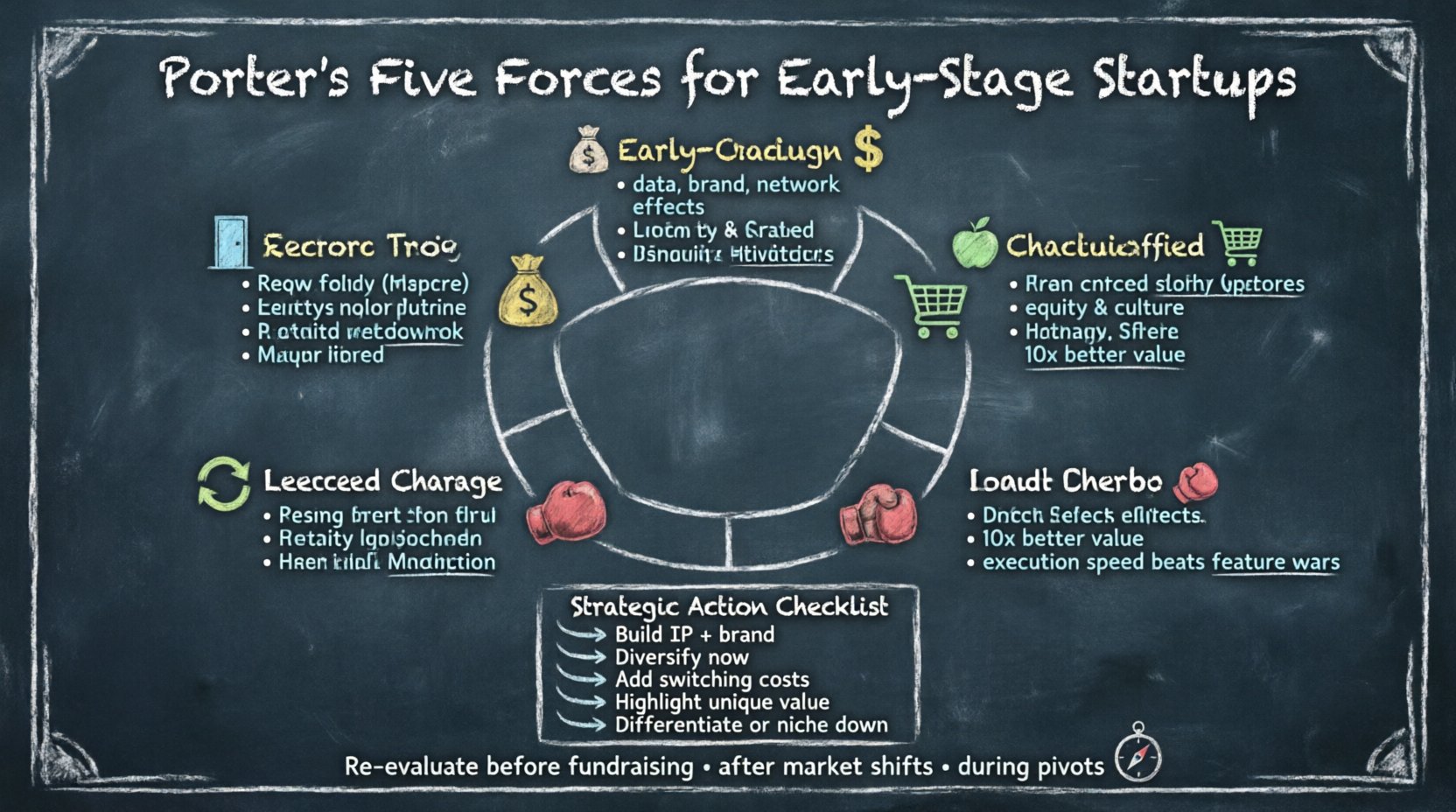
1. Threat of New Entrants 🚪
This force measures how easy it is for new competitors to enter your market. For startups, this is a double-edged sword. Low barriers to entry mean you can launch quickly, but they also mean your competitors can copy you just as fast.
Key Factors to Consider
- Capital Requirements: Does your model require significant upfront investment? High capital needs act as a natural barrier.
- Regulatory Hurdles: Are there licenses or compliance standards that slow down new players?
- Access to Distribution Channels: Can you reach customers easily? If incumbents control the channels, new entrants struggle.
- Proprietary Technology: Do you have patents or trade secrets that protect your core offering?
For an early-stage company, high barriers to entry often provide a safety buffer. However, startups typically operate with lower barriers to succeed. The strategy here is to build speed and brand loyalty faster than new entrants can catch up. If your business relies on a network effect, the threat decreases as your user base grows.
Startup Context: In the software sector, the cost to copy code is low. This makes the threat of new entrants high. To counter this, focus on data accumulation. The more data your users provide, the harder it is for a new entrant to replicate your value. User experience and community building also create intangible barriers that are difficult for capital alone to overcome.
2. Bargaining Power of Suppliers 💰
Suppliers can raise prices or reduce the quality of goods and services. In the startup world, this often translates to reliance on key technology providers or talent pools.
Assessing Supplier Power
- Number of Suppliers: If there is only one provider for a critical component, their power is high.
- Switching Costs: How expensive is it to move to a different supplier? High switching costs lock you in.
- Product Differentiation: Is the supplier’s input unique? Generic inputs lower their leverage.
- Forward Integration: Can the supplier compete with you directly?
Startups often face high supplier power because they lack volume leverage. A small business cannot negotiate the same rates as a giant corporation. To mitigate this, diversify your supply chain where possible. Avoid single points of failure. If you rely on a specific API or cloud infrastructure, have a contingency plan ready. Building relationships is crucial, but contractual terms should also reflect your growth potential.
Startup Context: Human capital is often the most critical supplier for a tech startup. If your key engineers leave, the project stalls. Treat talent acquisition as a supply chain issue. Offer equity, culture, and growth opportunities to reduce the power of competitors poaching your team. Avoid over-reliance on a single consultant or contractor for core development.
3. Bargaining Power of Buyers 🛒
Buyers drive down prices and demand better quality or service. In B2B startups, this might be enterprise clients. In B2C, it is the end-user.
Understanding Buyer Power
- Price Sensitivity: Are customers buying based on price or value? High sensitivity increases buyer power.
- Concentration of Buyers: Do you have a few large clients or many small ones? Few large clients give buyers more leverage.
- Switching Costs: Is it hard for a customer to leave you? High switching costs reduce their power.
- Availability of Information: Do buyers know exactly what your product costs to make? Transparency increases their power.
For startups, buyer power is often high because customers have many alternatives. You must differentiate beyond price. Focus on customer success and retention. If you can make it difficult or costly for a client to leave, you reduce their bargaining power. This is often achieved through data integration, custom workflows, or deep ecosystem integration.
Startup Context: In the early days, you might offer discounts to gain traction. This trains customers to expect lower prices. Be careful. As you grow, raise prices gradually to signal value. If you target enterprise clients, understand that their procurement teams have significant power. You must align your sales process with their compliance and security requirements to reduce friction.
4. Threat of Substitute Products 🔄
Substitutes are not direct competitors but offer a different way to solve the same problem. A taxi service is threatened by ride-sharing apps, which are in turn threatened by remote work tools.
Identifying Substitutes
- Relative Price/Performance: Does the substitute offer better value for money?
- Customer Tendency to Switch: How willing are users to change habits?
- Innovation Rate: How fast is technology evolving in adjacent sectors?
Startups often underestimate indirect competition. Your product might not be competing against another SaaS tool, but against a spreadsheet or an email inbox. Analyze how customers solve the problem today without you. If the current solution is cheap and effective, you must prove your solution is significantly better. Reducing the friction of switching is key to overcoming substitutes.
Startup Context: Look at the budget line item. If your product competes with a manual process, the substitute cost is the employee’s time. If it competes with a competitor, the substitute cost is the switching risk. Position your product as a risk reducer. Show that staying with the old way is more expensive than switching to you. Use case studies to prove the ROI of your solution over the status quo.
5. Rivalry Among Existing Competitors 🥊
This is the intensity of competition in the industry. High rivalry leads to price wars and increased marketing spend.
Drivers of Rivalry
- Number of Competitors: More players mean more competition.
- Industry Growth: In slow-growth markets, fighting for market share is fierce.
- Product Differentiation: If products are similar, price becomes the main lever.
- Exit Barriers: Are companies forced to stay in the market even if they lose money?
For a startup, entering a crowded market is risky. However, it can also validate demand. The key is to find a niche where the major players are not focused. Look for underserved segments. If you enter a red ocean, you need a clear cost advantage or a unique value proposition. Constant monitoring of competitor moves is essential to adjust your strategy quickly.
Startup Context: In a hot market, many startups will enter. Expect to be copied. Focus on execution speed. In a mature market, focus on efficiency. Do not burn cash on features that do not directly impact revenue. Monitor competitor funding rounds. If they are raising large sums, they may be planning an aggressive expansion. Prepare defensive strategies such as locking in key partners or securing exclusive distribution deals.
Strategic Application Table 📊
Use the following table to summarize your findings and create an action plan. This visual aid helps teams align on the risks they face.
| Force | Level of Impact | Strategic Question | Proposed Action |
|---|---|---|---|
| New Entrants | High / Medium / Low | What stops others from copying us? | Build IP, focus on brand, speed to market |
| Supplier Power | High / Medium / Low | Are we reliant on one source? | Diversify vendors, negotiate volume tiers |
| Buyer Power | High / Medium / Low | Can customers easily leave? | Increase switching costs, improve onboarding |
| Substitutes | High / Medium / Low | What solves the problem without us? | Highlight unique benefits, lower price |
| Rivalry | High / Medium / Low | How aggressive are competitors? | Find niche, differentiate features |
Integrating Analysis into Startup Operations 🛠️
Conducting this analysis is not a one-time event. It should be integrated into your regular planning cycles. This ensures you remain agile as the market evolves.
When to Re-evaluate
- Before Raising Capital: Investors want to see you understand the risks.
- After Major Market Shifts: New regulations or technologies change the game.
- Product Pivot: If you change direction, the forces change.
Data Gathering Methods
To fill in the table accurately, you need real data. Rely on assumptions at your peril.
- Customer Interviews: Ask about their current solutions and pain points.
- Competitor Monitoring: Track their pricing changes and feature releases.
- Industry Reports: Look for market size and growth rate data.
- Supplier Conversations: Talk to vendors about their own market challenges.
Financial Modeling Implications 💸
Understanding these forces directly impacts your financial projections. High supplier power might mean lower margins. High buyer power might mean longer sales cycles. You must adjust your cash flow forecasts accordingly.
- Margin Protection: If rivalry is high, plan for lower margins initially to gain share.
- Customer Acquisition Cost: If substitutes are plentiful, CAC will be higher. You need more runway.
- Churn Rate: If buyer power is high, churn will be higher. Factor this into LTV calculations.
Investors will scrutinize these assumptions. Be honest about the risks. A realistic plan that accounts for these forces is better than an optimistic one that ignores them. Show how you have mitigated the risks in your strategy.
Team Alignment and Roles 👥
Everyone on the team should understand the competitive landscape. This ensures everyone is working towards the same strategic goals.
- Product Team: Focus on features that differentiate you from substitutes.
- Sales Team: Focus on arguments that reduce buyer power.
- Operations: Focus on supply chain resilience.
- Marketing: Focus on brand barriers against new entrants.
Common Pitfalls to Avoid 🚫
Even with a framework, mistakes happen. Here are common errors startups make during this process.
- Overestimating Your Moat: Just because you have a patent does not mean customers will pay for it.
- Ignoring Adjacent Markets: Competition often comes from outside your defined category.
- Static Analysis: Markets evolve. A snapshot today is outdated tomorrow.
- Internal Bias: Do not assume your product is better without evidence.
Final Considerations on Strategic Clarity 🧭
Applying Porter’s Five Forces provides a structured way to view the external environment. It shifts the focus from internal capabilities to external realities. For an early-stage startup, clarity on these forces reduces uncertainty. It allows you to position your product where the pressure is lowest and the opportunity is highest. By recognizing these dynamics early, you build a business that is resilient against market shifts.
This framework is a tool for thinking, not a rigid rule. Use it to challenge your assumptions. Test your hypotheses with the market. The goal is not to predict the future perfectly, but to be prepared for it. Startups that understand their competitive landscape navigate the early years with more confidence and fewer surprises.
Remember that strategy is about trade-offs. You cannot be everything to everyone. Define where you will compete and where you will not. This clarity is your strongest asset as you grow. Keep the analysis alive. Review it quarterly. Adapt your tactics as the forces shift. This disciplined approach separates sustainable businesses from fleeting trends.
Related posts:
 Porter’s Five Forces Analysis: A Complete Framework Breakdown for Strategic Decision-Making
 How to Apply Porter’s Five Forces to Evaluate Industry Attractiveness and Profit Potential
 Porter’s Five Forces Explained: Key Concepts Every Business Leader Should Know
 Step-by-Step Guide to Conducting a Porter’s Five Forces Analysis from Scratch