


Enterprise architecture (EA) is often perceived as a siloed discipline, disconnected from business strategy and operational realities. At its core, the challenge lies not in complexity—but in communication. How do architects ensure that stakeholders from finance, operations, technology, and leadership understand the same vision, using a shared language that transcends technical jargon?
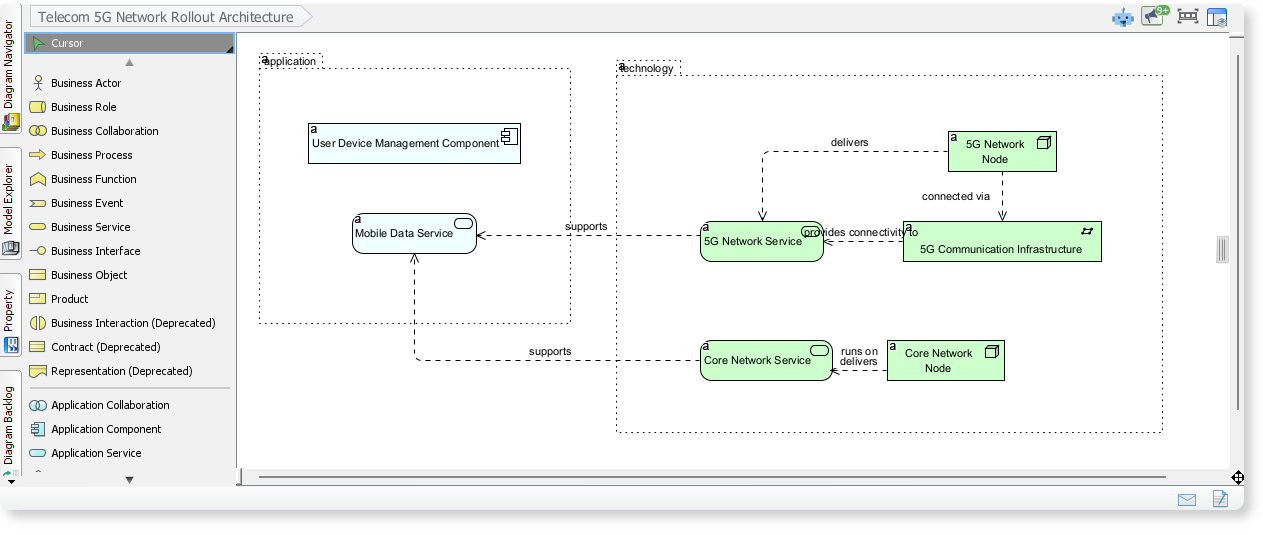 Introducing ArchiMate—a structured, domain-agnostic language designed to bridge the communication divide in enterprise architecture. Beyond static diagrams, ArchiMate creates a shared vocabulary through intentional semantics, layered viewpoints, and narrative flow. When combined with the intelligent automation and contextual insight offered byVisual Paradigm AI, ArchiMate transforms from a modeling tool into a strategic communication engine that supports decentralized, stakeholder-centric decision-making.

VP AI: How Visual Paradigm AI Empowers Dynamic, Human-Centered Enterprise Architecture
Visual Paradigm’s AI-powered capabilities go beyond auto-generation of diagrams. They offer real-time semantic understanding, context-aware recommendations, and adaptive documentation that dynamically respond to stakeholder needs. This integration elevates ArchiMate from a static modeling framework to a living, responsive architecture communication platform.
For EA teams, this means:
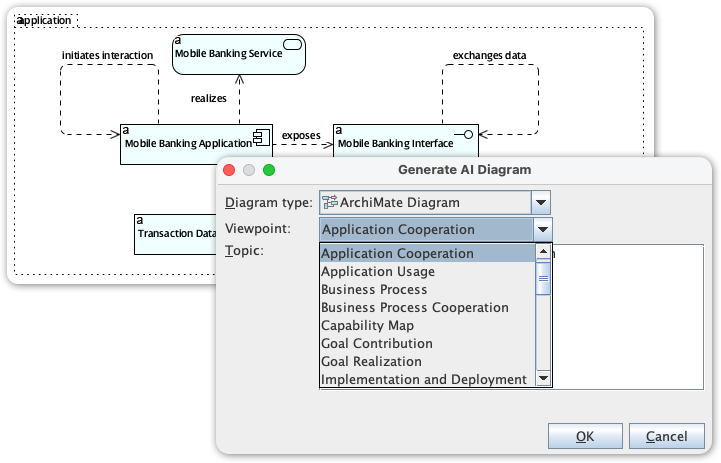
- Automated Viewpoint Generation: AI analyzes stakeholder roles, business objectives, and data inputs to suggest the most appropriate viewpoint (e.g., ‘Strategic Overview,’ ‘Technical Gap Analysis’)—reducing manual effort and ensuring alignment with organizational goals.
- Contextual Storytelling: AI interprets relationships between business processes and IT systems and constructs narrative journeys—turning model elements into a ‘story’ that stakeholders can follow, whether they are executives or developers.
- Smart Translation of Concepts: The AI translates technical terms into accessible language for non-technical audiences and vice versa, maintaining accuracy while improving comprehension across departments.
- Dynamic Feedback Loops: As stakeholders interact with ArchiMate models, AI learns from their queries, comments, and navigation patterns, refining future outputs to better match their understanding and needs.
For example, when a CTO requests a technical breakdown of cloud migration impacts, the AI can extract relevant ArchiMate elements—such as ‘Cloud Infrastructure’ linked to ‘Application Layer’ and ‘Business Process’—and generate a tailored view with clear, non-technical explanations, embedded with visuals and key risks highlighted in color.
VP Tools & Resources: Why Visual Paradigm Is the Leading Platform for ArchiMate Implementation
While many tools offer basic diagramming or modeling, few provide the full ecosystem needed to implementArchiMateeffectively across a diverse organization. Visual Paradigm stands out as the most comprehensive, integrated solution that blends robust ArchiMate support with AI-driven intelligence and collaborative workflows.
Key advantages include:
- Native ArchiMate Support: Full integration of the ArchiMate 3.0 standard with a rich repository of elements, relationships, and view templates tailored to business, technology, and application layers.
- Stakeholder-Driven Viewpoint Creation: Pre-built templates for different stakeholder groups (e.g., executive, IT, operations) enable rapid construction of relevant, domain-specific views with minimal configuration.
- Built-in Collaboration & Versioning: Teams can co-edit models in real time with audit trails, ensuring transparency and traceability across changes.
- Export to Multiple Formats: Models can be exported as presentations, reports, or interactive web visualizations—ideal for leadership briefings or cross-functional workshops.
- Integration with Project & DevOps Tools: Seamlessly connects with Jira, Confluence, and Azure DevOps to align EA outputs with agile delivery pipelines.
Organizations using Visual Paradigm report a 40% reduction in stakeholder misalignment, with an average improvement in cross-departmental understanding and decision velocity—proving the platform’s value in real-world scenarios.
VP Features: How Specific ArchiMate Capabilities Are Enhanced by VP’s Advanced Features
Below is a detailed breakdown of how Visual Paradigm’s core features directly support ArchiMate’s core principles of clarity, adaptability, and stakeholder relevance.
1. Domain-Specific Vocabulary with Semantic Context
ArchiMate defines a comprehensive vocabulary spanning Strategy, Motivation, Business, Application, and Technology. Visual Paradigm implements this through a structured element library where each entity—such as ‘Customer,’ ‘Process,’ or ‘Data Store’—is tagged with semantic metadata, enabling AI to interpret relationships beyond surface-level lines and arrows.
For instance, when a stakeholder selects ‘Customer Experience’ as a business goal, VP’s AI can auto-suggest related ArchiMate elements like ‘Service Process’ or ‘Customer Data Management,’ and highlight how they align with technology layers like ‘Cloud Services’ or ‘APIs.’
2. Viewpoint-Driven Communication with Purpose Dimensions
One of ArchiMate’s most powerful features is its use of viewpoints—structured representations tailored to different stakeholder needs. Visual Paradigm enables architects to create, modify, and manage viewpoints using the following dimensions:
| Viewpoint Type | Stakeholder Focus | Visual Style |
|---|---|---|
| Informing | Executives, Board Members | High-level overview with key drivers, flow, and outcomes—minimal detail |
| Deciding | Business Managers, Budget Teams | Gap analysis, dependency mapping, decision-support matrices |
| Designing | IT, Developers, Architects | Technical deep dives, system integrations, implementation workflows |
VP’s AI automatically recommends the best viewpoint for a given query or scenario, ensuring that decision-makers are not overwhelmed by technical detail while still receiving actionable insights.
3. Visual Storytelling Through Journeys and Layered Abstraction
ArchiMate models are not static—they represent ‘journeys’ or ‘experiences’ that users have across business and technology layers. Visual Paradigm supports this through:
- Scene-Based Viewpoints: Each diagram is treated as a scene in a larger narrative. Architects can sequence multiple viewpoints to show how a customer journey moves from business process (e.g., order placement) through application (e.g., payment gateway) to technology (e.g., payment processing API).
- Nesting & Encapsulation: Instead of complex dependency lines, the AI suggests visual encapsulation—placing one layer inside another (e.g., ‘Payment Process’ within ‘Order Management’)—which is easier for non-technical users to interpret.
- Color & Highlighting: While color has no formal meaning in ArchiMate, VP allows intelligent use—such as marking at-risk flows in red or highlighting new initiatives in blue—enhancing visual communication without sacrificing accuracy.
This storytelling approach turns abstract architecture into a tangible, relatable experience. For example, during a change management review, an AI-generated journey map can show how a new compliance rule affects the customer onboarding process—across business, application, and data layers.
4. Progressive Abstraction and Cross-Language Integration
ArchiMate is designed as a ‘means to an end’—a bridge between high-level strategy and detailed implementation. Visual Paradigm supports this progression through:
- Overview → Coherence → Details: The platform enables stepwise zooming into models, starting with a high-level ‘helicopter’ view and progressing to detailed interactions between components.
- Overlay with Domain-Specific Notations: When needed, VP allows overlaying UML for software, BPMN for business processes, or data flow diagrams—without losing the core ArchiMate structure.
This layered approach ensures that EA teams can maintain strategic clarity while enabling deep technical analysis when required.
5. Incremental Value Delivery with AI-Driven Iteration
Effective EA doesn’t happen overnight. It evolves through stages:
- Common Language: Shared understanding of terms and relationships across departments.
- Common Notation: Unified visual representation that allows diverse teams to interpret the same model.
- Analysis & Decision Support: Using the model to identify gaps, dependencies, and risks.
Visual Paradigm AIfacilitates this progression by enabling iterative refinement. As teams begin to use the models, AI learns from feedback and improves the relevance, clarity, and accuracy of the outputs—turning EA communication into a self-improving process.
Conclusion: From Communication Gap to Strategic Alignment
ArchiMatefundamentally redefines how enterprise architecture is communicated—not as a series of technical diagrams, but as a structured, human-centered narrative that spans strategy, operations, and technology.
When paired with Visual Paradigm’s AIcapabilities, this narrative becomes dynamic, adaptive, and deeply responsive to real-world stakeholder needs. It empowers EA teams to move beyond documentation and into true stakeholder engagement—delivering clarity, reducing friction, and accelerating decision-making across the organization.
This is not just about better diagrams. It’s about building a shared mental model that enables diverse teams to work together with confidence, purpose, and alignment.