


Building a business alone presents a distinct set of challenges that differ significantly from managing a large corporation or even a small team. When you are the sole decision-maker, the margin for error narrows, and the weight of execution rests entirely on your shoulders. Traditional strategic frameworks often assume the presence of departments, capital reserves, and specialized roles that do not exist in a one-person operation. This is where the SWOT analysis becomes critical, but not in the standard way taught in business schools.
A standard SWOT (Strengths, Weaknesses, Opportunities, Threats) template is designed for organizations with resources to spare. For a solo founder, every resource is a trade-off. Time spent on marketing is time not spent on product. Capital spent on ads is capital not saved for taxes. This guide explores how to adapt the SWOT framework specifically for the reality of limited resources, ensuring that your strategic planning is grounded in the actual capacity of a single individual.
Why Standard Planning Fails Solo Founders 🛑
Most strategic planning documents are built on the assumption of scalability through delegation. A traditional plan might suggest hiring a marketing director to handle customer acquisition. For a solo founder, this is a theoretical exercise rather than a practical step. The disconnect arises because standard models do not account for the cognitive load placed on one person.
- Resource Constraints: You do not have a budget for trial and error. Every pivot costs time and money.
- Cognitive Bandwidth: You are the CEO, the CTO, the CMO, and the support team. Mental energy is your scarcest asset.
- Speed vs. Depth: Corporations move slowly but deeply. Solo founders move fast but risk superficiality.
- Isolation: There is no board of directors to challenge your assumptions. You must generate your own feedback loops.
Understanding these constraints is the first step in a tailored SWOT analysis. You are not analyzing a company; you are analyzing your own capacity to sustain the company.
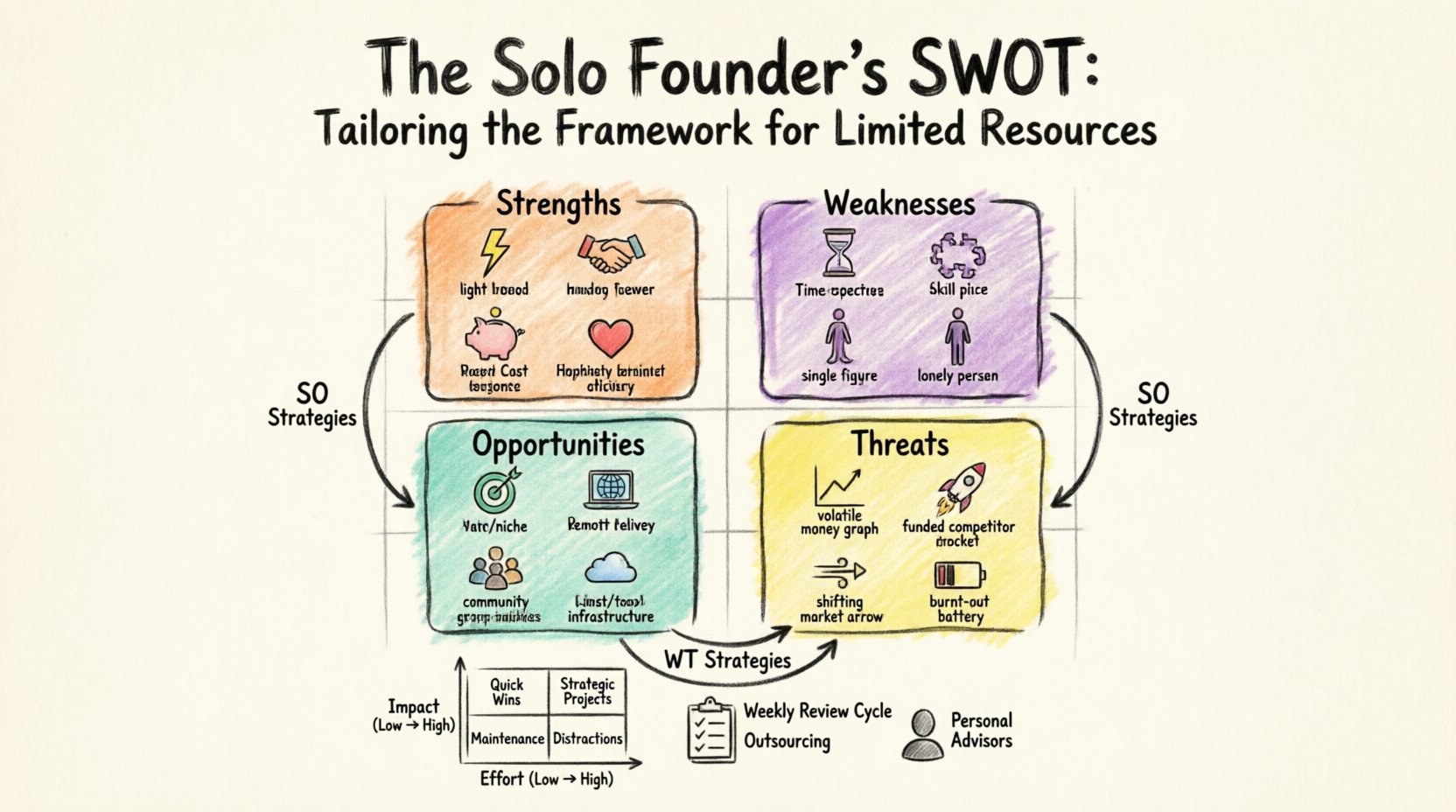
Strengths: Leveraging the Solo Advantage 💪
It is easy to view being a solo founder as a deficit. However, there are inherent structural benefits that teams cannot replicate. These are your internal strengths. Recognizing them allows you to double down on what works rather than trying to mimic corporate structures.
1. Agility and Speed
Decision-making is instantaneous. There is no need for consensus, meetings, or committee approvals. If you identify a market shift, you can pivot the product or strategy within hours. This speed is a competitive moat against slower competitors.
- Implementation: Deploy changes immediately.
- Feedback: Test new ideas without bureaucracy.
- Focus: Execute without distraction from internal politics.
2. Direct Connection to Customers
You are the face of the brand. Customers feel a direct line to the creator. This builds trust and loyalty that often translates into higher retention rates. You hear the feedback directly, not filtered through a support ticket system.
3. Cost Efficiency
Without payroll, overhead is significantly lower. You do not need to maintain a large office or fund multiple salaries. This allows you to survive on less revenue than a funded startup.
4. Passion and Drive
There is no motivation gap. You are building this because you believe in it. This intrinsic motivation drives persistence when external funding is unavailable or difficult to secure.
Weaknesses: Navigating Internal Constraints 🧩
Being alone means you cannot do everything. Acknowledging your limitations is not a sign of weakness; it is a strategic necessity. The goal is to identify where the bottlenecks exist and manage them proactively.
1. Time Scarcity
You have 24 hours a day, and they are finite. Deep work, marketing, sales, development, and administration compete for the same hours. This often leads to burnout or neglect of critical tasks.
- The Trap: Spending too much time on low-value activities.
- The Reality: You cannot be the best coder, writer, and salesperson simultaneously.
2. Skill Gaps
Most founders excel in one area (e.g., product) but lack proficiency in others (e.g., legal, finance, advanced marketing). Relying on general knowledge in these areas creates risk.
3. Lack of Redundancy
If you get sick, the business stops. There is no backup system. This makes continuity planning a critical component of your strategy.
4. Isolation
Decision fatigue increases when you have no peers to consult. This can lead to tunnel vision where you miss broader market trends because you are too focused on daily operations.
Opportunities: The External Landscape 🌍
Opportunities are external factors you can exploit. For a solo founder, the landscape has shifted in ways that favor smaller, nimbler entities. You do not need to compete on scale; you compete on specificity.
1. Niche Markets
Large corporations often ignore small, specialized segments because the total addressable market (TAM) is too small. For a solo founder, a niche that is too small for a giant is a goldmine. You can dominate a specific vertical where others are too slow to enter.
2. Remote and Digital Delivery
Technology has removed the need for physical presence. You can serve a global audience from a single laptop. This reduces overhead and expands your potential customer base without increasing headcount.
3. Community-Driven Growth
Modern audiences prefer authentic voices over corporate branding. Building a community around your expertise allows for organic growth without paid advertising. This leverages your personality as a strength.
4. Low-Cost Infrastructure
Cloud computing and open-source tools have democratized access to enterprise-grade technology. You can access powerful infrastructure without the capital expenditure required in the past.
Threats: Protecting Against External Risks 🛡️
Threats are external factors that could harm your business. For a solo founder, these threats are often amplified because you lack the defensive layers of a larger organization.
1. Cash Flow Volatility
One bad month can be catastrophic. Without a team to absorb the shock, financial stability is fragile. You must maintain a runway that is longer than you think you need.
2. Competitor Funding
Competitors with venture capital backing can price you out or outspend you on marketing. They can afford to lose money on customer acquisition; you cannot.
3. Market Shifts
Technology trends change rapidly. A platform update or algorithm change can destroy your distribution channel overnight. Dependency on a single channel is a major vulnerability.
4. Burnout and Health
The health of the founder is the health of the business. High stress, lack of sleep, and lack of boundaries lead to poor decision-making and eventual collapse.
Integrating the Quadrants: Strategic Synthesis 🔄
Listing the four quadrants is only the first step. The real value lies in cross-referencing them. You need to see how your strengths can mitigate your weaknesses, or how opportunities can offset threats. This creates actionable strategies rather than a static list.
Here is how to map your findings into specific strategic actions:
- SO Strategies (Maxi-Maxi): Use your strengths to capture opportunities. Example: Use your agility (Strength) to launch a feature in a new niche (Opportunity) before larger competitors react.
- WO Strategies (Mini-Maxi): Overcome weaknesses by taking advantage of opportunities. Example: Use community-driven growth (Opportunity) to reduce the need for a paid marketing team (Weakness).
- ST Strategies (Maxi-Mini): Use strengths to avoid threats. Example: Use your low overhead (Strength) to survive a price war (Threat) that would bankrupt a high-burn competitor.
- WT Strategies (Mini-Mini): Minimize weaknesses to avoid threats. Example: Automate administrative tasks (Mitigate Weakness) to prevent burnout (Threat).
Resource Allocation Matrix 📊
Because resources are limited, you cannot pursue every opportunity. You must prioritize based on impact and feasibility. Use the following table to categorize your strategic initiatives.
| Priority Level | Definition | Resource Commitment | Example Action |
|---|---|---|---|
| High Impact / Low Effort | Quick wins that move the needle immediately. | Minimal time or money. | Optimizing landing page copy for higher conversion. |
| High Impact / High Effort | Strategic projects that define the future. | Significant time or capital. | Developing a new core product feature. |
| Low Impact / Low Effort | Maintenance tasks. | Minimal time or money. | Social media posting schedule. |
| Low Impact / High Effort | Distractions that consume resources. | High time or capital. | Attending networking events with no ROI. |
Execution: Turning Analysis into Action 🚀
Analysis without action is procrastination. Once you have completed the SWOT, you must translate it into a workflow that fits your limited capacity.
1. The Weekly Review Cycle
Set aside a specific time each week to review your SWOT. Markets change, and so does your capacity. A strategy that worked last quarter may not work this quarter.
- Monday: Review priorities against the SWOT matrix.
- Friday: Assess what was accomplished and what blocked you.
- End of Month: Update the SWOT quadrants with new data.
2. Outsourcing Non-Core Tasks
Identify tasks that do not require your unique skills. If you are a developer, do not spend time on bookkeeping or graphic design. Delegate or automate these areas to free up your primary strength.
3. Building a Personal Board of Advisors
Since you lack a team, you need a peer group. Find other founders who can provide objective feedback. This mitigates the isolation weakness identified earlier.
Common Pitfalls to Avoid ⚠️
Even with a solid framework, solo founders often fall into traps that derail their progress. Be vigilant against these common errors.
- Over-Engineering the Plan: Spending weeks perfecting the strategy instead of selling the product. The plan is a tool, not the product.
- Ignoring Financial Reality: Assuming revenue will cover expenses without a buffer. Always plan for a 6-month runway.
- Chasing Trends: Jumping on every new technology or marketing channel. Focus on what drives revenue for your specific model.
- Neglecting Personal Health: Treating your body as a machine. Burnout is the single biggest threat to solo sustainability.
The Feedback Loop: Continuous Improvement 🔄
A SWOT analysis is not a one-time event. It is a living document that evolves as your business grows. As you gain resources, your weaknesses may change. As the market shifts, your threats may evolve.
Consider the following indicators that your SWOT needs updating:
- Revenue Growth: If you hit a revenue milestone, re-evaluate your capacity constraints.
- Customer Feedback: New customer needs may reveal new opportunities.
- Competitor Activity: If a competitor enters your niche, your threat assessment changes.
- Personal Capacity: If you feel overwhelmed, your weakness assessment needs adjustment.
Final Thoughts on Strategic Clarity ✨
Running a business alone is a test of endurance and adaptability. The SWOT analysis provides the structure you need to navigate uncertainty without a safety net. It forces you to look at your reality honestly, acknowledging where you are strong and where you are vulnerable.
The goal is not to eliminate all weaknesses or threats. That is impossible. The goal is to understand them well enough to manage them. By leveraging your agility, protecting your health, and focusing on high-impact opportunities, you can build a sustainable venture that thrives despite the lack of resources. This framework is your compass. Use it to navigate the complexities of the market with confidence and clarity.
Remember, the most successful solo founders are not those who try to do everything. They are those who know exactly what to do, and more importantly, what to ignore. Keep your focus tight, your strategy flexible, and your execution consistent.
Related posts:
 SWOT Analysis for Startups: A Beginner’s Step-by-Step Guide to Launching Strong
 The 5-Minute SWOT Analysis: Quick Start Framework for Freelancers and Sole Proprietors
 SWOT Analysis Breakdown: How to Decode Your Business Strengths and Weaknesses Today
 Real Startup Case Studies: What Happens When Founders Ignore SWOT Analysis Risks