

Abstraction is the cornerstone of Object-Oriented Analysis and Design. Yet, for many individuals entering the field, it remains a persistent stumbling block. You may have read the definitions: abstraction is hiding implementation details, exposing only essential features. But when it comes time to apply this concept to a real system, the mental shift often feels elusive. Why is this specific concept so difficult to grasp?
The struggle usually stems from a transition from concrete thinking to abstract thinking. Beginners often focus on what an object is, rather than what it does. This guide explores the cognitive hurdles involved in abstraction, the common traps that lead to rigid code, and practical methods to develop a more flexible design mindset. We will move beyond theory into the mechanics of structure, relationships, and behavior.
The Cognitive Gap: Concrete vs. Abstract Thinking 🧠
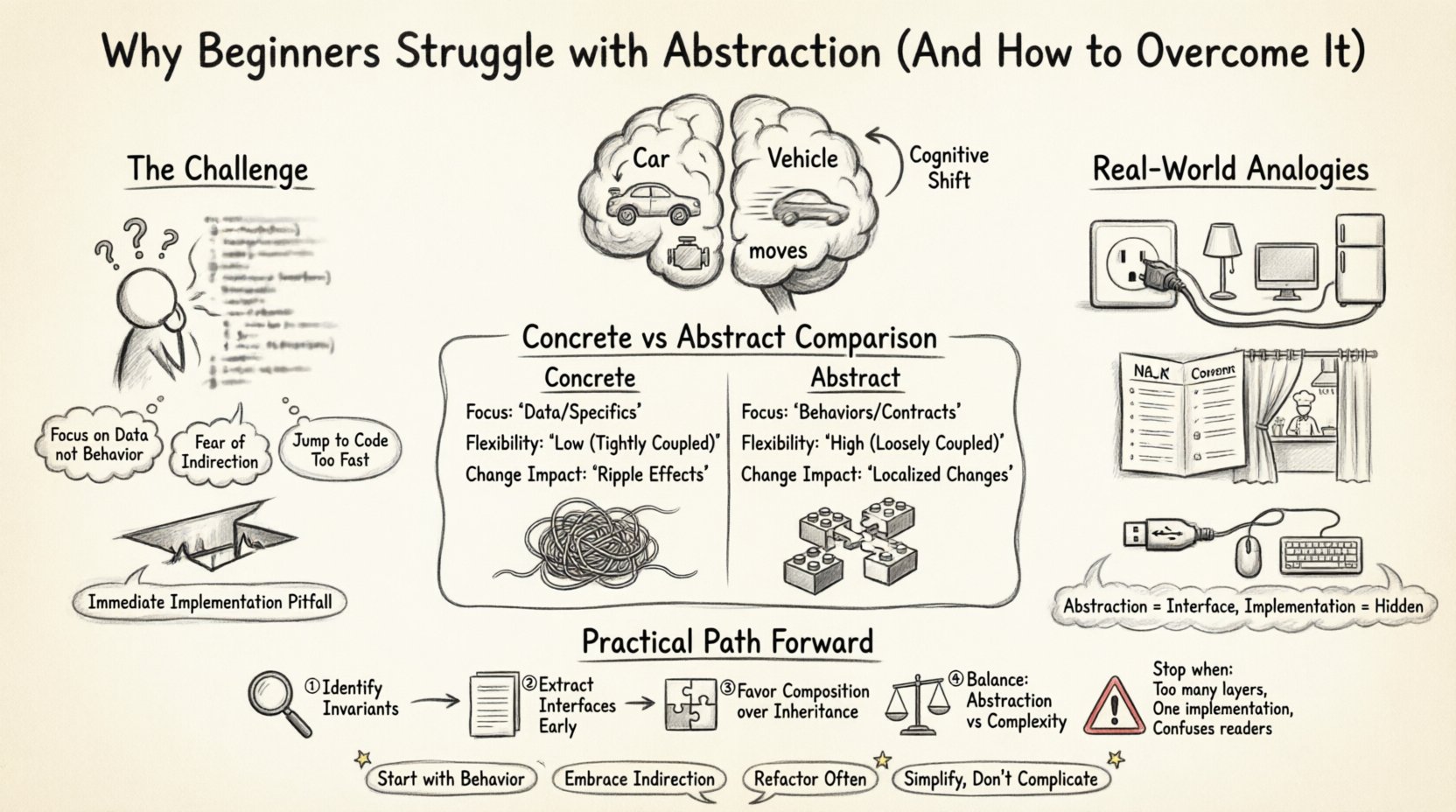
When you first start learning about object-oriented structures, your brain naturally gravitates toward the tangible. You want to define a Car as having wheels, an engine, and a color. This is concrete data. It is specific and easily visualized. Abstraction requires you to step back and define Vehicle as something that moves, regardless of whether it has wheels, wings, or tracks.
This shift creates a cognitive friction. Here is why the gap exists:
Focus on Data over Behavior: Beginners often model data structures first. They ask, “What properties does this need?” instead of “What actions can this perform?”
Fear of Indirection: Abstraction introduces layers. You are not calling a function directly; you are calling a method on an interface that delegates to an implementation. This adds mental overhead.
Immediate Implementation Bias: There is a temptation to write the code immediately. Abstraction requires thinking before writing, which feels slower and less productive initially.
Understanding this gap is the first step toward bridging it. You must train yourself to see the system not as a collection of boxes with data, but as a network of responsibilities.
The Trap of Immediate Implementation 🛠️
One of the most common pitfalls is the urge to solve the problem before defining the structure. When a requirement comes in, such as “we need to print reports,” a beginner might immediately create a ReportPrinter class.
Later, requirements change. Now we need to send emails. The beginner creates EmailSender. Then, they need to print to PDF. PDFExporter.
Eventually, the codebase becomes a sprawling collection of specific classes that handle specific tasks. This is the opposite of abstraction. Abstraction seeks to group these behaviors under a common interface. If you had defined an OutputHandler interface early on, all three classes could implement it. The core logic of the system remains stable even when the output mechanism changes.
Why This Happens
Comfort with Knowns: It is easier to write code for a specific printer than to design an interface for all printers.
Lack of Vision: It is difficult to predict future requirements. Beginners often design for the current state, not the evolving state.
Overconfidence: There is a belief that the current solution is the final solution.
Understanding the Cost of Abstraction ⚖️
Abstraction is not free. It introduces complexity. Every layer of indirection you add requires more effort to understand the flow of data. You must weigh the benefit of flexibility against the cost of complexity.
Consider the trade-off:
High Abstraction: Changes to one part of the system do not ripple through others. However, the code is harder to read initially. You need to jump between interfaces and implementations.
Low Abstraction: Code is straightforward and easy to read. However, changing a specific detail might break the entire system because everything is tightly coupled.
The goal is not maximum abstraction, but appropriate abstraction. You want to hide details that change frequently and expose details that are stable.
Common Patterns of Confusion 🤔
There are specific patterns where abstraction is often misunderstood. Recognizing these helps in self-correction.
1. Inheritance vs. Composition
Beginners often rely too heavily on inheritance. They create deep hierarchies: Animal -> Mammal -> Dog -> Poodle.
This becomes rigid. If you add a new feature to Mammal, it applies to all dogs. But what if a dog does not need that feature? Composition allows you to build objects by combining behaviors. Instead of inheriting, a Dog class might contain a FeedingStrategy object. This allows you to change the feeding behavior without changing the dog class itself.
2. Interface Over Implementation
It is common to write code that depends on concrete classes. For example:
var printer = new LaserPrinter();
If you swap this for a NetworkPrinter, you must update the code everywhere LaserPrinter is referenced. Abstraction suggests:
var printer = new Printer();
Here, Printer is an interface. The concrete implementation is injected. This decouples the logic from the hardware details.
Concrete vs. Abstract: A Comparison 📊
To visualize the difference, consider the following comparison table. This highlights how abstraction changes the focus from specific instances to general behaviors.
Aspect | Concrete Approach | Abstract Approach |
|---|---|---|
Focus | Data and Specifics | Behaviors and Contracts |
Flexibility | Low (Tightly Coupled) | High (Loosely Coupled) |
Readability | High (Direct) | Medium (Requires Context) |
Change Impact | High (Ripple Effects) | Low (Localized Changes) |
Maintenance | Difficult (Hard to Swap) | Easier (Plug-in Architecture) |
Practical Steps to Refine Your Design 🛤️
How do you move from confusion to competence? You need a structured approach to applying abstraction without over-engineering. Follow these steps when designing a new component.
1. Identify Invariants
Look at the requirements. What stays the same regardless of the context? If you are building a payment system, the concept of a Transaction is invariant. The currency might change, but the need to record a transaction remains. Focus your abstraction on the invariant.
2. Extract Interfaces Early
Do not wait until you have finished writing the code to define the interface. Draft the interface before you write the implementation. This forces you to think about what the client needs, not how you intend to build it.
Define the Contract: What methods must exist?
Define the Inputs: What data is required?
Define the Outputs: What results are returned?
3. Favor Composition
Ask yourself: “Does this object need to be something, or does it need to have a capability?” If it is a capability, use composition. This reduces the depth of your class hierarchy and makes testing easier.
4. Apply the Principle of Least Astonishment
When you define an interface, ensure the methods do what users expect. If you have a method called Close(), users expect the resource to become unavailable. If it merely pauses, they will be surprised. Abstraction should make the system predictable, not clever.
When to Stop Abstraction 🛑
There is a point of diminishing returns. If you spend more time designing the abstraction than writing the logic, you have gone too far. This is often referred to as premature optimization or over-designing.
Signs You Are Over-Abstracting
Too Many Layers: You find yourself calling a method that calls another method that calls a third method just to get a value.
Complexity for Clarity: The abstraction is harder to read than the concrete code it replaces.
Lack of Variation: You only have one implementation of the interface. If there is only one way to do something, abstraction adds no value.
Confusion for New Users: A new developer cannot understand the flow without reading three different files to see how the logic connects.
Abstraction is a tool, not a goal. Its purpose is to manage complexity, not create it. If the code is clear without an interface, do not force an interface.
The Iterative Nature of Design 🔄
Designing abstract systems is rarely a one-time event. It is a continuous process of refinement. You will often write code concretely first, observe how it changes, and then refactor it into an abstraction.
This is known as Refactoring. It is the process of improving the design of existing code without changing its external behavior. This approach is often safer than trying to predict every future need. You can refactor when you see the duplication or the rigidity.
Steps for Refactoring into Abstraction
Identify Duplication: Find code that looks similar but exists in multiple places.
Verify Behavior: Ensure tests cover the current behavior so you do not break anything.
Extract Interface: Create an interface that represents the common behavior.
Replace Instances: Change the concrete references to use the interface.
Test Again: Run tests to ensure the change did not introduce bugs.
Real-World Analogies Without Software 🏗️
Sometimes abstract concepts are easier to understand through non-technical analogies.
The Power Outlet: A power outlet is an abstraction. It does not care if you plug in a lamp, a computer, or a fridge. It provides electricity. You do not need to know the voltage or the wiring behind the wall. You just plug it in.
The Restaurant Menu: The menu is an abstraction of the kitchen. You order a dish, you do not need to know how the chef chops the vegetables or the temperature of the oven. The kitchen is the implementation; the menu is the interface.
The USB Port: You can plug a mouse or a keyboard into a USB port. The computer does not care which one it is. It handles the data transfer based on the protocol. This is polymorphism and abstraction working together.
Building Mental Models for Stability 🏛️
To become proficient, you must build mental models of stable systems. This involves understanding how data flows through your application. When you design an abstraction, you are essentially defining a contract between the user of the system and the system itself.
Ask yourself these questions during the design phase:
What does this object promise to do?
How will this object change in the future?
Who depends on this object?
Can I swap the implementation without breaking the dependents?
If you can answer yes to the last question, you have achieved a solid level of abstraction. If the answer is no, you likely have tight coupling that needs to be decoupled.
Summary of Key Takeaways 📝
Abstraction is a skill that develops over time. It is not something you learn in a single session. It requires practice, reflection, and a willingness to rewrite code.
Start with Behavior: Focus on what objects do, not just what they hold.
Embrace Indirection: Accept that layers add complexity but reduce risk.
Use Composition: Prefer combining behaviors over deep inheritance trees.
Refactor Often: Do not fear changing your design as requirements evolve.
Know When to Stop: Abstraction should simplify, not complicate.
By understanding the cognitive hurdles and applying these structured strategies, you can move from struggling with abstraction to using it as a powerful tool for building robust, maintainable systems. The journey is continuous, but the reward is a codebase that stands the test of time.