

In the landscape of software architecture, the structural integrity of your codebase determines its longevity. One of the most critical factors influencing this integrity is the level of coupling between components. Tight coupling creates a fragile system where changes ripple unpredictably. To build systems that endure, developers must prioritize loose coupling through deliberate design choices. This guide explores the mechanics of coupling and provides actionable strategies to achieve robust object design.
Understanding Coupling in Object-Oriented Systems 🧩
Coupling refers to the degree of interdependence between software modules. When two classes rely heavily on each other’s internal details, they are tightly coupled. This dependency makes the system rigid. If you need to modify one class, the other often breaks or requires significant rework.
Conversely, low coupling means modules interact through well-defined interfaces or abstractions. They remain unaware of each other’s internal implementation. This separation allows components to evolve independently. Achieving this state requires a shift in mindset from “how do I connect these classes?” to “how do these classes communicate without knowing each other?”.
Key Characteristics of Tight Coupling 🔗
- Direct Instantiation: One class creates instances of another directly using the
newkeyword or similar mechanisms. - Concrete Dependencies: Code depends on specific implementations rather than interfaces or abstract base classes.
- Knowledge of Internal State: A class accesses the private or protected data members of another class.
- Complex Initialization: Objects require a complex chain of dependencies to be constructed correctly.
Identifying these traits early prevents technical debt from accumulating. The goal is to create a system where components are replaceable without causing a cascade of errors.
Recognizing the Symptoms of Tight Coupling ⚠️
Before applying solutions, you must identify the problem. Tight coupling often manifests during the development lifecycle. Look for these warning signs in your codebase:
- Refactoring Resistance: You feel afraid to change a specific class because you cannot predict what will break.
- Testing Difficulties: Unit tests require setting up complex environments or mocking many layers just to test a single function.
- High Change Impact: A minor bug fix in one module triggers failures in unrelated modules.
- Code Duplication: Logic is repeated across classes because they share state or rely on similar concrete implementations.
- Sequential Dependency: Code execution order matters significantly; changing the order causes runtime errors.
When these symptoms appear, the architecture is likely too rigid. Addressing them involves restructuring relationships between objects.
Strategy 1: Dependency Injection 🚀
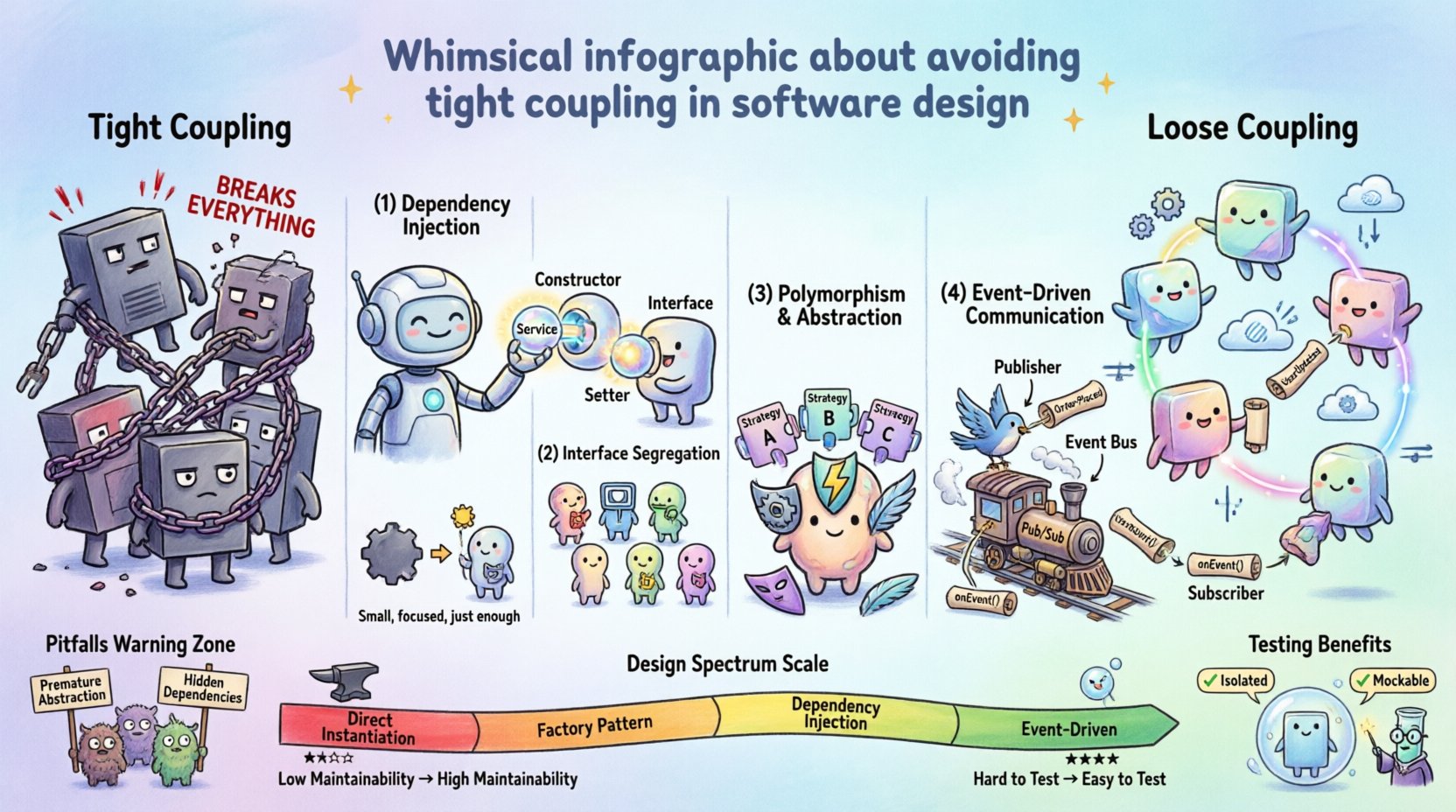
Dependency Injection (DI) is a fundamental technique for reducing coupling. Instead of a class creating its own dependencies, those dependencies are provided from the outside. This shifts the responsibility of instantiation away from the class itself.
How It Works
- Constructor Injection: Dependencies are passed into the object when it is created.
- Setter Injection: Dependencies are assigned via setter methods after creation.
- Interface Injection: The dependency defines an interface that the consumer implements.
By injecting dependencies, a class only knows about the interface, not the concrete implementation. This allows you to swap implementations without altering the consumer code. It also simplifies testing, as you can provide mock objects instead of real ones.
Benefits of Dependency Injection
- Enhanced testability through mock substitution.
- Clearer separation of concerns.
- Flexibility to change implementation details.
- Reduced initialization complexity.
Strategy 2: Interface Segregation 🛑
Interface Segregation Principle (ISP) states that no client should be forced to depend on methods it does not use. In the context of coupling, this means designing specific interfaces rather than large, monolithic ones.
Implementing Segregation
- Analyze Client Needs: Identify what specific behaviors each class actually requires.
- Create Focused Interfaces: Break down large interfaces into smaller, role-specific ones.
- Avoid Empty Implementations: Do not force a class to implement methods it cannot use.
This approach prevents a class from depending on functionality it never touches. It reduces the surface area for potential errors and makes the contract between classes more precise.
Strategy 3: Polymorphism and Abstraction 🎭
Polymorphism allows objects to be treated as instances of their parent class rather than their specific type. Abstraction hides complex implementation details, exposing only the necessary operations. Together, they create a layer of indirection.
Applying Abstraction
- Use Abstract Classes: Define common behavior in a base class that derived classes must implement.
- Interface Contracts: Define a set of methods that any implementing class must support.
- Strategy Pattern: Encapsulate algorithms so they can vary independently from the client that uses them.
When code depends on an abstract type, it is decoupled from the concrete logic. You can introduce new behaviors by creating new implementations of the interface without changing the existing code. This adheres to the Open/Closed Principle, allowing systems to be open for extension but closed for modification.
Strategy 4: Event-Driven Communication 📡
In many systems, direct method calls create a synchronous link between objects. Event-driven architecture breaks this link by introducing an intermediary mechanism. Objects emit events, and other objects listen for them.
Key Components
- Event Publisher: The object that triggers an event.
- Event Subscriber: The object that reacts to the event.
- Event Bus/Dispatcher: The mechanism that routes events from publishers to subscribers.
This pattern ensures the publisher does not know who is listening. It does not know if anyone is listening at all. This is the ultimate form of decoupling in communication. It allows for dynamic addition and removal of listeners without touching the publisher code.
When to Use Event-Driven Design
- When multiple systems need to react to the same state change.
- When the timing of the reaction is not critical (asynchronous).
- When you need to decouple subsystems completely.
Comparing Coupling Strategies ⚖️
The following table summarizes how different design choices impact coupling levels and system maintainability.
| Design Approach | Coupling Level | Maintainability | Testability |
|---|---|---|---|
| Direct Instantiation | High | Low | Low |
| Dependency Injection | Low | High | High |
| Interface Segregation | Low | High | Medium |
| Event-Driven | Very Low | Medium | High |
| Polymorphism | Low | High | High |
The Impact on Testing and Maintenance 🧪
Loose coupling fundamentally changes how you approach testing. When dependencies are injected, you can isolate the unit under test. You do not need to spin up databases or external services to verify logic.
Testing Benefits
- Isolation: Tests focus on a single class without side effects.
- Speed: Mocking dependencies is faster than initializing real objects.
- Reliability: Tests fail due to logic errors, not environment issues.
- Regression Prevention: Refactoring is safer because tests catch unintended changes.
Maintenance becomes less about “patching” and more about “extending”. When you need to add a feature, you create a new implementation of an interface rather than modifying existing code. This reduces the risk of introducing bugs into stable areas.
Common Pitfalls to Avoid 🕳️
While aiming for loose coupling is beneficial, there are risks of over-engineering. Not every class needs to be fully decoupled. Consider these common mistakes:
- Premature Abstraction: Creating interfaces before you understand the actual requirements. This leads to generic code that is hard to use.
- Over-Reliance on Patterns: Applying complex architectural patterns where simple logic suffices. Simplicity is often the best form of robustness.
- Ignoring Performance: Excessive indirection can introduce latency. Ensure the abstraction does not hinder critical performance paths.
- Hidden Dependencies: Relying on global state or static methods to share data. This is just as bad as tight coupling because it hides the flow of data.
Refactoring Steps for Existing Systems 🛠️
If you inherit a codebase with tight coupling, do not attempt a complete rewrite. Follow a gradual refactoring process:
- Identify Key Dependencies: Map out which classes depend on which others.
- Introduce Interfaces: Define interfaces for the dependencies that are currently concrete.
- Inject Dependencies: Modify constructors or setters to accept the new interfaces.
- Write Tests: Create unit tests to ensure behavior remains unchanged during the transition.
- Swap Implementations: Replace concrete classes with mocks or new implementations.
- Remove Unused Code: Delete the old concrete implementations once they are no longer needed.
This iterative approach minimizes risk. You can verify the system works at every step. It allows the team to move forward without halting development.
Final Thoughts on Architectural Stability 🌟
Building robust object design is an ongoing practice. It requires constant vigilance against the temptation to make quick, hard-wired connections. The effort invested in decoupling pays dividends in the form of agility and resilience.
By applying strategies like Dependency Injection, Interface Segregation, and Polymorphism, you create a foundation that supports change. Systems become easier to understand, test, and extend. This is not about adhering to rules for the sake of rules; it is about respecting the complexity of the software you build.
Remember that coupling is not inherently evil. Some degree of connection is necessary for functionality. The goal is to manage that connection deliberately. Choose your dependencies wisely, define your contracts clearly, and let your objects interact through established channels rather than hidden pathways.
As you continue to design and refactor, keep these principles in mind. They serve as a compass for navigating complex technical challenges. A well-structured system is a pleasure to work with and a reliable asset for the business.