

Building robust software requires a structured approach. In the context of Object-Oriented Analysis and Design (OOAD), creating a Library Management System involves identifying core entities, defining their behaviors, and establishing the relationships that bind them together. This guide explores the architectural steps necessary to construct a scalable and maintainable system.
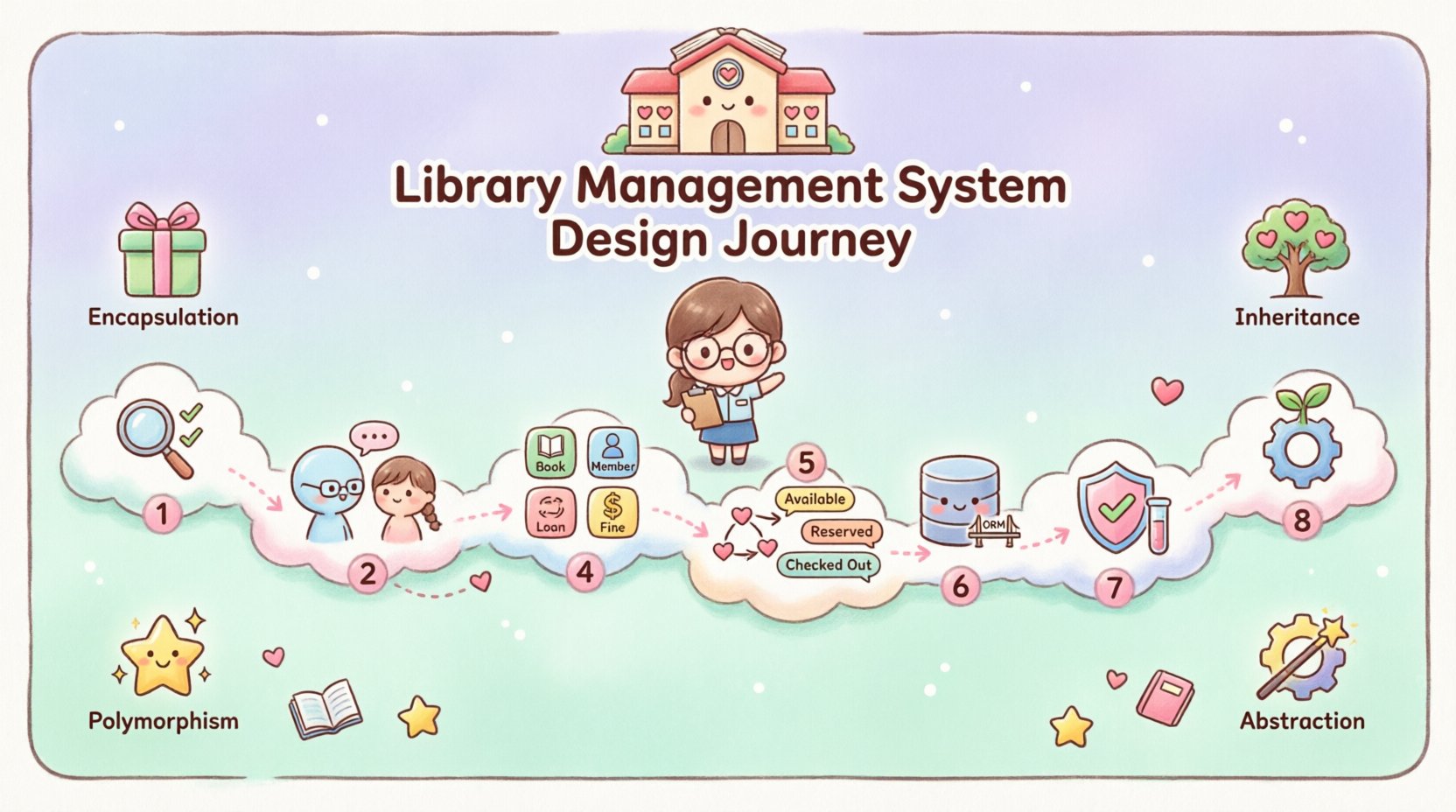
🔍 Understanding Object-Oriented Analysis and Design (OOAD)
Object-Oriented Analysis and Design is a methodology that structures software around data, or objects, rather than functions and logic. For a library system, this means focusing on the things the system needs to manage: books, members, loans, and fines. By modeling the real-world domain into software constructs, developers can create systems that are easier to modify and extend.
Key principles driving this approach include:
- Encapsulation: Bundling data and methods that operate on that data within a single unit.
- Inheritance: Allowing new classes to adopt the properties and methods of existing classes.
- Polymorphism: Allowing objects to be treated as instances of their parent class.
- Abstraction: Hiding complex implementation details and exposing only necessary features.
📋 Phase 1: Requirements Elicitation
Before writing code, the system must understand what it needs to do. Requirements are split into functional and non-functional categories.
Functional Requirements
These define the specific behaviors the system must exhibit:
- Book Management: Add, update, and remove book records from the database.
- Member Registration: Capture user details and issue identification cards.
- Circulation: Process book checkouts and returns.
- Fine Calculation: Compute penalties for overdue items automatically.
- Search Functionality: Locate books by title, author, or ISBN.
Non-Functional Requirements
These define the quality attributes of the system:
- Performance: Search queries must return results within seconds.
- Scalability: The system must handle increased user load during peak hours.
- Security: Member data requires protection from unauthorized access.
- Availability: The system should remain operational 24/7.
👥 Phase 2: Use Case Modeling
Use cases describe how actors interact with the system to achieve specific goals. Identifying actors helps define the boundaries of the software.
Identified Actors
- Librarian: Manages inventory, processes loans, and handles administrative tasks.
- Member: Searches for books, borrows items, and returns items.
- System: Automates notifications and fine calculations.
Sample Use Case: Borrowing a Book
- Member requests a specific book.
- Librarian scans the book barcode.
- System checks availability status.
- If available, the system updates the status to “Checked Out”.
- System records the due date.
- Transaction is logged in the database.
🏗️ Phase 3: Class Identification and Design
The core of OOAD is identifying classes. A class represents a blueprint for objects. In a library context, specific classes emerge from the requirements.
Primary Classes
- Book: Represents physical or digital items. Attributes include ISBN, Title, Author, Publisher, and Location.
- Member: Represents the user. Attributes include Member ID, Name, Email, Phone Number, and Membership Status.
- Loan: Represents the transaction between a member and a book. Attributes include Loan ID, Date Issued, Due Date, and Return Date.
- Fine: Represents financial penalties. Attributes include Fine ID, Amount, Payment Status, and Associated Loan ID.
Class Attributes and Methods
Each class must define what data it holds and what actions it can perform. Below is a breakdown of the Book class structure:
| Attribute | Data Type | Description |
|---|---|---|
| bookID | Integer | Unique identifier for the book. |
| title | String | Full title of the publication. |
| author | String | Primary author name. |
| isAvailable | Boolean | Indicates if the book is currently on shelf. |
Methods associated with the Book class might include:
checkAvailability(): Returns the current status.markAsCheckedOut(): Updates status upon borrowing.markAsReturned(): Updates status upon return.getDetails(): Retrieves all metadata for display.
🔗 Phase 4: Defining Relationships and Multiplicities
Classes do not exist in isolation. They interact through relationships. Understanding these connections is vital for database design and logic flow.
Relationship Types
- Association: A structural link between objects. A Member borrows a Book.
- Aggregation: A “whole-part” relationship where the part can exist independently. A Library has Books. If the library closes, the books still exist.
- Composition: A stronger form of aggregation where the part cannot exist without the whole. A Book contains Chapters. If the book is deleted, chapters are removed.
- Inheritance: A specialized class derives from a base class. For example, StudentMember and FacultyMember both inherit from GeneralMember.
Multiplicity
Constraints define how many instances of a class relate to another:
- One-to-Many: One Member can borrow Many Books.
- Many-to-One: Many Books can belong to One Publisher.
- One-to-One: One Member has One Membership Card.
🔄 Phase 5: Behavioral Modeling
Static structure is not enough. We must understand how objects behave over time. Sequence diagrams and state diagrams help visualize this flow.
Sequence Diagram Flow
A sequence diagram shows the interaction between objects in a time-ordered sequence. For a loan process:
- UI sends a request to LoanController.
- LoanController queries MemberRepository for validity.
- LoanController queries BookRepository for availability.
- If both are valid, LoanController creates a new Loan object.
- Loan updates Book status to unavailable.
- UI displays confirmation to the user.
State Diagrams
State diagrams track the lifecycle of an object. Consider the Book object lifecycle:
- Available: Initial state. Ready for borrowing.
- Reserved: Someone has requested the book.
- Checked Out: Currently with a member.
- Lost: Reported missing or damaged beyond repair.
- Under Repair: Currently being fixed.
🗄️ Phase 6: Database Mapping and Persistence
Object-oriented designs must persist data. While objects live in memory, databases store records. Mapping these two paradigms is a critical step.
Relational Mapping
Objects map to tables in a relational database. The Book class becomes the Books table. Foreign keys enforce relationships.
- The Loans table links Members and Books using their primary keys.
- The Fines table references the Loans table.
ORM Considerations
Object-Relational Mapping (ORM) tools bridge the gap between code and database. They allow developers to query using object syntax rather than raw SQL. Key considerations include:
- Lazy Loading: Load related data only when needed to improve performance.
- Transaction Management: Ensure data integrity during complex operations like checking out multiple books.
- Indexing: Optimize queries for frequently searched fields like ISBN or Title.
🛡️ Phase 7: Validation and Testing Strategies
Design is not complete until the system is verified. Testing ensures the design holds up under scrutiny.
Unit Testing
Test individual classes in isolation. Verify that the calculateFine() method returns the correct amount based on overdue days. Ensure boundary conditions are handled, such as zero days overdue.
Integration Testing
Test how classes interact. Verify that updating a book status in the Book class correctly reflects in the Loan class. Check database connectivity and transaction rollback mechanisms.
System Testing
Validate the complete workflow. A librarian should be able to process a loan from start to finish without data loss or errors. Test with high volumes of data to ensure performance stability.
🔧 Phase 8: Maintenance and Scalability Considerations
Software evolves. The design must accommodate future changes without requiring a complete rewrite.
Extensibility
Use inheritance to add new types of members or books. If the library adds digital media, a DigitalItem class can extend the base Item class, inheriting common properties while adding unique ones like File Format or Download Limit.
Modularity
Keep components decoupled. The Search Module should not depend on the Payment Module. This allows independent updates. If the notification system changes, it should not break the loan processing logic.
Security Updates
Authentication mechanisms must be robust. Store passwords securely using hashing algorithms. Implement role-based access control so members cannot access administrative functions.
💡 Final Considerations
Designing a Library Management System using Object-Oriented Analysis and Design requires a balance between theoretical models and practical constraints. By focusing on clear class definitions, robust relationships, and comprehensive behavioral modeling, developers can create systems that serve users effectively.
The process outlined above provides a roadmap. It emphasizes understanding the domain before writing code. Each step builds upon the previous one, ensuring that the final architecture is sound. Regular reviews of the design against new requirements will keep the system relevant and functional over time.
Success lies in attention to detail during the analysis phase. A well-designed system reduces technical debt and simplifies future enhancements. With a solid foundation, the software can grow alongside the needs of the library it serves.