

Object-oriented programming has long been the backbone of enterprise software development. The promise is seductive: encapsulation, inheritance, and polymorphism should create systems that are modular, extensible, and easy to maintain. Yet, in practice, many projects spiral into complexity. Features take longer to implement, bugs appear in unrelated modules, and the codebase becomes a tangled web of dependencies that no one dares to touch.
If you find yourself in this situation, you are not alone. The failure often stems not from the language itself, but from the misapplication of design principles. This guide explores the root causes of object-oriented project failure and provides a structured path to recovery. We will examine common anti-patterns, dissect the violation of core design tenets, and outline actionable strategies for stabilization.
The Illusion of Control 🎢
When a project begins, the architecture often looks promising. Classes are created, objects are instantiated, and the flow seems logical. However, as requirements evolve, the initial design rarely scales. The problem is usually a gradual drift away from established principles. Developers prioritize feature delivery over structural integrity. This leads to a state where the code works, but it is brittle.
Signs that your object-oriented analysis and design are under stress include:
- High Cognitive Load: Understanding a single function requires tracing logic across five different files.
- Regression Bugs: A change in one area breaks functionality in a completely different module.
- Test Resistance: Unit tests are difficult to write because dependencies are hardcoded or global state is pervasive.
- Feature Bloat: New requirements result in classes that grow indefinitely rather than new, focused classes.
Recognizing these symptoms early is the first step toward remediation. The goal is not to rewrite the entire system, but to introduce stability through targeted intervention.
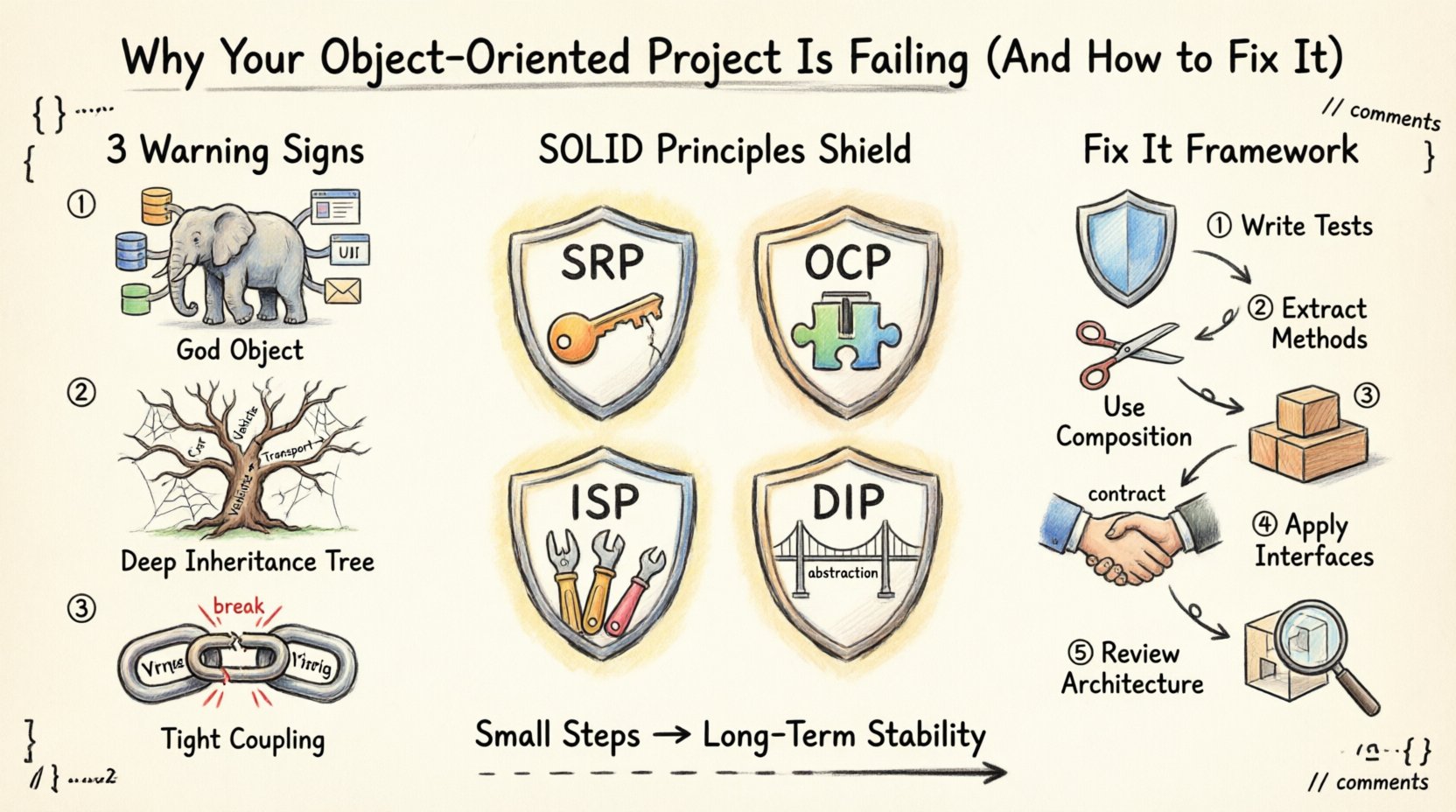
Symptom 1: The God Object Syndrome 🐘
One of the most common failure points is the creation of the “God Object.” This is a class that knows too much and does too much. It holds references to every other object in the system and performs a vast array of operations. Initially, this seems efficient because it centralizes logic. Over time, it becomes a bottleneck.
Why does this happen?
- Convenience: It is easier to add a method to an existing class than to create a new one.
- Lack of Encapsulation: Data is not protected, allowing the God Object to manipulate internal states of other classes.
- Single Responsibility Violation: The class handles business logic, data access, and UI concerns simultaneously.
The fix requires decomposition. You must identify the distinct responsibilities within the God Object and extract them into separate classes. This process is known as the Extract Class refactoring. Each new class should focus on a specific domain concept. If a class manages users, it should not manage database connections or email notifications.
Symptom 2: Deep Inheritance Trees 🌲
Inheritance is a powerful tool for code reuse, but it is frequently misused. Many projects suffer from deep inheritance hierarchies where a class is several levels removed from the base object. This creates fragility because a change in the parent class ripples down to all children.
Common issues with inheritance include:
- Liskov Substitution Violation: A subclass behaves in a way that breaks the expectations of the base class.
- Brittle Base Classes: Modifying a base class requires recompiling and testing the entire hierarchy.
- Fragile Factory Patterns: Creating objects becomes complex because the correct subclass depends on the depth of the tree.
The solution is to prefer composition over inheritance. Instead of making a class a Car that is-a Vehicle that is-a Transport, consider making a Car that has-a Engine and has-a Transmission. This approach, often called Has-A relationships, decouples the implementation details. It allows you to change the engine without rewriting the car class.
Symptom 3: Tight Coupling 🔗
Loose coupling is a hallmark of maintainable software. Tight coupling means that classes are heavily dependent on each other’s internal implementations. If Class A needs to know the exact structure of Class B to function, they are tightly coupled.
Consequences of tight coupling:
- Testing Difficulty: You cannot test Class A without instantiating Class B, which might require a database connection.
- Low Reusability: You cannot move Class A to another project without dragging Class B along.
- Parallel Development Blocks: Teams cannot work on different modules simultaneously because changes in one break the other.
To reduce coupling, rely on interfaces or abstract classes rather than concrete implementations. This ensures that a class only depends on the contract of another class, not its internal logic. This is a core component of the Dependency Inversion Principle. By depending on abstractions, you can swap out implementations without altering the client code.
Table: Common OOP Anti-Patterns and Fixes
| Anti-Pattern | Definition | Recommended Fix |
|---|---|---|
| Feature Envy | A method that uses more methods or data from another class than its own. | Move the method to the class that owns the data it uses. |
| Long Method | A function that is too large to read easily. | Split into smaller, named helper methods. |
| Data Clumps | Groups of data that always travel together. | Group them into a single object. |
| Parallel Inheritance Hierarchies | Two class hierarchies that must be modified together. | Use composition to link the hierarchies. |
| Refused Bequest | A subclass does not use or support a method from its parent. | Refactor the parent class or remove the inheritance. |
The SOLID Principles Revisited ⚖️
The SOLID principles were developed to address exactly the issues described above. When a project fails, it is almost always because these five principles have been violated. Reviewing them with fresh eyes can reveal the structural flaws in your system.
1. Single Responsibility Principle (SRP)
A class should have only one reason to change. If a class handles both file I/O and data validation, a change in the file format forces a change in the validation logic. Separate these concerns. Create a FileReader class and a Validator class.
2. Open/Closed Principle (OCP)
Software entities should be open for extension but closed for modification. You should be able to add new behavior without changing existing code. Achieve this through interfaces and polymorphism. Instead of adding if-else statements for new types, create new classes that implement the same interface.
3. Liskov Substitution Principle (LSP)
Objects of a superclass should be replaceable with objects of its subclasses without breaking the application. If a subclass changes the behavior of a method, it violates this principle. Ensure that subclasses honor the preconditions and postconditions of the parent class.
4. Interface Segregation Principle (ISP)
Clients should not be forced to depend on methods they do not use. A large, monolithic interface is worse than multiple smaller, specific interfaces. If a class implements an interface with ten methods but only uses three, refactor the interface to expose only the three necessary methods.
5. Dependency Inversion Principle (DIP)
High-level modules should not depend on low-level modules. Both should depend on abstractions. This is the key to decoupling. Define the behavior you need as an interface, and inject the implementation when building the object graph.
Refactoring Strategies 🛡️
Once you have identified the problems, you need a plan to fix them. Refactoring is not about adding features; it is about improving the internal structure without changing external behavior. Follow these steps to stabilize your object-oriented project.
- Establish a Safety Net: Before making changes, ensure you have comprehensive tests. If tests are missing, write them for the current behavior. This prevents regression during the fix.
- Identify Smells: Look for long methods, large classes, and duplicated code. These are indicators of deeper design issues.
- Extract Methods: Break down complex logic into smaller, descriptive functions. This improves readability and allows for reuse.
- Introduce Parameter Objects: If a method has many arguments, group them into a single object. This reduces the signature complexity.
- Replace Conditional Logic: If you see many
if-elsestatements checking for types, consider using polymorphism to replace them with method dispatch.
Refactoring should be done incrementally. Do not attempt to rewrite the entire system in one go. Focus on the module that causes the most pain. Stabilize that area, then move to the next. This approach minimizes risk and keeps the project moving.
The Human Factor 👥
Technical debt is often a result of human factors. Teams under pressure may cut corners on design. Code reviews might become a formality rather than a quality check. To fix the project, you must also address the culture surrounding the code.
- Enforce Code Review Standards: Require that new code adheres to the SOLID principles. Reject pull requests that introduce God Objects or deep inheritance.
- Pair Programming: Use pair programming to share knowledge and catch design flaws early. This is especially effective for junior developers learning the domain model.
- Domain-Driven Design: Align the code structure with the business domain. Use ubiquitous language in class and method names so that developers and stakeholders speak the same language.
- Regular Architecture Reviews: Schedule periodic sessions to review the high-level structure. Identify drift before it becomes a crisis.
Documentation as Code 📝
Documentation is often an afterthought, yet it is crucial for understanding complex object relationships. Instead of separate documents, use inline documentation and structure your code to be self-explanatory.
Effective documentation includes:
- Clear Class Descriptions: At the top of each class, explain its purpose and its dependencies.
- Method Signatures: Ensure parameters and return values are documented clearly. Avoid ambiguous names.
- Sequence Diagrams: For complex interactions, use diagrams to show the flow of messages between objects.
- Decision Records: Document why certain design decisions were made. This helps future developers understand the trade-offs.
Monitoring and Metrics 📊
To prevent future failures, you need to measure the health of your codebase. Static analysis tools can automatically detect violations of coding standards. They can identify classes that are too large, methods that are too complex, or cyclomatic complexity that is too high.
Track these metrics over time:
- Cyclomatic Complexity: Measures the number of linearly independent paths through a program’s source code.
- Code Coverage: Ensures that the majority of the code is executed by tests.
- Dependency Graph: Visualizes how classes depend on one another. Look for circular dependencies or overly dense clusters.
- Change Frequency: Identify which files are modified most often. These are likely candidates for refactoring or potential hotspots for bugs.
Conclusion on Stability
Recovering from a failing object-oriented project requires patience and discipline. There is no quick fix. It involves acknowledging the debt, understanding the principles that were violated, and methodically applying corrections. By focusing on single responsibilities, reducing coupling, and favoring composition over inheritance, you can transform a fragile system into a robust foundation.
The journey is ongoing. Software architecture is not a one-time achievement; it is a continuous practice of maintenance and improvement. As your team grows and requirements shift, the design must evolve to support them without compromising integrity. Start today by identifying one class that violates the Single Responsibility Principle and refactor it. Small steps lead to significant long-term stability.
Remember, the goal is not perfection, but maintainability. A system that is easy to change is a system that survives.