


The technology sector moves at a pace that often leaves traditional strategic frameworks behind. Yet, when market volatility increases, capital allocation becomes critical, and competitive landscapes shift overnight, a structured approach to understanding industry dynamics remains essential. This guide explores how Porter’s Five Forces Analysis applies specifically to the technology sector, offering a roadmap for strategic planning without relying on hype or fleeting trends. 🧭
📊 Understanding the Framework in a Digital Context
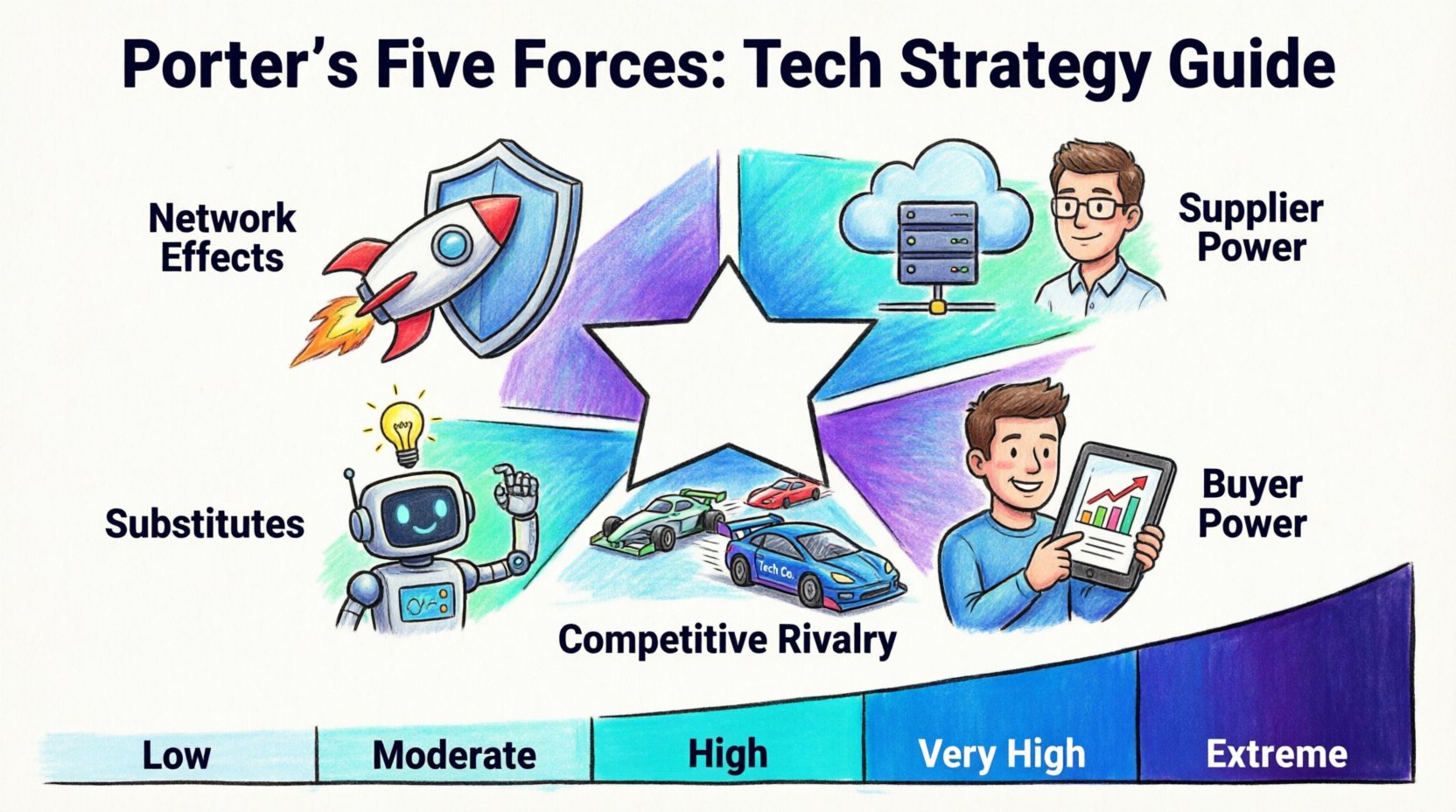
Michael Porter’s Five Forces framework was designed to evaluate the competitive intensity and attractiveness of a market. In the tech industry, this evaluation requires nuance. Standard manufacturing metrics often fail to capture the dynamics of software, cloud infrastructure, hardware manufacturing, and digital services. The framework helps organizations identify where power lies in their industry and what levers they can pull to influence profitability.
Unlike static industries, technology markets are defined by rapid innovation cycles, network effects, and shifting regulatory environments. A robust analysis must account for these fluid variables. The five forces act as diagnostic tools to understand the structural underpinnings of an industry.
- Threat of New Entrants: How easy is it for a competitor to enter your space?
- Bargaining Power of Suppliers: Can vendors dictate terms on cost or availability?
- Bargaining Power of Buyers: Can customers force prices down or demand better service?
- Threat of Substitutes: Are there alternative solutions to the problem you solve?
- Competitive Rivalry: How fierce is the competition among existing firms?
Applying these forces to tech requires looking beyond price. It involves assessing intellectual property, switching costs, data portability, and ecosystem lock-in. 🧩
⚡ Force 1: Threat of New Entrants
In the technology sector, barriers to entry have fluctuated wildly over the last two decades. While cloud computing has lowered the cost of infrastructure, it has simultaneously raised the bar for user acquisition and trust. Understanding this force is critical for startups and incumbents alike.
🔓 Key Drivers in Tech
- Capital Requirements: Developing core software is cheaper than building hardware. However, scaling user bases requires significant marketing spend and infrastructure investment. 💰
- Regulatory Compliance: Data privacy laws (like GDPR) and security standards create hurdles for new players who lack compliance infrastructure.
- Access to Distribution: App stores, marketplaces, and enterprise sales channels are often gatekept. Gaining visibility without a legacy brand is difficult.
- Network Effects: Platforms that gain value as more users join create a high barrier. New entrants struggle to break the cycle without a critical mass of users.
🛡️ Strategic Implications
Incumbents must focus on building moats that are not easily replicated. This includes proprietary data sets, complex integrations, and brand loyalty. For new entrants, the strategy often involves niche targeting. Finding a specific vertical where the incumbents are slow to react can provide a foothold. 🎯
🤝 Force 2: Bargaining Power of Suppliers
Technology companies rely heavily on external inputs. Unlike traditional manufacturing, the “suppliers” in tech are often specialized talent, cloud infrastructure providers, or chip manufacturers. The power dynamic here is often asymmetrical.
⚙️ Key Drivers in Tech
- Talent Scarcity: Specialized skills in AI, cybersecurity, or distributed systems are in high demand. Companies often compete fiercely for the same pool of engineers. 👩💻
- Infrastructure Dependence: Many businesses rely on a single cloud provider for hosting and database services. Switching costs can be prohibitive.
- Component Availability: Hardware manufacturers depend on semiconductor supply chains. Shortages can halt production entirely.
- Proprietary Technology: If a company relies on a specific API or SDK from a dominant player, they are vulnerable to changes in pricing or terms.
🛡️ Strategic Implications
Diversification is key. Relying on a single vendor for critical infrastructure introduces risk. Open standards and interoperability reduce dependency. Furthermore, investing in internal talent development can reduce reliance on external hiring markets. 🏗️
🛒 Force 3: Bargaining Power of Buyers
Buyer power is often high in the technology sector. Information is transparent, and comparison is easy. Customers know what features are available and what competitors offer. This forces companies to constantly justify their value proposition.
📉 Key Drivers in Tech
- Low Switching Costs: SaaS models often allow users to cancel subscriptions easily. Data portability tools help customers move to competitors. 🔄
- Price Sensitivity: In commoditized markets, price becomes the primary differentiator. Margin compression is a common result.
- Information Availability: Reviews, forums, and benchmarking reports give buyers leverage to negotiate terms.
- Concentration of Buyers: Enterprise clients often have significant leverage over smaller vendors. They can demand custom features or lower pricing.
🛡️ Strategic Implications
To mitigate buyer power, companies must increase switching costs. This can be achieved through deep integration into client workflows, data accumulation, or training programs that make the tool indispensable. Value-based pricing is also more effective than feature-based pricing when differentiation is low. 📈
🔄 Force 4: Threat of Substitutes
Substitutes in tech are not just competitors; they are alternative ways of solving the same problem. A project management tool is a substitute for spreadsheets. A video conference solution is a substitute for business travel. The threat comes from outside the immediate industry.
🚀 Key Drivers in Tech
- Technological Disruption: New paradigms can render old solutions obsolete. For example, AI coding assistants are changing how software is built. 🤖
- Cost-Benefit Ratio: If a substitute is significantly cheaper and “good enough,” customers will switch. Perfection is often not required for adoption.
- User Behavior Shifts: Changes in how people work or consume content can invalidate existing business models.
- Convenience: Sometimes a substitute wins simply because it is easier to use, even if the incumbent is more powerful.
🛡️ Strategic Implications
Companies must monitor adjacent industries. Innovation should not just be about improving the current product but about anticipating what replaces the need for the product. Continuous R&D investment is necessary to stay ahead of substitutes. 🔬
🔥 Force 5: Competitive Rivalry
This force measures the intensity of competition among existing players. In tech, rivalry is often characterized by rapid feature updates, pricing wars, and aggressive marketing. The goal is often market share rather than immediate profitability.
⚔️ Key Drivers in Tech
- Number of Competitors: Fragmented markets with many small players lead to high rivalry. Consolidation can reduce it.
- Industry Growth Rate: In slow-growth markets, companies fight for market share (zero-sum game). In high-growth markets, there is room for everyone.
- Product Differentiation: If products are perceived as identical, price competition dominates.
- Exit Barriers: High fixed costs and specialized assets make it hard to leave the market, leading to prolonged price wars. 💸
🛡️ Strategic Implications
Differentiation is the only way to escape the price trap. This can be technical (better performance) or experiential (better support, UX). Strategic alliances can also reduce direct rivalry by creating complementary ecosystems. 🤝
📋 Comparative Analysis of Tech Forces
To visualize how these forces interact in a typical technology environment, consider the following summary.
| Force | Typical Intensity in Tech | Primary Driver | Strategic Focus |
|---|---|---|---|
| New Entrants | Moderate to High | Cloud Infrastructure & Open Source | Build Moats & IP |
| Supplier Power | High (Talent/Chips) | Specialized Skills & Supply Chain | Diversify & Train |
| Buyer Power | High | Low Switching Costs & Transparency | Integration & Value |
| Substitutes | High | Innovation & Alternative Workflows | R&D & Adjacency |
| Rivalry | Very High | Feature Parity & Market Share | Differentiation & Niche |
🛠️ How to Conduct the Analysis: A Step-by-Step Guide
Implementing this framework requires a disciplined approach. It is not a one-time exercise but a recurring strategic activity. The following steps outline a practical process for conducting a Five Forces analysis within a technology organization.
1. Define the Scope
Begin by clearly defining the market. Is it enterprise security? Consumer mobile apps? B2B SaaS? The boundaries of the analysis dictate the data you need. A broad definition dilutes insights. A narrow definition might miss external threats. ⚖️
2. Gather Data
Collect information from internal sales teams, customer feedback, and market research. Look at pricing trends, churn rates, and feature release cycles. Avoid relying solely on internal assumptions. 📊
3. Assess Each Force
Rate each force as Low, Medium, or High. Be specific about why. For example, “Supplier Power is High because there are only three major cloud providers available globally.” Quantify where possible.
4. Identify Strategic Levers
For each force rated as “High,” determine what actions can reduce its impact. Can you reduce dependency on a supplier? Can you increase switching costs for buyers? 🛠️
5. Review Regularly
Technology changes monthly. An analysis from six months ago may be obsolete. Schedule quarterly reviews to update the assessment based on new market entrants or regulatory changes. 📅
🚧 Common Pitfalls in Tech Analysis
Even with a solid framework, organizations often stumble in execution. Being aware of common mistakes helps ensure the analysis yields actionable insights.
- Ignoring Indirect Competition: Focusing only on direct rivals misses the threat of substitutes. A video chat tool competes with email, not just Zoom.
- Overestimating Brand Loyalty: In tech, loyalty is often to the workflow, not the brand. If a competitor offers better integration, users will leave.
- Neglecting Regulatory Risks: Policy changes can instantly alter the power balance between buyers and sellers.
- Static Thinking: Treating the market as static rather than dynamic. Tech is inherently fluid. 🌊
🌐 Future Outlook: Adapting to AI and Automation
The rise of artificial intelligence and automation is reshaping the Five Forces. Generative AI, for instance, lowers the barrier to entry for software development, potentially increasing the Threat of New Entrants. It also changes the nature of the workforce, impacting the Bargaining Power of Suppliers.
Companies must consider how automation affects their own cost structures and how it empowers their customers. The strategic landscape is evolving faster than ever. Agility in strategic planning is now a competitive advantage in itself. 🤖
🎯 Conclusion
Porter’s Five Forces provides a robust lens for examining the structural health of a technology business. It moves beyond surface-level metrics to reveal the underlying power dynamics. By systematically analyzing each force, leaders can make informed decisions about resource allocation, product roadmaps, and market positioning. The goal is not to predict the future with certainty but to prepare for multiple scenarios. In a sector defined by change, strategic clarity is the most valuable asset. 🧠
Remember, the framework is a tool for thinking, not a crystal ball. Regular application, combined with deep market knowledge, will guide your organization through the complexities of the modern tech landscape. Stay vigilant, stay adaptive, and focus on creating genuine value. 💡
Related posts:
 Porter’s Five Forces Analysis: A Complete Framework Breakdown for Strategic Decision-Making
 How to Apply Porter’s Five Forces to Evaluate Industry Attractiveness and Profit Potential
 Porter’s Five Forces Explained: Key Concepts Every Business Leader Should Know
 Step-by-Step Guide to Conducting a Porter’s Five Forces Analysis from Scratch