

In the complex landscape of modern enterprise architecture, making strategic decisions requires more than intuition. It demands a structured framework that connects high-level aspirations to concrete actions. The Business Motivation Model (BMM) provides this structure. It serves as a standardized approach to modeling business strategy, enabling organizations to understand the relationships between their intentions and their outcomes. By applying BMM principles, leaders can navigate ambiguity with greater precision.
This guide explores how to utilize the Business Motivation Model to enhance decision-making processes. We will examine the core elements, the mechanics of alignment, and the practical application of this model across various organizational layers. The goal is to provide a clear path from abstract motivation to tangible execution without relying on specific tooling or proprietary platforms.
🧩 Understanding the Business Motivation Model
The Business Motivation Model is an open standard developed by the Object Management Group (OMG). It is designed to represent the motivations behind business behavior. Unlike traditional flowcharts that focus on process steps, BMM focuses on why things happen. This distinction is crucial for decision-making because it forces stakeholders to articulate the drivers behind a proposed change.
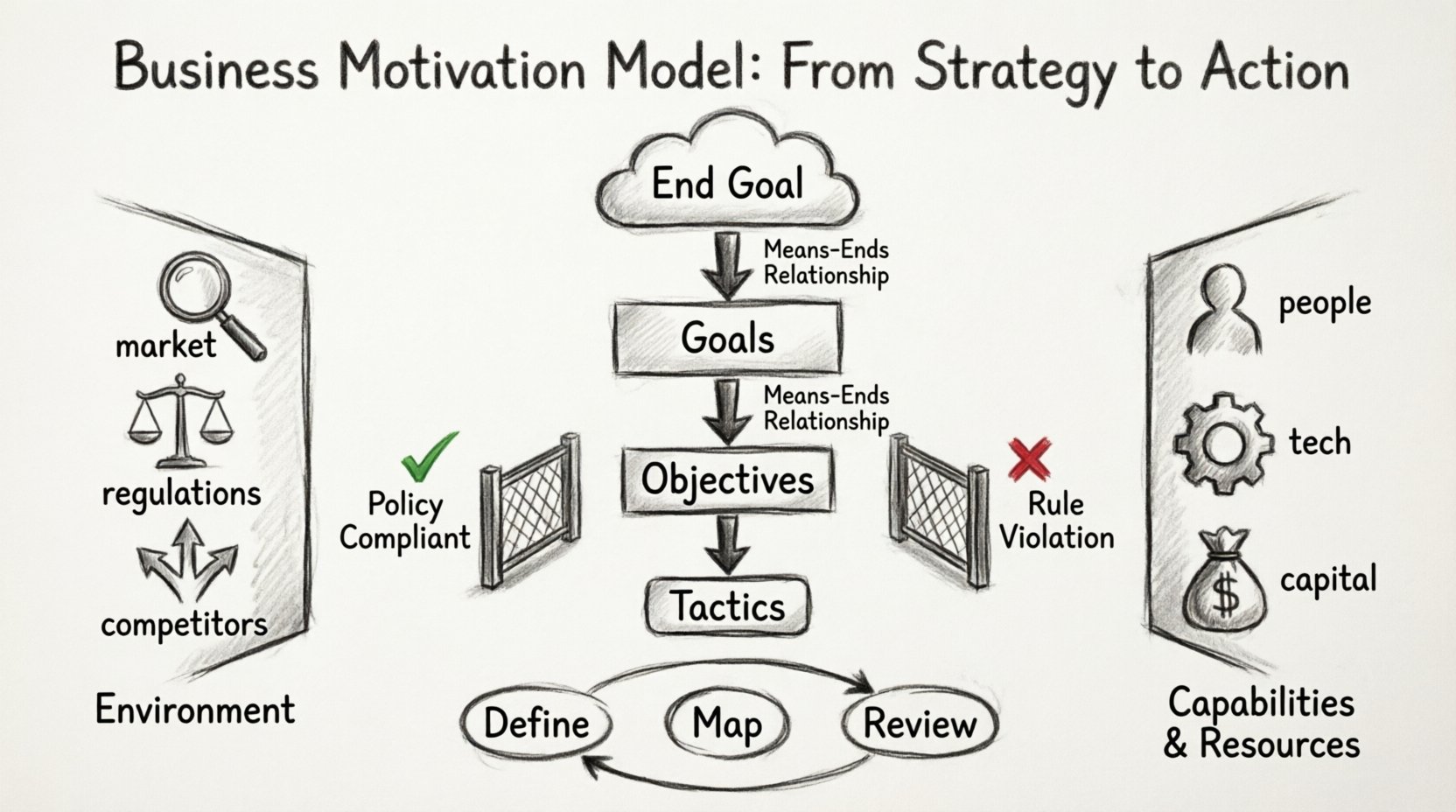
At its core, the model separates the what from the why. It distinguishes between the environment in which the business operates and the internal capabilities used to achieve results. This separation allows decision-makers to isolate variables. For example, a drop in revenue might be due to an external market shift (Environment) or an internal policy change (Policy). BMM helps map these relationships clearly.
When applied to decision-making, the model acts as a diagnostic tool. It allows teams to trace a decision back to its root motivation. If a decision cannot be traced back to a Goal or Objective, it risks being a distraction. This traceability ensures that every action contributes to the broader business intent.
🎯 Core Elements of the Model
To leverage BMM effectively, one must understand its fundamental building blocks. These elements form the vocabulary of strategic planning within the model. Each element plays a specific role in the decision-making hierarchy.
- End Goal: The ultimate desired state. This is often abstract, such as “Sustainable Growth” or “Market Leadership.” End Goals are long-term and do not have a fixed completion date.
- Goal: A specific target that contributes to an End Goal. Goals are measurable and time-bound. For instance, “Increase market share by 5% within 12 months.”
- Objective: A concrete, actionable target. Objectives are often used for tactical planning. They differ from Goals in granularity. An Objective might be “Launch Product X in Region Y by Q3.”
- Tactic: A specific action or method used to achieve an Objective. Tactics are the “how” of the model. Example: “Implement a new customer feedback loop.”
- Policy: A rule or guideline that constrains or enables actions. Policies act as guardrails for decision-making. They ensure consistency across the organization.
- Business Rule: A specific constraint defined within a policy. Rules are binary or quantitative. Example: “All purchases over $10,000 require executive approval.”
- Resource: The assets required to execute tactics. This includes people, technology, and capital. BMM models how resources are consumed to achieve objectives.
- Capability: The ability of the organization to perform tasks. Capabilities are often modeled as distinct units of competence.
- Environment: The external factors influencing the business. This includes competitors, regulations, and economic trends.
Understanding these definitions is the first step. However, the real power lies in the relationships between them. These relationships define the logic of the decision-making process.
📊 Goals vs. Objectives: A Critical Distinction
Confusion between Goals and Objectives is a common pitfall in strategic planning. The Business Motivation Model clarifies this distinction, which is vital for accurate decision-making. If you treat a Goal as an Objective, you risk setting a strategy that is too broad to execute. If you treat an Objective as a Goal, you may miss the long-term vision.
| Feature | Goal | Objective |
|---|---|---|
| Timeframe | Long-term, often indefinite | Short-term, specific deadline |
| Measurability | Directional | Quantitative |
| Focus | Strategic intent | Tactical execution |
| Example | Improve Customer Satisfaction | Achieve 90% satisfaction score by December |
This table illustrates the difference clearly. When making decisions, leaders must ask: Are we planning for the long-term vision (Goal) or the immediate milestone (Objective)? Mixing these up leads to misallocated resources and unclear accountability.
🔗 The Means-Ends Relationship
The engine of decision-making in BMM is the Means-Ends relationship. This concept links actions (Means) to outcomes (Ends). It creates a chain of logic that validates every proposed initiative.
When a manager proposes a new project, the Means-Ends relationship requires them to answer a specific question: Does this project directly support a Goal or Objective? If the answer is no, the project should be scrutinized. If the answer is yes, the project is validated.
This relationship works in two directions:
- Decomposition: Breaking down an Objective into smaller Objectives or Tactics. This is used for planning. “To achieve Objective A, we must complete Tactic B and Tactic C.”
- Aggregation: Combining results from Tactic B and Tactic C to determine if Objective A is met. This is used for reporting and monitoring.
By enforcing this logic, organizations avoid the common trap of “activity traps,” where teams are busy but not productive. Every activity must have a defined end it serves.
🛡️ Policies and Rules as Decision Filters
One of the most underutilized aspects of the Business Motivation Model is the modeling of Policies and Business Rules. In many organizations, policies exist in word documents that are rarely consulted during decision-making. BMM integrates these policies directly into the strategic model.
When a decision is proposed, it must be checked against the Policy layer. If a tactic violates a policy, the decision is blocked. This creates a governance framework that is transparent and auditable.
Consider a scenario involving resource allocation. A department wants to hire ten new staff members. The decision process involves:
- Check Objective: Does this hiring support the Objective of “Expand Sales Team”?
- Check Policy: Does the “Headcount Budget Policy” allow for this increase?
- Check Rule: Is the new hire within the approved salary band defined by the “Compensation Rule”?
By modeling these checks as part of the BMM, the decision becomes a structured evaluation rather than a political negotiation. This reduces friction and increases speed in approved decisions.
🌍 Integrating Environment and Capabilities
Strategic decisions cannot be made in a vacuum. The Business Motivation Model explicitly models the Environment and Capabilities. This integration ensures that decisions are realistic.
External Environment
The Environment element captures external forces. This includes market trends, regulatory changes, and competitor actions. When making a decision, leaders must map these environmental factors to the model.
For example, if a new regulation (Environment) is introduced that affects data privacy, the model forces a review of existing Goals and Policies. If the current Goal assumes free data usage, it is no longer valid. This triggers a decision to revise the Goal. This dynamic updating is essential for agility.
Internal Capabilities
Capabilities represent what the organization can actually do. A Goal might be “Enter the Asian Market.” However, if the Capability model shows no existing expertise in Asian regulations or logistics, the decision to enter must be paused or adjusted.
Mapping Capabilities to Objectives reveals gaps. If an Objective relies on a capability the organization does not possess, the decision-maker must choose to:
- Acquire the capability (e.g., buy a company).
- Develop the capability (e.g., train staff).
- Reframe the Objective to match existing capabilities.
This prevents over-promising and under-delivering, a common cause of strategic failure.
🛠️ Practical Implementation Steps
Implementing the Business Motivation Model for decision-making does not require complex software. It requires discipline and a structured approach to documentation. Here is a step-by-step guide to integrating BMM into your workflow.
- Define the End Goal: Start at the top. What is the ultimate state the organization seeks? Ensure all stakeholders agree on this definition.
- Identify Key Goals: Break the End Goal into 3 to 5 major Goals. These should be strategic pillars.
- Set Objectives: For each Goal, define specific Objectives with clear metrics and deadlines.
- Map Tactics: Identify the specific actions required to meet the Objectives. Assign owners to each tactic.
- Document Policies: List all policies and rules that govern these tactics. Ensure they are accessible to decision-makers.
- Assess Capabilities: Evaluate if current capabilities support the Tactics. Identify gaps.
- Review Environment: Regularly scan for environmental changes that might impact the Goals or Policies.
This process creates a living document. It should not be static. As the business evolves, the model must be updated to reflect new realities.
⚠️ Common Pitfalls to Avoid
While the Business Motivation Model is robust, it is not immune to misuse. Several common errors can undermine its effectiveness in decision-making.
- Over-Modeling: Trying to model every single detail leads to paralysis. Focus on the strategic drivers. If a detail does not impact a Goal, it does not need to be in the BMM.
- Ignoring Policies: Many organizations build models for Goals but forget the Policies that constrain them. This leads to strategies that are legally or operationally impossible to execute.
- Lack of Traceability: If a Tactic cannot be traced back to an Objective, it is a waste of resources. Ensure every line item in the budget has a corresponding trace in the model.
- Static Modeling: Treating the model as a one-time exercise. The environment changes, and the model must change with it. Regular reviews are mandatory.
- Confusing Means and Ends: Sometimes teams confuse a Tactic with a Goal. “Launch a website” is a Tactic, not a Goal. The Goal is “Increase Digital Reach.” Confusing them leads to focusing on the wrong metrics.
📈 Measuring the Impact of BMM
How do you know if leveraging the Business Motivation Model is improving your decision-making? There are several indicators of success to track.
- Alignment Rate: Measure the percentage of projects that can be traced back to a Strategic Goal. A higher rate indicates better alignment.
- Decision Speed: Track how long it takes to approve major initiatives. With clear Policies and Objectives, decisions should become faster, not slower.
- Resource Efficiency: Monitor budget variance. When resources are allocated to clear Objectives, waste decreases.
- Strategic Agility: Assess how quickly the organization can pivot when environmental changes occur. A well-modeled BMM makes pivots easier because the dependencies are known.
🔮 Future-Proofing Decisions
The business landscape is becoming increasingly volatile. Decisions made today may be obsolete tomorrow. The Business Motivation Model offers a way to future-proof decision-making by focusing on the underlying motivations rather than temporary tactics.
By modeling the Why, organizations can adapt the How without losing the What. If a new technology emerges, the Tactics change, but the Goals remain. This stability allows for consistent leadership even amidst disruption.
Furthermore, BMM supports scenario planning. Decision-makers can model different “What If” scenarios. For example, “What if our primary supplier fails?” By modeling the dependencies, the organization can see exactly which Objectives are at risk and prepare alternative Tactics in advance.
🤝 Collaboration and Communication
One of the greatest benefits of BMM is its ability to facilitate communication. Because it uses standard terminology, it bridges the gap between business leaders and technical teams.
IT teams often struggle to understand business strategy. BMM translates business language into structural requirements. When a business leader says “We need to improve security,” the BMM model helps define the specific Objectives and Policies required to achieve that.
This shared language reduces miscommunication. It ensures that when a decision is made, everyone understands the context and the constraints. It turns decision-making from a siloed activity into a collaborative effort.
🏁 Final Thoughts on Strategic Clarity
Adopting the Business Motivation Model is not about adding bureaucracy. It is about adding clarity. In a world of noise and distraction, BMM provides a signal. It helps leaders focus on what matters most.
By rigorously applying the principles of Goals, Objectives, Policies, and Capabilities, organizations can make decisions that are not only quick but also correct. They become decisions that drive the business toward its intended destination.
The path forward requires commitment. It requires treating strategy as a model that is built, tested, and refined. But the reward is a decision-making process that is transparent, aligned, and resilient. This is the foundation of sustainable business success.
Start small. Pick one department. Model their primary Goals and Objectives. Trace their Tactics. Review their Policies. You will quickly see the value in the structure. From there, expand the model across the enterprise. The journey from motivation to action is long, but with BMM, it is a path you can walk with confidence.