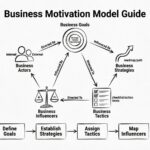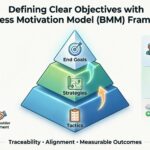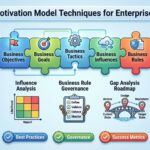


Strategy consulting involves navigating complex organizational landscapes where goals often diverge from execution capabilities. The Business Motivation Model (BMM) provides a standardized framework to clarify the why behind business actions. For consultants, mastering this model ensures that recommendations are not just technically sound but fundamentally aligned with stakeholder drivers. This guide outlines essential practices for applying BMM effectively without relying on specific tooling.
Understanding the Foundation 🏗️
Before implementing best practices, it is vital to understand the core components of the model. BMM focuses on the elements that drive business behavior. It distinguishes between what a business wants to achieve and the factors that influence that achievement.
Key elements include:
- Directives: Statements that define what the business intends to do, such as Goals, Objectives, and Plans.
- Influencers: Factors that impact the achievement of directives, including Requirements, Rules, and Policies.
- Assets: Resources owned by the business, such as Products, Services, and People.
- Resources: External or internal capabilities needed to execute directives, like Financial Capital or Infrastructure.
Understanding the distinction between an Asset and a Resource is critical. Assets are typically things the business possesses that generate value. Resources are often inputs required to transform those assets into outcomes. Confusing these leads to flawed strategy maps.
Core Best Practices for Modeling 📋
Effective modeling requires discipline. Consultants often rush to map high-level goals, skipping the foundational details. This results in models that look good on a slide but fail to support actual decision-making. The following practices ensure robustness.
1. Define Clear and Measurable Directives 🎯
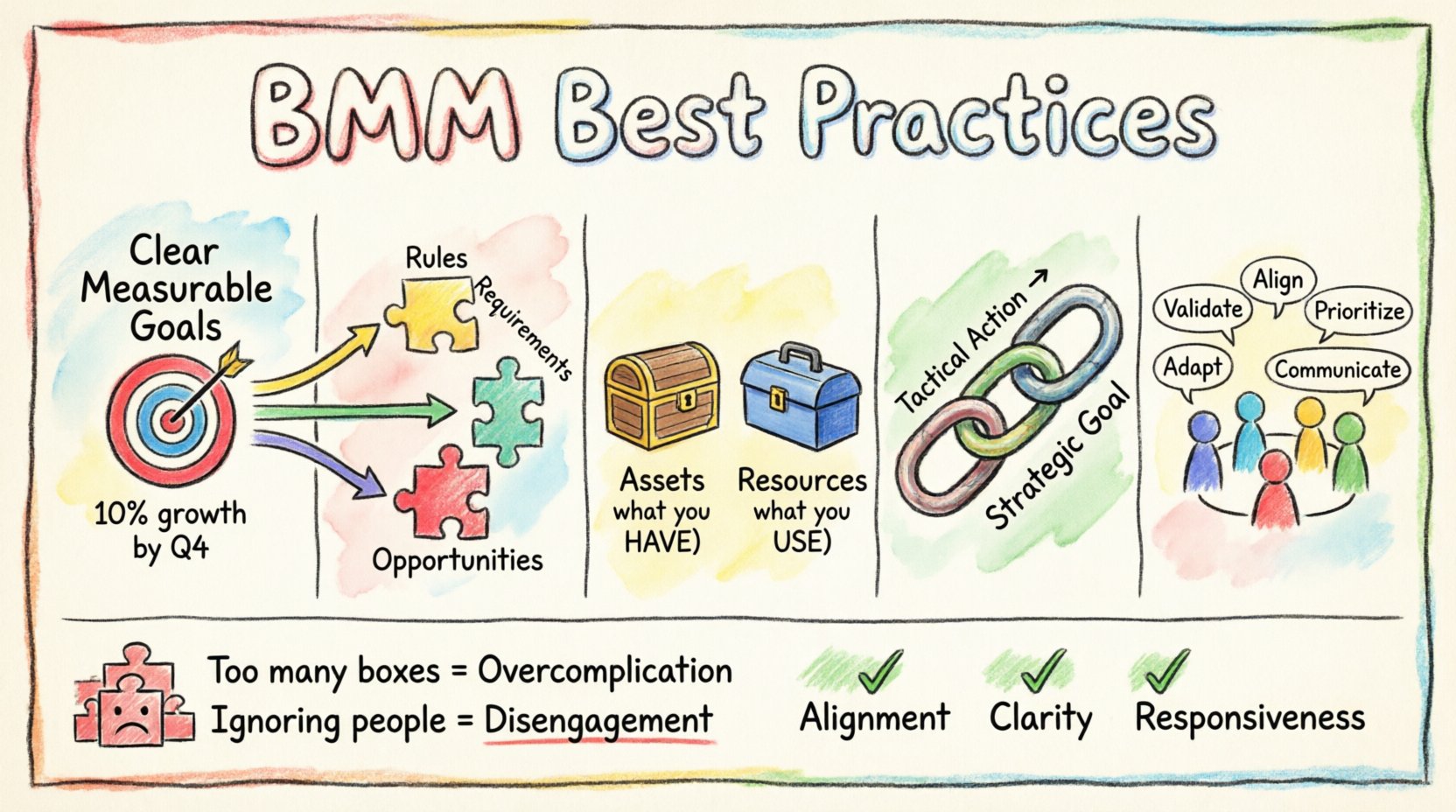
A directive must be unambiguous. Vague goals like “Improve Customer Satisfaction” are difficult to model because they lack a clear success criterion. Instead, use measurable language.
- Bad: Increase sales revenue.
- Good: Achieve a 10% year-over-year growth in North American sales by Q4.
When defining Goals versus Objectives, remember that Goals are often long-term and strategic, while Objectives are specific, measurable steps toward the Goal. Maintaining this hierarchy helps consultants trace the lineage of a strategy from the boardroom to the frontline.
2. Map Influencers to Specific Directives 🧩
Every directive should have a traceable set of influencers. This ensures that when a constraint changes, its impact on the goal is immediately visible. Use relationships to show how an influencer supports or hinders a directive.
Common influencers include:
- Requirements: External mandates or internal needs.
- Rules: Policies that must be followed.
- Opportunities/Threats: Market conditions affecting the outcome.
Consultants should explicitly document the nature of the relationship. Is the influence positive (support) or negative (hinder)? This distinction allows for better risk assessment during the strategy phase.
3. Distinguish Assets from Resources Clearly 🔄
As noted earlier, the line between Assets and Resources can blur. A rigorous model requires a strict definition.
- Assets: What you have that creates value (e.g., Brand Reputation, Intellectual Property).
- Resources: What you use to create value (e.g., Labor Hours, Budget, Raw Materials).
Table 1 below summarizes the distinction for quick reference.
| Category | Definition | Example |
|---|---|---|
| Asset | Owned value generator | Customer Database |
| Resource | Input consumed for production | IT Server Capacity |
| Directive | Intention to be achieved | Launch New Product |
| Influencer | Factor impacting intention | Regulatory Change |
4. Ensure Traceability Across the Chain 🔗
Traceability is the backbone of a useful model. A consultant must be able to trace a tactical action back to a strategic goal. If a task cannot be linked to a Goal or Objective, it may not be aligned with the business strategy.
Best practice dictates creating a traceability matrix. This document lists every directive and links it to its parent directives. This prevents “zombie strategies”—initiatives that continue to exist without a clear purpose or link to higher-level objectives.
5. Engage Stakeholders in Validation 🗣️
A model created in isolation is prone to bias. Stakeholder engagement ensures that the model reflects reality. Consultants should conduct workshops where stakeholders validate the definitions of Goals and the identification of Influencers.
- Ask: “Does this goal accurately represent what you are trying to achieve?”
- Ask: “Are we missing any external factors that could stop us?”
- Ask: “Do we have the assets required to support this plan?”
This collaborative approach builds ownership. When stakeholders see their input reflected in the model, they are more likely to adhere to the resulting strategy.
Advanced Modeling Techniques 🔍
Once the basics are established, consultants can apply more advanced techniques to handle complexity. These methods help manage large-scale transformations where hundreds of goals and rules may exist.
Decomposition and Aggregation
Large strategies often require decomposition. Break down high-level Goals into lower-level Objectives. Conversely, aggregate lower-level results to show progress toward a high-level Goal. This hierarchical view allows management to drill down into details or zoom out for high-level reporting.
Handling Conflicting Directives
Conflicts arise when one Goal supports another while hindering a third. For example, “Minimize Cost” may conflict with “Maximize Quality.” A BMM model should explicitly flag these conflicts.
- Identify the conflict clearly.
- Document the priority or weighting of each directive.
- Record the decision logic used to resolve the conflict.
This transparency prevents hidden trade-offs that surface only during execution.
Dynamic vs. Static Models
Business environments change. A static model becomes obsolete quickly. While the core structure remains, the values and statuses within the model should be updated regularly.
- Review Influencers quarterly to account for market shifts.
- Update Resource availability as budgets are allocated.
- Reassess Goals annually or upon major strategic pivots.
Common Pitfalls to Avoid ⚠️
Even experienced consultants make mistakes when applying this framework. Awareness of common errors helps maintain the integrity of the model.
Pitfall 1: Over-Complication
There is a temptation to model every single detail. A model with thousands of elements becomes unreadable. Focus on the critical path. Use abstraction for non-critical components. The goal is clarity, not exhaustive documentation.
Pitfall 2: Ignoring the Human Element
BMM models often focus on structural elements and miss the human motivation aspect. While the model maps the “what” and “why,” it must also account for the people driving it. Ensure that roles and responsibilities are linked to the Assets and Resources in the model.
Pitfall 3: Confusing Rules with Requirements
Rules are internal constraints (e.g., “Must comply with policy X”). Requirements are needs (e.g., “Must handle 10,000 transactions”). Mixing these up leads to ambiguity. A Rule restricts; a Requirement defines a need.
Pitfall 4: Lack of Maintenance
A model that sits in a repository and is never updated is a liability. It creates a false sense of security. Establish a governance process where the model is reviewed and approved by a steering committee.
Integration with Other Frameworks 🤝
BMM does not exist in a vacuum. It often complements other modeling standards used in strategy and operations.
Alignment with Process Modeling
When using process modeling standards, link processes to the Directives they support. This ensures that process improvements are tied to business outcomes. If a process change does not impact a Goal, its priority should be questioned.
Support for Enterprise Architecture
In enterprise architecture, BMM helps justify investments. By mapping Assets and Resources to Goals, consultants can demonstrate the value of technology investments. This provides a business case grounded in motivation rather than just technical capability.
Bridge to Performance Management
Performance metrics should map to Objectives. If an Objective exists in the model, there should be a corresponding metric to track progress. This closes the loop between planning and execution.
Governance and Lifecycle Management 🛡️
Sustaining a BMM requires governance. Without it, the model degrades into a set of disconnected diagrams.
Roles and Responsibilities
Define who owns the model. A Model Owner is responsible for the structure and integrity. Domain Owners are responsible for the content within their specific areas. This separation of duties prevents bottlenecks.
Version Control
Changes to the model must be tracked. Versioning allows consultants to compare the “As-Is” state with the “To-Be” state. This is crucial for audit trails and understanding the evolution of strategy.
Communication Strategy
How is the model communicated? A full model is too dense for a general audience. Create summaries that highlight key Goals and their status. Use visualizations to show the flow from Influencers to Directives to Outcomes.
Measuring Success in BMM Implementation 📊
How do you know if the BMM implementation is working? Look for these indicators of success:
- Alignment: Projects can be traced back to strategic goals.
- Clarity: Stakeholders understand their role in achieving directives.
- Responsiveness: The model can be updated quickly when external factors change.
- Decision Quality: Strategic decisions are supported by clear data on goals and influencers.
Final Considerations for the Modern Consultant 💡
The Business Motivation Model is a tool for clarity in a complex world. It does not solve the strategy itself but provides the structure necessary to validate and execute it. For the strategy consultant, the value lies in the rigor of the application.
By adhering to these best practices, consultants ensure that their work is not just theoretical but actionable. The focus must remain on the relationships between elements. A diagram is only as good as the logic connecting the boxes.
Remember that the model is a living artifact. It evolves as the business evolves. Maintain the discipline of updating the model, and it will remain a reliable guide through organizational change. The goal is to create a shared language for strategy that reduces ambiguity and increases alignment across the enterprise.
Start small. Map the core goals and their primary influencers. Expand the scope as the organization demonstrates the value of the model. This incremental approach reduces risk and builds confidence in the methodology. With patience and discipline, BMM becomes a cornerstone of effective strategic consulting.