

In the modern enterprise landscape, the gap between high-level vision and daily execution often widens due to misalignment. Organizations frequently possess robust strategic plans that fail to translate into actionable business processes. To bridge this divide, the Business Motivation Model (BMM) offers a standardized framework. This guide explores how to align enterprise strategy with BMM standards effectively. We will examine the core components, the mechanics of influence, and the practical steps required to integrate these models into your organizational architecture.
Strategic alignment is not merely about documentation; it is about ensuring that every action taken within the organization supports the overarching goals. By utilizing the Business Motivation Model, stakeholders can visualize the connections between what the business wants to achieve and how it plans to achieve it. This approach reduces ambiguity and creates a clear line of sight from the boardroom to the operational floor.
Understanding the Business Motivation Model Framework 🧩
The Business Motivation Model, standardized by the Object Management Group (OMG), provides a structured way to describe the business logic and motivation behind business rules and processes. It is distinct from process modeling because it focuses on the why and the what, rather than just the how. This distinction is crucial for enterprise architects who need to understand the drivers behind specific business capabilities.
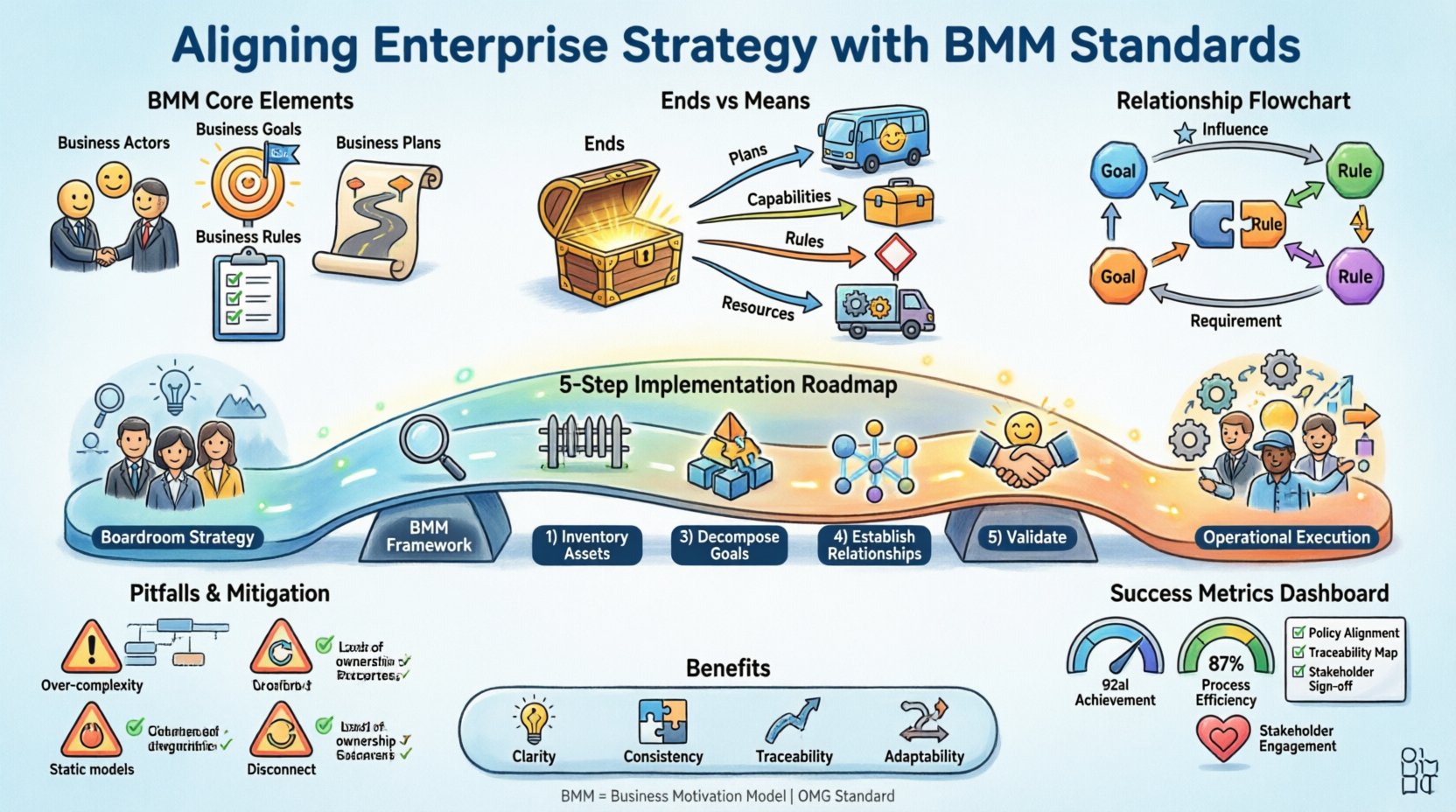
At its core, BMM is built on four primary categories of elements:
- Business Actors: The entities involved in the business, such as customers, employees, partners, and regulators.
- Business Goals: The desired outcomes that the organization aims to achieve. These can be strategic, tactical, or operational.
- Business Plans: The structured approaches designed to achieve the goals.
- Business Rules: The constraints and guidelines that govern the behavior of the business actors and processes.
Within these categories, specific relationships define how elements interact. The model distinguishes between Ends (goals) and Means (plans, rules, capabilities). Understanding this distinction is vital. A goal is the destination; the means are the vehicles and roads used to get there.
The Anatomy of BMM: Ends, Means, and Actors 👥
To align strategy effectively, one must first deconstruct the enterprise strategy into BMM-compliant elements. This process involves identifying the hierarchy of goals and the specific means required to satisfy them.
1. Defining Strategic Goals
Strategic goals in BMM are not vague aspirations. They are specific, measurable targets that drive the organization forward. When mapping these into the model, consider the following:
- Direct vs. Indirect Goals: Some goals are direct results of specific actions, while others are indirect outcomes of broader initiatives.
- Quantifiable Metrics: Every goal should ideally have associated metrics. For example, increasing market share by 5% is a quantifiable strategic goal.
- Timeframes: Goals often have deadlines. Short-term goals feed into long-term strategic objectives.
2. Identifying Business Means
Means are the mechanisms used to achieve the ends. In the context of BMM, means include:
- Business Plans: Detailed roadmaps outlining the steps to reach a goal.
- Business Capabilities: The skills, resources, and technologies required to execute plans.
- Business Rules: The policies that constrain or enable actions within the business.
Aligning these means with strategy ensures that resources are not wasted on initiatives that do not contribute to the primary goals. It forces a critical evaluation of every project and capability against the strategic backdrop.
3. Mapping Business Actors
Actors are the participants in the business environment. They can be internal (employees, departments) or external (customers, suppliers). In the alignment process, it is essential to map which actors are responsible for which goals and means. This clarifies accountability and ownership.
Bridging Strategy and Execution 🔗
Once the elements are defined, the next step is establishing the relationships that link them. This is where the true power of the Business Motivation Model lies. The relationships define the flow of influence and requirement satisfaction.
The Influence Relationship
Influence describes how one element affects another. For example, a change in a business rule might influence the achievement of a strategic goal. This is a directional relationship that highlights dependencies.
- Positive Influence: A change in one element supports the achievement of another.
- Negative Influence: A change in one element hinders the achievement of another.
By mapping influence, enterprise leaders can predict the impact of strategic changes. If a new regulation (Actor) imposes a new rule, the model shows which goals are at risk of negative influence.
The Requirement Relationship
Requirement relationships specify that one element is necessary for the satisfaction of another. This is often used to link means to ends. A specific capability is required to achieve a specific goal.
This relationship helps in resource allocation. If a goal is critical but the required means are missing, the organization knows exactly where to invest resources to close the gap.
Comparison of Strategy vs. BMM Elements
| Strategic Concept | BMM Equivalent | Function |
|---|---|---|
| Vision | Strategic Goals | Defines the future state |
| Initiatives | Business Plans | Defines the path to take |
| Capabilities | Business Capabilities | Defines what is needed |
| Policies | Business Rules | Defines constraints |
| Stakeholders | Business Actors | Defines who is involved |
Implementation Steps for Alignment 🛠️
Implementing BMM alignment requires a systematic approach. Rushing this process often leads to incomplete models that fail to capture the complexity of the enterprise. Follow these structured steps to ensure a robust implementation.
Step 1: Inventory Existing Assets
Before drawing new models, gather existing documentation. This includes strategic plans, mission statements, organizational charts, and process maps. The goal is to understand the current state without altering it yet.
- Collect all high-level strategy documents.
- Identify existing KPIs and performance metrics.
- Map current departmental responsibilities.
Step 2: Define the Strategic Context
Establish the boundaries of the model. What part of the enterprise are you modeling? Is it the whole organization or a specific division? Clear boundaries prevent scope creep and ensure the model remains manageable.
- Identify the primary Business Actors involved.
- Define the top-level Strategic Goals.
- Set the timeframe for the strategic horizon.
Step 3: Decompose Goals and Means
Break down high-level goals into smaller, manageable sub-goals. Similarly, decompose the means into specific plans and rules. This hierarchical structure allows for detailed tracking and management.
- Ensure every sub-goal supports a higher-level goal.
- Verify that every means is linked to a specific goal.
- Check for redundancy in the means.
Step 4: Establish Relationships
Connect the elements using Influence and Requirement relationships. This creates the logic of the model. It explains how changes propagate through the system.
- Draw lines between Actors and their Goals.
- Link Plans to the Goals they satisfy.
- Connect Rules to the Goals they constrain or enable.
Step 5: Validate with Stakeholders
Review the model with key stakeholders. Do the relationships reflect reality? Is the logic sound? This step ensures buy-in and accuracy.
- Conduct workshops with department heads.
- Validate the hierarchy of goals.
- Confirm the feasibility of the means.
Common Pitfalls and Mitigation Strategies ⚠️
Even with a clear framework, organizations often encounter obstacles when aligning strategy with BMM. Recognizing these pitfalls early can save significant time and effort.
1. Over-Complexity
Attempting to model every single detail can make the BMM unreadable. A model that is too complex becomes a reference book that no one opens.
- Mitigation: Focus on the critical path. Model only the elements that directly impact the strategic goals. Use abstraction for lower-level details.
2. Static Models
Business environments change rapidly. A BMM that is created once and never updated becomes obsolete quickly.
- Mitigation: Treat the model as a living document. Schedule regular review cycles to update goals, rules, and relationships based on market conditions.
3. Lack of Ownership
If no one is responsible for maintaining the model, it will decay. Ambiguity regarding who updates the relationships leads to stale data.
- Mitigation: Assign model owners for each major goal or domain. Make maintenance part of their performance metrics.
4. Disconnect from Operations
Strategies often remain in the strategy department without reaching operational teams. This creates a silo effect.
- Mitigation: Translate BMM elements into operational dashboards. Ensure that daily tasks are linked back to the strategic goals in the model.
Measuring Alignment Success 📏
How do you know if the alignment is working? You need metrics that reflect the health of the relationship between strategy and execution. These metrics should track both the state of the goals and the effectiveness of the means.
Key Performance Indicators for BMM
- Goal Achievement Rate: The percentage of strategic goals met within the defined timeframe.
- Plan Efficiency: The ratio of resources spent to the value delivered by business plans.
- Rule Compliance: The frequency of violations against business rules.
- Actor Engagement: The level of participation and contribution from key business actors.
Feedback Loops
Establish feedback loops to ensure data flows from operations back to strategy. When operational data shows a goal is not being met, the model should trigger a review of the means or the goal itself.
- Monitor KPIs continuously.
- Trigger alerts when goals deviate from targets.
- Update the BMM model based on empirical evidence.
Governance and Maintenance 🔄
Sustaining alignment requires a governance framework. This framework defines the rules for how the BMM is created, updated, and used. It ensures consistency across the enterprise.
Roles and Responsibilities
- Enterprise Architect: Oversees the overall structure and standards of the model.
- Business Analyst: Details the specific goals and means for their domain.
- Strategic Lead: Defines the high-level direction and validates goals.
- Process Owner: Ensures operational processes align with the defined means.
Change Management
When the strategy changes, the BMM must adapt. A formal change management process ensures that updates are reviewed and approved before implementation.
- Submit change requests for goal modifications.
- Analyze the impact on dependent means and rules.
- Communicate changes to all affected actors.
The Value of Structured Alignment 💡
Aligning enterprise strategy with Business Motivation Model standards provides a tangible competitive advantage. It transforms abstract strategy into a structured, manageable asset. By clarifying the relationships between goals and means, organizations can make more informed decisions.
This approach fosters transparency. Stakeholders can see how their work contributes to the broader mission. It reduces duplication of effort by highlighting where capabilities are already in place. Furthermore, it enhances agility. When market conditions shift, the model allows for rapid reassessment of which means are still relevant to the ends.
Summary of Benefits
- Clarity: Clear definition of what the business wants and how to get there.
- Consistency: Unified language across departments for discussing strategy.
- Traceability: Ability to trace operational tasks back to strategic objectives.
- Adaptability: Framework that supports change without losing strategic focus.
Implementing the Business Motivation Model is not a one-time project. It is a discipline that requires commitment and continuous improvement. By adhering to the standards and maintaining a rigorous alignment process, enterprises can ensure that their strategy remains a living, breathing component of their daily operations. The result is an organization that is not only reactive but proactive, driven by a clear and validated motivation model.
Start by reviewing your current strategic documents. Identify the gaps between what is planned and what is modeled. Begin mapping the actors, goals, and means. As you build the relationships, you will uncover the true drivers of your business performance. This path leads to a more resilient and focused enterprise architecture.