


Most organizations treat the SWOT analysis as a static document—a checklist to complete at the start of a fiscal year before filing it away. This approach leaves valuable insights on the shelf, disconnected from actual execution. A Strategic SWOT analysis is not an endpoint; it is the foundation for a dynamic 12-month roadmap. The transition from analysis to action requires a deliberate framework that connects internal capabilities with external opportunities.
This guide outlines the specific steps to bridge that gap. We will move beyond simple categorization into a structured planning process that ensures your strengths are leveraged, weaknesses are mitigated, opportunities are seized, and threats are managed. By following this method, you transform abstract data into a concrete timeline that drives measurable progress.
🔍 Step 1: Stress-Testing Your Data
Before drafting a single action item, the integrity of the SWOT analysis must be verified. A flawed input leads to a flawed roadmap. Teams often list generic statements like “strong brand” or “high competition” without substantiation. To build a reliable roadmap, you must validate these points against current market data.
- Verify Internal Strengths: Ask for evidence. Does “strong brand” translate to higher customer retention rates? Does “efficient supply chain” result in faster delivery times compared to competitors?
- Challenge Weaknesses: Is the lack of digital presence a technical limitation or a budget constraint? Distinguish between temporary hurdles and structural deficits.
- Assess External Opportunities: Are market trends genuine long-term shifts or short-term spikes? Consult industry reports and historical data to confirm viability.
- Quantify Threats: Define the impact of potential threats. Is a regulatory change a minor compliance issue or a business model disruptor?
Without this validation phase, the roadmap is built on assumptions. This step ensures that the resources allocated over the next 12 months are directed toward issues that genuinely impact performance.
🔗 Step 2: Bridging the Gap with the TOWS Matrix
The standard SWOT format lists factors in isolation. The TOWS matrix is the critical tool for synthesis. It forces you to cross-reference internal and external factors to generate specific strategic options. This is where the roadmap begins to take shape.
- S-O Strategies (Maxi-Maxi): Use strengths to maximize opportunities. If you have strong R&D and a new market trend exists, how do you launch a product first?
- W-O Strategies (Mini-Maxi): Overcome weaknesses by taking advantage of opportunities. If you lack data analytics but the market demands personalization, how do you partner to fill that gap?
- S-T Strategies (Maxi-Mini): Use strengths to minimize threats. If you have a loyal customer base, how does that protect you against a new competitor entering the space?
- W-T Strategies (Mini-Mini): Minimize weaknesses and avoid threats. This is often the defensive layer of the roadmap, ensuring survival during volatile periods.
By mapping these intersections, you create a list of potential strategic initiatives. Each initiative represents a potential node on your 12-month roadmap.
🏛️ Step 3: Defining Strategic Pillars
A roadmap cannot be a long list of disconnected tasks. It requires pillars—broad areas of focus that align with the organization’s vision. These pillars provide the structure for the quarterly breakdown. Select 3 to 5 pillars based on the TOWS analysis.
For example, an organization might choose:
- Digital Transformation: Modernizing legacy systems to support growth.
- Market Expansion: Entering new geographic or demographic segments.
- Operational Excellence: Reducing costs and improving efficiency.
- Talent Development: Upskilling the workforce to meet future needs.
Every action item on the roadmap must roll up under one of these pillars. This ensures that daily work aligns with long-term goals. It prevents the “shiny object syndrome” where teams chase trends that do not contribute to the core strategy.
📅 Step 4: The Quarterly Execution Plan
A 12-month roadmap is best managed in four quarters. This allows for flexibility and regular review cycles. Each quarter should have specific themes and deliverables derived from the strategic pillars.
Q1: Foundation and Planning
The first quarter is about setting the stage. It is not always about heavy output; sometimes it is about preparation.
- Resource Allocation: Secure the budget and personnel needed for the year.
- Process Design: Establish the workflows and governance structures for new initiatives.
- Quick Wins: Identify low-hanging fruit to build momentum early.
Q2: Implementation and Testing
This is the period of active execution. Pilots and beta launches happen here.
- Pilot Programs: Roll out new products or services in controlled environments.
- Feedback Loops: Gather data from early adopters to refine the approach.
- Mid-Year Review: Assess progress against the initial benchmarks.
Q3: Scaling and Optimization
Once validation is achieved, the focus shifts to scaling up operations.
- Broader Rollout: Expand successful pilots to the wider market.
- Optimization: Tweak processes to handle increased volume efficiently.
- Team Expansion: Hire or train additional staff to support growth.
Q4: Consolidation and Future Planning
The final quarter is about locking in gains and looking ahead.
- Performance Audit: Measure final results against the annual goals.
- Knowledge Capture: Document lessons learned for the next cycle.
- Strategic Refresh: Begin the analysis for the following year.
📊 Mapping SWOT Elements to Roadmap Phases
To visualize how the analysis translates to time, use the following framework. This table demonstrates how specific SWOT insights drive specific timeline activities.
| SWOT Element | Roadmap Action | Target Quarter | Success Metric |
|---|---|---|---|
| Strength: Proprietary Technology | Launch new feature suite | Q2 | Adoption Rate % |
| Weakness: Slow Customer Support | Implement new ticketing workflow | Q1 | Response Time (Hours) |
| Opportunity: Emerging Market | Establish regional partnership | Q3 | Revenue Growth % |
| Threat: Supply Chain Disruption | Diversify vendor list | Q4 | Vendor Dependency % |
📋 Step 5: Establishing Accountability and Metrics
A roadmap without accountability is merely a wish list. Every initiative must have an owner and a clear definition of success. This section ensures that the plan is lived, not just read.
Assigning Ownership
- Executive Sponsor: A senior leader who champions the initiative and removes roadblocks.
- Project Lead: The individual responsible for day-to-day execution and delivery.
- Stakeholders: Departments that are impacted by or contribute to the outcome.
Defining Key Performance Indicators
Metrics must be measurable and relevant. Avoid vanity metrics that look good but do not indicate progress.
- Leading Indicators: Predictive measures (e.g., number of sales calls made).
- Lagging Indicators: Outcome measures (e.g., total revenue closed).
- Health Metrics: Operational stability (e.g., system uptime, employee satisfaction).
Regular check-ins are essential. Monthly reviews allow the team to track progress against the roadmap. Quarterly reviews allow for strategic pivots if the external environment changes.
🚧 Navigating Obstacles Along the Way
Even the best-laid plans encounter resistance. Resource constraints, shifting priorities, and unexpected market shifts are common. The roadmap must be resilient enough to absorb these shocks.
- Resource Conflicts: When multiple initiatives compete for the same budget or talent, prioritize based on strategic impact. Do not over-commit capacity.
- Scope Creep: Guard against adding new tasks mid-year. If a new opportunity arises, evaluate it against the current pillars. Does it fit? If not, move it to the next cycle.
- Change Fatigue: Constant change wears down teams. Communicate the “why” behind every shift. Celebrate milestones to maintain morale.
🚀 Maintaining Momentum Over 12 Months
Momentum is the lifeblood of the roadmap. Once the initial excitement fades, execution often stalls. To prevent this, maintain a rhythm of accountability and visibility.
Communication Cadence
- Weekly Stand-ups: Tactical updates for project leads.
- Monthly Steering Committee: Strategic review for leadership.
- Quarterly Town Halls: Broad communication to the entire organization.
Visualizing Progress
Use visual tools to track the roadmap. Gantt charts, Kanban boards, or simple status dashboards help everyone see where the organization stands. Transparency builds trust and keeps the team aligned.
🛠️ Common Pitfalls to Avoid
Several errors frequently derail the SWOT to roadmap process. Awareness of these pitfalls helps you stay on course.
- Analysis Paralysis: Spending too much time analyzing and not enough time acting. Aim for “good enough” data to start moving.
- Ignoring Weaknesses: Focusing only on strengths and opportunities while neglecting internal fixes. Weaknesses can become fatal if left unaddressed.
- Static Planning: Treating the roadmap as a contract that cannot change. It must be a living document that evolves with the market.
- Lack of Buy-in: Creating the plan in a vacuum. Involve key stakeholders in the creation process to ensure commitment.
🔄 The Feedback Loop
The final component of a successful roadmap is the feedback loop. Data from execution informs the next cycle of analysis. At the end of the 12 months, conduct a fresh SWOT analysis. Compare the results against the initial assumptions. What changed? What was predicted correctly? What was missed?
This continuous improvement cycle ensures that the organization remains agile. It transforms the SWOT from a one-time exercise into a recurring strategic rhythm. By the end of the year, you should have a refined understanding of your position and a clear path forward.
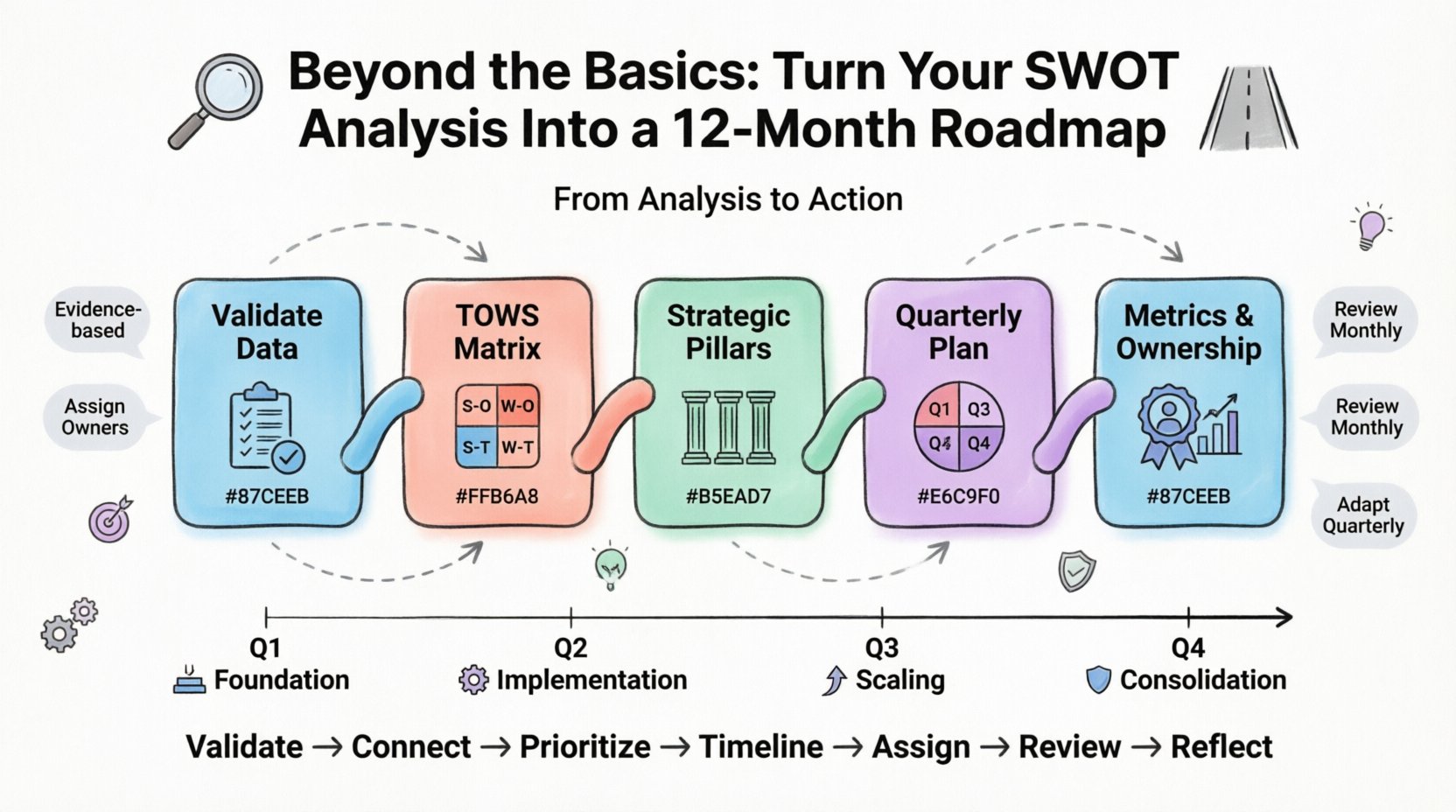
📝 Summary of Execution Steps
- Validate: Ensure data is accurate and evidence-based.
- Connect: Use the TOWS matrix to link internal and external factors.
- Prioritize: Select strategic pillars that align with vision.
- Timeline: Break initiatives into quarterly themes and milestones.
- Assign: Define owners and metrics for every action.
- Review: Monitor progress monthly and adjust quarterly.
- Reflect: Conduct a new analysis at year-end to restart the cycle.
Turning a SWOT analysis into a 12-month roadmap is a disciplined process. It requires moving from passive observation to active planning. By following these steps, you create a clear path that guides the organization through the complexities of the market. The result is not just a document, but a strategy that delivers results.