


In the modern business landscape, saturation is the norm. Most industries have players who have claimed the major territories, leaving little room for newcomers to simply “join the party.” For entrepreneurs and strategic planners, the challenge is no longer just about having a good idea, but about identifying a specific space where demand exists but supply does not adequately meet it. This space is known as a market gap.
Finding this gap often feels like searching for a needle in a haystack. However, structured analysis can turn this search into a systematic process. One of the most enduring and effective frameworks for this task is the SWOT analysis. While traditionally used for broad strategic planning, when applied with a focus on niche identification, it becomes a powerful tool for uncovering specific opportunities that competitors may have overlooked.
This guide provides a comprehensive look at how to leverage SWOT analysis to pinpoint your niche. We will move beyond the basic definitions and explore the mechanics of internal and external factor alignment, data collection methods that require no budget, and the synthesis process that turns raw data into actionable market intelligence.
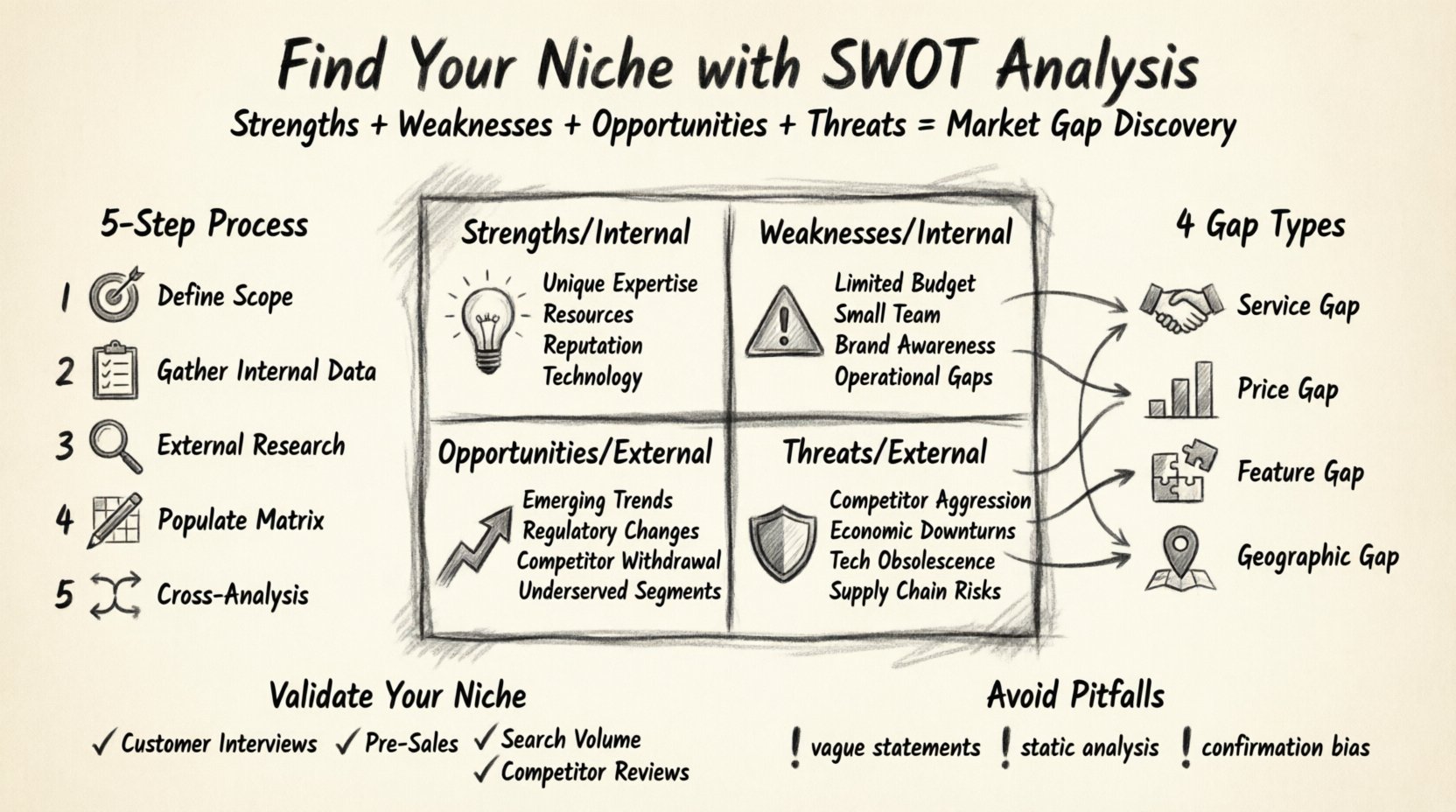
🧩 Understanding the SWOT Framework in Context
Before diving into niche finding, it is essential to understand the components of the SWOT framework. SWOT stands for Strengths, Weaknesses, Opportunities, and Threats. It is a matrix that divides factors into two categories: internal and external.
Internal factors are elements within your control or direct influence. External factors are market conditions, competitor actions, and economic trends that exist outside your organization. To find a niche, you must understand how these four quadrants interact.
🟢 Strengths (Internal)
Strengths are the positive attributes of your current or proposed business. These are resources, skills, or advantages you possess that allow you to execute a strategy better than others. In the context of niche finding, strengths answer the question: “What do we do well?”
- Unique Expertise: Specialized knowledge or certifications held by your team.
- Resources: Capital, time, or equipment available to you.
- Reputation: Existing brand equity or community trust.
- Technology: Proprietary processes or tools you have developed.
🔴 Weaknesses (Internal)
Weaknesses are internal limitations that hinder performance. Identifying these is crucial because a niche often exists where a competitor’s weakness overlaps with a customer need. If you are strong where others are weak, that is your entry point.
- Limited Budget: Constraints on marketing spend or R&D.
- Small Team: Limited manpower to scale operations quickly.
- Brand Awareness: Lack of recognition in the broader market.
- Operational Gaps: Inefficiencies in current workflows.
🟡 Opportunities (External)
Opportunities are favorable external conditions that could be exploited for gain. In niche identification, opportunities often manifest as market gaps. These are trends, regulatory changes, or unmet customer needs.
- Emerging Trends: Shifts in consumer behavior or technology adoption.
- Regulatory Changes: New laws creating demand for compliance services.
- Competitor Withdrawal: Larger players exiting a specific segment.
- Underserved Segments: Specific demographics ignored by mass-market providers.
🔵 Threats (External)
Threats are external challenges that could cause trouble for the business. Understanding threats helps validate if a potential niche is sustainable or if it is a dead end.
- Competitor Aggression: New entrants with significant funding.
- Economic Downturns: Reduced consumer spending power.
- Technological Obsolescence: New tech making current offerings irrelevant.
- Supply Chain Disruptions: Reliance on unstable vendors.
📊 The SWOT Matrix for Niche Identification
To visualize how these factors combine to reveal a niche, consider the matrix below. This structure helps organize your thinking before you begin the detailed analysis.
| Internal Factors | External Factors |
|---|---|
| Strengths (S) What we do well |
Weaknesses (W) Where we lack |
| Opportunities (O) Market gaps |
Threats (T) Risks to avoid |
The magic happens in the cross-referencing. A niche is not just a list of Opportunities; it is an Opportunity that aligns with your Strengths, or a Threat that you can mitigate better than the competition.
🛠️ Step-by-Step Guide to Analysis
Executing a SWOT analysis for niche discovery requires discipline and honest data. It is not enough to guess; you must gather evidence. The following steps outline a rigorous process to ensure your findings are grounded in reality.
Step 1: Define the Scope and Objective
Before filling out the matrix, you must define what you are analyzing. Are you looking for a product niche, a service niche, or a geographic market? A broad scope leads to broad, unactionable data. A narrow scope yields specific, actionable insights.
- Define the industry vertical you are interested in.
- Identify the target customer profile.
- Set a time horizon (e.g., the next 12 to 24 months).
Step 2: Gather Internal Data
Start with what you know about yourself. If you are a new venture, look at the skills of the founders. If you are an existing business, look at performance metrics. Be brutally honest about weaknesses; ignoring them leads to strategic failure.
- Review Financials: Where is cash flowing? Where are losses occurring?
- Analyze Past Projects: What types of work yielded the highest profit margins?
- Team Audit: What skills are missing from the current roster?
- Customer Feedback: What do clients praise or complain about most?
Step 3: Conduct External Research
This step requires looking outward. You do not need expensive software to do this. Public records, industry reports, social media discussions, and competitor websites are valuable sources.
- Competitor Analysis: List the top 5 competitors. What are they missing? Look at their reviews for complaints.
- Search Trends: Use search engine tools to see what people are asking for but not finding.
- Industry Reports: Read white papers or news articles regarding market shifts.
- Community Listening: Join forums or groups where your potential customers hang out.
Step 4: Populate the Matrix
Now, transfer the data into the four quadrants. Do not be vague. Instead of writing “Good Marketing,” write “High engagement on Instagram Stories due to video content.” Instead of “Bad Economy,” write “Reduced discretionary spending in Q4.” Specificity is key.
| Strengths (Internal) | Weaknesses (Internal) |
|---|---|
|
|
| Opportunities (External) | Threats (External) |
|
|
Step 5: Cross-Analysis for Gaps
This is the most critical step. You must connect the dots between the quadrants. Look for specific intersections that point to a viable niche.
- S-O Strategies: How can you use your Strengths to seize Opportunities? This is where you dominate.
- W-O Strategies: How can you overcome Weaknesses to take advantage of Opportunities? This often involves partnerships or outsourcing.
- S-T Strategies: How can you use Strengths to minimize Threats? This is defensive positioning.
- W-T Strategies: How do you prevent Weaknesses from making you vulnerable to Threats? This is risk mitigation.
🔎 Identifying the Specific Gap
Once the matrix is populated, you need to translate the data into a concrete market gap. A market gap is a specific need that is not being met by current solutions. Here is how to extract that from your analysis.
1. The Service Gap
This occurs when competitors offer a product but fail to provide necessary support or customization. For example, if all competitors sell generic software, but customers constantly complain about the lack of onboarding support, the gap is “Implementation Services.” You leverage your Strength (knowledge) to fill the Opportunity (demand for support).
2. The Price Gap
Markets often polarize between high-end luxury and low-cost budget options. If you find a segment of customers who need quality but cannot afford the top tier, a mid-tier niche exists. This aligns with an Opportunity (underserved price point) and may require addressing a Weakness (cost structure) to be viable.
3. The Feature Gap
Competitors often bundle features together, forcing customers to pay for what they don’t need. If your analysis shows that customers want a specific feature stripped out for a lower price, that is a gap. This requires a Strength (modular product design) to exploit the Opportunity (demand for flexibility).
4. The Geographic Gap
Sometimes the gap is location-based. If you identify that a service is popular in urban centers but non-existent in rural areas, you have a geographic niche. This leverages a Strength (local presence) against a Threat (remote competitors).
✅ Validating the Niche
Once you have identified a potential gap, do not commit resources immediately. Validation is the process of confirming that the gap is real and that people are willing to pay to close it. This step prevents the common error of building a solution for a problem that does not exist.
- Customer Interviews: Speak to 10 to 20 potential customers. Ask them about their current pain points. Do not pitch your idea; ask about their problems.
- Pre-Sales: If possible, try to sell the solution before it is fully built. A landing page with a waitlist can indicate interest.
- Search Volume: Verify that people are searching for keywords related to the gap.
- Competitor Reviews: Read one-star reviews of competitors. If multiple people complain about the same issue, that is a validated gap.
⚠️ Common Pitfalls in SWOT Analysis
Even with a solid framework, errors can occur. Being aware of these pitfalls ensures your analysis remains accurate.
- Confusing Internal and External: A common mistake is listing “Competitor Price Increase” as a Strength. This is external. Ensure you categorize correctly.
- Vague Statements: “Good quality” is not a Strength. “99% defect-free rate” is a Strength. Specificity allows for measurement.
- Static Analysis: Markets change rapidly. An analysis done once a year may be obsolete by next month. Treat SWOT as a living document.
- Confirmation Bias: Do not fill the matrix only with data that supports your preconceived idea. If the data says your niche is a bad idea, listen to the data.
- Ignoring the Threats: Many planners focus only on Strengths and Opportunities. Ignoring Threats can lead to a niche that collapses under regulatory or competitive pressure.
📈 Long-Term Strategy and Adaptation
Finding a niche is not the end of the journey; it is the beginning. Once you have established your position, the market will evolve. Competitors will notice your success and attempt to enter the space. Continuous monitoring of the SWOT factors is necessary.
- Monitor Weaknesses: As you grow, new weaknesses will emerge. Address them proactively.
- Track Threats: Keep an eye on industry news. If a regulatory threat looms, pivot before it impacts you.
- Re-evaluate Strengths: What was a strength yesterday may be a commodity today. Invest in maintaining your unique advantages.
- Scan for New Opportunities: Markets are dynamic. New opportunities will arise as the old ones fill up.
🔗 Synthesis: Turning Analysis into Action
The final output of this process is not a document, but a strategy. Here is a checklist to ensure your SWOT analysis translates into business action.
- Document the Findings: Store the matrix in a central location accessible to key decision-makers.
- Assign Owners: Every item on the SWOT list should have an owner responsible for addressing it.
- Set KPIs: Define how you will measure success in closing the identified gap.
- Review Cycle: Schedule quarterly reviews to update the matrix with new data.
- Communication: Ensure the team understands the chosen niche and why it was selected based on this data.
By rigorously applying this framework, you move from guessing to knowing. You replace intuition with evidence. While the process requires time and effort, the clarity it provides is invaluable. In a crowded market, the ability to see clearly where others cannot is the ultimate competitive advantage.
Remember, a niche is not just a segment of the market; it is a specific intersection of your capabilities and the market’s needs. SWOT analysis provides the map to find that intersection. Use it with discipline, update it with frequency, and let the data guide your strategic decisions.