


Strategic planning is the backbone of sustainable business growth. Yet, many small business owners approach this process with a sense of dread or treat it as a bureaucratic checkbox. Among the various frameworks available, the SWOT analysis remains one of the most popular tools for assessing internal capabilities and external conditions. However, popularity does not guarantee effectiveness. In fact, a poorly executed SWOT analysis can create a false sense of security or lead to paralysis by analysis.
Many owners spend hours filling out the four quadrants but end up with a document that gathers dust on a shelf. They fail to translate insights into strategy. This guide identifies the specific pitfalls that undermine the value of this tool and provides concrete methods to correct them. By addressing these issues, you ensure that your strategic planning serves as a living document that drives decision-making rather than a static artifact.
Understanding the Framework 🧩
Before diving into the errors, it is essential to recall the core components. SWOT stands for Strengths, Weaknesses, Opportunities, and Threats. It is a structured method to evaluate these four elements.
- Strengths: Internal attributes that give an advantage over others.
- Weaknesses: Internal attributes that place the business at a disadvantage.
- Opportunities: External chances to make progress.
- Threats: External elements that could cause trouble.
The error often lies not in the definition, but in the execution. Below, we explore the most frequent mistakes and how to resolve them with precision.
Mistake #1: Stating the Obvious 🛑
One of the most common errors is listing generic statements that apply to almost any business in the industry. If your Strengths section says “We have good employees” or “We offer high-quality products,” the analysis lacks utility.
Generic statements do not differentiate your business. They do not help you identify a competitive edge. When a business owner writes vague points, they fail to uncover the specific advantages that allow them to win in their market.
The Fix: Be Specific and Data-Driven 📈
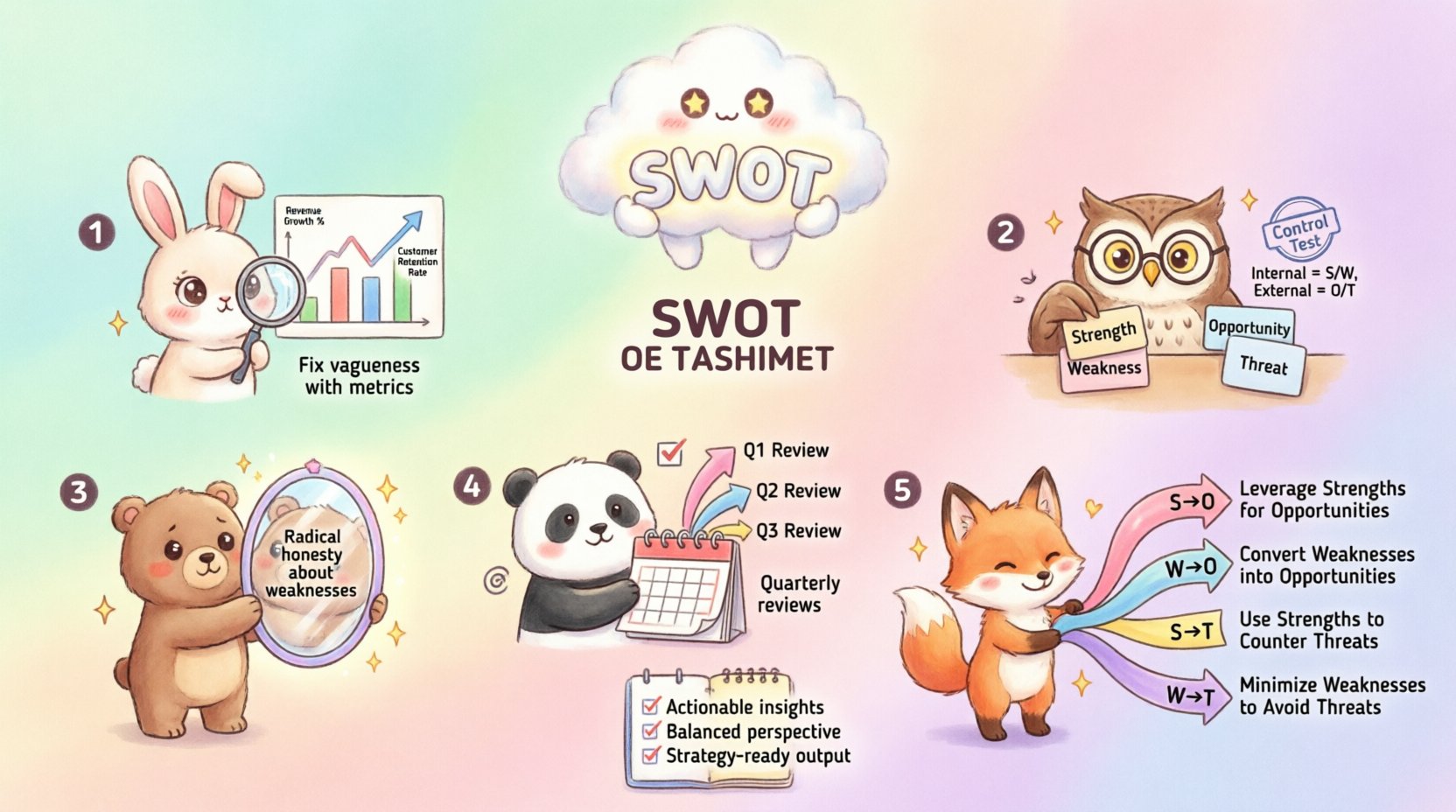
To correct this, move from subjective adjectives to objective metrics. Ask yourself: What specific data supports this claim? Why is this a strength compared to the competition?
- Instead of: “Good customer service.”
- Use: “95% customer retention rate compared to the industry average of 80%.”
- Instead of: “Large inventory.”
- Use: “30% more stock variety than the nearest competitor in the region.”
This level of detail forces you to validate your claims. If you cannot back it up with numbers or specific examples, it might not be a strength worth highlighting. It prevents the analysis from becoming a list of platitudes.
Mistake #2: Confusing Internal and External Factors 🔍
The SWOT matrix relies on a strict distinction between what you can control and what you cannot. Strengths and Weaknesses are internal. Opportunities and Threats are external. A frequent error occurs when owners mix these categories. For example, listing “New technology” as a Strength when it is actually a market trend (Opportunity).
When you confuse these quadrants, your strategy becomes misaligned. You might try to control an external threat or fail to leverage an internal strength against an external opportunity. This confusion leads to wasted resources and ineffective planning.
The Fix: The Control Test ✅
For every item you write, apply the “Control Test”. Ask: Can my business directly influence or change this factor right now?
- If Yes (Internal): It belongs in Strengths or Weaknesses.
- If No (External): It belongs in Opportunities or Threats.
Example Scenario:
- Item: “Competitor lowered prices.”
- Analysis: You cannot control what the competitor does. This is a Threat.
- Item: “We can lower our prices.”
- Analysis: You can control your pricing strategy. This is a Strength or a tactical move.
By rigorously applying this filter, you ensure that the internal factors are actionable and the external factors are monitored for environmental shifts.
Mistake #3: Hiding or Ignoring Weaknesses 🚫
Business owners often view SWOT analysis as a marketing exercise. They want to look good on paper. Consequently, they downplay weaknesses or omit them entirely. This is dangerous. A SWOT analysis that only highlights positives is a self-deception tool.
Weaknesses are not failures; they are areas for improvement. Ignoring them creates blind spots. If you do not acknowledge that your supply chain is fragile, you cannot build a contingency plan for when it breaks.
The Fix: Radical Honesty 🗣️
Treat the Weaknesses quadrant as a diagnostic tool, not a judgment. Encourage your team to be brutally honest. Create a safe environment where admitting a gap in skills or resources is seen as a step toward improvement, not a sign of incompetence.
- Ask: “What stops us from growing faster right now?”
- Ask: “Where do we lose customers most frequently?”
- Ask: “What processes cause the most delays?”
Once identified, prioritize these weaknesses. Not all weaknesses need immediate fixing. Focus on the ones that directly impact your strategic goals. Addressing these honestly allows you to mitigate risks before they become crises.
Mistake #4: Creating a Static Document 📄
Many owners conduct a SWOT analysis once a year, print it out, and file it away. They treat it as a one-time event. The business environment, however, is dynamic. Competitors change, consumer behavior shifts, and economic conditions fluctuate.
A static document becomes obsolete quickly. Relying on a plan created six months ago to guide current decisions is risky. The analysis loses its relevance if it does not evolve with the business.
The Fix: Regular Reviews and Updates 🔄
Integrate SWOT analysis into your regular operational rhythm. Schedule quarterly reviews rather than just annual ones. During these reviews, ask:
- Did any Strengths become Weaknesses? (e.g., a technology that was once new is now standard.)
- Did any Threats become Opportunities? (e.g., a regulation that used to hurt now helps if you are compliant.)
- Are there new external factors? (e.g., new legislation, new competitors.)
Keep the document accessible. A digital version stored in a shared workspace is better than a printed PDF. This ensures that the information is available to decision-makers whenever a strategic choice needs to be made.
Mistake #5: Failing to Connect to Action 🎯
The most critical failure is stopping at the list. You identify a Strength and a Threat, but you do not figure out what to do about it. A SWOT analysis without a strategy is just a list. It provides data but no direction.
Without linking the quadrants, the insights remain theoretical. You need to convert the findings into actionable strategies. This is often referred to as TOWS analysis, where you cross-reference the elements to generate strategies.
The Fix: Cross-Reference and Strategize 🧠
Do not just list items. Connect them. Look for relationships between the quadrants.
- S-O Strategies: How can we use our Strengths to take advantage of Opportunities?
- W-O Strategies: How can we overcome Weaknesses to take advantage of Opportunities?
- S-T Strategies: How can we use Strengths to minimize Threats?
- W-T Strategies: How can we minimize Weaknesses to avoid Threats?
For example, if you have a Strength in rapid shipping and a Threat in a competitor lowering prices, your strategy might be to emphasize speed over price in your marketing. If you have a Weakness in cash flow and a Threat in rising interest rates, your strategy must be to reduce debt before rates climb higher.
Summary of Common Errors and Solutions 📋
For quick reference, here is a structured overview of the mistakes and the corrective actions required.
| Mistake | Consequence | Solution |
|---|---|---|
| Vague Statements | Unable to differentiate from competitors | Use specific data and metrics |
| Internal/External Confusion | Misaligned strategy and wasted effort | Apply the Control Test |
| Ignoring Weaknesses | Blind spots lead to unexpected failures | Practice radical honesty and prioritize fixes |
| Static Document | Plan becomes obsolete quickly | Schedule quarterly reviews |
| No Action Plan | Insights remain theoretical | Link quadrants to create TOWS strategies |
Deep Dive: Opportunities and Threats 🌍
While internal factors are often easier to identify, the external landscape requires constant monitoring. Small business owners frequently underestimate the speed at which the market changes.
Identifying Opportunities 💡
Opportunities are not just “good things that happen.” They are gaps in the market that your business can fill. Look for trends that align with your strengths.
- Technological Shifts: Is there new software or hardware that can improve your efficiency?
- Regulatory Changes: Are there new laws that favor your business model?
- Demographic Shifts: Is your target audience growing or moving locations?
- Competitor Gaps: Is a competitor leaving a market segment open?
When identifying opportunities, avoid wishful thinking. An opportunity is only valid if you have the capacity to pursue it. If you see a chance to expand but lack the capital or staff, it is a wish, not a strategic opportunity.
Identifying Threats ⚠️
Threats are external forces that could harm your business. These are often the most uncomfortable to discuss but the most vital to address.
- Economic Conditions: Inflation, recession, or interest rate hikes.
- Competitive Actions: New entrants, price wars, or product launches.
- Supply Chain: Reliance on a single vendor or geopolitical issues.
- Consumer Trends: Changes in customer preferences or habits.
The goal here is not fear, but preparedness. For every significant threat identified, you should have a contingency plan. If a supplier fails, who is the backup? If a competitor lowers prices, do you have a value proposition that justifies your cost?
Implementation Strategy for Small Businesses 🚀
Putting this into practice requires a structured approach. You do not need expensive consultants or complex software. You need a disciplined process.
- Assemble the Right Team: Do not do this alone. Include employees from different departments. A salesperson sees threats that a developer might miss.
- Gather Data: Before the meeting, collect customer feedback, financial reports, and market research. Do not rely on memory.
- Conduct the Session: Dedicate time to brainstorming. Write everything down. Do not judge ideas during the initial phase.
- Categorize: Sort the ideas into the four quadrants. Apply the Control Test to ensure accuracy.
- Prioritize: Select the top 3 to 5 items from each quadrant. You do not need to fix everything at once.
- Create Action Items: Assign owners and deadlines to specific strategic actions derived from the analysis.
- Review: Set a date to revisit the document in 90 days.
The Psychology of Strategic Planning 🧠
Understanding why owners make these mistakes helps in preventing them. There is often a cognitive bias at play. The optimism bias leads owners to overestimate their strengths and underestimate threats. The status quo bias makes them reluctant to change or admit weaknesses.
Recognizing these biases is the first step to overcoming them. It requires a shift in mindset. The goal of the analysis is not to prove you are right, but to find the truth about your business situation. This truth might be uncomfortable, but it is the foundation of a resilient business.
Furthermore, small businesses often lack the time to dedicate to long planning sessions. This leads to the “quick and dirty” approach. While speed is valuable, accuracy is more valuable in the long run. Investing time now prevents costly mistakes later.
Conclusion on Continuous Improvement 📝
A SWOT analysis is not a destination; it is a tool for navigation. By avoiding the common pitfalls of vagueness, confusion, and inaction, you transform this framework into a powerful engine for growth. The difference between a successful business and a struggling one often lies in the clarity of their strategic vision.
When you commit to specific data, honest self-assessment, and actionable follow-through, you build a strategy that withstands market volatility. Remember that the document is only as good as the actions it inspires. Regular updates ensure it remains relevant. Connecting the quadrants ensures it drives results.
Take the time to do this right. Your business deserves a plan based on reality, not wishful thinking. Start by reviewing your current understanding of your strengths, weaknesses, opportunities, and threats. Identify the gaps. Fill them. And move forward with confidence.
Related posts:
 SWOT Analysis for Startups: A Beginner’s Step-by-Step Guide to Launching Strong
 The 5-Minute SWOT Analysis: Quick Start Framework for Freelancers and Sole Proprietors
 SWOT Analysis Breakdown: How to Decode Your Business Strengths and Weaknesses Today
 Real Startup Case Studies: What Happens When Founders Ignore SWOT Analysis Risks