


When evaluating potential acquisitions, financial statements tell only part of the story. The true value and risk of a target company are often embedded in the structural dynamics of its industry. This is where Porter’s Five Forces for M&A Due Diligence becomes an essential tool. Understanding the competitive landscape allows acquirers to predict future profitability, identify hidden liabilities, and negotiate better terms.
This guide provides a deep dive into applying the Five Forces framework specifically within the context of mergers and acquisitions. We will examine how each force impacts valuation, synergy realization, and long-term strategic fit. By analyzing these dynamics, investors can move beyond surface-level metrics and assess the durability of the target’s competitive advantage.
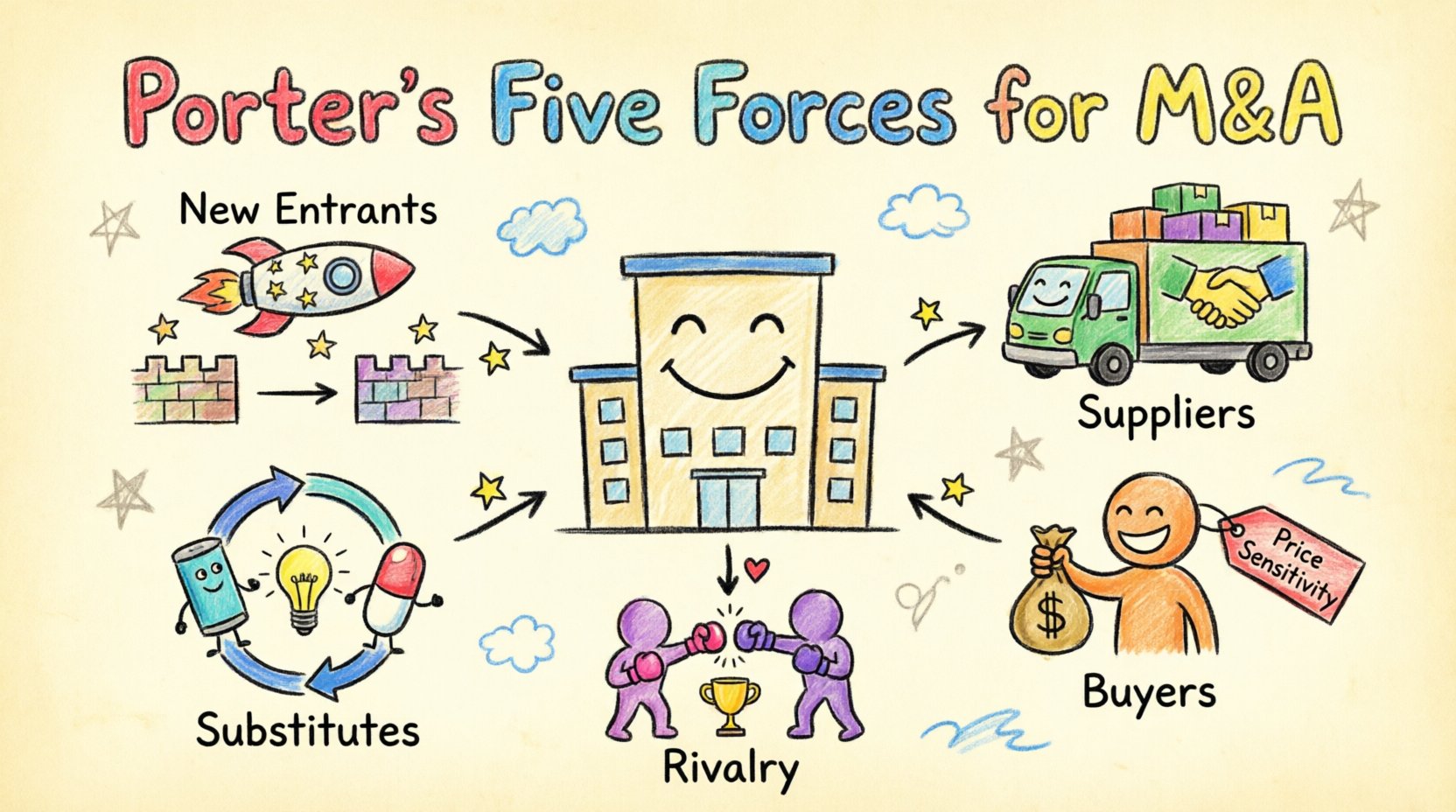
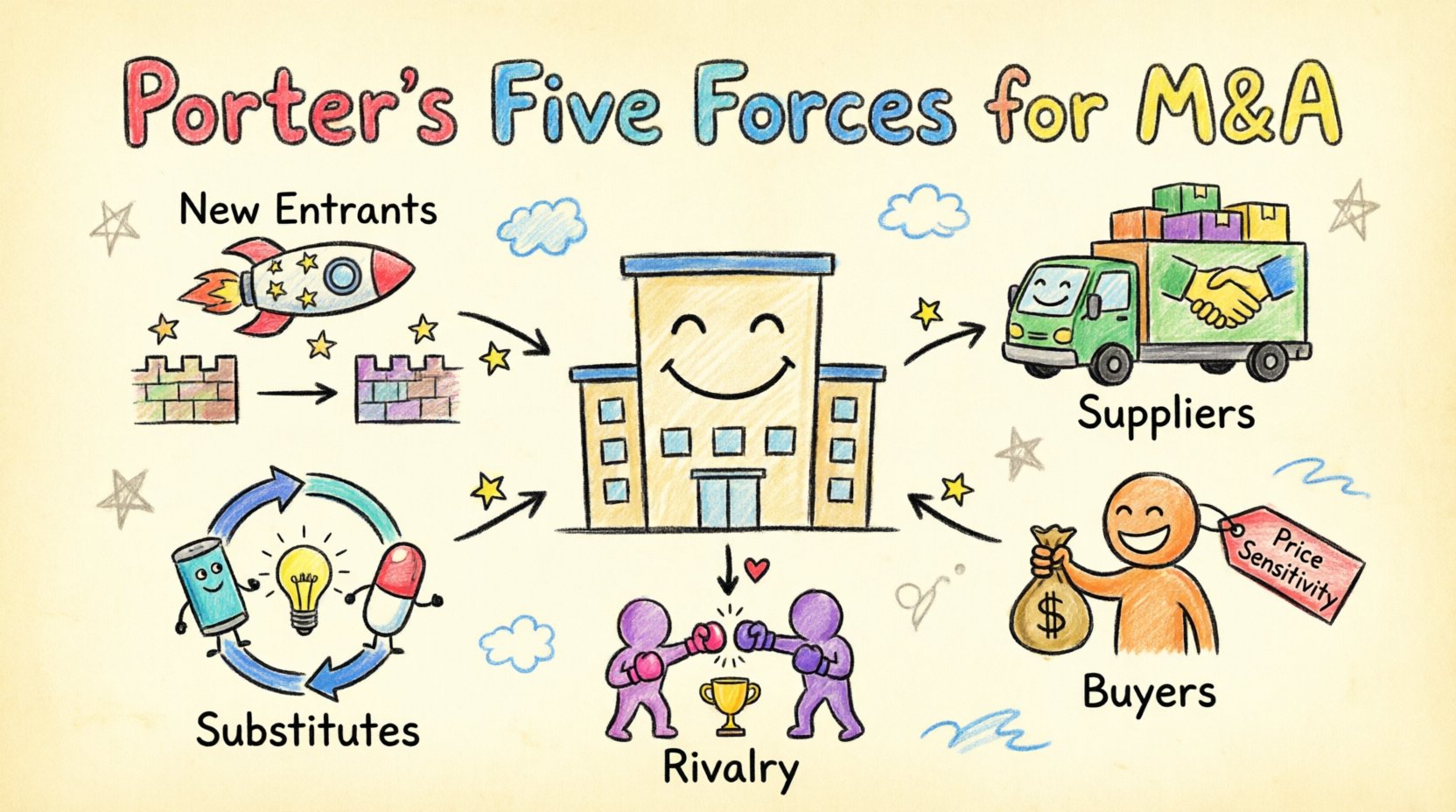
Why Industry Dynamics Matter in Mergers 🧩
Acquisition failures often stem from overestimating the strength of a target’s position. A company might show strong historical earnings, yet operate in an industry where profitability is eroding rapidly. Due diligence must therefore extend beyond the balance sheet to the external environment.
- Valuation Accuracy: Industry headwinds can justify lower multiples, while tailwinds support premium pricing.
- Risk Identification: High supplier power or buyer concentration creates operational fragility.
- Integration Planning: Understanding the competitive landscape helps align post-merger strategies.
- Longevity of Synergies: Synergies based on cost-cutting may vanish if market pressure increases.
Without a rigorous assessment of industry forces, an acquirer risks paying a premium for an asset that is structurally vulnerable. The framework helps quantify these qualitative risks.
The Framework Applied to Acquisition Strategy 🛡️
Michael Porter’s original framework was designed to analyze industry attractiveness. In M&A, the lens shifts slightly. The question is not just “Is this industry attractive?” but “Is this target’s position within the industry defensible?” and “How will the merger alter these forces?”
Applying the model requires gathering specific data points. It involves talking to customers, suppliers, and industry experts. It also requires analyzing historical trends to see if the forces are static or evolving.
1. Threat of New Entrants 🚀
This force examines the ease with which new competitors can enter the market. High barriers to entry generally protect incumbent margins. In due diligence, the acquirer must assess if the target’s moat is widening or narrowing.
Key Indicators to Investigate
- Capital Requirements: Does the industry require massive upfront investment? High capital intensity deters new players.
- Regulatory Hurdles: Are there licenses, patents, or compliance standards that block entry?
- Switching Costs: How difficult is it for a customer to move from the target to a new entrant?
- Distribution Access: Is the target’s channel of distribution exclusive or hard to replicate?
- Cost Advantages: Does the target have proprietary technology or economies of scale?
M&A Implications
If barriers to entry are low, the target’s market share is fragile. A new competitor could emerge and trigger a price war, eroding the EBITDA projections used for valuation. Conversely, if the target controls a critical patent or regulatory license, this provides a defensive moat that justifies a higher purchase price.
Acquirers should also consider if the merger itself lowers barriers for others. For example, combining two mid-sized players might create a giant that attracts regulatory scrutiny, or conversely, creates a dominant entity that scares off entrants.
2. Bargaining Power of Suppliers 📦
Supplier power dictates the cost structure of the business. If suppliers can raise prices or reduce quality without losing customers, the target’s margins are at risk. This is critical for understanding cost-of-goods-sold (COGS) stability.
Assessment Criteria
- Supplier Concentration: How many suppliers dominate the market? If the target relies on a single vendor, risk is high.
- Switching Costs: Does the target need to retool machinery or retrain staff to change suppliers?
- Forward Integration: Can the supplier threaten to become a competitor directly?
- Criticality of Input: Is the supplied component unique or a commodity?
- Price Sensitivity: How much does the supplier’s price change affect the target’s final product price?
M&A Implications
High supplier power often signals a need for vertical integration in the deal strategy. An acquirer might consider buying a supplier to secure margins. Alternatively, if the target has diversified its supply chain, this reduces operational risk.
During due diligence, review supply contracts. Are there volume guarantees? Are there price escalation clauses? Long-term contracts can lock in favorable rates, acting as a buffer against inflation. Short-term contracts leave the target exposed to market volatility.
3. Bargaining Power of Buyers 💰
Buyer power is the ability of customers to drive prices down or demand higher quality. In many industries, this force is the primary driver of margin compression. For the acquirer, this determines revenue predictability.
Assessment Criteria
- Customer Concentration: Does the target derive significant revenue from a few large clients? This creates dependency risk.
- Product Differentiation: Is the target’s offering unique, or can customers easily find a substitute?
- Price Sensitivity: How elastic is demand regarding price changes?
- Threat of Backward Integration: Can the customers start manufacturing the product themselves?
- Information Availability: Do customers have perfect information about costs and alternatives?
M&A Implications
High buyer power requires a strategy focused on brand loyalty or switching costs. If the target relies on a few key accounts, the deal carries a significant concentration risk. Due diligence must include churn analysis and contract renewal probability.
If the target serves fragmented customers (e.g., small businesses), buyer power is lower, providing more pricing flexibility. However, this often comes with higher sales and marketing costs. The acquirer must weigh the margin potential against the cost of acquiring customers.
4. Threat of Substitute Products 🔄
Substitutes are products from other industries that fulfill the same need. This is often the most overlooked force in traditional analysis but is critical in tech and consumer sectors. A substitute can cap the price ceiling regardless of the target’s efficiency.
Assessment Criteria
- Price-Performance Ratio: Is the substitute cheaper and good enough?
- Switching Costs: How much effort does it take for a user to adopt the substitute?
- Technological Disruption: Is there a new technology rendering the current solution obsolete?
- Consumer Trends: Are preferences shifting towards alternative solutions?
M&A Implications
A high threat of substitution suggests a need for heavy R&D investment to maintain relevance. If the target is lagging in innovation, the acquisition may be a mistake. The acquirer must assess the R&D pipeline of the target.
For example, a traditional hardware company might face substitution from a cloud-based software service. In this scenario, the acquirer needs to understand if the target has a migration strategy. Valuation multiples should be discounted if the threat of substitution is rising rapidly.
5. Rivalry Among Existing Competitors 🥊
This force looks at the intensity of competition. High rivalry leads to price wars, aggressive marketing, and innovation races, all of which eat into profitability. It is the most direct indicator of current market health.
Assessment Criteria
- Number of Competitors: Is the market fragmented or consolidated?
- Industry Growth Rate: In a stagnant market, firms fight for share aggressively.
- Exit Barriers: Are costs high to leave the industry? High exit barriers keep struggling firms in the market, sustaining rivalry.
- Product Homogeneity: Are products commoditized?
- Capacity Expansion: Is the industry over-capacitated?
M&A Implications
In highly competitive industries, M&A is often pursued to achieve scale and reduce rivalry. However, if the target is already in a price war, the acquirer inherits that margin pressure. Due diligence should analyze competitor pricing trends over the last 3-5 years.
Consolidation can reduce rivalry. If the acquirer and target are the only two major players, the merger might reduce competition significantly, leading to regulatory scrutiny. The acquirer must balance efficiency gains with antitrust risks.
Integrating Findings into Valuation Models 📉
The qualitative insights from the Five Forces analysis must translate into quantitative adjustments in the valuation model. Here is how each force influences the financial assumptions:
- Discount Rate: High industry risk (e.g., high rivalry or substitution) warrants a higher cost of equity.
- Revenue Growth: Low barriers to entry might require conservative growth assumptions.
- EBITDA Margins: High supplier power suggests a cap on margin expansion.
- Capital Expenditures: High rivalry often requires higher capex to maintain competitiveness.
By stress-testing the valuation against these industry forces, the acquirer creates a more robust financial model. This protects against overpaying based on optimistic, static assumptions.
Risk Assessment Matrix 📋
To visualize the impact of each force on the deal, a risk matrix can be created during the diligence phase. This helps prioritize which risks require mitigation strategies or price adjustments.
| Force | Intensity Level (1-5) | Impact on Margin | Mitigation Strategy |
|---|---|---|---|
| Threat of New Entrants | 2 | Low | Leverage existing IP portfolio |
| Bargaining Power of Suppliers | 4 | High | Negotiate long-term contracts or integrate vertically |
| Bargaining Power of Buyers | 3 | Medium | Diversify customer base |
| Threat of Substitutes | 2 | Low | Monitor tech trends closely |
| Rivalry Among Competitors | 5 | High | Focus on differentiation and cost leadership |
Note: Scoring is subjective based on industry analysis. 1 indicates low threat, 5 indicates high threat.
Strategic Recommendations 📝
Once the analysis is complete, the findings should guide the final decision. Here are actionable steps to take based on the assessment:
- Adjust Offer Price: If industry dynamics are deteriorating, lower the purchase price to reflect the increased risk premium.
- Structure the Deal: Use earn-outs if future performance depends on maintaining market share in a competitive environment.
- Plan Integration Carefully: Identify which synergies are realistic given the competitive pressure. Do not count on cost savings that require market price increases.
- Monitor KPIs Post-Close: Track industry-specific metrics (e.g., market share, pricing trends) to ensure the thesis holds true.
- Engage Experts: Use industry consultants to validate the assessment of forces, as internal teams may lack external perspective.
Applying Porter’s Five Forces in M&A due diligence transforms the process from a financial exercise into a strategic evaluation. It forces the acquirer to look outward, understanding the ecosystem in which the target operates. This perspective is crucial for avoiding value destruction and ensuring that the acquisition creates genuine, sustainable value.
By systematically evaluating these forces, investors gain the confidence to proceed with a deal or walk away from a risky proposition. The goal is not just to buy a company, but to buy a viable business that can withstand the pressures of its industry for years to come.
Final Thoughts on Industry Analysis 📊
The landscape of competition is never static. New technologies emerge, regulations change, and consumer behaviors shift. Therefore, the Five Forces analysis should not be a one-time check-box activity. It requires continuous monitoring.
For the M&A practitioner, the framework offers a structured way to ask the right questions. It highlights where the risks lie and where the opportunities for growth exist. When combined with rigorous financial analysis, it provides a complete picture of the target’s potential.
Remember that the strength of the acquirer also matters. A strong parent company might be able to withstand high supplier power or intense rivalry better than the target could alone. This synergistic potential is a key part of the valuation argument.
Ultimately, the success of an acquisition depends on the ability to navigate the industry dynamics. Porter’s Five Forces provides the map for that journey. By understanding the terrain, the acquirer can steer the merged entity toward profitability and long-term stability.
Related posts:
 Porter’s Five Forces Analysis: A Complete Framework Breakdown for Strategic Decision-Making
 How to Apply Porter’s Five Forces to Evaluate Industry Attractiveness and Profit Potential
 Porter’s Five Forces Explained: Key Concepts Every Business Leader Should Know
 Step-by-Step Guide to Conducting a Porter’s Five Forces Analysis from Scratch