


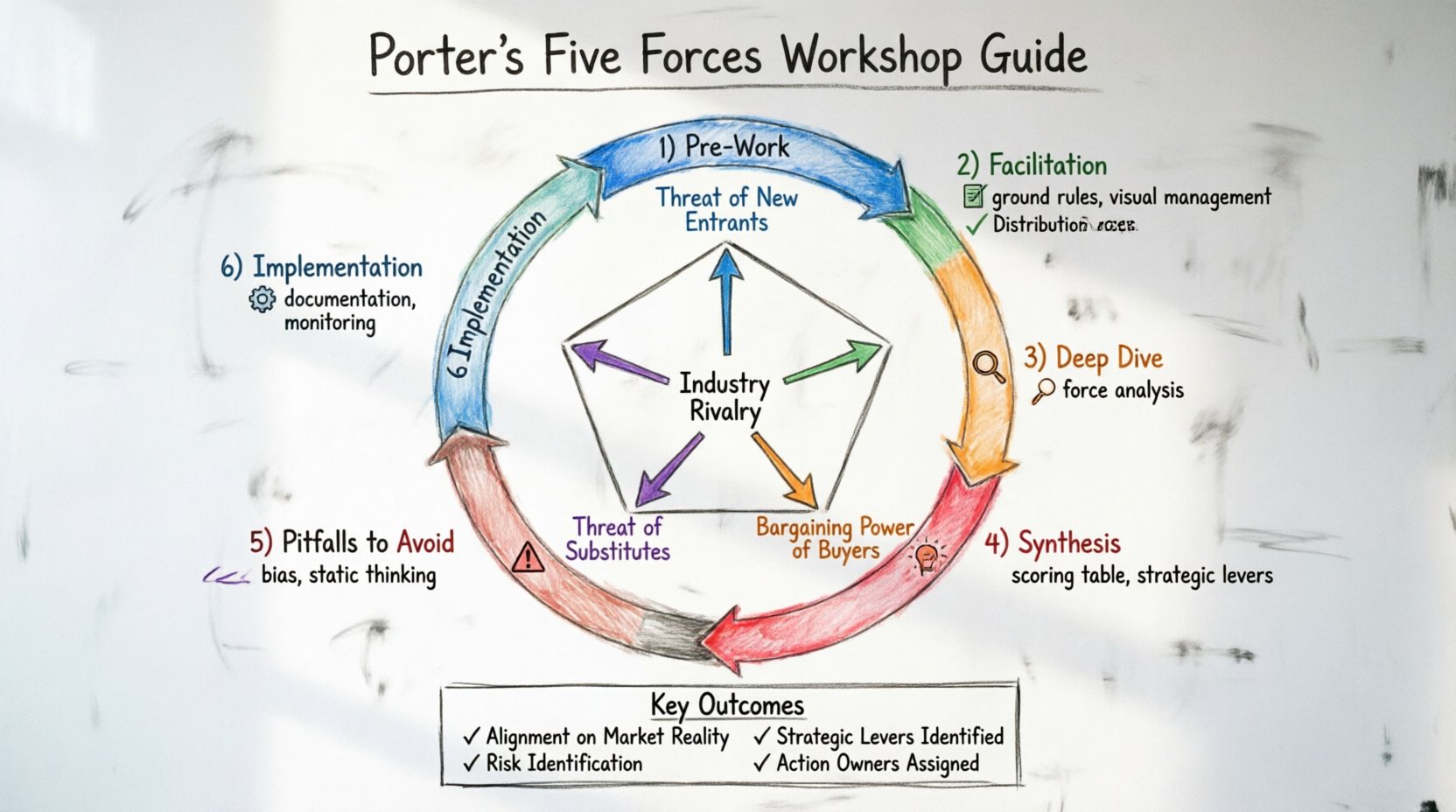
Strategic clarity does not emerge from spontaneous conversation. It is built through rigorous analysis and disciplined debate. For executive leadership teams, understanding the structural forces shaping an industry is not optional; it is the foundation of sustainable competitive advantage. This guide provides a structured approach to conducting a Porter’s Five Forces workshop, designed to extract actionable insights from senior stakeholders without relying on hype or generic frameworks.
Facilitating this session requires a specific methodology. You must navigate high-level perspectives, manage conflicting agendas, and ensure the analysis moves beyond theoretical models into practical application. The following sections outline the preparation, execution, and synthesis phases required to run an effective strategic session.
📋 Why This Workshop Matters for Leadership
Executives often operate within silos of functional expertise. Marketing leaders focus on demand, while operations leaders focus on efficiency. A Porter’s Five Forces analysis forces a convergence of these viewpoints onto a single canvas: the industry structure. This session serves several critical purposes:
- Alignment on Market Reality: It ensures the C-suite agrees on the fundamental economics of the business environment.
- Risk Identification: It surfaces external threats that might be invisible from a single departmental perspective.
- Opportunity Mapping: It highlights areas where the organization holds leverage over suppliers, buyers, or competitors.
- Resource Allocation: It informs where capital and talent should be invested to defend or capture value.
Without this shared context, strategic initiatives often fail because they address symptoms rather than structural conditions. This workshop establishes the baseline reality against which all future strategies are measured.
🛠️ Phase 1: Pre-Workshop Preparation
Success in a strategic session is determined before the meeting begins. The facilitator must curate the environment, gather the necessary data, and set clear expectations. Rushing into analysis without preparation leads to debates based on opinions rather than evidence.
1. Define the Scope and Boundaries
Porter’s framework is broad. Applying it to an entire conglomerate can dilute focus. The team must define the specific industry or market segment under review.
- Geographic Scope: Is this analysis global, regional, or local?
- Product Lines: Are we analyzing a specific division or the core business unit?
- Time Horizon: Is the focus on the current state or a projection for the next 3 to 5 years?
2. Data Collection Protocol
Executives bring intuition, but the workshop demands data. Assign pre-work to key participants to gather evidence for each of the five forces. This prevents the session from becoming a brainstorming exercise lacking grounding.
| Force Category | Key Data Points to Gather | Primary Sources |
|---|---|---|
| Supplier Power | Concentration ratios, switching costs, input cost trends | Procurement reports, vendor contracts, market research |
| Buyer Power | Price sensitivity, volume concentration, alternative options | Sales data, customer feedback, churn analysis |
| Threat of Substitution | Cross-industry alternatives, price-performance ratios | Competitive intelligence, trend analysis |
| Threat of New Entry | Barriers to entry, capital requirements, regulatory hurdles | Legal reviews, financial modeling, industry reports |
| Rivalry Among Existing Competitors | Market share, growth rates, capacity utilization | Financial statements, industry associations, sales intel |
3. Participant Selection
The room composition dictates the quality of the output. A workshop of 10 to 15 executives is ideal. Include:
- The CEO or Sponsor (for authority and decision-making).
- Heads of Strategy, Marketing, Sales, and Operations.
- Financial Leadership (for economic modeling).
- External Advisors (optional, to challenge internal bias).
🚀 Phase 2: Facilitation Mechanics
Running a session with senior leaders requires a balance of structure and flexibility. The facilitator must guide the conversation without dominating it. The goal is to surface disagreement, not suppress it. Conflict in this context is valuable; it indicates a deeper understanding of the complexities.
1. Setting the Stage
Begin by reviewing the objective. Reiterate that the goal is not to assign blame but to understand the economic structure. Establish ground rules:
- Focus on Facts: Opinions must be backed by data collected in the pre-work phase.
- One Conversation: Allow one person to speak at a time to ensure all voices are heard.
- Timeboxing: Allocate specific durations for each force to prevent one area from consuming the entire session.
2. Visual Management
Use physical or digital whiteboards to capture the analysis in real-time. Visualizing the forces helps the team see relationships and gaps in logic. Avoid using complex software features; simplicity ensures focus remains on the content.
- Draw the industry structure clearly.
- Use different colored markers for different types of insights (e.g., threats vs. opportunities).
- Place evidence directly next to the claims being made.
3. Managing Group Dynamics
Executive teams often face power dynamics. Seniority can stifle dissent. The facilitator must actively invite input from those who might remain silent.
- Round-Robin Checks: Ask each participant to contribute one insight per force before opening the floor.
- Devil’s Advocate: Assign a role to someone to challenge the consensus on specific points.
- Breakout Groups: If the group is large, split into smaller teams to analyze specific forces, then reconvene to share findings.
🔍 Phase 3: Deep Dive into the Five Forces
Each force requires a specific line of questioning. The analysis must be quantitative where possible and qualitative where data is scarce. Below is a detailed breakdown of how to facilitate the discussion for each component.
1. Threat of New Entrants 🚪
How easy is it for a competitor to enter the market and gain traction? This force determines the long-term stability of industry profits.
- Capital Requirements: Does starting this business require massive investment?
- Regulatory Barriers: Are there licenses, patents, or compliance standards that block access?
- Access to Distribution: Can a new player reach customers as easily as incumbents?
- Switching Costs: Is it difficult for customers to move to a new provider?
Workshop Output: Rate the threat as High, Medium, or Low. Identify specific barriers the company can strengthen to protect its position.
2. Bargaining Power of Suppliers 🏭
Can suppliers dictate prices or terms? High supplier power erodes profitability by increasing input costs.
- Supplier Concentration: Are there few suppliers for critical inputs?
- Uniqueness of Input: Is the supply differentiated or commoditized?
- Threat of Forward Integration: Can suppliers bypass the company and sell directly to customers?
- Switching Costs: How expensive is it to change vendors?
Workshop Output: Determine if the company is vulnerable to price hikes. Discuss strategies like vertical integration or supplier diversification.
3. Bargaining Power of Buyers 🛒
Can customers force prices down or demand better quality? High buyer power limits the ability to raise prices.
- Volume Concentration: Do a few customers control a large share of revenue?
- Price Sensitivity: Are customers looking for the cheapest option or the best value?
- Availability of Alternatives: Can customers easily find substitutes?
- Threat of Backward Integration: Can customers make the product themselves?
Workshop Output: Assess the risk of margin compression. Identify opportunities to increase switching costs for clients.
4. Threat of Substitute Products or Services 🔄
Are there solutions outside the industry that solve the same customer problem? Substitutes often cap the price ceiling.
- Performance vs. Price: Do substitutes offer better value?
- Customer Habit: How entrenched is the current behavior?
- Technological Shifts: Is innovation creating new ways to solve the problem?
Workshop Output: Map out cross-industry competitors. Discuss how to differentiate the core offering from functional alternatives.
5. Rivalry Among Existing Competitors 🥊
How intense is the competition for market share? High rivalry leads to price wars and reduced profitability.
- Number of Competitors: Is the market fragmented or consolidated?
- Industry Growth: Is the market growing slowly, forcing a fight for share?
- Product Differentiation: Are products commoditized?
- Exit Barriers: Is it hard for competitors to leave the market, keeping supply high?
Workshop Output: Define the competitive posture. Decide whether to compete on cost, differentiation, or niche focus.
🧩 Phase 4: Synthesizing Findings
Completing the analysis is only half the work. The team must synthesize the data to form a coherent strategic narrative. This phase transforms the static model into a dynamic roadmap.
1. Scoring the Industry Attractiveness
Assign a weighted score to the overall industry environment. This helps prioritize strategic initiatives based on where the structural pressures are highest.
| Force | Impact Score (1-5) | Company Vulnerability (1-5) | Priority Action |
|---|---|---|---|
| New Entrants | 3 | 2 | Strengthen IP portfolio |
| Supplier Power | 4 | 4 | Develop alternative sourcing |
| Buyer Power | 5 | 3 | Enhance customer loyalty program |
| Substitutes | 2 | 1 | Monitor closely |
| Rivalry | 4 | 3 | Optimize operational efficiency |
2. Identifying Strategic Levers
Based on the scores, identify where the company can exert control. Strategy is about making choices where others cannot.
- Cost Advantage: Can we reduce costs faster than competitors if rivalry increases?
- Differentiation: Can we create unique value that reduces buyer power?
- Niche Focus: Is there a segment where the five forces are weaker?
3. Scenario Planning
Discuss how the forces might change over the next three years. Develop scenarios for:
- Best Case: Forces weaken, allowing for margin expansion.
- Worst Case: Forces intensify, requiring defensive measures.
- Disruption: A new entrant or technology shifts the landscape entirely.
⚠️ Phase 5: Common Pitfalls to Avoid
Even well-intentioned workshops can veer off course. Awareness of common traps ensures the session remains productive.
1. Internal Bias
Teams often assume their competitors are weaker than they are. They may underestimate the agility of new entrants or the loyalty of their customers. Challenge these assumptions with hard data.
2. Static Analysis
Industry structures are not static. A workshop that only looks at the current state misses future risks. Ensure the conversation includes trends and trajectory.
3. Lack of Ownership
Analysis without action is academic. Assign specific owners to the recommendations generated. If a vulnerability is identified, a mitigation plan must follow immediately.
4. Over-Reliance on Consensus
Seeking agreement too quickly can suppress valid dissent. Encourage debate on the scoring of forces. Disagreement on the intensity of rivalry often leads to better strategic clarity.
📈 Phase 6: Post-Workshop Implementation
The value of the session is realized only after the room disperses. A clear follow-up plan is essential to maintain momentum.
1. Documentation and Distribution
Create a formal record of the findings. This document serves as a reference point for future decision-making. Ensure it is accessible to all relevant stakeholders.
- Summarize the scoring of each force.
- List the agreed-upon strategic priorities.
- Record any unresolved debates for future review.
2. Integration with Planning Cycles
Link the output of this workshop to the annual budgeting and strategic planning processes. The insights should directly influence resource allocation decisions.
- Update the strategic roadmap based on the analysis.
- Adjust KPIs to reflect the new focus areas.
- Set review milestones to monitor changes in the industry forces.
3. Continuous Monitoring
Establish a mechanism to track the five forces over time. Assign a team or individual to monitor specific indicators (e.g., supplier pricing, competitor marketing spend) on a quarterly basis.
🔑 Key Takeaways for Facilitators
Facilitating a strategic session with executive teams is a high-stakes activity. The facilitator must remain neutral while driving the group toward clarity. Remember these core principles:
- Preparation is 80% of the work. Ensure data is gathered before the meeting.
- Structure enables freedom. The framework provides the boundaries within which creativity can operate safely.
- Conflict is data. Disagreements highlight areas where the team lacks information or alignment.
- Action follows insight. Never end a workshop without assigning next steps.
By adhering to this guide, organizations can transform a theoretical model into a practical tool for decision-making. The Porter’s Five Forces analysis, when executed with rigor, provides a durable lens for viewing the competitive landscape. It shifts the conversation from reactive problem-solving to proactive strategic positioning.
Ultimately, the goal is not just to complete the analysis but to build a shared language for strategy. When executives can discuss supplier power or buyer leverage with a common understanding of the data, the organization becomes more agile and resilient. This workshop is the catalyst for that alignment.
Related posts:
 Porter’s Five Forces Analysis: A Complete Framework Breakdown for Strategic Decision-Making
 How to Apply Porter’s Five Forces to Evaluate Industry Attractiveness and Profit Potential
 Porter’s Five Forces Explained: Key Concepts Every Business Leader Should Know
 Step-by-Step Guide to Conducting a Porter’s Five Forces Analysis from Scratch