


Entering a new market is a high-stakes endeavor. For founders, the difference between success and failure often lies in understanding the competitive landscape before launching. Traditional intuition is rarely enough. A structured analytical framework provides clarity amidst uncertainty.
Porter’s Five Forces offers a robust method to evaluate the attractiveness and profitability of an industry. By applying this model to your market entry strategy, you gain insight into the structural forces that determine long-term viability. This guide details how to dissect these forces and translate findings into actionable startup decisions.
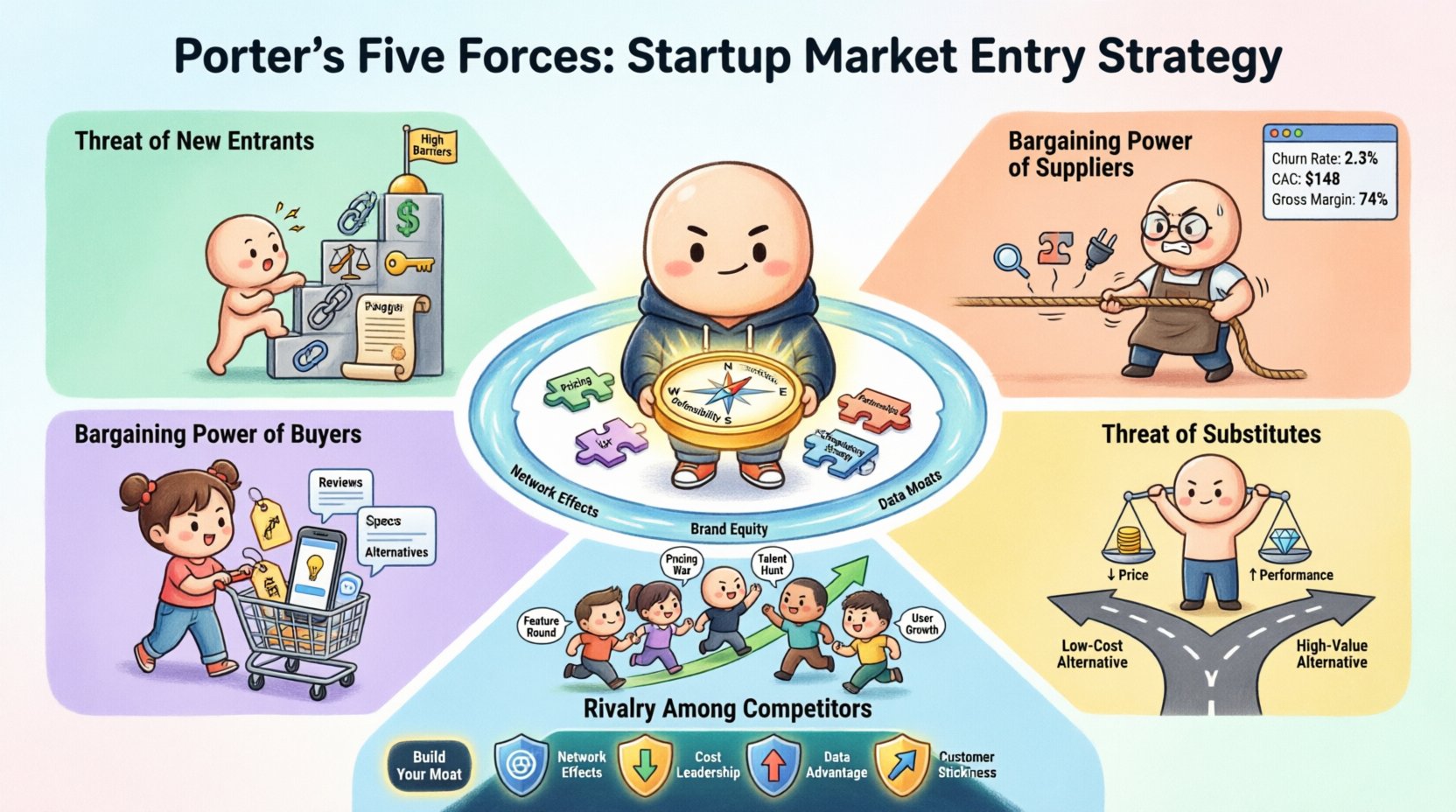
🧠 Understanding the Five Forces Framework
Developed by Michael Porter, this framework identifies five key factors that shape industry competition. It moves beyond simple competitor analysis to examine the underlying economics of the market. For a startup, this means understanding where power lies and where risks hide.
- Threat of New Entrants: How easy is it for others to copy your model?
- Bargaining Power of Suppliers: Do vendors control your costs?
- Bargaining Power of Buyers: Can customers drive prices down?
- Threat of Substitute Products: Are there alternative solutions to your problem?
- Rivalry Among Existing Competitors: How intense is the current competition?
When entering a market, founders must assess each force to determine if the industry offers sufficient margins to sustain growth. A high intensity in multiple areas suggests a difficult entry. Conversely, structural weaknesses in competitors can present opportunities.
🛡️ 1. Threat of New Entrants
This force measures how easily new competitors can enter the market. If barriers are low, incumbents face constant pressure. For startups, this is a double-edged sword. It means you can enter easily, but others can follow you just as fast.
Key Barriers to Entry
Founders should analyze specific obstacles that protect existing players. These typically include:
- Capital Requirements: Does the industry need heavy investment in infrastructure?
- Regulatory Hurdles: Are there licenses or compliance standards to meet?
- Access to Distribution: Do incumbents control the channels to customers?
- Switching Costs: How hard is it for customers to leave an existing provider?
- Proprietary Technology: Are there patents or trade secrets involved?
If barriers are low, your strategy must focus on speed and brand differentiation. You cannot rely solely on product features if replication is cheap. You must build community and ecosystem lock-in early.
🤝 2. Bargaining Power of Suppliers
Suppliers exert power when they can raise prices or reduce quality without losing business. In a startup context, this often relates to talent, raw materials, or platform dependencies.
Assessing Supplier Dynamics
Use the following criteria to evaluate supplier power:
- Concentration: Are there few suppliers or many?
- Uniqueness of Input: Is the input specialized or commoditized?
- Threat of Forward Integration: Could the supplier become a competitor?
- Switching Costs: Is it expensive to change vendors?
| Factor | High Supplier Power | Low Supplier Power |
|---|---|---|
| Market Concentration | Few dominant vendors | Many small vendors |
| Product Differentiation | Unique or proprietary | Standardized commodity |
| Switching Costs | High technical debt | Easy to migrate |
Founders often overlook this force until a crisis hits. For example, relying on a single cloud provider or a specific API can create vulnerability. Diversifying supply chains early mitigates risk. Negotiating long-term contracts can also stabilize unit economics before scaling.
💰 3. Bargaining Power of Buyers
Buyers are customers. Their power lies in their ability to demand lower prices or higher quality. In saturated markets, buyers hold the most leverage. Startups must understand how much control their customers have.
Indicators of Buyer Power
- Concentration of Buyers: Do a few customers buy most of your product?
- Price Sensitivity: Is the product a large part of their budget?
- Availability of Information: Do customers know exactly what they are paying for?
- Threat of Backward Integration: Could customers build the solution themselves?
High buyer power squeezes margins. To counter this, startups should focus on differentiation. If your solution is unique, customers cannot easily switch. Building strong relationships and embedding your product into their workflow increases switching costs for them.
Consider the volume of your target market. If you are selling to enterprise clients, they often have more power than individual consumers. Adjust your pricing model accordingly. Subscription models work well when you can prove continuous value over time.
🔄 4. Threat of Substitute Products
Substitutes are not direct competitors. They solve the same problem using a different method. For example, a video conferencing tool is a substitute for business travel. This force is often underestimated by founders.
Identifying Substitutes
Look beyond your immediate industry. Ask what else customers do to solve their pain point.
- Price-Performance Trade-off: Are substitutes cheaper or better?
- Switching Incentive: Do customers have a reason to try alternatives?
- Buyer Propensity: Are customers already using a workaround?
Many startups fail because they focus on beating competitors while ignoring substitutes. If your product is expensive, a spreadsheet or a manual process might be a cheaper substitute. Address this by proving your ROI clearly. Show that the cost of the problem is higher than the cost of your solution.
⚔️ 5. Rivalry Among Existing Competitors
This is the most obvious force. It measures the intensity of competition. High rivalry leads to price wars and increased marketing costs. For a new entrant, this is the primary obstacle.
Drivers of Competitive Intensity
- Number of Competitors: Is the market fragmented or consolidated?
- Industry Growth Rate: Is the pie growing or static?
- Product Similarity: Are offerings commoditized?
- Exit Barriers: Is it hard to leave the market?
In a slow-growth market, competition is fierce. Everyone fights for the same share. In a fast-growth market, companies can coexist. If the market is crowded, do not compete on price. Compete on service, niche focus, or innovation.
📊 Integrating Analysis into Market Entry Strategy
Analysis is useless without action. Once you have scored each force, you must translate this into a strategic plan. Here is how to apply the findings.
Step 1: Validate Market Attractiveness
Combine the scores of all five forces. If three forces are “High” or “Very High,” the market may be unprofitable. You might need to pivot or target a niche segment where forces are weaker. For instance, the enterprise market might have high buyer power, but the SMB market might have low switching costs.
Step 2: Identify Strategic Levers
Use the analysis to find where you have leverage. If supplier power is high, look for open-source alternatives. If buyer power is high, focus on brand loyalty. If rivalry is high, find an underserved segment.
Step 3: Design Your Moat
Your moat protects your business from these forces. Examples include:
- Network Effects: The product gets better as more people use it.
- Cost Leadership: You can operate cheaper than anyone else.
- Data Advantage: You have unique data that others cannot access.
- Customer Stickiness: High switching costs for users.
🛠️ Practical Application: A Scenario
Imagine a startup launching a project management tool for construction firms.
- Rivalry: High. Many general tools exist. Strategy: Focus specifically on construction compliance features.
- Buyers: Moderate. Construction managers have budgets but need efficiency. Strategy: Offer free trials to prove value.
- Suppliers: Low. Cloud infrastructure is commoditized. Strategy: Focus on integration capabilities.
- Substitutes: High. Spreadsheets and whiteboards are common. Strategy: Show time-saving metrics.
- New Entrants: Moderate. Tech skills are available. Strategy: Build industry relationships early.
This specific analysis guides product development and sales pitches. It prevents building features that don’t matter to the specific market forces at play.
⚠️ Common Pitfalls in Analysis
Even experienced founders make mistakes when using this framework. Avoid these common traps.
- Static Analysis: Markets change. Revisit your analysis every quarter.
- Ignoring Global Trends: Local forces might shift due to global supply chains.
- Focusing Only on Direct Competitors: This ignores the substitute force.
- Overestimating Your Own Strength: Be honest about your resources. A weak startup in a tough market will struggle.
- Skipping Customer Validation: Data is good, but talking to users is better.
📈 Measuring Success Post-Entry
After entering the market, track how the forces evolve. Did your entry change the rivalry? Did you successfully lower buyer power through loyalty programs? Monitoring these metrics helps you adapt.
Set key performance indicators (KPIs) related to each force:
- Churn Rate: Reflects buyer power and switching costs.
- CAC (Customer Acquisition Cost): Reflects rivalry and marketing pressure.
- Gross Margin: Reflects supplier power and pricing ability.
- Market Share Growth: Reflects overall market attractiveness.
🔍 Deep Dive: Rivalry Dynamics
Rivalry is often the most visible force. It manifests in price wars, marketing spend, and feature copying. For startups, direct confrontation is usually a losing battle against incumbents with more capital.
Strategies to Manage Rivalry:
- Blue Ocean Strategy: Create a new market space where competition is irrelevant.
- Niche Dominance: Serve a small segment so well that large players ignore you.
- Innovation Speed: Move faster than established players can react.
- Partnerships: Ally with other companies to share resources.
When rivalry is high, marketing becomes expensive. You must ensure your retention rates are high enough to offset acquisition costs. If customers leave quickly, you are burning money to fight competitors.
🔍 Deep Dive: Substitutes and Innovation
Substitutes are often invisible until they disrupt the market. The rise of streaming services was not just about competing with cable; it was about competing with sleep, gaming, and social media.
Founders must constantly scan for alternatives. Is your product becoming obsolete because technology changes? Are customers finding cheaper ways to achieve the same outcome?
- Monitor Tech Trends: AI and automation often create new substitutes.
- Customer Feedback: Ask users what they used before your solution.
- Value Proposition: Ensure your value is emotional or strategic, not just functional.
🔍 Deep Dive: Supplier Negotiations
Supplier power affects your bottom line directly. In the early stages, cash flow is king. If suppliers demand payment terms that hurt liquidity, you risk failure.
Negotiation Tactics:
- Volume Commitments: Promise future volume in exchange for current discounts.
- Alternative Sourcing: Always have a backup vendor ready.
- Vertical Integration: Consider building parts of your supply chain yourself if it becomes too costly.
🔍 Deep Dive: Buyer Expectations
Buyer power has increased significantly with the internet. Customers compare prices instantly. They expect transparency and speed.
Reducing Buyer Leverage:
- Personalization: Tailor the experience to specific user needs.
- Community: Create a user base that values connection over price.
- Service Levels: Offer support that competitors cannot match.
When buyers have power, you must reduce their risk. Offer guarantees, free trials, or money-back policies. This reduces the friction of buying.
🔍 Deep Dive: New Entrants and Barriers
Low barriers mean you must innovate constantly. If you stop moving, someone will copy you. High barriers can be a safety net, allowing you to build slower.
Building Barriers:
- Patents: Protect core technology legally.
- Brand: Invest in reputation so trust is high.
- Scale: Use volume to lower costs.
📝 Final Considerations
Porter’s Five Forces is not a crystal ball. It is a map. It shows the terrain, but you still have to walk the path. The goal is not to eliminate risk but to understand it.
Founders who take the time to analyze these forces make better decisions. They allocate capital wisely. They avoid industries with structural headwinds. They find gaps in the market where they can win.
Remember that this analysis is dynamic. Markets shift. Regulations change. Competitors adapt. Treat this framework as a living document. Review it regularly as your startup grows.
By grounding your market entry strategy in this analysis, you move from guessing to planning. You build a foundation that can withstand competitive pressure. This disciplined approach increases the odds of long-term survival in a volatile business environment.
Related posts:
 Porter’s Five Forces Analysis: A Complete Framework Breakdown for Strategic Decision-Making
 How to Apply Porter’s Five Forces to Evaluate Industry Attractiveness and Profit Potential
 Porter’s Five Forces Explained: Key Concepts Every Business Leader Should Know
 Step-by-Step Guide to Conducting a Porter’s Five Forces Analysis from Scratch