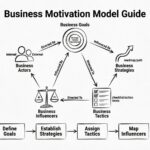


The Business Motivation Model (BMM) serves as a foundational framework for understanding the motivations behind business actions. It provides a standardized way to capture the why and what of an organization, distinct from the how which is typically covered by other modeling standards. Implementing this model requires a structured approach to align strategic intent with operational execution. This guide outlines the specific steps required to operationalize the BMM within your organization without relying on proprietary software tools.
By following these actionable steps, you can create a transparent link between high-level vision and day-to-day activities. The process involves defining purpose, setting measurable targets, mapping influences, and establishing rules that govern behavior. Each section below details the necessary actions, considerations, and outputs for a successful deployment.
Understanding the Business Motivation Model Framework 🧩
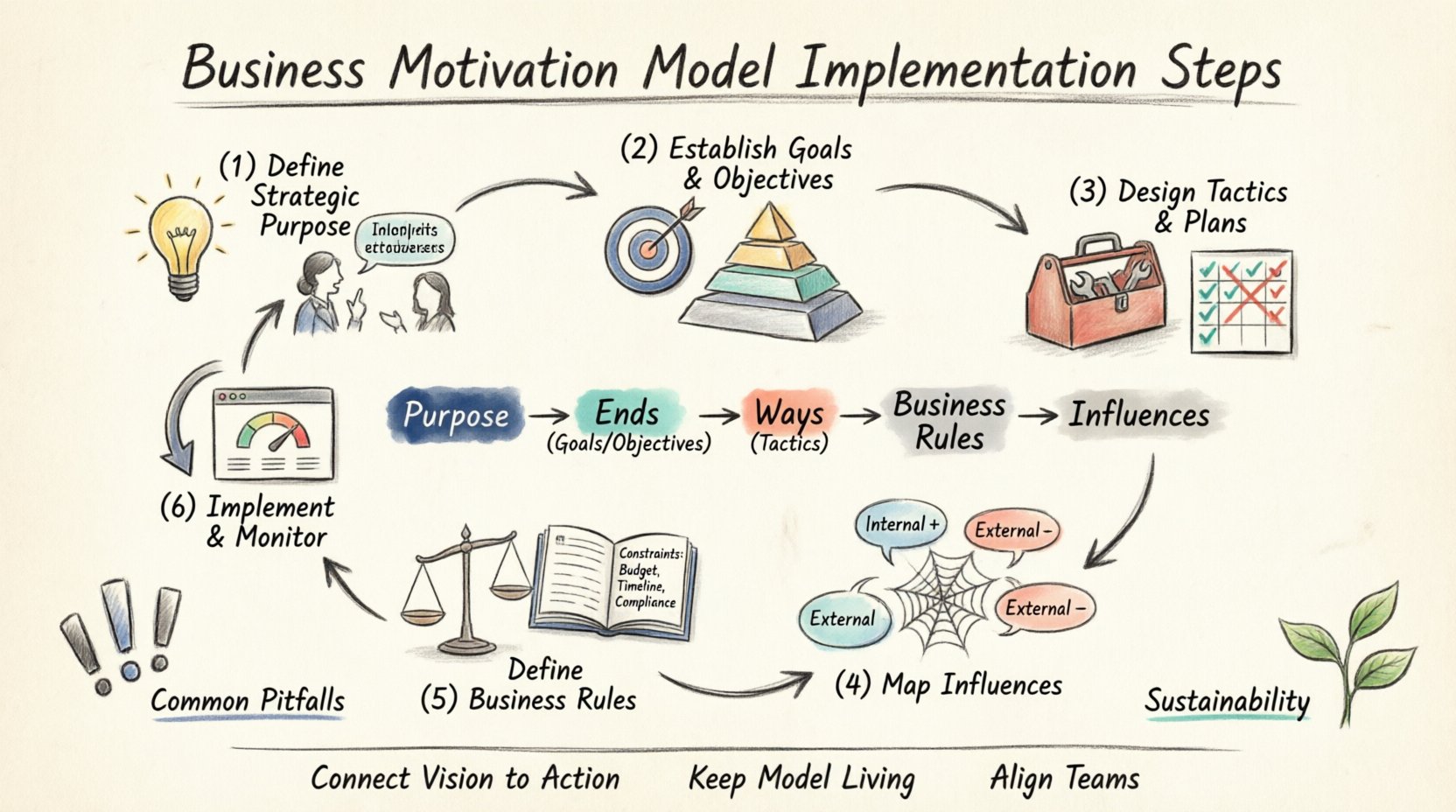
Before diving into implementation, it is essential to grasp the core elements of the Business Motivation Model. The model is not a software application but a conceptual schema designed to clarify relationships within a business. It connects the Purpose of the organization to the Ends it wishes to achieve and the Ways it plans to get there.
The following table outlines the primary categories and their definitions to ensure a common understanding across stakeholders.
Category | Definition | Example |
|---|---|---|
Purpose | The reason for the business entity’s existence. | Provide sustainable energy solutions. |
Ends (Goals/Objectives) | The desired outcomes the business seeks. | Reduce carbon footprint by 20%. |
Ways (Tactics) | The means taken to achieve the Ends. | Install solar panels on all roofs. |
Business Rules | Constraints or directives governing behavior. | All installations must meet safety code X. |
Influences | Factors that affect the success of Ends or Ways. | Government regulations on energy. |
Phase 1: Defining Strategic Purpose 🎯
The first actionable step is to articulate the Purpose. This is not merely a mission statement found on a website; it is the fundamental reason the organization exists. Without a clear purpose, subsequent modeling efforts lack direction.
Step 1.1: Conduct Stakeholder Interviews
Action: Engage with founders, executives, and key leadership.
Goal: Extract the core value proposition.
Output: A consensus statement on organizational purpose.
Step 1.2: Validate Against Market Reality
Action: Review current market positioning and customer feedback.
Goal: Ensure the purpose resonates with external stakeholders.
Output: A refined purpose statement.
It is critical to avoid vague language. The purpose must be specific enough to guide decision-making but broad enough to allow for flexibility. If the purpose changes frequently, the model will suffer from instability. Document this purpose in a central repository accessible to all planning teams.
Phase 2: Establishing Goals and Objectives 📋
Once the purpose is defined, the next step is to define the Ends. In the BMM context, Ends are divided into Goals and Objectives. Distinguishing between these two is a common area of confusion that must be resolved during implementation.
Step 2.1: Differentiate Goals from Objectives
Goals: These are qualitative statements of desired results. They describe the state of the world the organization wants to see.
Objectives: These are quantitative, measurable targets. They provide the specific metrics used to determine if a Goal has been met.
Step 2.2: Create a Hierarchical Structure
Not all Ends are created equal. You must organize them into a hierarchy:
Strategic Ends: High-level targets set by the board or executive team.
Tactical Ends: Targets set by department heads to support Strategic Ends.
Operational Ends: Specific targets for individual teams or processes.
Example:
Goal: Improve customer satisfaction.
Objective: Achieve a Net Promoter Score (NPS) of +50 by Q4.
Step 2.3: Assign Ownership
Every Goal and Objective must have an assigned owner. This ensures accountability. Use a simple tracking matrix to record:
End Name
Type (Goal or Objective)
Owner
Status
Phase 3: Designing Tactics and Plans 🛠️
Tactics represent the Ways the organization intends to achieve its Ends. While Ends describe the destination, Tactics describe the path. This phase focuses on translating abstract goals into concrete actions.
Step 3.1: Identify Potential Ways
For every major Objective, brainstorm a list of potential Tactics. Do not limit yourself initially. Use brainstorming sessions to generate a wide range of possibilities.
Example Objective: Increase online sales revenue by 15%.
Potential Tactics: Improve website SEO, launch a referral program, optimize checkout flow.
Step 3.2: Select and Prioritize
Resources are finite. You cannot pursue every potential Way. Evaluate each tactic based on:
Feasibility: Can we actually do this?
Impact: How much will this help achieve the Objective?
Cost: What are the resource requirements?
Step 3.3: Link Tactics to Ends
Create explicit links between the selected Tactics and the specific Objectives they support. This linkage is the backbone of the Business Motivation Model. If a tactic does not support an End, it should be questioned or discarded.
Phase 4: Mapping Influences and Dependencies 🕸️
Businesses do not operate in a vacuum. Influences are external or internal factors that affect the success of your Ends or Ways. Identifying these early allows for better risk management and contingency planning.
Step 4.1: Categorize Influences
Classify influences into two main types:
Internal Influences: Capabilities, culture, internal policies, resource availability.
External Influences: Market trends, regulatory changes, competitor actions, economic conditions.
Step 4.2: Determine Impact Direction
For each influence, determine if it is positive or negative regarding the specific End or Way.
Positive Influence: A factor that helps achieve the goal (e.g., a new tax incentive).
Negative Influence: A factor that hinders the goal (e.g., a new compliance requirement).
Step 4.3: Document Relationships
Use a relationship matrix to map influences to specific Ends or Ways. This visualization helps teams understand the context of their work. If a critical negative influence is identified, you may need to adjust the Tactics or even the Objective.
Phase 5: Defining Business Rules and Constraints ⚖️
Business Rules are the constraints that govern the behavior of the business. They dictate what is allowed, what is required, and what is forbidden. Unlike Tactics, Rules are not actions; they are boundaries within which actions must occur.
Step 5.1: Inventory Existing Rules
Conduct an audit of current policies, regulations, and standards. Often, organizations have rules that are undocumented or siloed within specific departments.
Compliance Rules: Legal and regulatory requirements.
Operational Rules: Internal policies for efficiency or quality.
Strategic Rules: Guidelines that define the scope of business activities.
Step 5.2: Formalize Rule Definitions
Write rules in clear, unambiguous language. Avoid jargon. A rule should be testable. For example, instead of “Employees should be polite,” use “Customer interactions must follow the communication protocol outlined in Section 4.”
Step 5.3: Link Rules to Processes
Identify which specific Tactics or Processes are governed by which Rules. This ensures that when a rule changes, you know which parts of the model are affected. This linkage is crucial for change management.
Phase 6: Implementation and Monitoring 📊
Creating the model is only the first step. The value of the Business Motivation Model lies in its use for ongoing management. This phase focuses on integrating the model into daily operations.
Step 6.1: Integrate with Reporting Cycles
Align your reporting cycles with the objectives set in the model. If an Objective is quarterly, the report on that Objective should be generated quarterly. This ensures the data is relevant when decisions are made.
Step 6.2: Establish Review Cadence
Set a regular schedule to review the BMM. Business conditions change, and the model must evolve. A quarterly review session is recommended to:
Check progress on Objectives.
Assess the validity of Influences.
Update Tactics if necessary.
Step 6.3: Communicate Changes
When the model changes, communicate this to all stakeholders. If a Goal is retired or a new Objective is added, everyone affected must know. Transparency maintains trust and alignment.
Common Pitfalls to Avoid ⚠️
Even with a solid plan, implementation challenges arise. Be aware of these common issues to navigate them successfully.
Pitfall 1: Over-Complexity
Do not attempt to model every single detail of the business immediately. Start with the high-level Purpose and top-tier Ends. Expand the model gradually as the organization becomes comfortable with the framework. A complex model that no one uses is worse than a simple one that guides decisions.
Pitfall 2: Lack of Stakeholder Buy-In
If the team building the model is not the team executing it, the model will likely fail. Involve operational leaders in the definition of Tactics and Objectives. Their input ensures the model reflects reality.
Pitfall 3: Static Documentation
Treating the BMM as a document to be filed away is a mistake. It must be a living artifact. If it does not change when the business changes, it becomes obsolete quickly.
Pitfall 4: Ignoring Negative Influences
It is tempting to focus only on positive factors. However, identifying risks (negative influences) is often more valuable for risk mitigation. Ensure negative influences are highlighted and addressed in the planning phase.
Ensuring Long-Term Sustainability 🌱
To maintain the integrity of the Business Motivation Model over time, you must embed it into the organizational culture. This involves training and continuous improvement.
Step 7.1: Training and Onboarding
Include the BMM framework in the onboarding process for new managers. They should understand the difference between Goals, Objectives, and Tactics from day one. This creates a shared language across the organization.
Step 7.2: Audit and Refine
Periodically audit the model structure. Are there dangling elements? Are there links that no longer make sense? Clean up the model to keep it relevant and accurate.
Step 7.3: Reward Alignment
Link performance incentives to the Objectives defined in the model. When employees see that their rewards are tied to the strategic Ends they are working towards, motivation increases naturally.
Conclusion on Effective BMM Adoption
Implementing the Business Motivation Model is a journey of clarity and alignment. It requires discipline to define purpose, precision to set objectives, and honesty to map influences. By following these steps, organizations can create a robust framework that connects vision to action.
The model does not guarantee success on its own, but it provides the necessary structure to understand the drivers of success. It helps leaders see the connections between their high-level strategies and the daily tasks performed by their teams. When the model is kept current and used actively, it becomes a powerful tool for decision-making and strategic planning.
Start small, focus on the core elements, and expand as the benefits become evident. The goal is not perfection, but clarity. With a clear understanding of why the business exists and how it plans to succeed, you can navigate market changes with confidence and agility.