

Organizations often face a persistent challenge: the disconnect between strategic goals and technical execution. This gap frequently leads to wasted resources, missed deadlines, and solutions that fail to meet user needs. To address this, the Business Motivation Model (BMM) offers a structured approach to understanding why an organization exists and how technology serves that purpose. By mapping motivations directly to capabilities and actions, teams can ensure that every line of code and every server deployed contributes to a defined outcome. This guide explores how to implement this model effectively without relying on specific tools, focusing instead on the underlying principles of alignment.
🧠 Understanding the Core of Business Motivation
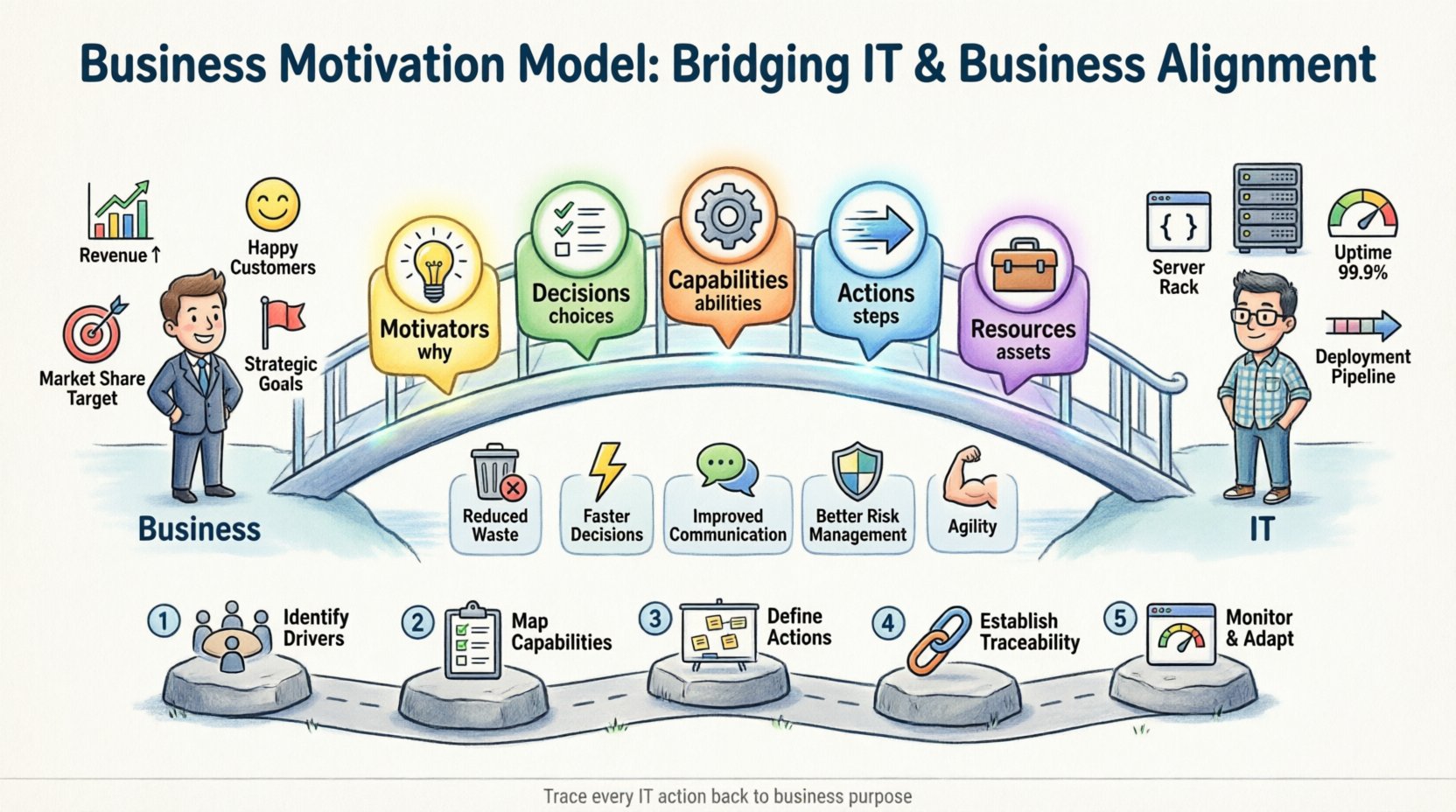
At its heart, the Business Motivation Model is a framework for describing the reasons behind organizational activities. It moves beyond simple requirements lists. Instead, it captures the why before the what. This distinction is vital for IT alignment. When developers understand the motivation behind a feature, they make better architectural decisions. When stakeholders understand the cost of maintaining a capability, they prioritize better.
The model relies on several fundamental concepts that work together to create a cohesive view of the enterprise:
- Motivators: The drivers that push an organization toward a goal. These can be internal (profitability, efficiency) or external (regulatory compliance, market demand).
- Assessments: The current state of affairs. These are evaluations of where the organization stands relative to its motivators.
- Decisions: The choices made to address assessments. Decisions bridge the gap between the current state and the desired state.
- Capabilities: The abilities required to execute decisions. This is where IT systems often reside.
- Actions: The specific steps taken to utilize capabilities. These are the workflows and processes.
- Resources: The assets (people, data, hardware) needed to perform actions.
By defining these elements clearly, an organization creates a map of intent. IT teams can then trace every system function back to a specific motivation. If a system feature cannot be traced to a motivator, it is likely technical debt or unnecessary complexity.
🔗 Bridging the Gap: IT and Business Alignment
Alignment is not a one-time event; it is a continuous process of verification. In many organizations, business teams speak in terms of revenue, customer satisfaction, and market share. IT teams speak in terms of uptime, latency, code coverage, and deployment pipelines. The Business Motivation Model provides the vocabulary to translate between these two worlds.
Consider the flow of information:
- Business Side: We need to reduce customer churn by 10% this quarter. 📉
- Motivator: Increase customer retention.
- Decision: Improve the onboarding experience.
- Capability: A self-service portal.
- IT Action: Develop a mobile-responsive frontend.
- Resource: Frontend developers and cloud hosting.
Without this traceability, IT might build a complex backend system that the business never uses. The BMM ensures that the backend supports the frontend, which supports the onboarding, which supports the retention.
📋 Key Components Explained
To implement this model, one must understand how the components interact. The following table outlines the primary categories and their specific roles within the alignment framework.
| Component | Focus Question | Example |
|---|---|---|
| Motivator | Why do we do this? | Compliance with new data privacy laws. |
| Capability | What must we be able to do? | Ability to export user data in standard formats. |
| Action | How do we do it? | Run the data export script every 24 hours. |
| Requirement | What is needed to succeed? | The script must handle 10,000 records per second. |
| Resource | What do we need to use? | Database server and storage space. |
Notice how the table moves from abstract intent to concrete technical constraints. This hierarchy allows IT leaders to prioritize technical work based on business urgency rather than just technical curiosity.
🛠️ Implementing the Model: A Step-by-Step Approach
Adopting the Business Motivation Model requires a shift in culture. It is not about buying a new tool but changing how requirements are gathered and managed. The following steps outline a practical path to integration.
1. Identify Strategic Drivers
Start at the top. Leadership must articulate the primary motivators. These are the high-level goals that justify the existence of the business units. Without this clarity, lower-level alignment is impossible.
- Hold workshops with executive stakeholders.
- Document the specific goals for the next fiscal year.
- Distinguish between needs (must have) and wants (nice to have).
2. Map Capabilities to Drivers
Once motivators are defined, identify the capabilities required to achieve them. This is where IT architecture comes into play. IT leaders should review existing systems and determine which ones support the identified motivators.
- Conduct an audit of current applications.
- Mark each application with the business goals it supports.
- Identify gaps where no system supports a critical goal.
3. Define Actions and Resources
Capabilities are theoretical until they are acted upon. Define the specific actions that activate these capabilities. This helps in resource planning.
- List the processes that utilize the capabilities.
- Estimate the effort required for each action.
- Assign resources (budget, personnel, infrastructure) accordingly.
4. Establish Traceability
This is the most critical step for long-term alignment. Every requirement in the IT backlog must link back to a capability, which links back to a decision, which links back to a motivator.
- Use a tracking system to maintain these links.
- Review links during sprint planning.
- Remove items from the backlog if the link is broken.
5. Monitor and Adapt
Business environments change. Motivators evolve. The model must be dynamic.
- Schedule quarterly reviews of the motivator map.
- Update capability assessments based on performance data.
- Adjust actions if resources become constrained.
📈 Benefits of a Structured Alignment Model
Implementing this framework yields tangible benefits for both business and IT departments. These advantages extend beyond simple efficiency.
- Reduced Waste: Resources are not spent on features that do not support core goals.
- Faster Decision Making: When priorities are clear, teams spend less time debating what to build next.
- Improved Communication: A shared vocabulary reduces misunderstandings between technical and non-technical staff.
- Better Risk Management: Understanding the impact of a change on the business motivators helps assess risk more accurately.
- Agility: When the model is clear, pivoting strategies is easier because the impact on capabilities is known.
Furthermore, this approach fosters a sense of purpose among technical teams. Developers often struggle to see the impact of their work. When they see their code directly supporting a stated business motivator, engagement increases.
⚠️ Common Challenges and Mitigation Strategies
While the model is robust, implementation is not without obstacles. Organizations often face resistance or confusion during the transition.
Challenge 1: Complexity
The model can become overly complex if every minor task is linked to a high-level motivator.
- Mitigation: Use aggregation. Group low-level tasks under broader capability buckets. Only drill down to the motivator level for major initiatives.
Challenge 2: Cultural Resistance
Business teams may view IT alignment as bureaucracy. IT teams may view it as micromanagement.
- Mitigation: Frame the model as a tool for empowerment, not control. Show how it reduces the need for rework.
Challenge 3: Static Documentation
Models often become outdated quickly if treated as static documents.
- Mitigation: Treat the model as a living process. Integrate updates into regular governance meetings.
Challenge 4: Lack of Visibility
It is difficult to see the big picture when working in silos.
- Mitigation: Create dashboards that visualize the connections between business goals and IT work. Make the data visible to all stakeholders.
📊 Measuring Success and Effectiveness
How do you know if the alignment is working? Metrics should reflect both business outcomes and IT efficiency. Relying solely on technical metrics like uptime is insufficient.
Business Metrics
- Goal Achievement Rate: Percentage of business motivators met within the target timeframe.
- ROI per Initiative: Return on investment calculated for specific capabilities.
- Customer Satisfaction: Changes in feedback correlated with new features.
IT Metrics
- Requirement Traceability: Percentage of requirements linked to a business motivator.
- Delivery Velocity: Speed of delivering value aligned with strategic goals.
- Technical Debt Ratio: Amount of work spent on non-strategic features.
Combining these metrics provides a holistic view. If business goals are met but IT velocity is dropping, the model may be too rigid. If IT velocity is high but business goals are missed, the alignment is broken.
🔄 Sustaining the Model Over Time
Long-term success requires maintenance. The initial setup is only the beginning. To keep the model effective, organizations must embed it into their standard operating procedures.
- Onboarding: Include the model in training for new product owners and architects.
- Governance: Make alignment a criteria for project approval.
- Retrospectives: Discuss alignment issues during sprint retrospectives.
- Tooling: Use generic tracking systems to maintain the links without forcing specific software adoption.
It is also important to recognize that not all motivators are equal. Some will change frequently, while others are stable. Prioritize the maintenance efforts on the stable motivators to ensure the foundation remains solid.
🚀 The Future of Enterprise Alignment
As technology evolves, the need for alignment grows. Automation, artificial intelligence, and cloud computing introduce new variables into the equation. A static plan will not suffice. The Business Motivation Model must adapt to these changes.
- Dynamic Requirements: Systems must handle requirements that change in real-time based on data inputs.
- Decentralized Decision Making: As organizations flatten, more decisions are made at the edge. The model must support distributed alignment.
- Data-Driven Motivators: Use analytics to inform motivators rather than just intuition.
The core principle remains the same: technology must serve the business intent. By maintaining a clear link between the two, organizations can navigate technological shifts without losing their strategic direction.
💡 Final Thoughts on Strategic Execution
Aligning IT and business is not about making them the same. It is about making them mutually supportive. The Business Motivation Model provides the structure to do this without stifling innovation. It ensures that innovation serves a purpose.
When teams focus on the why, the how becomes clearer. Resources are allocated wisely. Risks are managed proactively. The result is an organization that is resilient, responsive, and focused.
Start small. Pick a single project. Map its motivators. Trace its capabilities. Measure the outcome. Use that success to expand the model across the enterprise. With patience and discipline, the gap between business strategy and technical execution can be closed.