

Organizations often struggle to connect high-level aspirations with daily actions. This gap between vision and execution is where strategic intent gets lost. The Business Motivation Model (BMM) provides a structured approach to clarify this connection. It transforms abstract ideas into a tangible map of organizational drive. By using this framework, leaders can visualize how motivations translate into specific outcomes.
Strategic intent is not just a statement on a wall. It is the driving force behind resource allocation, decision-making, and operational focus. When visualized correctly, it reveals the path from a motivating factor to a tangible end goal. This guide explores how to leverage the Business Motivation Model to create clarity, ensure alignment, and maintain focus on what truly matters.
🧠 Understanding Strategic Intent
Strategic intent defines the desired future state of an organization. It answers the question: “Where are we going and why?” Unlike a simple goal, intent encompasses the energy and determination required to reach that destination. It is the “why” behind the “what”.
Without a clear visualization of intent, resources scatter. Teams work on tasks that do not contribute to the bigger picture. The Business Motivation Model bridges this gap by introducing a hierarchy of motivation.
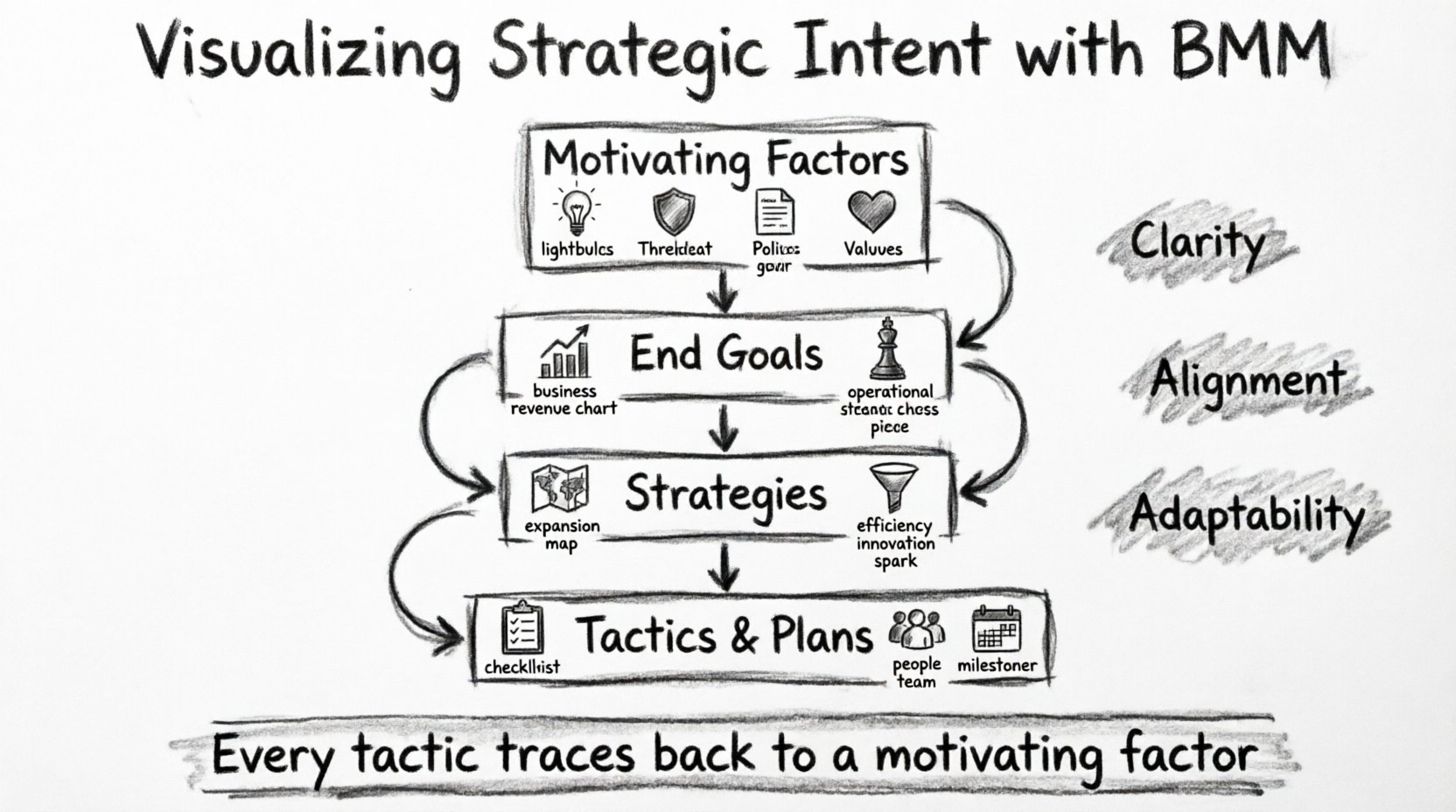
Clarity: Everyone understands the purpose behind their work.
Alignment: Individual efforts support organizational objectives.
Adaptability: The model allows for changes in motivation without losing the core direction.
🏗️ The Core Philosophy: Means-Ends Relationships
At the heart of the Business Motivation Model lies the concept of means-ends relationships. This is the logic that connects actions to outcomes. It is a chain of reasoning that explains how one element supports another.
Think of it as a ladder. You climb the rungs (means) to reach the top (end). However, in business, the “rungs” are often strategies, and the “top” is a goal. Understanding this hierarchy is crucial for effective planning.
The Hierarchy of Motivation
The model organizes elements into specific categories. Each category serves a distinct function in the strategic chain.
Motivating Factors: The external or internal drivers that spark action.
End Goals: The desired states the organization seeks to achieve.
Strategies: The approaches taken to reach the goals.
Tactics: The specific actions implemented within strategies.
Plans: The detailed schedules and resources for tactics.
Visualizing these relationships ensures that every tactic can be traced back to a motivating factor. If a task cannot be traced, it does not belong in the strategic plan.
🧩 Key BMM Elements Explained
To visualize strategic intent effectively, one must understand the building blocks. The Business Motivation Model defines specific types of elements. Each plays a role in the overall architecture.
1. Motivating Factors
These are the reasons why an organization acts. They can be internal, such as a desire for growth, or external, such as market competition. Without a motivating factor, there is no reason to pursue an end goal.
Opportunities: External conditions that can be exploited.
Threats: External conditions that must be mitigated.
Policies: Internal rules that guide behavior.
Values: Core principles that shape decision-making.
2. End Goals
End goals are the desired outcomes. They are the “ends” in the means-ends relationship. They must be specific and measurable to be effective. A vague goal makes visualization impossible.
Business Goals: High-level objectives like revenue targets.
Operational Goals: Specific targets for departments or teams.
Strategic Goals: Long-term positioning in the market.
3. Strategies
Strategies are the chosen paths to achieve goals. They represent the “how”. A single goal might have multiple strategies. Visualizing these helps in resource prioritization.
Expansion Strategies: Entering new markets.
Efficiency Strategies: Reducing costs or waste.
Innovation Strategies: Developing new products.
4. Tactics and Plans
Tactics are the concrete steps taken to execute a strategy. Plans organize these tactics into a timeline. This is where the rubber meets the road.
Activities: The actual work performed.
Resources: People, tools, and budget required.
Milestones: Key checkpoints to measure progress.
🗺️ Mapping the Hierarchy
Visualizing the Business Motivation Model requires mapping these elements together. A diagrammatic approach is often the most effective way to communicate this structure to stakeholders. The visualization should show the flow from the root motivation down to the daily activities.
Creating the Map
Identify the Core Motivation: Start with the primary driver. Is it profit, customer satisfaction, or compliance?
Define the End Goal: What is the specific result required by that motivation?
Outline Strategies: What are the main approaches to get there?
Break Down Tactics: What specific tasks support the strategies?
Assign Resources: Who and what is needed for each tactic?
This top-down approach ensures that the foundation is solid. If the motivation is weak, the goal will likely fail. If the strategy is flawed, the goal remains out of reach.
🛠️ Practical Implementation Steps
Implementing this model does not require expensive tools. It requires discipline and a structured process. Follow these steps to begin visualizing your strategic intent.
Stakeholder Workshops: Gather key leaders to define motivations and goals together. Group consensus is vital for alignment.
Document Relationships: Clearly write down how elements link. Use arrows or lines to show dependency.
Review Regularly: Strategic intent is not static. Review the model quarterly to ensure it matches reality.
Communicate Widely: Ensure that employees at all levels can see how their work fits the model.
📊 Comparing BMM Elements
The following table clarifies the distinctions between the core components. Understanding these differences prevents confusion during the planning process.
Element | Question Answered | Example | Timeframe |
|---|---|---|---|
Motivating Factor | Why do we do this? | Increase market share by 10% | Ongoing |
End Goal | What do we want to achieve? | Launch new product line | 1-3 Years |
Strategy | How will we achieve it? | Premium positioning strategy | 1-3 Years |
Tactic | What specific actions are taken? | Conduct market research | 6-12 Months |
Plan | When and with what resources? | Q3 Budget Allocation | 1-12 Months |
🤝 Organizational Alignment
One of the primary benefits of the Business Motivation Model is alignment. It ensures that the executive vision matches operational reality. When departments operate in silos, strategic intent fragments. The model forces integration.
Breaking Down Silos
Shared Language: Everyone uses the same terms for goals and strategies.
Visible Dependencies: Departments see how their output affects others.
Unified Direction: All efforts point toward the same end goals.
Consider a scenario where Marketing and Product Development are disconnected. Marketing promises features that Product cannot build. The BMM visualizes this gap. It shows that the Marketing strategy relies on a Product tactic that does not exist. This visibility allows for correction before resources are wasted.
⚖️ Measuring Impact and Success
Visualization is only useful if it leads to action. You must measure the effectiveness of your strategic intent. The model provides a framework for setting performance indicators.
Key Performance Indicators (KPIs): Link metrics directly to end goals.
Progress Tracking: Monitor tactics to ensure they support strategies.
Feedback Loops: Use data to adjust motivating factors or goals.
If a tactic is not delivering results, the model helps identify where the break occurs. Is the tactic flawed? Is the strategy ineffective? Or is the end goal unrealistic? This diagnostic capability is powerful for continuous improvement.
⚠️ Common Challenges and Solutions
Implementing the Business Motivation Model is not without difficulties. Organizations often face specific hurdles when trying to visualize their intent.
Challenge 1: Complexity Overload
Maps can become too detailed and confusing.
Solution: Focus on high-level elements first. Drill down only where necessary.
Solution: Use different views for different audiences (e.g., executive vs. operational).
Challenge 2: Static Planning
Plans become obsolete quickly in fast-changing markets.
Solution: Treat the model as a living document. Update it regularly.
Solution: Focus on the motivations rather than rigid goals.
Challenge 3: Lack of Ownership
Teams do not feel responsible for the goals.
Solution: Assign clear owners to each tactic and strategy.
Solution: Involve teams in the creation of the model.
🔄 Adapting to Change
Business environments are dynamic. Strategies that worked yesterday may not work tomorrow. The Business Motivation Model supports adaptation. It allows you to pivot without losing sight of the core intent.
When a motivating factor changes (e.g., a new regulation), the model helps trace the impact. You can see which end goals are affected. You can then adjust the strategies and tactics accordingly. This agility is a competitive advantage.
🔍 Deep Dive: The Means-Ends Chain
Understanding the chain is critical for visualizing intent. A chain is only as strong as its links. If a link breaks, the connection between action and outcome is lost.
Ends: These are the goals. They define success.
Means: These are the strategies and tactics. They define the path.
It is common to confuse the two. For example, a team might focus on a tactic (the means) while forgetting the goal (the end). The BMM forces a check. It asks: “Does this action help achieve the goal?” If the answer is no, the activity should be stopped or re-evaluated.
This discipline prevents “busy work.” It ensures that energy is directed toward value creation. Visualizing the chain makes it obvious when a disconnect occurs.
🚀 Future Proofing Strategy
Long-term success requires looking ahead. The Business Motivation Model supports this by encouraging scenario planning. You can visualize different futures based on different motivations.
Scenario A: Market growth is high. Strategy focuses on expansion.
Scenario B: Market growth is low. Strategy focuses on efficiency.
By mapping these scenarios, you prepare for multiple outcomes. You do not need to guess when the change happens. You have a plan ready for each possibility. This preparation reduces risk and increases confidence.
💡 Key Takeaways
The Business Motivation Model offers a robust framework for visualizing strategic intent. It moves planning from abstract concepts to concrete structures. By defining the hierarchy of motivation, organizations can ensure alignment and clarity.
Structure: Provides a clear hierarchy from motivation to action.
Clarity: Makes the “why” behind every task visible.
Alignment: Connects departments and levels of the organization.
Flexibility: Allows for adaptation without losing direction.
Adopting this model requires commitment. It is not a one-time exercise. It is a way of thinking that permeates the organization. When everyone understands the strategic intent, execution becomes more effective.
📝 Summary of Best Practices
To get the most out of the Business Motivation Model, adhere to these guidelines.
Keep it Simple: Avoid unnecessary complexity in the initial map.
Engage Stakeholders: Ensure all voices are heard during the modeling process.
Focus on Relationships: Prioritize understanding how elements link.
Review Often: Schedule regular reviews to keep the model current.
Visualize Clearly: Use diagrams to communicate the structure.
Strategic intent is the heartbeat of an organization. The Business Motivation Model is the tool that helps you hear it clearly. By visualizing the connections between motivation and action, you build a stronger, more responsive enterprise. This approach leads to sustainable growth and resilience in an unpredictable world.