


In the complex landscape of enterprise strategy, clarity is currency. Organizations often struggle to translate high-level vision into actionable directives. This is where the Business Motivation Model, commonly known as BMM, serves as a critical framework. It provides a structured approach to understanding why an organization exists and how it plans to achieve its intended outcomes. By leveraging this model, leaders can structure business policies with precision, ensuring alignment between what the organization wants to achieve and the methods used to get there.
Business policies are not merely rules; they are the guardrails that guide decision-making. When structured correctly using BMM principles, these policies become dynamic instruments of strategy rather than static documents gathering dust. This guide explores the mechanics of structuring policies within this model, focusing on the relationships between goals, objectives, means, and ends. We will examine how to build a coherent policy architecture that supports sustainable growth without relying on specific software tools.
🧩 Understanding the Business Motivation Model
The Business Motivation Model originates from the Object Management Group. It is designed to capture the rationale behind business decisions. Unlike other modeling languages that focus on process or data, BMM focuses on motivation. It asks fundamental questions: What are we trying to do? Why are we trying to do it? How will we know we succeeded? These questions form the backbone of policy structuring.
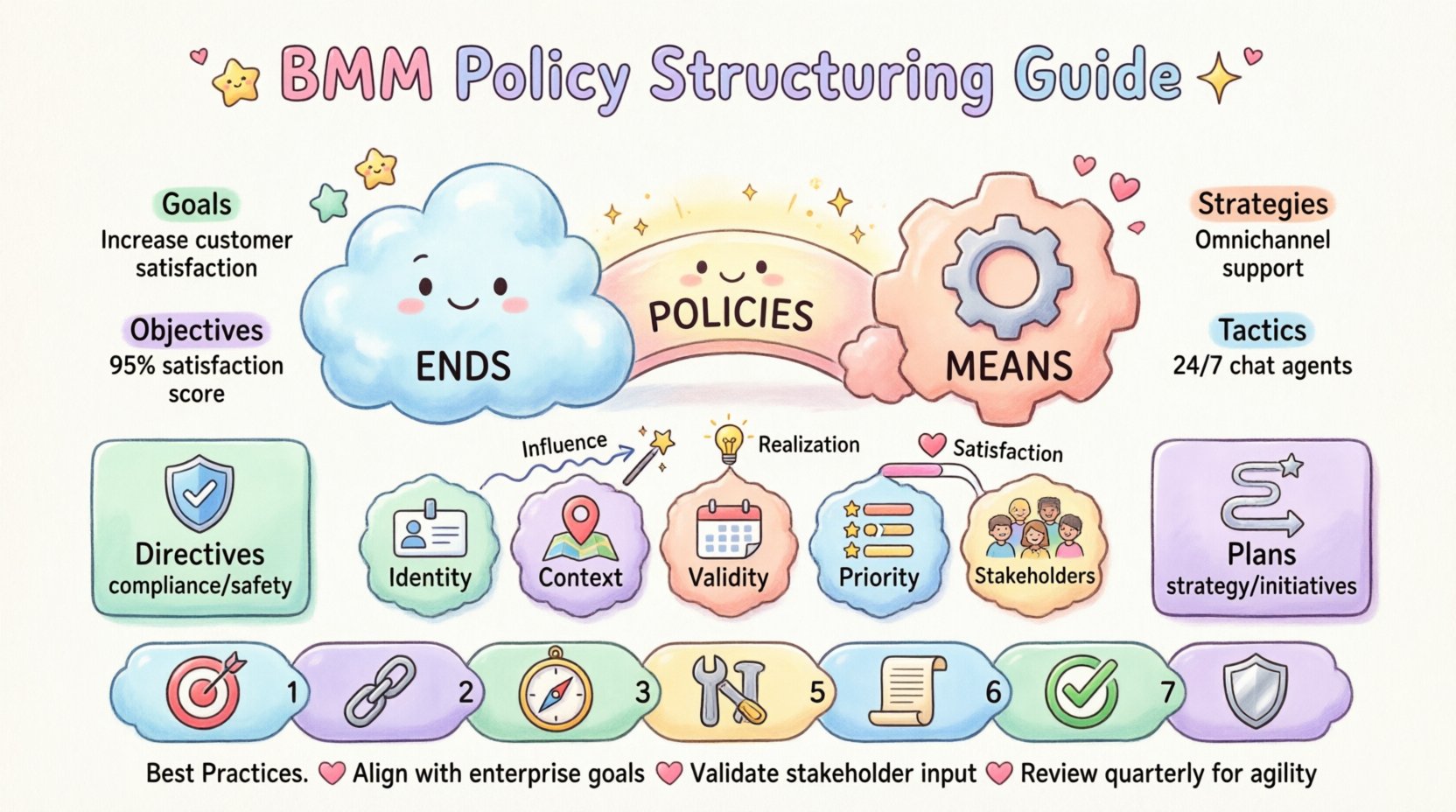
At its core, BMM divides the business landscape into two primary categories: Ends and Means. This separation is vital for policy design. Ends represent the desired results, while Means represent the capabilities and actions taken to achieve those results. Policies sit at the intersection, influencing how means are deployed to satisfy ends.
When structuring policies, it is essential to avoid conflating the policy itself with the goal it serves. A policy defines the constraints or directives, while the goal defines the target. Understanding this distinction prevents confusion during implementation and governance.
🔑 The Distinction Between Ends and Means
To structure policies effectively, one must first grasp the fundamental dichotomy of the model. Every business initiative involves a journey from a current state to a desired state. The Desired State is the End. The actions taken to reach that state are the Means.
- Ends: These are the targets. They include Goals and Objectives. A Goal is a qualitative measure of success, while an Objective is a quantitative measure. Both represent the value the organization seeks to create.
- Means: These are the resources and activities. They include Tactics and Strategies. Tactics are specific actions, while Strategies are broader approaches to organizing those actions.
Policies function as the bridge between these two concepts. They dictate which Means are acceptable for achieving specific Ends. Without this structure, tactics may drift away from strategic goals, leading to wasted resources and misaligned efforts.
| Category | Definition | Example |
|---|---|---|
| Goal | Qualitative desired outcome | Increase customer satisfaction |
| Objective | Quantitative desired outcome | Achieve 95% satisfaction score |
| Strategy | High-level approach | Implement omnichannel support |
| Tactic | Specific action | Deploy 24/7 chat support agents |
📜 Defining Business Policies within the Framework
In the context of BMM, a business policy is a directive that influences the selection and execution of Means to satisfy Ends. It is not a goal itself, but a constraint or a rule that governs how goals are pursued. Policies can be categorized into two main types: Directives and Plans.
Directives
Directives are mandatory rules. They often stem from external regulations or internal risk management requirements. When structuring policies, Directives set the hard boundaries within which the organization must operate. They are non-negotiable and must be satisfied.
- Compliance with industry regulations
- Adherence to safety standards
- Internal code of conduct
Plans
Plans are strategic intentions. Unlike Directives, Plans are flexible and can be adjusted based on changing circumstances. They represent the organization’s commitment to a specific course of action. Plans are often linked to specific Goals or Objectives.
- Market expansion strategy
- Technology modernization roadmap
- Workforce development initiative
When documenting these policies, clarity is paramount. A policy document should explicitly state the purpose, the scope, the stakeholders involved, and the consequences of non-compliance. This level of detail ensures that the policy is actionable and enforceable.
🏗️ Core Components of Policy Structure
Building a robust policy structure requires attention to specific attributes. Each policy within the BMM framework should possess certain characteristics to ensure it functions correctly within the enterprise architecture.
- Identity: Every policy must have a unique identifier. This allows for tracking, version control, and referencing across different parts of the organization.
- Context: The policy must define where it applies. Does it cover the entire enterprise, a specific department, or a particular project?
- Validity: Policies have a lifecycle. They have a start date and potentially an end date. Understanding the validity period prevents the application of outdated rules.
- Priority: When policies conflict, which one takes precedence? Establishing a priority hierarchy is essential for conflict resolution.
- Stakeholders: Identify who is responsible for the policy and who is affected by it. This ensures accountability and awareness.
By adhering to these components, organizations can maintain a clean and manageable policy repository. This structure supports auditability and makes it easier to update policies as business needs evolve.
🔗 Relationships and Dependencies
The power of BMM lies in the relationships it defines between elements. Policies do not exist in isolation; they are connected to Goals, Objectives, Strategies, and Tactics. Understanding these connections is crucial for effective structuring.
Influence
The Influence relationship indicates that one element affects the ability of another to be achieved. Policies exert Influence on Tactics. A restrictive policy might Influence a tactic to be more costly or complex. Conversely, an enabling policy can Influence a tactic to be more efficient.
- A policy requiring data encryption may Influence the choice of communication tools.
- A policy promoting sustainability may Influence supplier selection tactics.
Realization
Realization defines how an element contributes to achieving another. Strategies Realize Goals. Tactics Realize Strategies. Policies can also Realize Goals by providing the necessary governance framework. This relationship helps trace the lineage of a policy back to a strategic intent.
Satisfaction
Satisfaction measures the degree to which an Objective has been met. Policies contribute to Satisfaction by ensuring that the Means used to achieve the Objective are valid and compliant. If a policy is violated, the Satisfaction of the associated Objective may be compromised.
Mapping these relationships creates a web of accountability. It allows leaders to see the ripple effects of a policy change. If a policy is modified, the model can identify which Goals and Objectives are impacted, facilitating better risk assessment.
🚀 Step-by-Step Structuring Process
Implementing BMM for policy structuring is a methodical process. It requires collaboration between strategy leaders, policy owners, and operational managers. The following steps outline a practical approach to building this structure.
- Define Strategic Intent: Begin by identifying the primary Goals and Objectives of the organization. Without a clear target, policies lack direction. Ensure these are documented clearly and communicated widely.
- Identify Constraints and Directives: List all external and internal constraints that must be adhered to. These form the mandatory Directives within your policy structure. Categorize them by domain, such as legal, financial, or operational.
- Develop Strategies: Determine the high-level approaches needed to meet the Goals. These strategies will be influenced by the Directives identified in the previous step.
Select Tactics:
Choose specific actions that implement the strategies. Evaluate these tactics against the policy constraints. If a tactic violates a policy, it must be modified or discarded.
Formalize Policies:
Write the policy documents. Ensure they reference the specific Goals and Objectives they support. Include the Influence relationships explicitly in the documentation.
Validate Alignment:
Review the entire structure to ensure all Policies are linked to a Strategic Intent. Remove orphaned policies that do not contribute to organizational goals. This step ensures efficiency and reduces bureaucratic overhead.
Establish Governance:
Define the process for reviewing and updating policies. Assign ownership to specific roles. Create a schedule for regular audits to ensure continued alignment with business needs.
🤝 Aligning Policies with Strategic Goals
Alignment is the primary value proposition of using BMM for policy structuring. Many organizations suffer from policy fragmentation, where different departments operate under conflicting rules. BMM provides a unified view that highlights these conflicts.
When aligning policies, focus on the flow of value. A policy should enable the organization to move from its current state to its desired state more efficiently. If a policy hinders this flow without providing a corresponding benefit (such as risk reduction), it should be re-evaluated.
Consider the following alignment checks:
- Consistency: Do policies contradict each other? A sales policy might promise speed, while a compliance policy mandates lengthy checks. BMM helps visualize this tension.
- Completeness: Are there strategic goals without supporting policies? This gap indicates a risk area where unauthorized actions might occur.
- Relevance: Does the policy still serve its intended purpose? Business environments change, and policies must evolve to remain relevant.
Regular alignment workshops can be effective. Bringing together stakeholders from different functions allows for the identification of hidden dependencies and conflicts. This collaborative approach fosters a culture of shared responsibility for policy effectiveness.
⚖️ Governance and Evolution
Policies are living documents. They require governance to maintain their integrity over time. A governance framework ensures that changes to policies are controlled, reviewed, and communicated.
The evolution of policy structure follows the evolution of the business. As the organization grows, new Goals emerge. As regulations change, new Directives are added. The BMM framework accommodates this change by allowing new elements to be linked to existing structures without breaking the model.
Key governance activities include:
- Change Management: Any modification to a policy must go through a formal approval process. This prevents ad-hoc changes that could disrupt operations.
- Version Control: Maintain a history of policy versions. This is crucial for auditing and understanding the rationale behind past decisions.
- Communication: Policies are useless if no one knows them. Ensure that policy updates are communicated to all affected stakeholders.
- Training: Provide training on new policies to ensure proper implementation. Understanding the “why” behind a policy increases compliance.
By institutionalizing governance, the organization ensures that its policy structure remains robust and responsive to change.
📊 Measuring Policy Effectiveness
How do we know if a policy is working? Measurement is essential for continuous improvement. In the BMM context, effectiveness is measured by the degree to which the policy contributes to the satisfaction of Goals and Objectives.
Metrics should be defined for each major policy. These metrics can be quantitative or qualitative.
- Compliance Rate: The percentage of time or instances where the policy is adhered to.
- Risk Reduction: The reduction in incidents or losses attributed to the policy.
- Operational Efficiency: The impact of the policy on process speed or cost.
- Goal Achievement: The correlation between policy implementation and the achievement of strategic targets.
Regular reporting on these metrics allows leadership to make informed decisions about policy retention, modification, or retirement. If a policy shows no positive correlation with strategic goals, it is a candidate for removal.
🔍 Common Pitfalls and How to Avoid Them
Even with a robust framework like BMM, organizations can stumble. Recognizing common pitfalls helps avoid them.
- Over-Policying: Creating too many policies creates bureaucracy. Focus on policies that directly impact strategic outcomes.
- Static Documentation: Keeping policies in static documents that are rarely updated leads to obsolescence. Use a dynamic repository that links to current processes.
- Lack of Traceability: Failing to link policies back to Goals makes them seem arbitrary. Always maintain the traceability chain.
- Ignoring Context: Applying a policy globally when it should be specific to a region or department creates friction. Define scope clearly.
- Disconnecting Means from Ends: Focusing on the rules (Means) without remembering the purpose (Ends). Keep the strategic intent visible in all policy discussions.
🌐 Integration with Enterprise Architecture
Business Motivation Model does not exist in a vacuum. It integrates well with broader Enterprise Architecture frameworks. It provides the “Why” layer that complements the “What” and “How” layers found in other architectural models.
When integrating BMM with other models, ensure that the terminology is mapped correctly. For example, a “Business Capability” in another framework might be a “Strategy” in BMM. Consistency in mapping ensures that the policy structure supports the wider architectural vision.
This integration allows for a holistic view of the organization. It connects the motivation for change with the structural changes required to support it. Policies become the binding agent that holds the enterprise architecture together, ensuring that every component serves a strategic purpose.
📝 Summary of Best Practices
To summarize the approach to structuring business policies using BMM, consider these core principles.
- Always start with the End (Goal or Objective) before defining the Means.
- Distinguish clearly between Directives (mandatory) and Plans (intentional).
- Map relationships explicitly to understand dependencies and influence.
- Assign ownership and governance to ensure longevity.
- Measure effectiveness against strategic targets.
- Keep the documentation dynamic and linked to current operations.
By following these practices, organizations can build a policy structure that is not only compliant but also strategically aligned. The Business Motivation Model provides the logic needed to transform abstract intentions into concrete, actionable rules. This alignment is the foundation of a resilient and adaptive enterprise.
The journey to effective policy structuring is continuous. It requires ongoing attention and refinement. However, the clarity gained through this structured approach pays dividends in operational efficiency and strategic focus. By grounding policies in the logic of BMM, leaders can navigate complexity with confidence.