

Organizations striving for strategic alignment often turn to the Business Motivation Model (BMM) to structure their decision-making processes. It provides a standardized way to represent the “why” and “how” behind business actions. However, deploying a BMM framework is fraught with complexity. Many initiatives fail not because the model is flawed, but because of specific implementation errors during the design and adoption phases.
This guide details the common pitfalls encountered when integrating BMM principles into organizational strategy. By understanding these errors, leaders can construct a robust model that accurately reflects business intent without succumbing to structural weaknesses.
🧠 Understanding the Core Structure of BMM
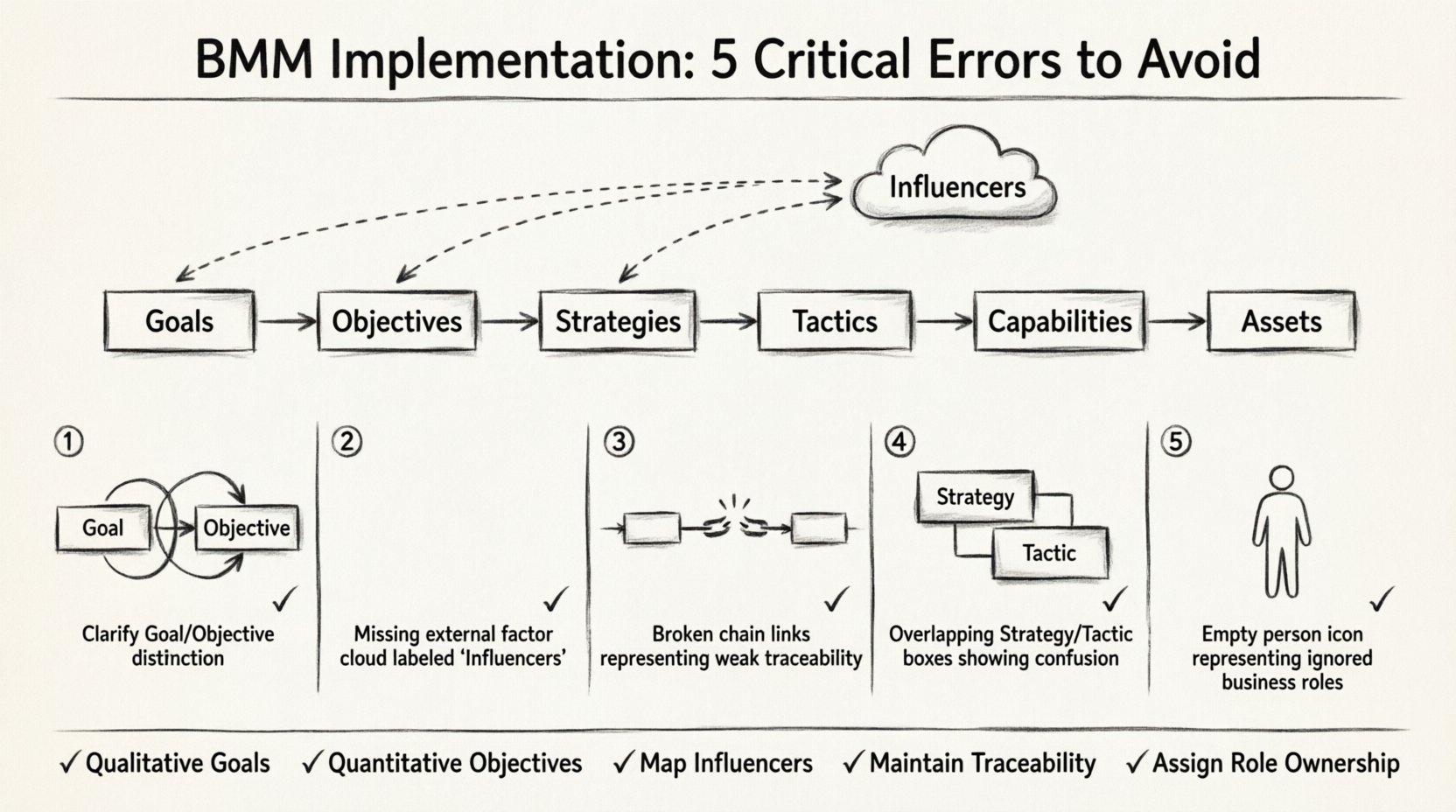
Before identifying errors, one must understand the anatomy of a correct implementation. The Business Motivation Model is designed to capture the relationships between various business elements. It is not merely a list of goals; it is a network of interdependencies.
- Goals: The broad, high-level desires of the organization.
- Objectives: Specific, measurable steps taken to achieve Goals.
- Influencers: External or internal factors that impact the realization of Goals or Objectives (Positive or Negative).
- Strategies: The “How” – the general approach to achieving Objectives.
- Tactics: Specific actions taken to execute Strategies.
- Capabilities: The capacity of the organization to perform activities.
- Assets: The resources required to support Capabilities.
When these elements are disconnected or misdefined, the model loses its utility. It becomes a static document rather than a dynamic planning tool.
⚠️ Critical Implementation Errors
The following sections outline the most frequent mistakes made during BMM implementation. Each error is analyzed to show its origin and its direct impact on business operations.
1. Misdefining Goals and Objectives
One of the most pervasive issues is the blurring of lines between Goals and Objectives. In a well-structured model, Goals represent the desired state, while Objectives represent the milestones required to reach that state. Confusing the two leads to ambiguity.
The Symptom
Teams list “Increase Revenue” as an Objective without specifying the measurable threshold. Simultaneously, they list “Achieve Market Leadership” as a Goal, which is actually a long-term Objective.
The Consequence
When Goals and Objectives are indistinguishable, performance tracking becomes impossible. Managers cannot determine if a specific milestone has been met because the metric itself was vague. This leads to misallocated resources and stalled initiatives.
The Fix
- Ensure all Goals are qualitative and broad.
- Ensure all Objectives are quantitative and time-bound.
- Verify that every Objective links directly to at least one Goal.
2. Neglecting Influencers
A model that only looks inward is incomplete. Influencers represent the factors that help or hinder progress. Ignoring them creates a false sense of security regarding the feasibility of a strategy.
The Symptom
Strategies are approved without mapping the external risks or internal dependencies that could derail them. For example, a plan to launch a new service ignores the “Negative Influencer” of regulatory changes.
The Consequence
When an Influencer materializes, the organization is caught off guard. Because the model did not account for the risk, there is no pre-defined mitigation plan attached to the Objective. This results in reactive crisis management rather than proactive planning.
The Fix
- Categorize every Influencer as Positive or Negative.
- Assign a specific mitigation strategy for every Negative Influencer.
- Review Influencers quarterly to ensure they remain relevant.
3. Weak Traceability Links
The power of BMM lies in its traceability. It allows stakeholders to trace a daily task back to a strategic Goal. If these links are broken, the model is useless for governance.
The Symptom
Tactics exist in isolation. A project team is working on a specific feature, but there is no model element linking that feature to a Strategy or an Objective.
The Consequence
Work becomes siloed. Teams optimize for local efficiency rather than global value. Resources are spent on activities that do not contribute to the overarching Goals. This fragmentation dilutes the organization’s strategic focus.
The Fix
- Enforce a rule: No Task exists without a link to a Capability or Asset.
- Validate the chain: Asset → Capability → Activity → Strategy → Objective → Goal.
- Use regular audits to ensure links are not orphaned.
4. Confusing Strategies with Tactics
Strategies define the approach, while Tactics define the specific execution. Blurring this distinction leads to operational paralysis or strategic drift.
The Symptom
Leadership defines a Strategy as “Hire 5 new engineers.” This is actually a tactic. The Strategy should be “Expand Development Capacity to Reduce Time-to-Market.” Hiring is just one way to achieve that.
The Consequence
When Strategies are too granular, they lose flexibility. If the market changes, the organization cannot pivot because the “Strategy” is too specific to a single action. Conversely, if Tactics are too vague, execution lacks direction.
The Fix
- Ask: Is this a general approach or a specific action?
- Ensure Strategies are repeatable and adaptable.
- Ensure Tactics are time-bound and resource-specific.
5. Ignoring the Human Element (Business Roles)
Models often focus on processes and objects but forget the people who execute them. Business Roles define who is responsible for what. Skipping this layer creates accountability gaps.
The Symptom
A Goal is assigned to a department, but no specific Business Role is linked to the execution. The assumption is that the department head will handle it, but no one owns the specific Objective.
The Consequence
Accountability diffuses. When an Objective is missed, everyone claims it was someone else’s responsibility. This lack of ownership stalls progress and frustrates stakeholders who expect clear lines of authority.
The Fix
- Map every Objective to a specific Business Role.
- Ensure Roles have defined Capabilities and Assets.
- Communicate Role responsibilities alongside the model.
📊 Comparison of Common Pitfalls vs. Correct Practices
Use the following table to quickly assess your current implementation against standard best practices.
| Area | Pitfall (❌) | Correct Practice (✅) |
|---|---|---|
| Goal Definition | Vague desires (e.g., “Be better”) | Specific desired states (e.g., “Reduce latency by 20%”) |
| Traceability | Disconnected Tactics and Strategies | Full chain from Asset to Goal |
| Influencers | Ignored external risks | Positive and Negative factors mapped |
| Roles | Department-level assignment only | Specific Role ownership per Objective |
| Metrics | Subjective success criteria | Quantitative Key Performance Indicators |
| Updates | Static annual document | Quarterly review and adjustment |
🛡️ Validation and Quality Assurance
Once the model is drafted, it requires rigorous validation. A model that looks good on paper may fail in practice if it does not reflect reality.
1. The Walkthrough Test
Select a random Objective from the model. Walk backward through the chain of Tactics, Strategies, and Goals. Can you clearly articulate why this Objective exists? If the answer is “to do the work,” the link is broken.
2. The Resource Check
For every Capability identified, verify the existence of the necessary Assets. If a strategy requires a new software capability, ensure the Asset budget is allocated in the model. If not, the model is aspirational, not operational.
3. The Stakeholder Review
Present the model to business owners, not just IT or analysts. If the business leaders cannot understand the Goals and Objectives, the model is too technical. Simplify the language to ensure alignment across the enterprise.
🔄 Sustaining the Model Over Time
A BMM is not a one-time project. It is a living system that must evolve with the business. Without maintenance, the model becomes obsolete.
Change Management Integration
When a major organizational change occurs, the BMM must be updated first. If a merger happens, Goals and Objectives may shift. The model should reflect the new reality immediately to guide the integration process.
Regular Audits
Schedule a quarterly review of the model. Check for:
- Orphaned Objectives (no longer active).
- Broken Links (Capabilities removed).
- Outdated Influencers (risks that no longer exist).
Continuous Improvement
Encourage feedback from the teams executing the Tactics. They are the ones closest to the work. If they identify that a Strategy is ineffective, the model should be updated to reflect this learning. This creates a culture of continuous improvement.
🏁 Final Thoughts on BMM Implementation
Building a Business Motivation Model requires discipline and precision. It is easy to fall into the traps of vagueness, disconnection, or neglect. By avoiding the critical errors outlined in this guide, organizations can ensure their strategic plans are not just documents, but actionable blueprints.
Success in BMM implementation depends on clarity. Clear Goals, clear Objectives, and clear links between the two. It also depends on people. Clear Roles and clear Responsibilities. When these elements are aligned, the model becomes a powerful engine for organizational performance.
Do not rush the process. Invest time in the initial structure. Validate the links. Respect the human element. With these principles in place, the Business Motivation Model will serve as a reliable foundation for decision-making and strategic execution.