


Enterprise alignment often suffers from a disconnect between what an organization wants to achieve and how it operates daily. This gap creates inefficiencies, wasted resources, and strategic drift. To bridge this divide, professionals turn to the Business Motivation Model (BMM) and Process Architecture. Combining these frameworks ensures that every process activity traces back to a strategic intent. This guide explores how to integrate BMM with process architecture effectively.
The integration is not merely about documentation; it is about establishing a living link between motivation and execution. When goals drive processes, organizations gain agility and clarity. This comprehensive guide details the mechanics of this integration, the mapping techniques, and the practical steps required for implementation.
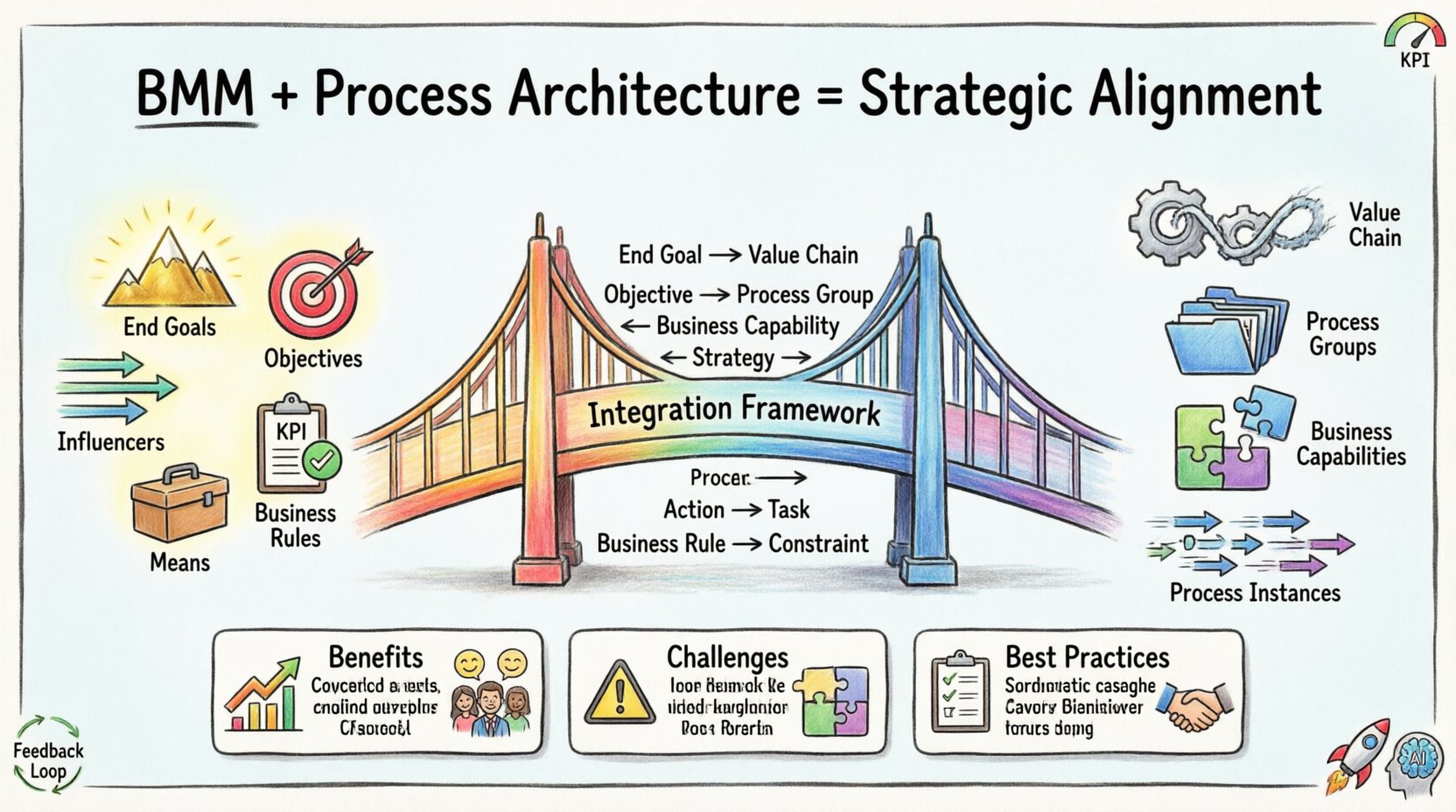
Understanding the Business Motivation Model (BMM) 🎯
The Business Motivation Model is a standard specification designed to describe how business decisions are made. It provides a structured way to articulate the “why” behind business actions. Developed to be vendor-neutral, it focuses on the elements that drive behavior within an organization.
Core Elements of BMM
To integrate BMM successfully, one must understand its fundamental components. These elements form the hierarchy of motivation:
- End Goals: The ultimate outcomes the business seeks. These are often high-level aspirations like profitability, market share, or sustainability.
- Objectives: Specific targets set to achieve the End Goals. These are measurable and time-bound.
- Influencers: Factors that impact the achievement of objectives. These can be internal or external forces.
- Means: The strategies, plans, and actions taken to meet objectives.
- Business Rules: The constraints and guidelines that dictate how activities are performed.
By breaking down motivation into these distinct parts, organizations can see exactly how a high-level vision translates into operational requirements. For instance, an End Goal of “Expand into Asia” influences an Objective to “Open three new regional offices.” This influence drives the Means, which includes hiring local staff and establishing legal compliance processes.
Defining Process Architecture 🔄
Process Architecture refers to the high-level design and organization of business processes. It maps the flow of work across the enterprise. Unlike detailed process modeling, which focuses on specific steps, architecture looks at the relationships between different process domains.
Key Layers of Process Architecture
A robust process architecture typically consists of several layers that connect strategy to execution:
- Value Chain: The overarching set of activities that create value for the customer.
- Process Groups: Collections of related processes, such as Order-to-Cash or Hire-to-Retire.
- Business Capabilities: The abilities required to perform the processes, such as “Customer Management” or “Supply Chain Optimization”.
- Process Instances: The specific executions of a process model.
Process architecture provides the “how.” It defines the structure, the roles, and the flow of information. When integrated with BMM, this structure becomes purpose-driven. Every capability and flow should have a reason for existing rooted in the business motivation.
The Integration Framework: Connecting Ends to Means 🔗
The core challenge in integration is linking the abstract elements of BMM to the concrete elements of Process Architecture. This requires a systematic mapping approach. The goal is to ensure traceability from the highest strategic intent down to the lowest level activity.
Mapping Logic
Integration relies on understanding the directional flow of influence. BMM flows from Ends to Means. Process Architecture flows from Capabilities to Activities. The integration point lies in the “Means” and “Capabilities” layers.
When a Business Strategy is defined in BMM, it must correspond to a Process Group in the Architecture. When a Plan is defined, it maps to specific Business Capabilities. When an Action is defined, it maps to a Business Process or a Business Rule.
Visualizing the Relationship
| BMM Element | Process Architecture Element | Relationship Description |
|---|---|---|
| End Goal | Value Chain | Defines the overall value proposition of the chain. |
| Objective | Process Group | Measures the success of a specific domain of work. |
| Strategy | Business Capability | Describes the ability required to execute the strategy. |
| Plan | Process Model | Details the sequence of steps to fulfill the plan. |
| Action | Task / Activity | The specific unit of work performed by an actor. |
| Business Rule | Constraint / Validation | Enforces logic within the process flow. |
This table serves as a reference for architects during the alignment phase. It ensures that no process exists in a vacuum without a strategic driver.
Step-by-Step Implementation Guide 📋
Implementing this integration requires a structured approach. It is not a one-time event but a continuous refinement process. The following steps outline the methodology for establishing this alignment.
1. Inventory Existing Motivations
Before mapping processes, gather all existing strategic documents. This includes mission statements, annual plans, and key performance indicators. Catalog these as BMM elements. Identify the primary End Goals and the Objectives supporting them. Avoid creating new motivations from scratch; instead, formalize what already exists.
2. Audit Current Process Architecture
Review the existing process landscape. Document all process groups and capabilities. Identify gaps where processes exist without a clear link to a strategic objective. Conversely, identify objectives where no supporting process has been defined. This audit reveals the misalignment.
3. Establish Traceability Links
Create the connections between the two models. For each Objective, identify the Process Group that supports it. For each Strategy, identify the Business Capability required. Use unique identifiers for both BMM elements and Process elements to maintain a clean data model. This allows for bidirectional navigation: from strategy to process, and from process to strategy.
4. Define Metrics and KPIs
Integration is incomplete without measurement. Link Objectives to Key Performance Indicators. Ensure that the metrics used to measure process performance align with the metrics used to measure business motivation. If a process is efficient but does not move the needle on the Objective, it is not valuable.
5. Embed in Governance
Make the integration part of the governance model. When proposing a new process, require a justification based on the BMM. When reviewing strategy, require evidence of process execution. This ensures that the models remain synchronized over time.
Benefits of Strategic Alignment 📈
Why invest the effort into this integration? The benefits extend beyond documentation. They impact the operational reality of the organization.
- Improved Decision Making: Leaders can see how a proposed change impacts the broader strategy. Decisions are no longer based on intuition but on mapped relationships.
- Resource Optimization: Resources can be directed toward processes that directly support high-priority objectives. Low-value processes can be identified and eliminated.
- Enhanced Agility: When the links are clear, changing a strategy allows for rapid identification of which processes need modification. The ripple effect is understood.
- Clarity in Communication: Employees understand the “why” behind their tasks. This improves engagement and reduces resistance to change.
- Risk Management: Gaps in process support for critical objectives become visible. These gaps represent risks that can be mitigated proactively.
Common Challenges in Integration ⚠️
While the theoretical benefits are clear, practical implementation faces hurdles. Recognizing these early helps in planning mitigation strategies.
1. Complexity and Overhead
Creating detailed mappings for every process can become overwhelming. Organizations may struggle with the volume of data. It is crucial to focus on critical paths and high-value processes first. Do not attempt to map every minor activity immediately.
2. Dynamic Environments
Business motivations change frequently. Strategies shift, and objectives evolve. Process architectures tend to be more stable. Keeping the two models synchronized requires discipline. Regular reviews must be scheduled to update the mappings.
3. Cultural Resistance
Process owners may view the BMM as abstract or irrelevant to their daily work. They prefer concrete diagrams over motivational models. It is essential to demonstrate the value of the BMM in terms of resource allocation and priority setting to gain buy-in.
4. Data Silos
Often, strategic data lives in one system, while process data lives in another. Integrating these systems can be technically challenging. A unified repository or data layer is often necessary to maintain the traceability links.
Best Practices for Success ✅
To navigate the challenges and maximize the benefits, adhere to these best practices.
- Start Small: Pilot the integration on a single department or value chain. Prove the concept before scaling.
- Use Standard Taxonomies: Ensure that terminology is consistent across both models. Avoid synonyms for the same concepts.
- Automate Where Possible: Use tools to manage the relationships. Manual tracking is prone to error and drift.
- Engage Stakeholders: Involve both strategy leaders and process owners in the design. This ensures both perspectives are represented.
- Review Regularly: Treat the integration as a living artifact. Schedule quarterly reviews to ensure alignment.
Advanced Considerations: Feedback Loops 🔁
Integration is not a one-way street. While BMM drives Process Architecture, process execution feeds back into BMM. This creates a feedback loop essential for continuous improvement.
Performance Data Influencing Strategy
Process execution generates data. This data reveals whether the current objectives are achievable. If a process consistently fails to meet its targets, the Objective itself may need to be revised. The feedback loop allows the organization to adapt its motivations based on reality.
Change Management
When a change occurs in the Process Architecture, the BMM must be evaluated. Does the change still support the original End Goal? If the process change alters the strategy, the BMM must be updated to reflect the new direction. This ensures that the motivation remains valid.
Measuring the Impact of Integration 📊
How do you know the integration is working? Establish metrics specific to the alignment itself.
- Traceability Coverage: The percentage of processes that have a linked strategic objective.
- Alignment Consistency: The frequency of conflicts between process decisions and strategic goals.
- Execution Efficiency: The reduction in time from strategy definition to process implementation.
- Stakeholder Satisfaction: Feedback from employees regarding clarity of purpose.
Tracking these metrics provides objective evidence of the value gained from the integration effort.
Future Trends in Motivation and Architecture 🚀
The landscape of business architecture is evolving. Several trends will influence how BMM and Process Architecture are integrated in the future.
1. Real-Time Alignment
As data availability increases, organizations will move from static models to dynamic dashboards. The link between motivation and process will be updated in real-time based on operational data.
2. Artificial Intelligence
AI can assist in identifying gaps between strategy and execution. Algorithms can suggest process improvements based on strategic priorities without manual intervention.
3. Ecosystem Integration
Businesses operate within broader ecosystems. Future models will need to integrate BMM elements from partners and suppliers, not just internal processes. This extends the architecture beyond organizational boundaries.
Conclusion
Integrating the Business Motivation Model with Process Architecture is a strategic imperative for modern enterprises. It transforms abstract goals into actionable workflows. By following the steps outlined in this guide, organizations can build a cohesive system where every process serves a purpose.
The journey requires commitment and discipline. It demands that leaders and process owners collaborate closely. However, the result is an organization that is aligned, efficient, and resilient. The connection between motivation and architecture is the backbone of sustainable performance. With clear mapping and continuous review, businesses can ensure that their daily operations remain faithful to their long-term vision.