

Strategic change is rarely a simple matter of issuing directives. It requires a deep understanding of why an organization moves and how its components align with new objectives. The Business Motivation Model (BMM) provides a structured framework for analyzing these dynamics. However, having a model is not enough; one must assess it rigorously to ensure it supports genuine transformation. This guide explores the assessment methods used to evaluate BMM frameworks within the context of strategic change.
Organizations often struggle with alignment. Goals are set at the top, but they do not translate effectively to operational execution. This gap often stems from a lack of clarity regarding motivations, influences, and the means required to achieve desired ends. By applying specific assessment methods, leaders can validate their BMM structures, identify misalignments, and facilitate smoother transitions. This process ensures that strategic intent is grounded in operational reality.
🧩 Understanding the Business Motivation Model Core
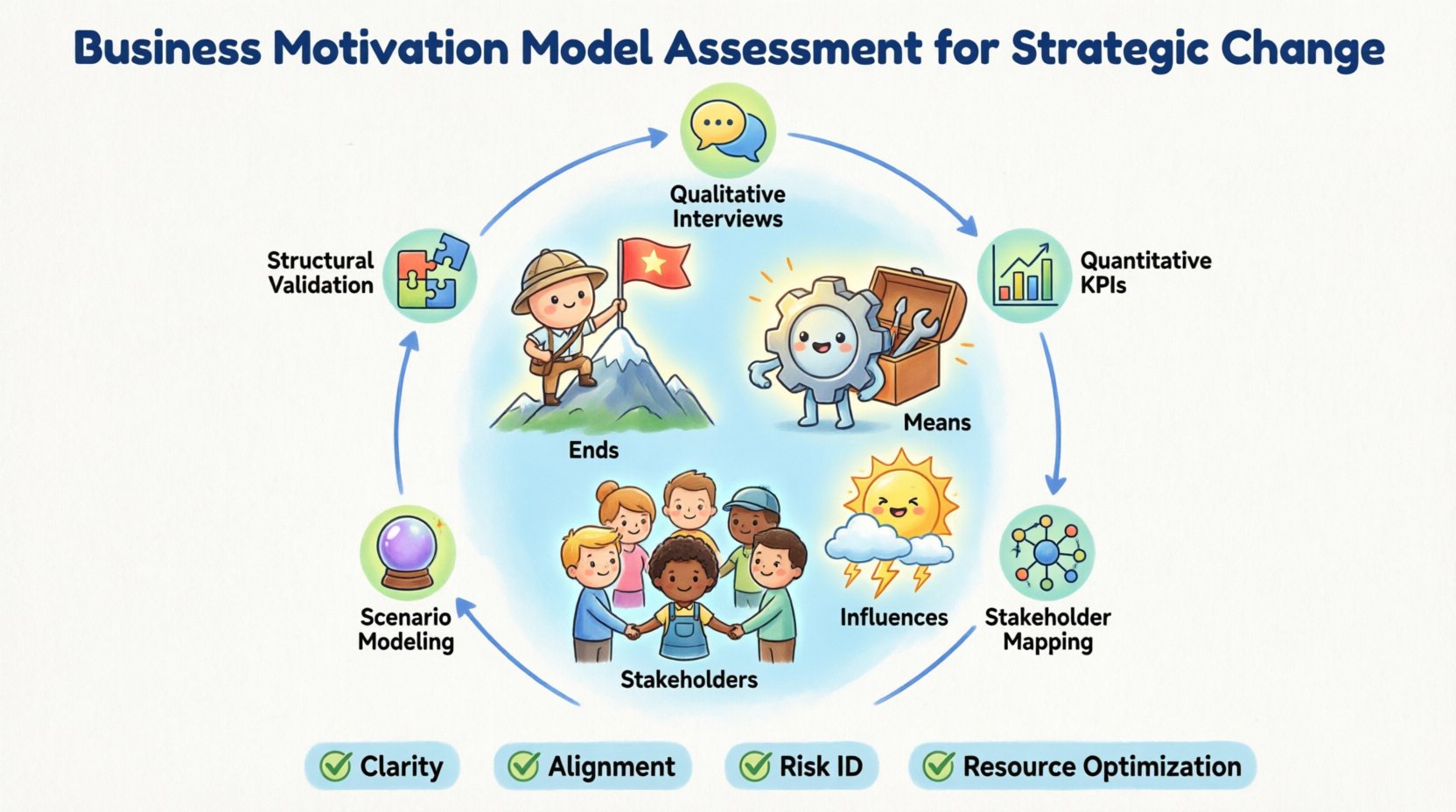
Before diving into assessment, it is essential to understand the components being evaluated. The BMM is not merely a chart; it is a logical structure that describes the relationships between organizational elements. The primary components include:
- Ends: These represent the goals or objectives. They define what the organization wants to achieve. Ends can be strategic (long-term) or tactical (short-term).
- Means: These are the actions or capabilities required to achieve the Ends. They define how the goals will be reached.
- Influences: These are factors that affect the Means or Ends. They can be positive (enablers) or negative (obstacles). Influences often include stakeholder opinions, regulatory constraints, or market conditions.
- Stakeholders: The people or groups who care about the Ends and use the Means. Their motivations drive the entire model.
Assessment in this context means verifying that these components are logically connected and accurately reflect the current state of the business. A flawed model leads to flawed strategy. Therefore, rigorous evaluation is the first step in any change initiative.
📊 Why Assessment Matters for Strategic Change
Strategic change often fails because the underlying assumptions about motivation are incorrect. A common pitfall is assuming that stakeholders want the same things as leadership. Assessment methods help uncover these discrepancies. They provide evidence to support or refute the current strategic direction.
Effective assessment yields several benefits:
- Clarity: It forces stakeholders to articulate their goals clearly.
- Alignment: It reveals where departmental goals conflict with corporate strategy.
- Risk Identification: It highlights influences that could derail the change process.
- Resource Optimization: It ensures that Means are matched to the most critical Ends.
Without this foundation, change initiatives often become disjointed efforts that consume resources without delivering value. Assessment provides the map needed to navigate complexity.
🔍 Key Assessment Methods for BMM
Evaluating a Business Motivation Model requires a mix of analytical techniques. No single method provides a complete picture. Instead, a combination of qualitative and quantitative approaches is necessary. Below are the primary methods used to assess BMM effectiveness.
1. Qualitative Analysis and Interviews
Qualitative methods focus on understanding the human element of the model. This involves gathering insights from key personnel to understand their motivations and perceptions. Interviews are the most common tool here.
- Semi-Structured Interviews: Leaders speak with department heads to discuss how current goals align with their daily operations. Questions focus on barriers and enablers.
- Workshops: Group sessions where stakeholders map their motivations against the proposed strategic Ends. This visualizes alignment and friction points.
- Document Review: Analyzing existing strategy documents, mission statements, and policy papers to see if they match the BMM structure.
This method is excellent for uncovering hidden influences. It captures the nuance of organizational culture that numbers cannot show. However, it can be subjective and prone to individual bias.
2. Quantitative Metrics and KPIs
While qualitative data explains the “why,” quantitative data explains the “how much.” This method involves measuring the performance of the Means against the Ends. It relies on data analytics and performance tracking.
- Goal Achievement Rates: Tracking how many strategic Ends are met within a specific timeframe.
- Resource Utilization: Measuring the efficiency of the Means. Are the capabilities being used effectively to drive results?
- Impact Scoring: Assigning numerical values to Influences based on their historical impact on performance.
Quantitative assessment provides an objective baseline. It helps prioritize which Ends deserve more focus based on past performance data. It reduces the influence of personal opinion on strategic decisions.
3. Stakeholder Influence Mapping
Stakeholders are the engine of motivation. Understanding their power and interest is crucial. This method involves creating a matrix to map stakeholders against the model.
- Power/Interest Grid: Classifying stakeholders based on their ability to influence the change and their level of interest in the outcome.
- Motivation Profiling: Determining what drives each stakeholder group. Is it financial reward, recognition, or stability?
- Conflict Analysis: Identifying where stakeholder motivations clash. For example, Sales may want speed, while Legal wants compliance.
This assessment ensures that the right people are engaged in the right way. It prevents resistance by addressing stakeholder concerns early in the process.
4. Scenario Modeling and Simulation
Strategic change occurs in a dynamic environment. Scenario modeling tests the robustness of the BMM under different conditions. It asks “What if?” questions to see if the model holds up.
- Best-Case Scenarios: Testing how the model performs when all Influences are positive.
- Worst-Case Scenarios: Testing how the model performs when key Influences become obstacles.
- Stress Testing: Introducing unexpected changes, such as market shifts or regulatory updates, to see if the Means remain viable.
This method builds resilience. It prepares the organization for volatility by ensuring the BMM is flexible enough to adapt to changing circumstances.
5. Structural Validation
This method focuses on the logical integrity of the model itself. It checks if the connections between Ends, Means, and Influences make sense.
- Dependency Checks: Ensuring that a Means actually supports its assigned End.
- Circular Reference Detection: Identifying loops where an End depends on a Means which depends on the End.
- Completeness Review: Verifying that all critical stakeholders and goals are represented in the model.
Structural validation ensures the model is not just a diagram but a functional tool. It prevents logical errors that could lead to strategic paralysis.
📋 Comparison of Assessment Methods
To help select the right approach, consider the following comparison of the methods discussed above. Each method has strengths and weaknesses depending on the organizational context.
| Method | Primary Focus | Strengths | Limitations |
|---|---|---|---|
| Qualitative Analysis | Human Motivation | Deep insights, captures culture | Subjective, time-consuming |
| Quantitative Metrics | Performance Data | Objective, measurable | May miss context, lagging indicators |
| Influence Mapping | Stakeholder Dynamics | Identifies risks, engages people | Requires high stakeholder trust |
| Scenario Modeling | Futuristic Robustness | Builds resilience, tests limits | Complex to run, requires data |
| Structural Validation | Logical Integrity | Ensures consistency, prevents errors | Does not measure real-world success |
Combining methods from different categories often yields the best results. For instance, using Qualitative Analysis to define goals and Quantitative Metrics to track them creates a balanced approach.
🛠️ Implementation Framework
Implementing these assessment methods requires a structured approach. It is not a one-time event but a cycle of evaluation and improvement. The following steps outline a practical workflow for integrating assessment into the change process.
Step 1: Define Assessment Scope
Determine which parts of the BMM need evaluation. Is the entire organization in scope, or just a specific department? Define the boundaries of the assessment to manage resources effectively.
Step 2: Select Methodology
Choose the assessment methods that fit the scope. A small team might rely on Qualitative Analysis, while a large enterprise might need Quantitative Metrics. Select based on data availability and time constraints.
Step 3: Data Collection
Gather the necessary information. This could involve sending out surveys, conducting interviews, or extracting data from performance systems. Ensure data privacy and ethical standards are maintained.
Step 4: Analysis and Synthesis
Process the collected data. Look for patterns, gaps, and contradictions. Synthesize findings into a report that highlights areas of strength and weakness in the current model.
Step 5: Strategy Adjustment
Use the findings to refine the BMM. Adjust Ends, Means, or Influences based on the assessment. Update the strategic plan to reflect the new understanding.
Step 6: Continuous Monitoring
Set up mechanisms to track changes over time. Assessment is not a finish line; it is a checkpoint. Regular reviews ensure the model remains relevant as the business environment evolves.
⚠️ Common Pitfalls and Challenges
Even with a solid plan, organizations face challenges during the assessment process. Being aware of these potential pitfalls helps avoid them.
- Confirmation Bias: Stakeholders may only provide information that supports their existing views. Assessment teams must remain neutral and challenge assumptions.
- Over-Engineering: Creating a model that is too complex to be useful. Simplicity is key to adoption. Keep the BMM as lean as possible.
- Static Thinking: Treating the model as a fixed document. BMMs must be living artifacts that evolve with the business.
- Lack of Ownership: If no one feels responsible for the BMM, it will be ignored. Assign clear ownership for maintenance and updates.
- Data Silos: Information often resides in isolated systems. Breaking down silos is necessary to get a holistic view of performance.
Awareness of these challenges allows leaders to mitigate risks. It is better to anticipate obstacles than to react to them after they cause damage.
📈 Measuring Success and KPIs
How do you know the assessment was successful? You need Key Performance Indicators (KPIs) specific to the BMM assessment process. These metrics track the health of the model itself.
- Alignment Score: A calculated metric showing the percentage of tactical goals that directly support strategic Ends.
- Stakeholder Engagement Rate: The percentage of key stakeholders actively participating in the BMM process.
- Goal Realization Time: The average time taken to achieve a defined End.
- Influence Mitigation Rate: The percentage of identified negative Influences that have been successfully managed or removed.
- Model Accuracy: The degree to which predicted outcomes match actual results in scenario modeling.
Tracking these KPIs provides feedback on the effectiveness of the assessment methods. If the Alignment Score is low, the Means-Ends connection needs strengthening. If Stakeholder Engagement is low, communication strategies need improvement.
🚀 Future Trends in BMM Assessment
The field of business modeling is evolving. New trends are emerging that will shape how assessments are conducted in the coming years.
- AI-Driven Analysis: Artificial Intelligence can process vast amounts of data to identify patterns in motivation and performance that humans might miss.
- Real-Time Dashboards: Moving from periodic reports to live data streams that show the status of Ends and Means continuously.
- Integrated Ecosystems: Connecting BMM assessment with other management frameworks, such as Agile or Lean, for a holistic view.
- Collaborative Modeling: Cloud-based platforms that allow stakeholders to contribute to the model in real-time, increasing transparency.
Adopting these trends can enhance the precision and speed of assessment. However, technology should support the process, not replace the critical thinking required for strategic planning.
🤝 Final Thoughts on Strategic Alignment
Evaluating a Business Motivation Model is a critical discipline for any organization aiming for meaningful change. It bridges the gap between high-level vision and ground-level execution. By using a combination of qualitative, quantitative, and structural methods, leaders can build a robust framework that withstands market pressures.
The goal is not perfection, but clarity. A well-assessed BMM provides a shared language for the organization. It ensures that everyone understands what is being pursued and why. This shared understanding is the foundation of sustainable success.
As you move forward, remember that assessment is an ongoing practice. Regular reviews keep the model relevant. Continuous feedback loops ensure that the strategy remains responsive to change. With the right methods in place, strategic change becomes a manageable journey rather than a leap into the unknown.
Start by auditing your current models. Identify the gaps. Select the methods that fit your context. Execute the assessment with rigor. And finally, use the insights to drive better decisions. This is the path to effective strategic management.