

Enterprise architecture demands a clear understanding of the forces driving organizational change. The Business Motivation Model (BMM) provides a standardized framework for capturing the “why” behind business decisions. For architects, this model is not merely a documentation exercise but a strategic tool for alignment. It bridges the gap between high-level strategy and operational execution.
This guide explores practical techniques for applying BMM within an architecture practice. We examine how to define objectives, manage influences, and align tactics without relying on proprietary tools. The focus remains on the structural integrity of the model and its ability to communicate intent across the enterprise.
Understanding the Core Components of BMM 🧩
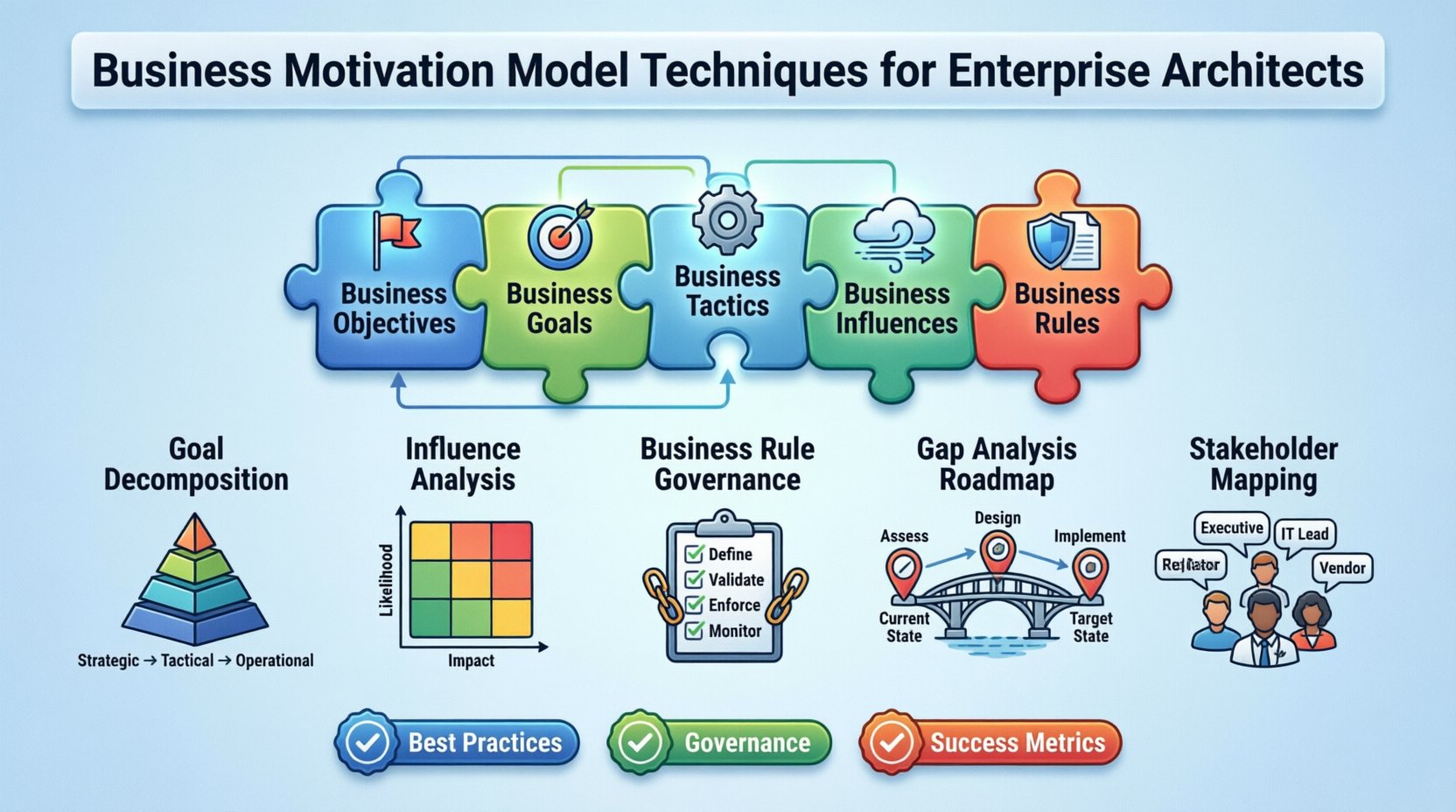
Before applying techniques, an architect must grasp the fundamental elements defined by the Object Management Group (OMG). The model separates the “want” from the “how”.
- Business Objectives: The high-level targets the organization aims to achieve. These are often qualitative and strategic.
- Business Goals: Specific, measurable outcomes that support objectives. They are time-bound and actionable.
- Business Tactics: The specific actions or initiatives taken to achieve goals. These are the “how” in the strategy.
- Business Influences: Factors that affect the achievement of goals or objectives. These can be internal or external.
- Business Rules: Constraints or directives that must be followed. They define the boundaries of operation.
Each component interacts with others. A tactic influences a goal, and a rule constrains a tactic. Understanding these relationships is vital for maintaining architectural coherence.
Technique 1: Strategic Alignment via Goal Decomposition 🎯
One of the primary challenges in architecture is ensuring that IT investments map to business value. BMM facilitates this through hierarchical goal decomposition.
Steps for Effective Decomposition
- Identify Top-Level Objectives: Start with the vision. What is the organization trying to become?
- Break Down into Goals: Convert vision into measurable milestones. Ensure they are SMART (Specific, Measurable, Achievable, Relevant, Time-bound).
- Map Tactics: Assign specific projects or initiatives to each goal. Avoid ambiguity in this layer.
- Validate Traceability: Ensure every tactic can trace back to a goal, and every goal traces back to an objective.
This technique prevents “shadow projects” that do not support the core mission. By maintaining a clear lineage, architects can prioritize initiatives based on strategic importance rather than political influence.
Example Hierarchy
| Level | Example | Characteristics |
|---|---|---|
| Objective | Market Leadership | Visionary, Long-term |
| Goal | Increase Market Share by 10% | Measurable, Time-bound |
| Tactic | Launch Customer Loyalty Program | Actionable, Resource-dependent |
Technique 2: Influence Analysis for Risk Management 📉
Business does not exist in a vacuum. External pressures and internal capabilities shape what is possible. BMM categorizes influences to help architects assess risk and feasibility.
Categorizing Influences
- Internal Influences: Budget, talent availability, legacy systems, and organizational culture.
- External Influences: Regulatory changes, competitor actions, market trends, and technological shifts.
Architects should map these influences directly to goals. If a goal relies on a resource that is subject to a volatile external influence, the goal carries higher risk. This analysis allows for contingency planning.
Impact Assessment Matrix
Use a matrix to score influences based on their power and urgency.
- High Power / High Urgency: Immediate attention required. These are critical blockers or enablers.
- High Power / Low Urgency: Strategic monitoring needed. These require long-term planning.
- Low Power / High Urgency: Operational issues. Delegate or manage quickly.
- Low Power / Low Urgency: Monitor periodically.
By documenting these relationships, the architecture becomes resilient. It acknowledges that plans must adapt when external conditions shift.
Technique 3: Business Rule Governance 📜
Rules are the guardrails of the enterprise. In BMM, they are distinct from logic in software. A business rule defines a constraint on behavior, not an implementation detail.
Distinguishing Rule Types
- Structural Rules: Define what exists. (e.g., “A Customer must have an ID.”)
- Operational Rules: Define how things happen. (e.g., “Orders must be shipped within 24 hours.”)
- Policy Rules: Define compliance requirements. (e.g., “Data must be encrypted at rest.”)
Architects often confuse system constraints with business rules. A system constraint might be “The database supports 10,000 records.” A business rule is “The warehouse can hold 10,000 records.” The former is technical; the latter is operational reality.
Integrating Rules into Architecture
- Extraction: Interview stakeholders to identify hard constraints.
- Formalization: Write rules in a clear, unambiguous language.
- Traceability: Link rules to the specific goals they protect.
- Validation: Test architecture designs against these rules before deployment.
This technique reduces technical debt. When rules are explicit, developers build systems that comply by design rather than by correction.
Technique 4: Gap Analysis and Roadmapping 🗺️
Once the current state and target state are defined, BMM helps visualize the path between them. This is where tactics become a roadmap.
Identifying the Gap
- Capability Gaps: What can the business do now vs. what must it do later?
- Process Gaps: Where are the inefficiencies in the current workflow?
- Technology Gaps: What tools are missing to support the new tactics?
BMM provides the context for these gaps. A capability gap is not just a missing skill; it is a missing link to a strategic goal. This distinction ensures resources are allocated to high-value areas.
Sequencing Initiatives
Not all tactics can happen at once. Dependencies must be managed.
- Foundational Initiatives: Infrastructure and data standards that must come first.
- Enabling Initiatives: Systems that allow other processes to function.
- Value Initiatives: Direct customer-facing improvements.
Mapping these sequences prevents the common error of building advanced features on a broken foundation.
Technique 5: Stakeholder Engagement Mapping 👥
Enterprise architecture is a social activity. The BMM model helps identify who influences what.
Mapping Influencers
- Decision Makers: Those who approve budgets and strategy.
- Process Owners: Those who manage the daily operations.
- Regulators: External bodies imposing rules.
- Customers: The end-users driving demand.
For each stakeholder group, identify their primary goals. A regulator’s goal might be compliance, while a customer’s goal is speed. Architecture must balance these sometimes competing motivations.
Communication Strategy
Use the BMM structure to tailor communication.
- For Executives: Focus on Objectives and Goals. Show alignment with strategy.
- For Managers: Focus on Tactics and Influences. Show how resources are deployed.
- For Teams: Focus on Rules and Capabilities. Show constraints and capabilities.
This ensures that the right message reaches the right audience, reducing friction and confusion.
Integrating BMM with EA Frameworks 🧠
While BMM is a standalone standard, it integrates well with other frameworks like TOGAF or ArchiMate.
Integration Points
- Business Strategy: BMM Objectives map directly to the Architecture Vision.
- Business Architecture: Goals and Tactics inform Capability Maps and Value Streams.
- Application Architecture: Business Rules drive system constraints and logic.
- Data Architecture: Goals define data retention and quality requirements.
This integration creates a unified language. When the strategy changes, the impact on the architecture is immediately visible through the BMM links.
Common Challenges and Mitigation ⚠️
Implementing BMM is not without difficulties. Architects often face resistance or complexity.
Challenge: Model Bloat
As the enterprise grows, the number of goals and tactics can explode. A model with thousands of elements becomes unmanageable.
- Mitigation: Use aggregation. Group related tactics into higher-level themes. Review the model periodically to archive outdated goals.
Challenge: Static Documentation
If the model is only created once, it becomes irrelevant quickly. Business changes faster than documentation.
- Mitigation: Treat the model as a living artifact. Link it to change management processes. Update it during major decision cycles.
Challenge: Cultural Resistance
Stakeholders may view this as extra paperwork.
- Mitigation: Demonstrate value early. Show how a specific BMM analysis prevented a costly mistake or clarified a priority.
Best Practices for Sustainable Implementation ✅
To ensure long-term success, architects should adopt specific disciplines.
- Keep it Simple: Start with the top 10 objectives. Expand only as needed.
- Assign Ownership: Every goal and objective must have a named owner. Accountability drives maintenance.
- Link to Budgeting: Connect tactics to financial planning. If a tactic has no budget, it is not a real tactic.
- Review Cadence: Schedule quarterly reviews to validate the relevance of influences and rules.
These practices transform BMM from a theoretical exercise into a practical management tool.
The Role of Architecture Governance 🛡️
Architecture governance ensures that the BMM model remains consistent with enterprise standards.
Governance Activities
- Definition Standards: Establish templates for writing goals and rules.
- Quality Checks: Verify traceability before approving architecture artifacts.
- Change Control: Manage updates to the BMM model through a formal process.
This oversight prevents fragmentation. Different departments might define “customer satisfaction” differently. Governance ensures a unified definition across the organization.
Measuring Success with BMM 📊
How do you know the model is working? Look for specific indicators.
- Alignment Score: Percentage of IT projects linked to a strategic goal.
- Rule Compliance: Rate of incidents caused by rule violations.
- Goal Achievement: Percentage of time-bound goals met within the target window.
- Stakeholder Satisfaction: Feedback from business leaders on clarity of strategy.
These metrics provide objective data on the effectiveness of the architectural approach.
Future Considerations for BMM 🚀
The landscape of enterprise architecture is evolving. BMM must adapt to new realities.
- Agile Integration: BMM can support agile by defining goals at the program level rather than the project level.
- Data-Driven Insights: Use analytics to update influence scores dynamically.
- Automation: Link rule engines directly to the BMM rule repository for real-time enforcement.
Staying current ensures the model remains relevant as the organization scales.
Final Thoughts on Strategic Modeling 💡
The Business Motivation Model offers a disciplined approach to capturing intent. It forces clarity on what matters and why. For the enterprise architect, it is a lens through which complexity becomes manageable.
By focusing on objectives, goals, tactics, influences, and rules, architects build a foundation that supports sustainable growth. The techniques outlined here provide a roadmap for implementation. Success depends on consistent application and a commitment to accuracy.
When strategy is clear, execution follows. The BMM model ensures that strategy is not just words, but a structured plan that guides every architectural decision.