

The alignment of business intent with operational execution is often where projects succeed or fail. The Business Motivation Model (BMM) offers a structured approach to visualize this alignment. For Business Analysts, understanding this framework is essential for defining clear objectives and ensuring that every requirement traces back to a strategic goal. This guide explores the core components, relationships, and practical application of the BMM standard without relying on specific software tools.
🎯 Understanding the Business Motivation Model
The Business Motivation Model is a standard developed by the Object Management Group (OMG). It serves as a foundation for understanding the why, what, and how of business operations. Rather than focusing solely on the functional requirements of a system, BMM focuses on the motivations behind those requirements.
Business Analysts utilize this model to bridge the gap between high-level strategy and low-level implementation. It provides a common vocabulary for stakeholders to discuss business drivers, goals, and the means to achieve them. By adopting this model, teams can ensure that resources are allocated efficiently and that changes are evaluated against established business intentions.
Core Purpose
- To create a clear link between business strategy and execution.
- To provide a structured way to document business drivers.
- To facilitate communication between strategic planners and operational teams.
- To support decision-making by clarifying the impact of changes.
🧩 The Core Elements of BMM
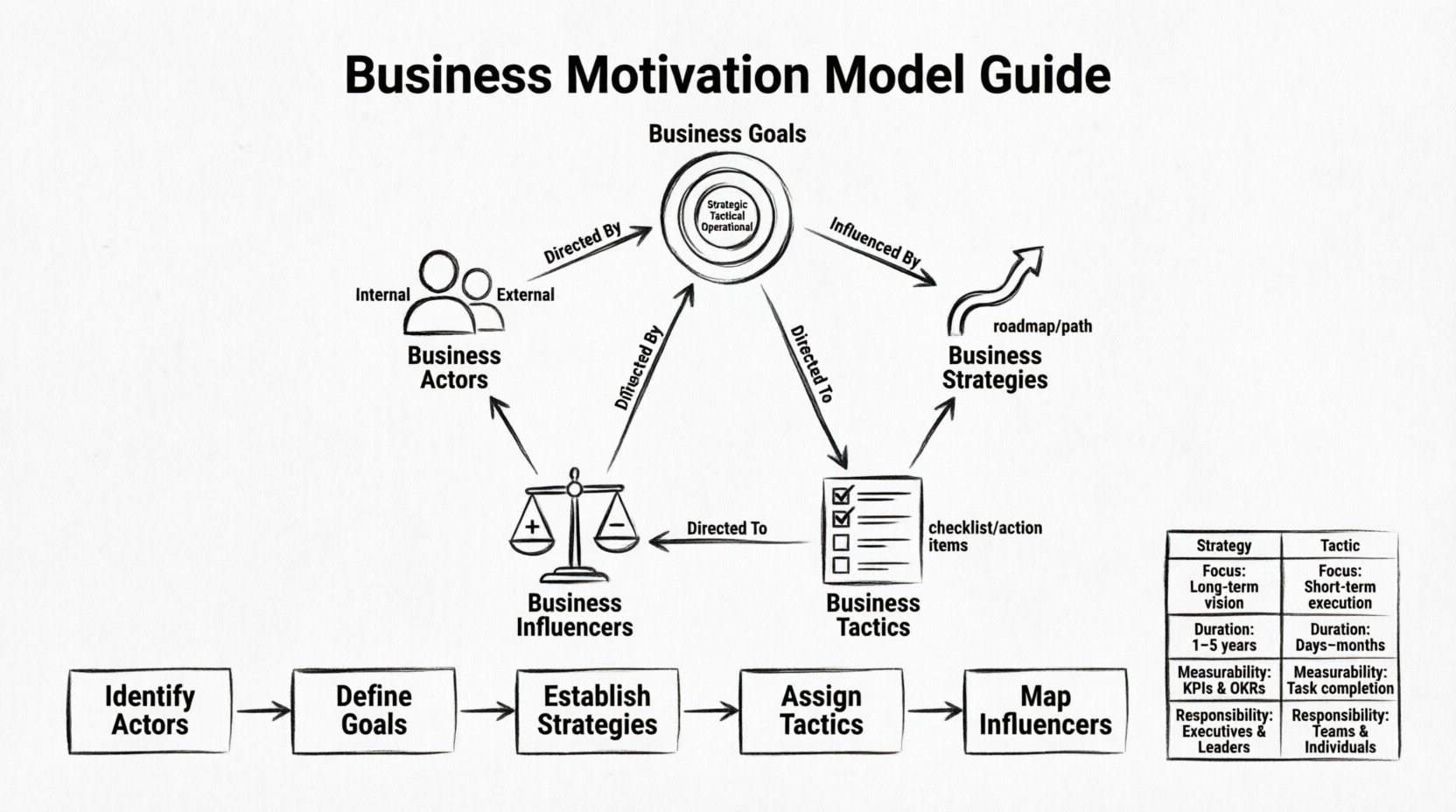
The model is built upon five distinct elements. Each element plays a specific role in the overall structure of business motivation. Understanding these components is the first step toward effective modeling.
1. Business Actors
Business Actors represent the entities responsible for performing business activities. These are not necessarily people, but rather roles or organizations. In the context of requirements, an Actor is who initiates or is affected by the business process.
- Internal Actors: Employees, departments, or management teams within the organization.
- External Actors: Customers, suppliers, regulators, or partners outside the organization.
Identifying actors early helps define who has the authority to set goals and who is impacted by tactics.
2. Business Goals
Goals are the desired outcomes that the business seeks to achieve. They are the why behind the activities. A goal must be specific enough to be actionable but broad enough to allow for flexibility in execution.
Effective goals are often categorized into:
- Strategic Goals: Long-term objectives that define the vision.
- Tactical Goals: Short-term objectives that support strategic goals.
- Operational Goals: Specific targets for day-to-day activities.
3. Business Strategies
Strategies define the approach taken to achieve a goal. They are the methods or plans chosen to bridge the gap between the current state and the desired goal. Strategies are often high-level and may not be directly measurable.
- They explain how a goal will be met.
- Multiple strategies can support a single goal.
- Strategies may be discontinued or modified based on performance.
4. Business Tactics
Tactics are the specific actions or measures taken to execute a strategy. Unlike strategies, tactics are often concrete and measurable. They represent the actual work that is performed.
- Tactics are assigned to specific Actors.
- They are directly linked to requirements or tasks.
- Success is measured by the achievement of the tactic.
5. Business Influencers
Influencers represent the internal and external factors that affect the motivation of the business. They are the context in which goals, strategies, and tactics exist.
- Positive Influencers: Factors that support or enhance performance.
- Negative Influencers: Factors that hinder or obstruct performance.
- These can include market conditions, regulatory changes, or resource availability.
🔗 Relationships and Connections
The power of the Business Motivation Model lies in the relationships between its elements. These relationships define the flow of influence and direction within the business structure.
Directed By
This relationship indicates that a Goal is driven by an Influencer. It answers the question: What is causing this goal to exist?
- A Regulatory Requirement might Direct By a Compliance Goal.
- A Market Opportunity might Direct By a Revenue Goal.
Influenced By
This relationship shows how an Influencer affects a Strategy, Goal, or Tactic. It does not necessarily drive the existence of the element but impacts its success.
- A Budget Constraint might Influence By a Cost-Reduction Tactic.
- A Competitor Launch might Influence By a Marketing Strategy.
Directed To
This relationship connects a Goal to a Strategy or a Strategy to a Tactic. It answers the question: How do we get there?
- A Goal is Directed To a Strategy that outlines the plan.
- A Strategy is Directed To Tactics that outline the actions.
🛠️ Building the Model: A Step-by-Step Approach
Creating a Business Motivation Model requires a systematic process. Below is a logical sequence for Business Analysts to follow when developing the model for a new initiative.
Step 1: Identify Business Actors
Begin by listing all entities involved in the business domain. Distinguish between those who perform work and those who are affected by the work. Use a brainstorming session with key stakeholders to ensure completeness.
Step 2: Define Business Goals
Work with leadership to articulate the primary objectives. Ensure these goals are SMART (Specific, Measurable, Achievable, Relevant, Time-bound). Avoid vague statements like “improve service”; instead use “reduce response time to under 24 hours”.
Step 3: Establish Strategies
For each goal, determine the high-level approach. Ask stakeholders how they plan to achieve the goal. Document these approaches as strategies. Ensure there is a clear logical link between the goal and the strategy.
Step 4: Assign Tactics
Break down each strategy into actionable items. Assign these tactics to specific Business Actors. This step often overlaps with requirements gathering, as tactics often translate into functional or non-functional requirements.
Step 5: Map Influencers
Identify the factors that could help or hinder the model. Categorize them as internal or external. Assign them to the relevant Goals, Strategies, or Tactics. This helps in risk management and contingency planning.
📊 Structuring Information with Tables
To ensure clarity, complex relationships are best presented in tabular formats. The following table illustrates the distinction between Strategies and Tactics.
| Feature | Strategy | Tactic |
|---|---|---|
| Focus | High-level approach | Specific action |
| Duration | Long-term | Short-term |
| Measurability | Indirect | Direct |
| Responsibility | Management | Operational Staff |
Another useful table is for categorizing Influencers. This helps in understanding the environment in which the business operates.
| Category | Example | Impact Type |
|---|---|---|
| Regulatory | New Data Privacy Law | Negative (Compliance Risk) |
| Market | Increased Customer Demand | Positive (Growth Opportunity) |
| Resource | Limited Budget Allocation | Negative (Constraint) |
| Technological | Availability of AI Tools | Positive (Efficiency) |
⚠️ Common Challenges and Solutions
Implementing the Business Motivation Model can present obstacles. Recognizing these early allows for better planning and execution.
- Challenge: Vague Goals. Stakeholders often provide high-level desires without specifics.
Solution: Use workshops to refine goals until they meet measurable criteria. - Challenge: Too Many Actors. The model can become cluttered with too many entities.
Solution: Group actors by department or function to maintain clarity. - Challenge: Weak Relationships. Links between goals and tactics may be unclear.
Solution: Require a justification for every link; if it cannot be explained, remove the link. - Challenge: Static Model. The model becomes outdated quickly.
Solution: Treat the model as a living document; review it during major project milestones.
🚀 Integration with Other Modeling Techniques
The Business Motivation Model does not exist in isolation. It complements other modeling standards used by Business Analysts.
Alignment with Use Cases
Use Cases describe how an Actor interacts with a system. BMM provides the context for why those interactions are necessary. A Use Case should trace back to a Tactic, which traces to a Strategy, which traces to a Goal.
Alignment with Process Models
Business Process Models (BPMN) show the flow of activities. BMM defines the motivation for those activities. When a process change is proposed, the BMM helps determine if the change aligns with business goals.
Alignment with Requirements
Requirements capture what the system must do. BMM captures why the system must do it. This creates a complete traceability chain from strategic intent to functional specification.
📈 Measuring Success and Performance
Once the model is established, it becomes a tool for performance measurement. Key Performance Indicators (KPIs) should be derived directly from the Tactics and Goals.
- Goal Achievement: Measure the degree to which a Goal is met.
- Strategy Effectiveness: Evaluate if the chosen approach is working.
- Tactic Efficiency: Assess the cost and time of specific actions.
Regular reviews ensure that the model remains relevant. If an Influencer changes significantly, such as a new competitor entering the market, the Strategies and Tactics may need adjustment.
💡 Best Practices for Business Analysts
To get the most value from the Business Motivation Model, follow these recommendations.
- Keep it Simple: Start with the most critical goals and tactics. Do not attempt to model the entire enterprise at once.
- Involve Stakeholders: Ensure that those who set the goals are involved in defining the tactics.
- Document Assumptions: Clearly state the assumptions behind each strategy and influencer.
- Visualize the Model: Use diagrams to show relationships. Visual aids improve understanding across the team.
- Update Regularly: Business environments change. Schedule periodic reviews of the model.
🔍 Deep Dive: Goal Decomposition
One of the most powerful aspects of BMM is Goal Decomposition. This process breaks down high-level goals into manageable sub-goals.
Why Decompose?
- Large goals are often too abstract to act upon directly.
- Decomposition allows for parallel work streams.
- It clarifies dependencies between different areas of the business.
How to Decompose
Start with the Strategic Goal. Identify the necessary conditions for it to succeed. These conditions become Sub-Goals. Continue breaking them down until you reach actionable items.
- Strategic Goal: Increase Market Share.
- Sub-Goal 1: Launch New Product Line.
- Sub-Goal 2: Expand into New Region.
- Tactic for Sub-Goal 1: Develop Prototype.
- Tactic for Sub-Goal 2: Hire Local Sales Team.
This hierarchy ensures that every task contributes to the overarching vision.
🌐 The Role of Influencers in Risk Management
Influencers are not just background noise; they are the primary source of risk and opportunity. By explicitly mapping them, Business Analysts can proactively manage uncertainty.
Risk Identification
Every Negative Influencer represents a potential risk. If a resource constraint is listed as an Influencer, it signals a risk to the Tactics dependent on that resource.
Opportunity Identification
Every Positive Influencer represents an opportunity. If a new technology is listed, it signals a chance to improve efficiency or reduce costs.
Contingency Planning
When an Influencer is identified, plan for its impact. Create mitigation strategies for negative factors and adoption plans for positive factors.
🤝 Collaboration Across Teams
The Business Motivation Model acts as a shared language. It facilitates collaboration between different groups within an organization.
- Strategic Planners: Define the Goals.
- Project Managers: Manage the Strategies.
- Business Analysts: Define the Tactics and Requirements.
- Operations: Execute the Tactics.
When everyone uses the same model, communication becomes more efficient. Misunderstandings regarding priorities are reduced because the link between work and goals is explicit.
🔮 Future Considerations
As business environments become more volatile, the need for clear motivation models increases. Agile methodologies often focus on delivery speed, but without a clear BMM, speed can lead to building the wrong things.
Integrating BMM into Agile practices ensures that sprints are aligned with business value. It allows teams to pivot quickly when Influencers change, knowing exactly which Goals are most important.
📝 Final Thoughts
The Business Motivation Model provides a robust framework for Business Analysts to navigate complex organizational structures. By focusing on the motivations behind requirements, teams can ensure that their efforts contribute meaningfully to business success. This model is not just about documentation; it is about alignment.
When implemented correctly, it reduces waste, improves communication, and clarifies decision-making. It transforms the role of the Business Analyst from a requirements collector to a strategic partner. The effort invested in building this model pays dividends throughout the lifecycle of the project.
Start small, focus on the critical drivers, and expand the model as the organization matures. The clarity gained from a well-structured Business Motivation Model is an asset that endures beyond any single project or initiative.