


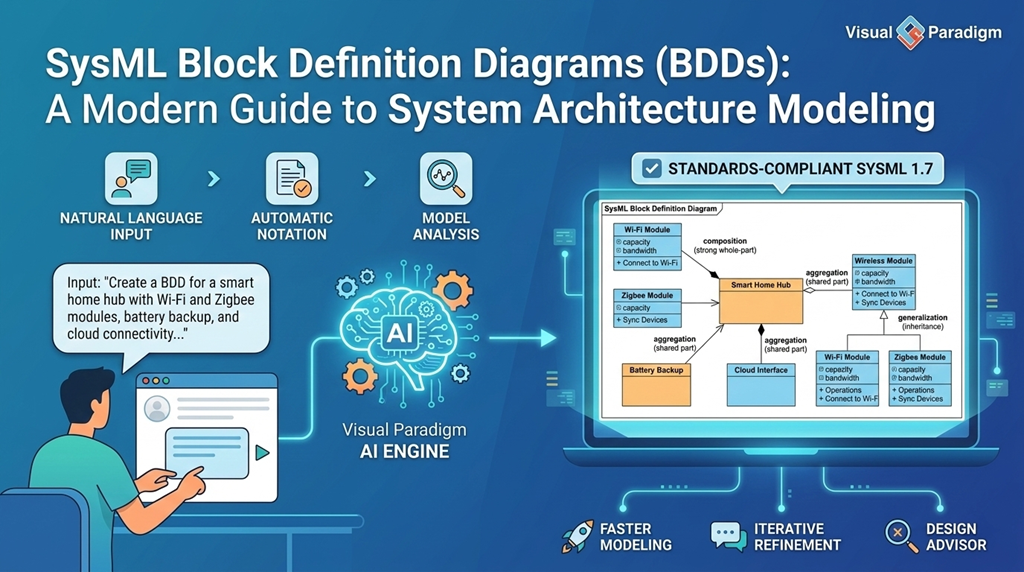
In systems engineering, visualizing a system’s structure is essential for clarity, collaboration, and precision. The Block Definition Diagram (BDD) in SysML (Systems Modeling Language) serves as the foundational blueprint for defining a system’s components and their relationships. This guide explores how BDDs work, why they matter, and how modern tools—especially those powered by AI—can streamline their creation and refinement.
What Is a Block Definition Diagram?
A Block Definition Diagram (BDD) is a structural diagram in SysML that defines the building blocks of a system. These blocks can represent physical components (like a sensor or a motor), software modules, data structures, or even human roles. BDDs are used early in the design process to establish a clear, high-level view of what a system is made of—before diving into internal behavior or interactions.
BDDs are not about how things work, but what exists. They act as a structural map, laying the groundwork for more detailed diagrams like Internal Block Diagrams (IBDs), which explore how blocks connect and interact.
Core Elements of a BDD
- Blocks: Represented as rectangles, blocks are the modular units of a system. Each block encapsulates a system element, such as a “Smart Home Hub” or “Battery Module.”
- Properties: Attributes that define a block’s characteristics—like “capacity” for a battery or “bandwidth” for a network interface.
- Operations: Functions or behaviors a block can perform—such as “Connect to Wi-Fi” or “Send Alert.”
- Relationships:
- Composition (Strong Whole-Part): Indicates that parts cannot exist independently. For example, a “Processor” is composed of a “CPU” and “GPU” — if the processor is removed, the components cease to function.
- Aggregation (Weak Whole-Part): Shows a shared relationship where parts can exist on their own. A “Vehicle” may aggregate a “Tire,” but the tire can be reused in another vehicle.
- Generalization (Inheritance): A hierarchical relationship where a specific block inherits properties and behaviors from a more general one. For instance, “Electric Car” inherits from “Car.”
These elements work together to create a structured, extensible model that supports system analysis, requirements traceability, and design evolution.
Why BDDs Matter in Modern Systems Engineering
BDDs are critical for managing complexity in large-scale systems—especially in domains like aerospace, automotive, and smart technology. They enable engineers to:
- Communicate clearly across teams (designers, developers, testers).
- Ensure consistency between system requirements and design.
- Support early validation of architecture before implementation.
- Enable reuse of well-defined components across projects.
Without a BDD, teams risk misalignment, design flaws, or costly rework. A well-structured BDD ensures that all stakeholders share a common understanding of system structure.
The Rise of AI in SysML Modeling
Creating a BDD manually can be time-consuming and error-prone—especially when dealing with complex systems. Enter AI-powered diagramming tools like Visual Paradigm, which integrate generative AI into the modeling workflow.
How AI Enhances BDD Creation
- Natural Language Input: Users can describe a system in plain English—such as “Create a block definition diagram for a smart home hub with Wi-Fi and Zigbee modules”—and the AI generates a compliant SysML diagram.
- Automatic Notation: The AI ensures correct use of SysML symbols, such as proper composition vs. aggregation arrows, reducing the risk of misinterpretation.
- Rapid Prototyping: Diagrams can be generated in seconds, allowing engineers to explore multiple architectural options quickly.
- Iterative Refinement: Instead of redrawing, users can chat with the AI: “Add a battery backup to the hub,” and the tool updates the model accordingly.
- Model Analysis: AI can detect missing relationships, incomplete properties, or structural inconsistencies—acting as a real-time design advisor.
This shift from manual drawing to AI-assisted design reduces cognitive load and accelerates the design process, allowing engineers to focus on system logic rather than diagram mechanics.
Practical Example: Smart Home Hub BDD
Imagine you’re designing a smart home hub. Using an AI-powered tool, you might input:
“Create a BDD for a smart home hub with Wi-Fi and Zigbee modules, battery backup, and cloud connectivity.”
The AI would generate a diagram with:
- A central Smart Home Hub block.
- Composed of Wi-Fi Module, Zigbee Module, and Battery Backup.
- Aggregated Cloud Interface (since it can exist independently).
- Generalized Wireless Module as a parent of Wi-Fi and Zigbee.
- Properties like “Power Consumption” and “Signal Range.”
- Operations such as “Sync Devices” and “Send Status.”
This model becomes a living document that can evolve with the system.
Tools and Platforms for BDD Modeling
Visual Paradigm stands out as a leading platform for SysML modeling, offering:
Visual Paradigm Desktop: AI Enabled Modeler
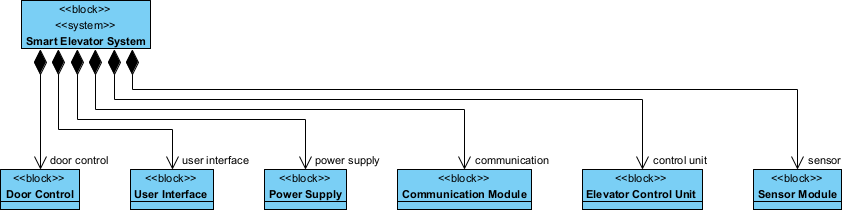
VP Desktop is Visual Paradigm’s flagship application, blending AI speed with professional-grade control. When you need precise SysML modeling—think aerospace systems, automotive architectures, or defense projects—this is where serious work happens.
Visual Paradigm OpenDocs: Smart, AI Powered Knowledge Management Platform
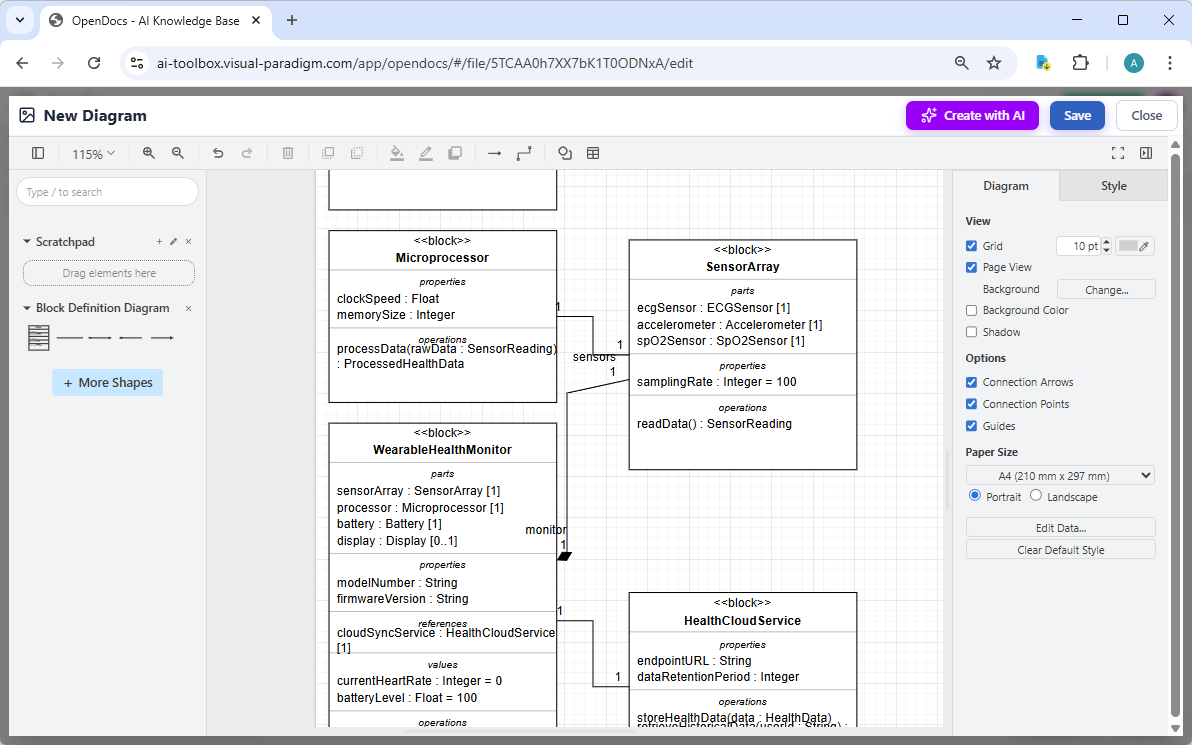
Diagrams don’t live alone. They explain, document, and align teams. OpenDocs turns your SysML Block Definition Diagrams into living parts of knowledge bases, wikis, or reports—think Notion but with editable, dynamic visuals.
Visual Paradigm AI Chatbot for Visual Modelers
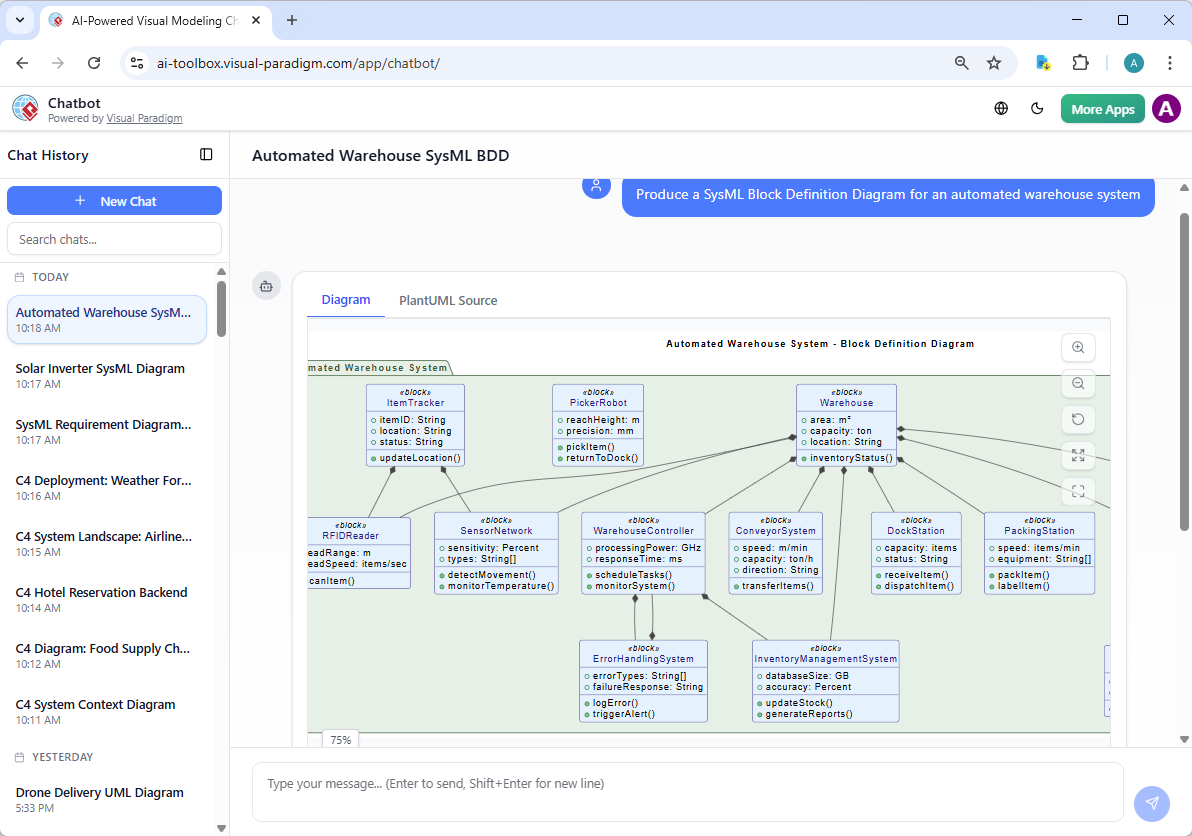
Need a BDD fast, without firing up the full desktop? Visual Paradigm’s AI Visual Modeling Chatbot is your instant co-pilot. It’s conversational, flexible, and surprisingly capable for exploratory work.
Type: “Generate a SysML Block Definition Diagram for a content management system including users, content items, repositories, and access controls.” The AI responds with a clean, editable diagram—blocks, properties, associations—all following SysML conventions. Not happy? Say “Add composition between Repository and ContentItem” or “Explain the value properties here.” It refines instantly.
Best Practices for Using BDDs
- Start Simple: Begin with a high-level view and refine iteratively.
- Use Generalization Wisely: Avoid overusing inheritance; only generalize when it adds clarity.
- Keep Properties and Operations Relevant: Only include what’s necessary for the system’s functionality.
- Validate with Stakeholders: Ensure the BDD reflects shared understanding across teams.
- Integrate with Other Diagrams: Use BDDs as a foundation for IBDs, sequence diagrams, and requirement models.
Conclusion
Block Definition Diagrams are a cornerstone of effective systems modeling. With the integration of AI, creating and refining BDDs has become faster, more accurate, and more intuitive. Tools like Visual Paradigm empower engineers to focus on architectural decisions rather than diagramming mechanics—resulting in better-designed systems, faster time-to-market, and improved collaboration.
As systems grow in complexity, the ability to model structure clearly and efficiently becomes increasingly vital. BDDs, especially when augmented by AI, provide a powerful way to manage that complexity with precision and clarity.
- SysML Block Definition Diagram Guide – Visual Paradigm: A comprehensive overview of BDDs in SysML, including best practices and use cases.
- AI-Powered SysML Diagram Tool – Visual Paradigm: Explore how AI enhances SysML modeling with automatic diagram generation and analysis.
- AI Diagram Generator – Visual Paradigm: A tool that converts natural language into compliant SysML diagrams, including BDDs.
- SysML BDD with AI – Visual Paradigm: A deep dive into using AI to design and validate BDDs.
- Beginner’s Guide to BDDs – Visual Paradigm: A step-by-step introduction to creating and interpreting BDDs.
- AI-Enhanced SysML Modeling – Visual Paradigm: Learn how AI supports SysML modeling across all diagram types.
- AI-Powered UML and SysML – Visual Paradigm: An analysis of AI’s role in modern modeling ecosystems.
- SysML Diagrams with AI – Visual Paradigm: A comparison of UML and SysML in the context of AI-assisted modeling.
- AI Diagrams for Systems Engineering – Visual Paradigm: A review of AI-powered diagramming tools for systems engineering.