


In the modern service economy, tangible products are often secondary to the experience provided. Whether you run a consulting firm, a marketing agency, a healthcare practice, or a logistics network, your primary asset is trust. Trust is built, maintained, and often measured through the voices of your clients. Yet, many service leaders collect feedback without a structured framework to interpret it. This results in data that sits idle rather than driving growth. A SWOT analysis offers the necessary structure. When applied specifically to client feedback, it transforms raw comments into a strategic roadmap. This guide details how to leverage these insights to build a resilient business model.
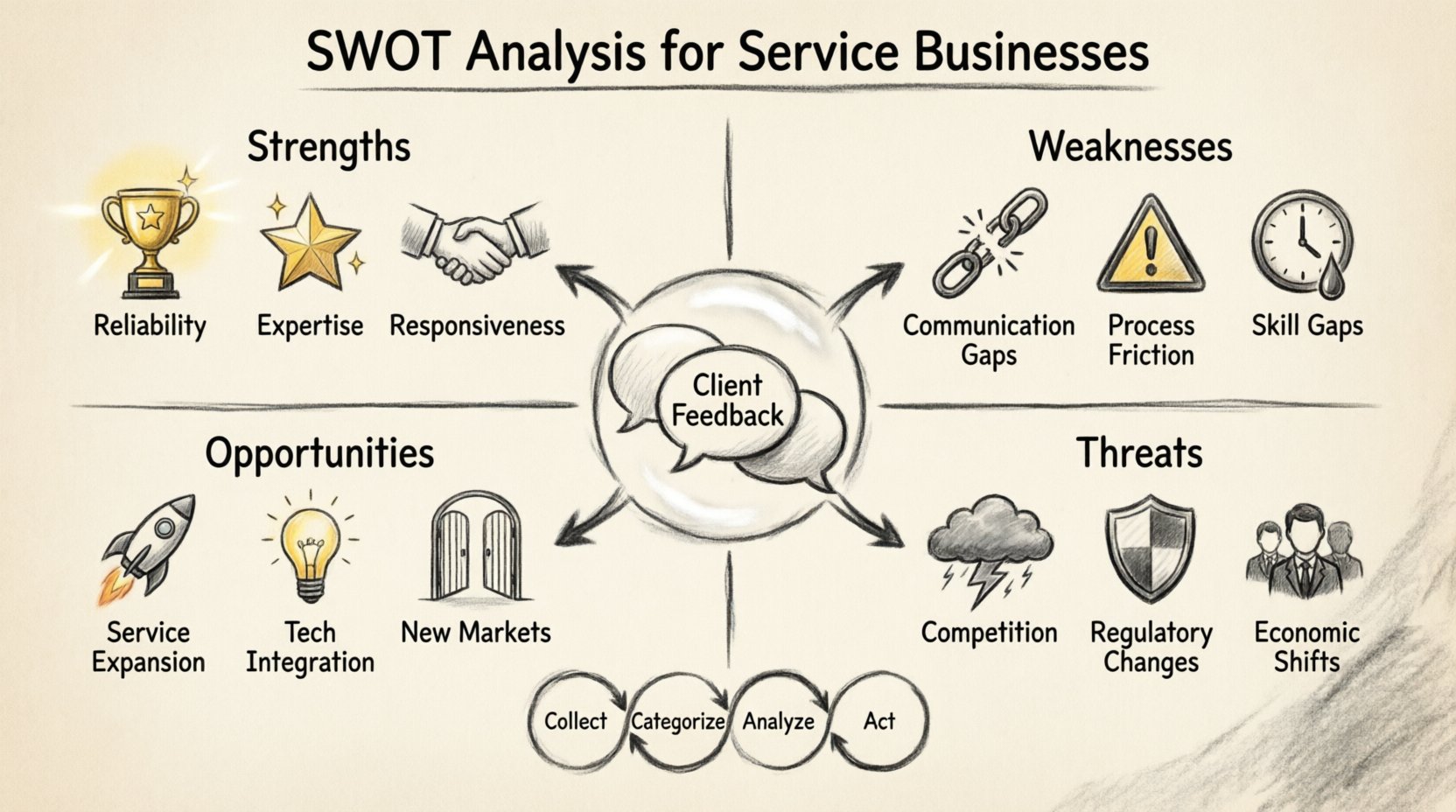
Understanding the SWOT Framework in a Service Context 🛠️
SWOT stands for Strengths, Weaknesses, Opportunities, and Threats. In traditional manufacturing, these elements often relate to supply chains, physical assets, and production efficiency. In service industries, the variables shift. The product is intangible. The delivery is often simultaneous with consumption. Therefore, the SWOT analysis must pivot around human interaction, process flow, and reputation management.
To execute this effectively, you must categorize internal and external factors. Internal factors are within your control, such as staff expertise or operational speed. External factors are market conditions or competitor actions. Client feedback bridges both. A complaint about billing is internal (Weakness), but it might reveal an external threat if competitors offer better transparency.
- Strengths: Internal attributes that help you succeed. In services, this includes specialized knowledge, high retention rates, or a strong brand reputation.
- Weaknesses: Internal limitations that hinder performance. Examples include slow response times, lack of training, or outdated technology.
- Opportunities: External chances to improve or expand. This could be a new market segment, a trend in the industry, or a gap left by competitors.
- Threats: External obstacles that could cause trouble. These include economic downturns, new regulations, or aggressive competitors entering your niche.
Why Client Feedback is the Critical Missing Piece 🔍
Many business owners rely on internal metrics like revenue or profit margins. While important, these are lagging indicators. They tell you what happened last quarter, not what will happen next month. Client feedback is a leading indicator. It signals dissatisfaction before churn occurs and highlights satisfaction before referrals start.
Without feedback, a SWOT analysis is a guess. You might assume your team is efficient because invoices are paid on time. However, if clients complain that communication is sporadic, that is a critical Weakness hidden behind the metric. Feedback provides the qualitative data needed to flesh out the SWOT matrix with reality rather than assumption.
Consider the following dynamic:
- Internal View: “Our team works 12 hours a day to meet deadlines.”
- Client View: “The team is responsive, but the output often requires rework.”
- SWOT Insight: The internal view highlights a Strength (dedication), but the client view reveals a Weakness (quality control). The SWOT analysis resolves this conflict.
Leveraging Feedback for Strengths 💪
Identifying Strengths is often the easiest part of the process, but it requires digging past the obvious. You cannot simply list “good service.” You need specific data points from your clients to validate these claims. Strengths in a service business are the reasons clients choose you over others.
Review your positive feedback for recurring themes. Look for words like “fast,” “clear,” “expert,” or “reliable.” These keywords form the foundation of your Strengths.
Common Strengths Derived from Feedback
- Reliability: Clients consistently mention that you do what you say you will do.
- Expertise: Testimonials highlight deep knowledge or problem-solving abilities.
- Accessibility: Clients feel they can reach you easily when issues arise.
- Customization: Feedback indicates you tailor solutions rather than using a one-size-fits-all approach.
- Responsiveness: Turnaround times are frequently praised in reviews.
Once identified, these strengths should be leveraged in marketing materials and sales conversations. If your feedback shows that clients value “transparency,” make transparency the core of your brand message.
Identifying Weaknesses Through Criticism 🚧
Weaknesses are uncomfortable to confront. They represent areas where the business is losing value. However, client feedback is the most honest source of truth regarding these gaps. Negative feedback, when analyzed correctly, points directly to operational inefficiencies.
Do not view negative feedback as a failure of character. View it as a diagnostic tool. When a client says, “The process was confusing,” they are highlighting a Weakness in your onboarding or communication workflow.
Categorizing Weaknesses from Data
- Communication Gaps: Clients feel left out of the loop or receive vague updates.
- Process Friction: Steps required to engage your service are too complex or time-consuming.
- Skill Gaps: Staff may lack the specific technical knowledge required for complex requests.
- Resource Constraints: Inability to scale services when demand spikes.
- Pricing Perception: Clients feel the value does not match the cost.
Addressing Weaknesses requires action. If communication is the issue, implement a structured update schedule. If pricing is the issue, re-evaluate your value proposition or cost structure. Ignoring these signals leads to stagnation.
Opportunities Hidden in Requests and Gaps 🚀
Opportunities are external possibilities. They often emerge when clients ask for something you do not currently offer. Every request for a new service is a market signal. If multiple clients ask for a specific add-on, that is a validated Opportunity.
Furthermore, Opportunities arise from market shifts. If clients are increasingly concerned with data security, and your current service does not emphasize this, you have an opportunity to pivot your offering to include enhanced security protocols.
Identifying Market Gaps
- Service Expansion: Clients ask for complementary services that fit your existing workflow.
- Technology Integration: Clients want to integrate your service with other tools they use.
- Training & Education: Clients struggle to use your service fully; offering training could be a new revenue stream.
- Segmentation: Feedback reveals a specific niche that is underserved by your current broad strategy.
- Partnerships: Clients mention needing other vendors; you can become the connector.
Threats Revealed by Churn and Negatives ⚠️
Threats are external risks. While you cannot control the market, you can anticipate how it affects your stability. Client feedback often warns of these threats before they become financial crises. High churn rates are a symptom, but the feedback explains the cause.
Competitors are the most common threat. If clients leave saying, “Company X offers a better price” or “Company Y has a better interface,” you are facing a competitive threat. Regulatory changes are another factor. If clients worry about compliance, your service must adapt.
Monitoring External Risks
- Competitor Moves: New features or pricing strategies launched by rivals.
- Economic Shifts: Clients cutting budgets or delaying projects due to inflation.
- Reputation Damage: Negative reviews spreading on public platforms.
- Regulatory Changes: New laws affecting how services are delivered.
- Talent Shortages: Difficulty in hiring or retaining staff to meet client demands.
A Step-by-Step Implementation Guide 📝
Conducting a SWOT analysis based on feedback is not a one-time event. It is a cycle. You must gather, analyze, act, and review. The following steps outline a robust process for service businesses.
1. Data Collection
Gather feedback from multiple channels. Do not rely solely on one method. Diverse sources provide a fuller picture.
- Surveys: Post-project surveys asking specific questions about satisfaction.
- Interviews: One-on-one calls with key accounts for deep insights.
- Reviews: Monitoring public platforms like Google, LinkedIn, or industry-specific sites.
- Support Tickets: Analyzing customer support logs for recurring issues.
- Churn Interviews: Speaking with clients who have left to understand why.
2. Categorization
Once collected, tag every piece of feedback. Use the SWOT categories. This creates a structured database of qualitative data.
- Tag positive praise as Strength.
- Tag complaints about internal processes as Weakness.
- Tag requests for new features as Opportunity.
- Tag mentions of competitors or market changes as Threat.
3. Analysis
Look for patterns. Is one Weakness mentioned more than others? Is one Strength driving the majority of referrals? Prioritize the items that appear most frequently. Frequency indicates impact.
4. Action Planning
Develop specific strategies for each quadrant. Do not leave them as abstract ideas. Assign owners and deadlines. For example, if “Slow Response Time” is a major Weakness, the Action Plan might be to hire two additional support staff by Q3.
Mapping Feedback to Strategy: A Practical Table 📊
To visualize how feedback translates into strategy, consider the following matrix. This table demonstrates how specific client comments map to SWOT categories and the resulting business action.
| Client Feedback Example | SWOT Category | Underlying Issue | Strategic Action |
|---|---|---|---|
| “Your team is always available, but the reports are confusing.” | Weakness | Clarity in deliverables | Redesign reporting templates for simplicity. |
| “We love your expertise in logistics, but you don’t offer air freight.” | Opportunity | Service gap | Research air freight partnerships. |
| “Competitor X offers 24/7 support for the same price.” | Threat | Competitive pressure | Evaluate cost structure for extended hours. |
| “You solved our problem in half the time of others.” | Strength | Efficiency | Highlight speed in marketing materials. |
| “The onboarding process was difficult to navigate.” | Weakness | User experience | Create a dedicated onboarding specialist. |
| “We need more data security compliance for our industry.” | Opportunity | Market demand | Develop compliance add-on packages. |
Common Mistakes to Avoid 🛑
Even with a clear framework, errors can occur during the analysis phase. Being aware of these pitfalls helps maintain the integrity of your strategy.
- Ignoring Negative Data: Focusing only on praise creates a false sense of security. Weaknesses must be addressed to prevent long-term damage.
- Confusing Symptoms with Causes: “Low satisfaction” is a symptom. “Slow response time” is the cause. Address the root cause.
- Generalizing Feedback: Avoid lumping all feedback together. Distinguish between feedback from new clients versus long-term clients.
- Setting It and Forgetting It: A SWOT analysis is static if not updated. Market conditions change, and so do client needs.
- Overloading the List: Do not list fifty Weaknesses. Focus on the top three that have the highest impact.
Ensuring Long-Term Sustainability 🔁
Strategic power comes from consistency. Once you have implemented changes based on your analysis, you must measure the results. Did the response time improve? Did churn decrease? This feedback loop closes the circle.
Integrate SWOT reviews into your regular business rhythm. A quarterly review is often sufficient for most service businesses. This ensures that the strategy evolves alongside the market.
By treating client feedback as the fuel for your SWOT analysis, you move from reactive management to proactive leadership. You stop guessing what your market wants and start delivering it based on evidence.
Final Thoughts on Strategic Growth 🌟
The service industry is defined by relationships. Those relationships are measured by satisfaction, retention, and advocacy. A SWOT analysis grounded in client feedback provides the clarity needed to nurture these relationships. It highlights where you excel, where you falter, where you can grow, and where you must be cautious.
There is no magic formula for success. However, there is a formula for understanding. By systematically collecting, categorizing, and acting on feedback, you build a business that is resilient and responsive. The data is there. The framework is clear. The opportunity is now.