


SWOT analysis is a staple in strategic planning. You have likely seen it in a business school lecture, a corporate boardroom, or a startup pitch deck. It stands for Strengths, Weaknesses, Opportunities, and Threats. It promises clarity. It promises structure. Yet, when teams gather to fill out the four quadrants, the results often feel generic. They feel safe. They rarely drive the transformative change leaders hope for.
There is a quiet problem with how this framework is taught and applied. Most tutorials treat SWOT as a simple checklist. They ignore the psychological traps, the structural limitations, and the context required to make the data actually useful. If you rely on a standard SWOT template without understanding its blind spots, you risk building strategy on a foundation of sand. This guide explores the critical weaknesses often overlooked in basic tutorials. We will examine why these failures happen and how to navigate them without relying on external tools.
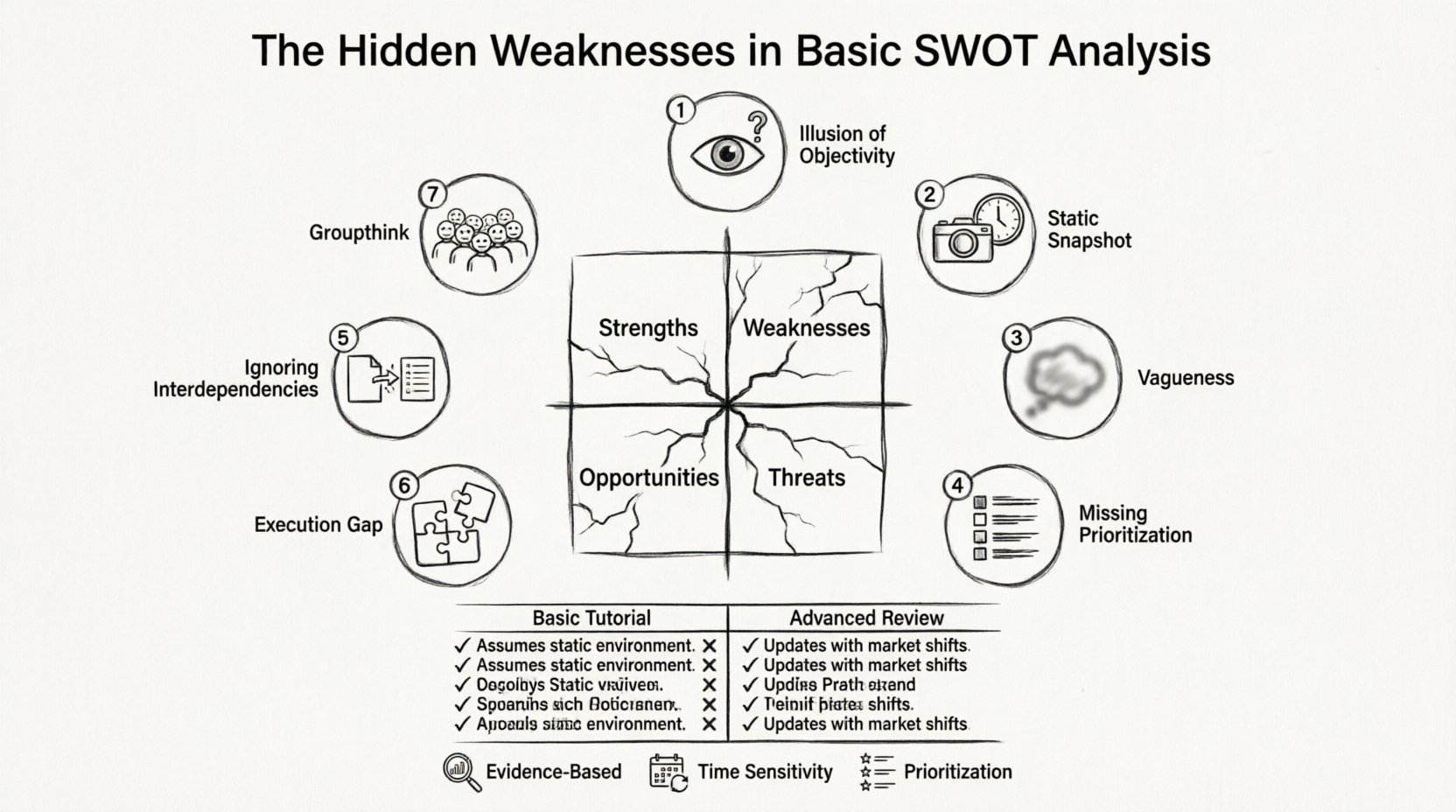
1. The Illusion of Objectivity 🧐
One of the most persistent myths about SWOT analysis is that it is an objective exercise. The framework suggests that you can simply list facts. In reality, every point entered into a SWOT matrix is filtered through human perception. This creates immediate vulnerability.
- Confirmation Bias: Teams often look for data that supports their existing beliefs. If leadership wants to launch a new product, they will categorize market trends as “Opportunities” while ignoring signals that suggest the market is saturated.
- The Halo Effect: If a company has a strong brand reputation, teams may list “Good Brand” as a Strength. This is vague. A strong brand is a perception, not a strategic asset unless linked to specific behaviors like higher price tolerance or lower customer acquisition costs.
- Departmental Silos: Marketing sees “Opportunities” that Sales does not. Engineering sees “Weaknesses” that Product Management ignores. Without deep integration, the SWOT becomes a collection of fragmented views rather than a unified strategic document.
When a SWOT is subjective, it ceases to be a diagnostic tool and becomes a negotiation document. Stakeholders fight over what constitutes a strength versus a weakness. This political friction often dilutes the final output, resulting in a list of points that everyone agrees to, but no one believes deeply.
2. The Static Snapshot Problem 📸
Business environments are dynamic. Markets shift, technologies emerge, and competitor strategies evolve daily. A SWOT analysis is, by definition, a static snapshot of a specific moment in time. This temporal limitation is a major weakness that tutorials rarely emphasize.
Consider a manufacturing company. Today, a specific raw material is cheap (Strength). Next month, a geopolitical event spikes the price (Threat). If the strategy is built solely on the static SWOT, the organization is already vulnerable.
- Lack of Time Horizon: Basic tutorials do not specify the validity period of the analysis. Is this SWOT for the next quarter? The next five years? The ambiguity leads to misaligned resource allocation.
- Velocity of Change: In fast-moving industries like technology, a SWOT created in January may be obsolete by March. Relying on it for long-term planning introduces significant lag time.
- Feedback Loops: A static SWOT does not account for the feedback loops created by the strategy itself. If you act on an Opportunity, you may create a new Threat. The framework rarely maps these dynamic interactions.
To mitigate this, the analysis must be treated as a living document. However, many organizations treat it as a quarterly box-checking exercise, rendering the data stale before it can be utilized.
3. Vagueness and Generic Categorization 📝
One of the most common failures in SWOT analysis is the use of non-actionable descriptors. Tutorials often encourage broad statements because they are easier to agree upon. Unfortunately, broad statements are useless for execution.
Compare these two entries:
- Weakness: “We need better marketing.”
- Weakness: “Current customer acquisition cost is 30% higher than the industry average due to reliance on paid search channels.”
The first statement is a wish. The second is a diagnostic fact. The first leads to a generic directive. The second leads to a specific investigation into channel efficiency.
When teams use vague language, the SWOT fails to provide direction. It becomes a list of complaints and praises rather than a strategic map. This vagueness stems from a fear of specificity. Specificity invites scrutiny. Generalities protect egos.
4. The Missing Prioritization Layer 🚦
SWOT analysis generates a list of items. It does not rank them. In a strategic context, not all Strengths are equal. Not all Threats are equally dangerous. A major weakness in a core competency is far more critical than a minor weakness in an administrative process.
Without a prioritization mechanism, leaders face a paralysis of choice. They see a list of twenty Opportunities and twenty Threats. Which ones do they pursue? Which ones do they defend against?
- Resource Allocation: Resources are finite. If a team attempts to address every item on a SWOT list, they will spread their efforts too thin. Nothing gets done well.
- Opportunity Cost: Focusing on a low-impact Strength means ignoring a high-impact Opportunity. The SWOT framework itself does not calculate this trade-off.
- Urgency vs. Impact: Some Threats are urgent but low impact. Some Opportunities are high impact but require long-term investment. Basic SWOT fails to distinguish between these dimensions.
This lack of hierarchy forces teams to rely on intuition or political power to decide what matters. This introduces another layer of subjectivity that undermines the analysis.
5. Ignoring Interdependencies 🕸️
The quadrants of SWOT are presented as separate boxes. In reality, the elements inside them are deeply interconnected. A Strength can become a Weakness. An Opportunity can trigger a Threat. Basic tutorials treat these quadrants as isolated silos.
Consider the relationship between Strengths and Opportunities. A common strategic move is to leverage a Strength to capture an Opportunity. This is the “S-O” strategy. However, tutorials rarely teach how to identify the friction points between them.
Similarly, consider “W-T” strategies (mitigating Weaknesses to avoid Threats). If a company has a weak supply chain (Weakness) and faces potential trade tariffs (Threat), the strategy should be to diversify suppliers. But a basic SWOT might just list “Supply Chain” under Weakness and “Tariffs” under Threat without explicitly linking them in the action plan.
6. The Execution Gap ⚙️
Perhaps the most significant weakness is the disconnect between the analysis and the execution. Organizations spend weeks analyzing but days executing. The SWOT becomes a decorative artifact rather than a working document.
- Storage, Not Strategy: The final SWOT document is often archived in a shared drive. It is never referenced again after the meeting ends.
- No Accountability: A SWOT list rarely assigns owners to specific points. Without ownership, the items on the list remain abstract concepts.
- Missing Metrics: There is rarely a definition of success attached to the items. How do we know if we have fixed the Weakness? How do we measure the capture of the Opportunity?
This gap turns the SWOT into a formality. It satisfies the need for “strategic planning” without delivering the value of “strategic action.”
7. Internal Politics and Groupthink 🗣️
SWOT sessions are often facilitated by leadership or consultants. This dynamic can suppress honest feedback. If a team member identifies a critical Weakness that reflects poorly on a leader, they may hesitate to write it down.
- Power Dynamics: Junior staff may not feel safe challenging senior staff during the categorization of “Strengths” and “Weaknesses.”
- Consensus Bias: Groups tend to converge on the middle ground. The most critical, controversial, or insightful points are often smoothed over to maintain harmony.
- External Validation: Teams often look for external validation of their internal feelings. They want the SWOT to confirm what they already want to believe, rather than challenge their assumptions.
Comparison: Basic vs. Advanced Strategic Review
To understand the gap between a standard tutorial and a robust strategic process, consider the following comparison.
| Feature | Basic SWOT Tutorial | Advanced Strategic Review |
|---|---|---|
| Time Horizon | Undefined / Static | Defined (e.g., 12-month rolling) |
| Data Source | Intuition / General Knowledge | Market Data / Customer Feedback / Internal Metrics |
| Specificity | Vague (e.g., “Good Brand”) | Specific (e.g., “Brand loyalty score 85%) |
| Prioritization | None | Weighted Scoring / Impact Matrix |
| Ownership | Team-wide | Individual Accountability |
| Review Cycle | Annual / Ad-hoc | Quarterly / Trigger-based |
| Connection | Isolated Quadrants | Interlinked Action Plans |
Mitigating the Weaknesses 🛠️
Recognizing the flaws is only the first step. To build a more resilient strategy, you must adjust the approach. Here is how to strengthen the process without changing the fundamental framework.
1. Enforce Evidence-Based Criteria
Require data for every point. If a team member lists a Strength, ask for the metric that supports it. If they list a Threat, ask for the source of the intelligence. This forces specificity and reduces subjectivity.
2. Assign Time Sensitivity
Tag each item with a validity date. Mark items that are high priority for the next 90 days versus those relevant for the next year. This acknowledges the static nature of the framework and forces regular updates.
3. Implement Prioritization Matrices
Use a voting system or a scoring model to rank items. Ask stakeholders to rate each item on Impact and Probability. This moves the discussion from “Is this true?” to “Does this matter enough to act on?”
4. Link to Action Plans
Do not end the session with the SWOT chart. End it with a list of initiatives. Every item on the SWOT should have a corresponding task, owner, and deadline. If an item cannot be linked to an action, it should be moved to a “Watch List” rather than a “Do List.”
5. Encourage Dissent
Assign a “Devil’s Advocate” role during the session. This person’s job is to challenge the categorization of every item. They ask, “Is this really a strength, or just a status quo?” This protects against groupthink.
6. Map Interdependencies
Create a cross-reference map. Draw lines between Strengths and Opportunities. Draw lines between Weaknesses and Threats. Visualizing these connections helps teams see how solving one problem might solve another.
Common Pitfalls in Application ⚠️
Even with adjustments, teams often stumble. Here are specific scenarios where SWOT analysis goes wrong.
- Listing Symptoms, Not Causes: “Low Revenue” is a symptom. “High Churn” is a cause. “Product Mismatch” is the root cause. A SWOT focused on symptoms leads to band-aid solutions.
- Confusing Internal and External: Strengths and Weaknesses are internal. Opportunities and Threats are external. Teams frequently list external factors under Internal categories, which confuses the strategy.
- Overloading the List: A SWOT with 100 items is a laundry list. A SWOT with 5 to 10 critical items is a strategy. Limit the list to force prioritization.
- Ignoring the Customer: Many SWOTs are entirely internal-focused. They list what the company does well without asking if the customer cares. External relevance is a prerequisite for strategic success.
The Role of Context 🌍
A SWOT analysis cannot exist in a vacuum. It requires context. What is the mission of the organization? What are the financial constraints? What is the culture?
For a startup, a “Weakness” in “Lack of Cash” is normal. For a mature enterprise, it is a critical risk. The meaning of the SWOT items depends entirely on the organizational stage and environment. This contextual nuance is often lost in generic templates.
Final Thoughts on Strategic Clarity 💡
SWOT analysis remains a valuable tool, but it is not a magic wand. It is a starting point, not an endpoint. The weaknesses identified in this guide—subjectivity, static nature, vagueness, lack of prioritization, and execution gaps—are not reasons to abandon the framework. They are reasons to treat it with rigor.
When you move beyond the basic tutorial, you transform a simple grid into a strategic engine. You demand evidence. You enforce prioritization. You link analysis to action. You accept that the landscape changes and plan for it.
By acknowledging the hidden weaknesses, you protect your strategy from the most common failure modes. You stop building on sand and start building on rock. This requires discipline and honesty, but the payoff is a strategy that actually works in the real world.