


The business landscape shifts with increasing velocity. Strategies that secured market share five years ago may become liabilities today. To navigate this volatility, organizations require more than static planning. They need a dynamic framework capable of forecasting change. The traditional Strengths, Weaknesses, Opportunities, and Threats (SWOT) model is a foundational tool, but it often lacks the temporal depth required for modern strategy.
This guide details how to adapt the SWOT methodology into a forward-looking instrument. By integrating trend analysis and scenario planning into the standard quadrants, you can build a resilient brand architecture. This approach moves beyond reactive problem-solving to proactive positioning. It is about understanding not just where you stand, but where the ground is moving beneath you.
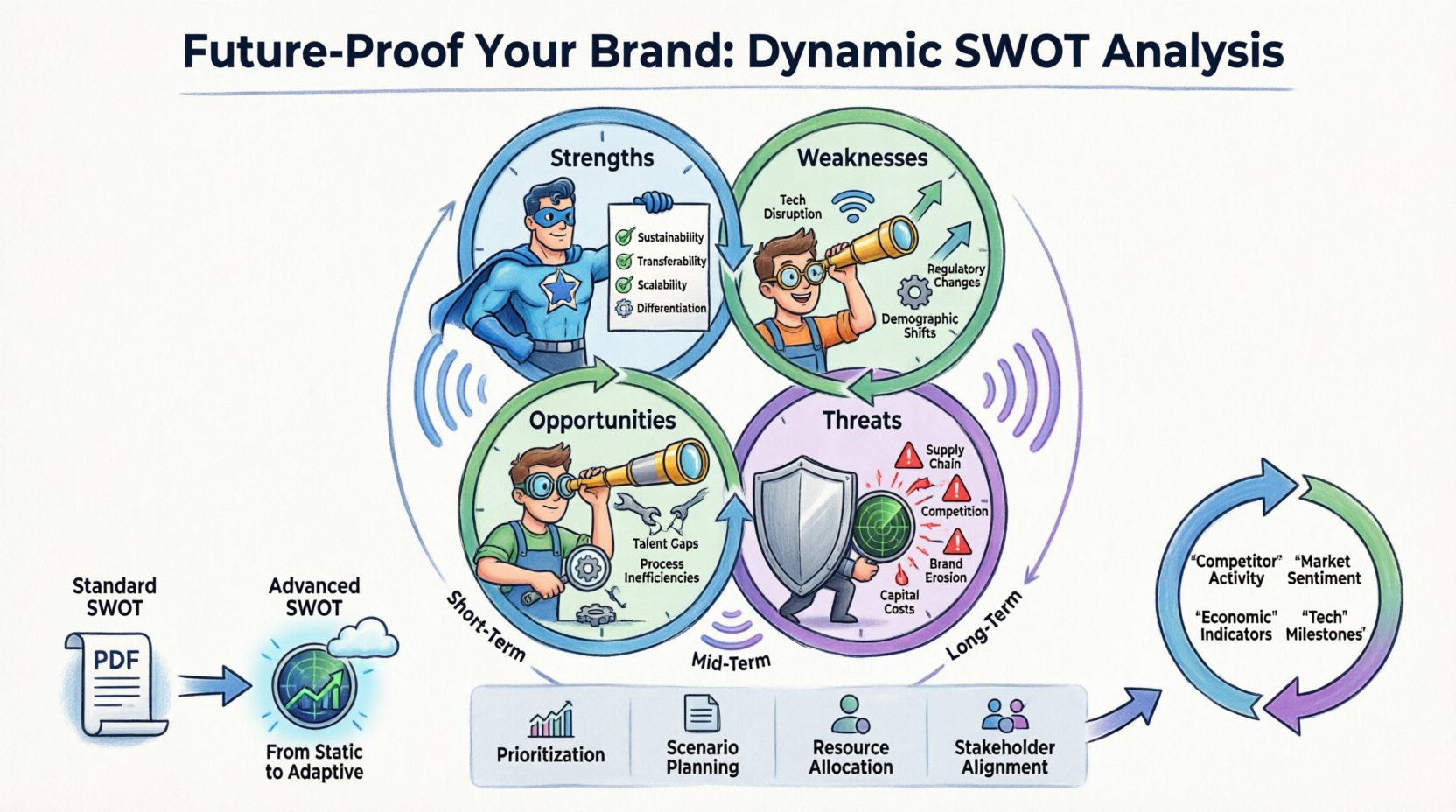
Why Standard SWOT Falls Short in a Dynamic Market 🛑
Traditional SWOT analysis often functions as a snapshot in time. It captures the current state of an organization but fails to account for the momentum of external forces. When teams conduct a standard session, they frequently rely on historical data. This creates a lag between reality and strategy. In an era defined by rapid technological disruption and shifting consumer behaviors, a static view is insufficient.
Common limitations include:
- Temporal Blindness: Focusing on the present ignores the trajectory of industry shifts.
- Internal Focus: Teams often spend too much time debating internal capabilities rather than external signals.
- Lack of Actionability: Lists of strengths and weaknesses often remain documents that are filed away, never translated into execution.
- Static Assumptions: The model assumes a linear progression, whereas modern markets operate in cycles and disruptions.
To future-proof a brand, the analysis must evolve. It must become a tool for anticipation rather than just description.
Introducing the Dynamic SWOT Framework ⏳
An advanced SWOT analysis integrates predictive indicators into the traditional quadrants. This method treats the brand as a living system interacting with an environment that is constantly changing. The goal is to identify not only current positions but also future vulnerabilities and latent potential.
This framework relies on three core principles:
- Contextual Depth: Data is gathered from broader market signals, not just internal metrics.
- Temporal Awareness: Each quadrant is evaluated across different time horizons (short-term, mid-term, long-term).
- Interconnectivity: Strengths are linked to potential threats; weaknesses are mapped to emerging opportunities.
The following table outlines the differences between a standard approach and this advanced methodology.
| Feature | Standard SWOT | Advanced Future-Focused SWOT |
|---|---|---|
| Time Horizon | Current State | Current + Predicted Future |
| Data Source | Internal Reports | Internal + External Market Signals |
| Output | Static List | Strategic Scenarios & Action Plans |
| Focus | Positioning | Resilience & Adaptability |
| Review Cycle | Annual | Continuous Monitoring |
Reimagining Opportunities: Predicting Market Shifts 🔍
In a traditional analysis, an opportunity is often a gap in the market identified through current customer complaints. An advanced analysis looks for structural changes. It asks what the market will demand three years from now, not just today.
To identify these forward-looking opportunities, teams must scan specific external vectors:
- Technological Disruption: Look for emerging technologies that could render current solutions obsolete or create entirely new categories.
- Regulatory Changes: Monitor legislative trends that could alter compliance costs or open new markets.
- Demographic Shifts: Analyze population movements and generational value changes that affect purchasing power.
- Societal Values: Track cultural shifts regarding sustainability, ethics, and transparency.
For example, a brand analyzing the beverage industry might notice a standard opportunity in health trends. An advanced analysis would predict the shift towards functional ingredients or personalized nutrition based on data patterns.
Criteria for Validating Future Opportunities
Not every trend represents a viable opportunity. To filter signal from noise, apply these filters:
- Scalability: Can the brand scale this opportunity without breaking existing infrastructure?
- Alignment: Does this opportunity align with the core mission and brand identity?
- Timing: Is the market ready for this shift, or is it too early to capture value?
- Competitive Moat: Does this opportunity provide a defensible advantage against competitors?
Reimagining Threats: Anticipating Risks Before They Materialize 🌪️
Threats are often treated as problems to be solved after they appear. In a future-proof strategy, threats are risks to be mitigated before they impact revenue. This requires looking beyond immediate competitors to existential risks.
Common sources of future threats include:
- Supply Chain Fragility: Global dependencies that could be severed by geopolitical events.
- Cannibalization: New products or services that might erode existing revenue streams.
- Brand Erosion: Changes in public sentiment that could damage reputation.
- Capital Costs: Rising costs of resources or energy that squeeze margins.
Advanced threat assessment involves stress testing the brand. Ask what would happen if a specific trend accelerated faster than expected. This helps identify the “black swan” events that could disrupt the business model.
Threat Matrix for Strategic Planning
| Threat Type | Probability | Impact Level | Mitigation Strategy |
|---|---|---|---|
| Regulatory Change | High | Medium | Advocacy & Compliance Overhaul |
| Competitor Innovation | Medium | High | R&D Acceleration & Partnership |
| Consumer Sentiment Shift | Low | Critical | Brand Monitoring & PR Response |
| Supply Disruption | Medium | High | Diversification of Suppliers |
Reimagining Strengths: Building Capabilities for Tomorrow 🏗️
Current strengths are often based on legacy systems. A brand might have a strong distribution network that was built for a different era. To future-proof, you must assess which strengths will remain valuable.
Ask these questions during the evaluation:
- Sustainability: Will this strength hold up as market conditions change?
- Transferability: Can this strength be applied to new products or markets?
- Scalability: Can this strength grow without diminishing returns?
- Differentiation: Is this strength truly unique, or is it an industry standard?
For instance, a company with a vast physical footprint might view it as a strength. However, if the market moves toward digital-first experiences, this strength could become a burden. The analysis must identify how to pivot this asset, perhaps by converting it into a logistics advantage for e-commerce.
Core Competency Audit
Use this checklist to audit your internal capabilities:
- Human Capital: Do you have the talent to adapt to new technologies?
- Financial Health: Is there liquidity to invest in innovation during downturns?
- Brand Equity: Is the brand trusted enough to launch new categories?
- Operational Agility: How quickly can you pivot processes when needed?
Reimagining Weaknesses: Identifying Structural Gaps 🏗️
Weaknesses are often viewed negatively. In strategic planning, they are simply gaps that need closing before the future arrives. An advanced analysis looks for weaknesses that will be exacerbated by future trends.
Consider these areas:
- Legacy Debt: Technical or financial obligations that slow down innovation.
- Talent Gaps: Missing skills required for the next phase of growth.
- Process Inefficiencies: Bottlenecks that will worsen as volume increases.
- Brand Perception: Internal biases or outdated messaging that alienate new demographics.
Addressing these weaknesses is not about fixing everything. It is about prioritizing the gaps that pose the highest risk to future stability.
Integrating Data into Strategic Decisions 📊
Once the quadrants are filled with forward-looking data, the analysis must translate into action. This requires a structured approach to decision-making. The output should not be a report, but a roadmap.
The following steps ensure the analysis drives real change:
- Prioritization: Rank items based on impact and feasibility. Focus on high-impact, high-feasibility items first.
- Scenario Planning: Develop plans for best-case, worst-case, and most-likely scenarios based on the identified threats and opportunities.
- Resource Allocation: Direct budget and talent to the areas that strengthen the brand against future risks.
- Stakeholder Alignment: Ensure leadership and teams understand the rationale behind the strategic shifts.
Continuous Monitoring and Adaptation 🔄
A SWOT analysis is not a one-time event. It is a cycle. The environment changes, and the analysis must evolve with it. Establishing a rhythm for review is critical for maintaining brand resilience.
Set up a monitoring system that tracks key indicators identified in the analysis. This might include:
- Competitor Activity: New product launches or pricing changes.
- Market Sentiment: Social listening and customer feedback trends.
- Economic Indicators: Inflation rates, interest rates, and consumer spending power.
- Technological Milestones: Adoption rates of new tools or platforms.
When a trigger point is reached, revisit the SWOT matrix. Update the data, reassess the risks, and adjust the strategy. This keeps the organization agile.
Case Study: Applying the Framework 📝
Consider a hypothetical mid-sized retail brand. A traditional analysis might list “strong physical stores” as a strength and “online competition” as a threat.
An advanced analysis would dig deeper:
- Strength: Physical stores offer immediate gratification. Future Application: Use stores as fulfillment hubs for local delivery to reduce shipping costs.
- Weakness: Limited data on customer behavior in-store. Future Application: Implement digital touchpoints to capture data and personalize offers.
- Opportunity: Growing demand for sustainable sourcing. Future Application: Launch a transparent supply chain initiative to attract conscious consumers.
- Threat: Supply chain volatility affecting inventory. Future Application: Diversify suppliers and increase safety stock for key items.
This level of detail transforms the analysis from a list into a strategic asset.
Building a Culture of Strategic Foresight 🧠
The most advanced tool is useless without the people to use it. Building a culture that values foresight ensures the analysis is taken seriously. Encourage teams to question assumptions. Reward those who identify risks early.
Key cultural shifts include:
- Transparency: Share findings openly so everyone understands the risks and opportunities.
- Collaboration: Involve cross-functional teams to get diverse perspectives.
- Learning: Treat failures as data points for future analysis.
- Curiosity: Foster an environment where asking “what if” is encouraged.
Final Considerations for Long-Term Success
Future-proofing is not about predicting the exact future. It is about preparing for multiple possibilities. The goal is to build a brand that is robust enough to withstand shocks and agile enough to seize new chances.
By upgrading your SWOT analysis to include predictive elements, you move from reacting to events to shaping them. This requires discipline and a commitment to continuous learning. It demands that you look beyond the immediate horizon and plan for the horizon that is forming.
Start by auditing your current processes. Identify where the data is static and where it needs to be dynamic. Engage your team in a session focused on the future, not just the present. The result will be a strategy that stands the test of time.
Remember that the market does not wait. It evolves, and your strategy must evolve with it. Use this framework to build a brand that is not just surviving the future, but thriving within it.