


Launching a new venture involves navigating a landscape filled with uncertainty. Every founder faces the challenge of allocating limited resources toward initiatives that yield the highest return. Without a structured approach to strategic planning, even the most innovative ideas can stumble over overlooked obstacles. This is where the SWOT analysis becomes an essential tool for clarity. By systematically evaluating internal capabilities and external conditions, new ventures can identify their true position before making critical decisions. This guide provides a comprehensive breakdown of how to conduct this analysis effectively, ensuring you build a foundation based on reality rather than assumption.
Why Strategic Planning Matters for Startups 📉
Many entrepreneurs jump straight into execution, assuming that speed will outpace competition. While agility is a core advantage of new ventures, lack of direction can lead to wasted capital and burnout. Strategic planning is not about creating a rigid document that sits on a shelf. It is about creating a mental model of your business environment. It forces the team to confront uncomfortable truths regarding their operations and the market.
Without this visibility, blind spots emerge. These are areas of risk or opportunity that remain invisible until they impact the bottom line. A blind spot in cash flow management can stall growth. A blind spot in competitor activity can render a product obsolete. The SWOT framework serves as a diagnostic instrument to illuminate these hidden areas. It creates a shared language for the team to discuss risks and strengths objectively.
Understanding the SWOT Framework 🎯
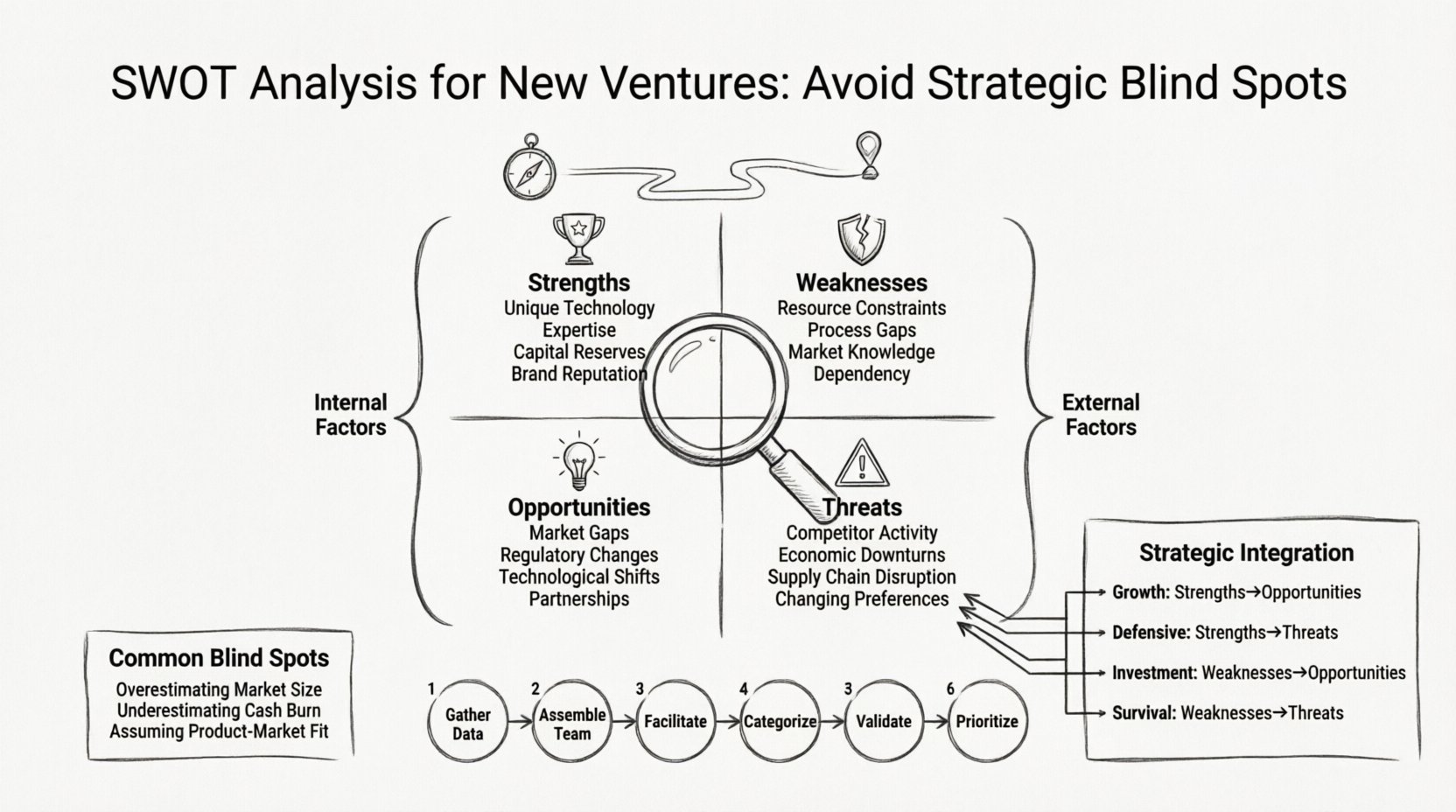
SWOT stands for Strengths, Weaknesses, Opportunities, and Threats. It is a matrix that categorizes factors influencing a business. The key to using this framework effectively lies in understanding the distinction between internal and external factors.
- Internal Factors: These are elements within your control. They relate to the organization itself. Strengths and Weaknesses fall into this category.
- External Factors: These are elements outside your organization. They relate to the market, economy, and industry. Opportunities and Threats fall into this category.
Confusing these two categories is a common error. For example, a competitor’s new product launch is an external factor (Threat), not a weakness in your own company. A weakness would be your inability to manufacture that product at a similar cost. Keeping this distinction clear is vital for accurate analysis.
Deep Dive: The Four Quadrants 🔍
To build a robust strategy, you must analyze each quadrant in depth. Generic answers like “good team” or “high competition” are insufficient. You need specific, actionable data.
1. Strengths (Internal) 💪
Strengths are what you do better than anyone else. In a new venture, these are your initial advantages. They are not just assets you own, but capabilities you possess.
- Unique Technology: Do you have proprietary code or a patent that competitors cannot easily replicate?
- Expertise: Does the founding team have specific domain knowledge that reduces the learning curve?
- Capital Reserves: Do you have enough runway to survive a downturn longer than peers?
- Brand Reputation: Is there existing goodwill from previous ventures or industry standing?
When listing strengths, focus on what drives value. A large office space is not necessarily a strength if it increases burn rate without increasing revenue. Focus on efficiency and capability.
2. Weaknesses (Internal) 🛡️
Weaknesses are internal limitations that hinder performance. Acknowledging these requires honesty. It is tempting to gloss over gaps, but doing so creates risk.
- Resource Constraints: Limited funding, small team size, or lack of technical infrastructure.
- Process Gaps: Absence of standard operating procedures leading to inconsistent output.
- Market Knowledge: Lack of understanding of specific customer segments or distribution channels.
- Dependency: Reliance on a single vendor, channel, or key individual.
Identifying weaknesses allows you to plan mitigation strategies. If you lack in-house coding, you might plan to outsource specific modules until you can hire. If you rely on one channel, you might allocate budget to test others.
3. Opportunities (External) 💡
Opportunities are favorable conditions in the external environment that you can exploit. They are trends or changes that align with your strengths.
- Market Gaps: Competitors are ignoring a specific niche or customer segment.
- Regulatory Changes: New laws that favor your business model or restrict competitors.
- Technological Shifts: New tools that lower your cost of acquisition or improve delivery.
- Partnerships: Potential alliances that can expand your reach without heavy investment.
Opportunities must be actionable. A growing market is an opportunity only if you have the capacity to capture it. If the market is growing but your distribution is weak, it is not a viable opportunity yet.
4. Threats (External) ⚠️
Threats are external challenges that could cause trouble for the business. These are often the hardest to control, requiring adaptation rather than elimination.
- Competitor Activity: Large incumbents entering your space or price wars.
- Economic Downturns: Reduced consumer spending affecting your target demographic.
- Supply Chain Disruption: Reliance on materials that could become scarce or expensive.
- Changing Customer Preferences: Shifts in taste or behavior that reduce demand for your solution.
Understanding threats allows for contingency planning. If a supply chain disruption is a threat, you identify alternative suppliers before the crisis hits.
Structuring the Analysis: A Practical Approach 📊
Conducting a SWOT analysis requires a structured process to avoid bias. Follow these steps to ensure data quality.
- Gather Data: Collect market research, customer feedback, financial records, and internal performance metrics.
- Assemble the Team: Include diverse perspectives. A developer sees different strengths than a salesperson.
- Facilitate the Session: Dedicate time for focused discussion without distractions.
- Categorize Findings: Sort ideas into the four quadrants.
- Validate: Check if the points are factual or assumed. Remove assumptions.
- Prioritize: Select the top three items in each category to focus on.
Do not treat this as a one-time event. It is a living document that should be reviewed quarterly.
Common Strategic Blind Spots in New Ventures ⚠️
Even with a framework, founders often miss critical elements. Below is a table detailing common blind spots and how to address them.
| Blind Spot | Impact | Correction Strategy |
|---|---|---|
| Overestimating Market Size | Over-allocation of marketing spend | Validate with pre-orders or paid pilots before scaling |
| Underestimating Cash Burn | Runway exhaustion before profitability | Model worst-case scenarios, not best-case |
| Ignoring Regulatory Risks | Fines or forced shutdown | Consult legal counsel early regarding compliance |
| Assuming Product-Market Fit | Building features nobody wants | Conduct continuous customer interviews |
| Team Skill Gaps | Bottlenecks in execution | Map skills against roadmap requirements honestly |
These blind spots often stem from optimism bias. Founders naturally want to believe their venture will succeed. The SWOT analysis acts as a reality check to counter this tendency.
From Analysis to Action: Strategic Integration 🔄
Completing the matrix is only half the work. The value lies in connecting the quadrants to form a strategy. This involves cross-referencing factors to create actionable plans.
Matching Strengths to Opportunities
This is your growth strategy. Identify where your internal capabilities can seize external market openings. For example, if you have a strong engineering team (Strength) and a new technology standard is emerging (Opportunity), you should prioritize building a solution around that standard immediately.
Using Strengths to Mitigate Threats
This is your defensive strategy. How can you use what you are good at to protect yourself? If you have a loyal customer base (Strength) and a competitor is launching a cheaper alternative (Threat), you can leverage your community to highlight value over price.
Fixing Weaknesses to Seize Opportunities
This is your investment strategy. What must you improve to capture potential? If you want to expand into a new region (Opportunity) but lack local sales staff (Weakness), you might invest in hiring or partnerships to bridge that gap.
Minimizing Weaknesses to Avoid Threats
This is your survival strategy. Which internal flaws leave you exposed to external risks? If you have high employee turnover (Weakness) and a talent shortage in the industry (Threat), you must improve culture and retention immediately.
When to Revisit the SWOT Analysis 📅
The business environment is dynamic. A SWOT analysis conducted today may be outdated in six months. Set triggers for review.
- Quarterly Reviews: A standard cadence to update data.
- Milestone Completion: After launching a major feature or hitting a revenue target.
- Market Shifts: If a competitor launches a major product or regulations change.
- Funding Rounds: Before seeking investment, as investors will scrutinize your strategic understanding.
Treating the analysis as a static document leads to strategic drift. Regular updates keep the team aligned with current realities.
The Role of Culture in Strategic Planning 🧠
A SWOT analysis is only as good as the culture surrounding it. If the team culture punishes bad news, the “Weaknesses” and “Threats” sections will be incomplete. Founders must foster an environment where transparency is rewarded. If an employee identifies a risk, they should be thanked, not silenced.
Psychological safety is the foundation of honest strategic planning. When team members feel safe admitting faults, the analysis becomes a tool for improvement rather than a blame exercise. This culture ensures that the strategic plan reflects the actual state of the venture.
Integrating with Other Planning Tools 🔗
SWOT is not a standalone strategy. It works best when integrated with other frameworks.
- Business Model Canvas: Use SWOT to validate assumptions in the canvas blocks.
- OKRs (Objectives and Key Results): Use SWOT findings to set realistic objectives.
- Financial Projections: Adjust revenue and cost assumptions based on identified threats and strengths.
By connecting SWOT to these operational tools, you move from theory to execution. The analysis informs the numbers, and the numbers validate the analysis.
Conclusion on Strategic Clarity 🌟
Success in new ventures is rarely accidental. It is the result of deliberate planning and continuous adaptation. The SWOT analysis provides the structure needed to navigate uncertainty. By distinguishing between internal and external factors, and by rigorously validating your assumptions, you reduce the risk of failure.
Remember that the goal is not to predict the future perfectly, but to prepare for multiple futures. A clear view of your strengths, weaknesses, opportunities, and threats empowers you to make better decisions. It shifts the focus from reactive firefighting to proactive strategy. Use this tool to build resilience. Regularly update your understanding of the landscape. Ensure your team is aligned on the realities of the market. With this clarity, you position your venture to withstand challenges and capitalize on growth.
Start the analysis today. Gather your team. Write down the facts. The path forward becomes clearer when you stop guessing and start knowing.