


Operating a business single-handedly presents a unique set of challenges and opportunities. Unlike established entities with layers of management and vast capital reserves, you possess agility and direct access to your customers. However, the landscape is dominated by giants. To navigate this effectively, you need a structured approach to understanding your position. The SWOT analysis serves as this foundation. It is not merely a buzzword; it is a diagnostic tool that clarifies your standing.
Many solopreneurs feel overwhelmed by the sheer scale of market competition. They assume that size equals success and that resources are the only path to growth. This perspective overlooks the inherent advantages of being small. You can pivot quickly. You can build personal relationships. You can focus on niches that are too small for larger players to address. But to leverage these advantages, you must see them clearly. This guide details how to conduct a rigorous SWOT analysis tailored for the independent operator.
Understanding the Framework 🧩
A SWOT analysis breaks down your business environment into four distinct categories. These categories help separate internal factors from external factors. They also distinguish between positive factors and negative factors. This separation is critical for strategic planning. Without this structure, information remains scattered and actionable insights are difficult to extract.
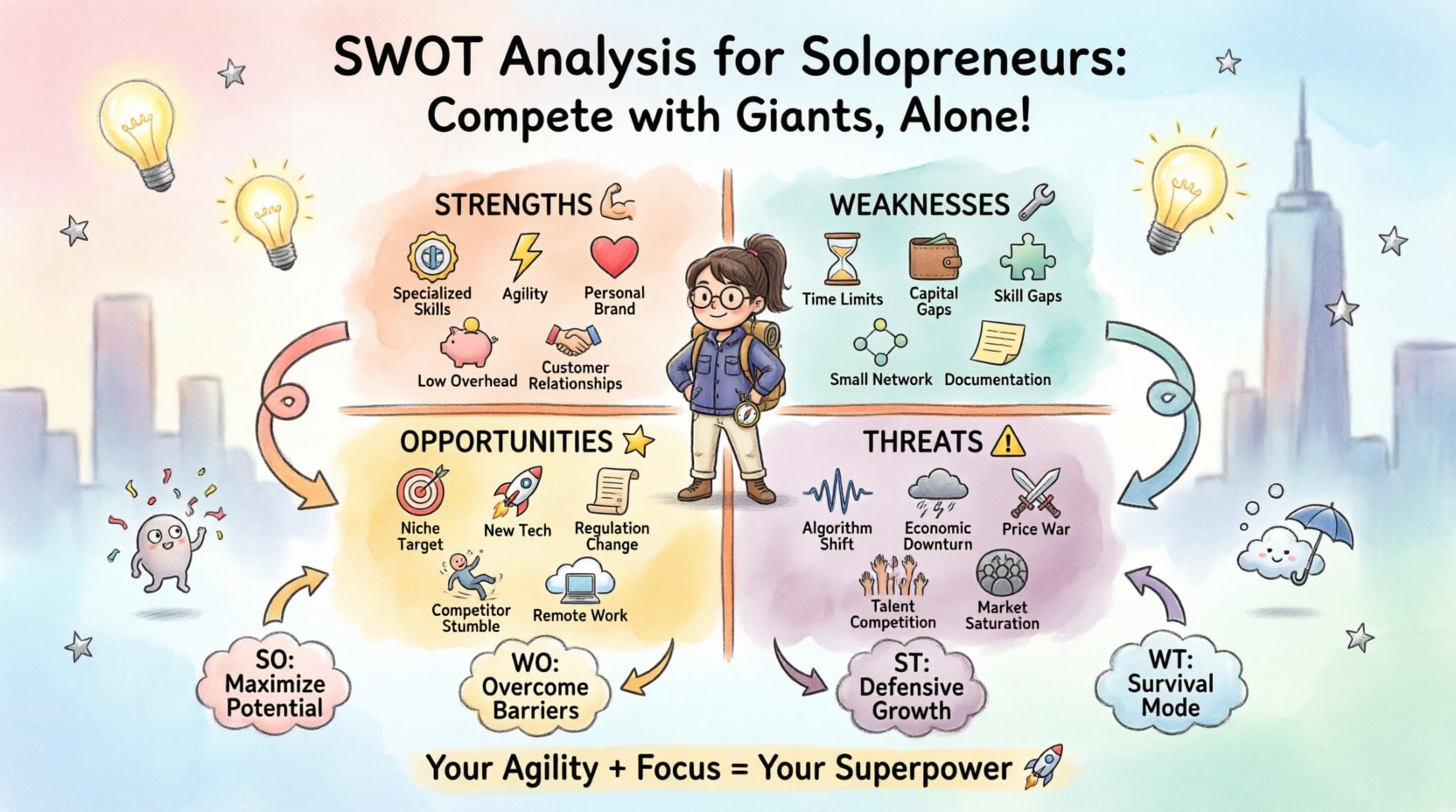
Here is the breakdown of the four quadrants:
- Strengths: Internal attributes that give you an advantage.
- Weaknesses: Internal attributes that place you at a disadvantage.
- Opportunities: External conditions that you could exploit for growth.
- Threats: External conditions that could cause trouble for your business.
When you analyze these factors, you move from guessing to planning. You stop reacting to market changes and start anticipating them. This shift in mindset is the first step toward sustainable independence.
Internal Analysis: Strengths and Weaknesses 🔍
Internal factors are things you control. They reside within your operations, your skills, and your resources. You can change these factors with effort and time. For a solopreneur, understanding your internal landscape is vital because you wear all the hats. You are the CEO, the sales team, the product developer, and the support staff.
Identifying Your Strengths
Strengths are not just about what you are good at. They are about what you do better than others. In a crowded market, this distinction defines your survival. Consider the following areas when evaluating your strengths:
- Specialized Skills: Do you have a technical certification or a niche expertise that generalists lack?
- Agility: Can you launch a product or change a strategy faster than a large team?
- Personal Brand: Do clients trust you personally, rather than just the company logo?
- Cost Structure: Do you have lower overhead costs than competitors who rent large offices?
- Customer Relationships: Can you offer a level of personal attention that big corporations cannot scale?
Be honest here. Strengths are not bragging rights. They are assets you can leverage. If you are a writer, your speed is a strength. If you are a consultant, your deep industry knowledge is a strength. List them without hesitation.
Identifying Your Weaknesses
Weaknesses are internal limitations. Acknowledging them is not a sign of failure; it is a sign of maturity. If you ignore a weakness, it will eventually become a threat. Common weaknesses for solo operators include:
- Time Availability: You have only 24 hours in a day. Can you scale your output without burning out?
- Capital Reserves: Do you have enough cash flow to survive a slow quarter?
- Skill Gaps: Is there a specific task, like tax preparation or advanced coding, that you struggle with?
- Network Size: Do you have a limited pool of referral partners compared to large firms?
- Process Documentation: Is your work reliant on your memory, making it hard to delegate later?
Documenting weaknesses allows you to plan around them. If you lack capital, you focus on high-margin, low-cost services. If you lack time, you automate or outsource specific tasks. Awareness creates options.
External Analysis: Opportunities and Threats 🌍
External factors are outside your direct control. You cannot force the market to change, but you can adapt to it. This quadrant requires you to look outward. You must monitor industry trends, competitor moves, and economic shifts. This is where you find the gaps that big corporations miss.
Spotting Opportunities
Opportunities are favorable circumstances in the external environment. They are openings for expansion. For a solopreneur, opportunities often exist in the gaps left by larger entities.
- Niche Markets: Large companies often ignore small segments. Is there a specific demographic you can serve?
- New Technologies: Are there new tools or platforms that can increase your efficiency without heavy investment?
- Regulatory Changes: Do new laws create a need for compliance consulting that you can fill?
- Competitor Missteps: Is a competitor losing reputation? Can you capture their dissatisfied clients?
- Remote Work Trends: Is there a growing demand for asynchronous, independent collaboration?
Opportunities require action. Identifying them is useless if you do not act. Once you spot a gap, you must move quickly. Speed is your weapon here.
Assessing Threats
Threats are elements in the environment that could cause your business to falter. They are risks you must mitigate. Threats are often external shifts that reduce your market share or increase your costs.
- Algorithm Changes: If you rely on social media traffic, how will a platform update affect you?
- Economic Downturns: Will clients cut your budget when the economy slows?
- Price Wars: Will large competitors lower their prices to undercut you?
- Talent Competition: Will big firms hire the specific freelancers you need for help?
- Market Saturation: Are too many people entering your specific niche?
Recognizing a threat allows you to build a defense. If you fear algorithm changes, you diversify your traffic sources. If you fear economic downturns, you build a cash reserve. Preparation is the antidote to fear.
The Strategic Matrix 📊
Now that you have gathered data for all four quadrants, you need to organize it. A table helps visualize the relationships between these factors. This matrix is not static. You should update it quarterly.
| Internal Factors | Positive (+) | Negative (-) |
|---|---|---|
| External Factors | ||
| Positive (+) (Opportunities) | SO Strategies Use strengths to take advantage of opportunities. |
WO Strategies Overcome weaknesses by taking advantage of opportunities. |
| Negative (-) (Threats) | ST Strategies Use strengths to avoid or reduce threats. |
WT Strategies Minimize weaknesses to avoid threats. |
This grid transforms analysis into strategy. Let us look at how to apply each section.
SO Strategies: Maximizing Potential
These strategies focus on growth. You combine what you are good at with what the market wants. For example, if you have deep coding skills (Strength) and there is a demand for custom automation tools (Opportunity), you build that product. You are not chasing leads; you are answering a call.
WO Strategies: Overcoming Barriers
These strategies focus on improvement. You use an opportunity to fix a weakness. If you lack marketing skills (Weakness) but there is a free webinar series available (Opportunity), you attend and learn. You use the external resource to build internal capacity.
ST Strategies: Defensive Growth
These strategies focus on protection. You use your strengths to shield against threats. If you have a loyal client base (Strength) and a new competitor enters (Threat), you engage them with personalized service that a new entrant cannot match. You defend your territory using your best assets.
WT Strategies: Survival Mode
These strategies focus on risk reduction. You minimize weaknesses to avoid threats. This is the most critical quadrant for solopreneurs. If you have limited cash (Weakness) and inflation is rising (Threat), you cut non-essential expenses immediately. You stop bleeding resources to survive the storm.
Common Pitfalls in Solo Planning ⚠️
Even with a framework, errors occur. Solopreneurs often make specific mistakes during this process. Recognizing these pitfalls ensures your analysis remains accurate.
- Over-optimism: You might list too many strengths and ignore real weaknesses. You need to be objective. Ask peers for feedback to validate your self-assessment.
- Static Thinking: You might create the analysis once and file it away. The market changes. Your business changes. This document must be alive.
- Ignoring Data: Relying on feelings instead of metrics. If you say you have “good traffic,” you need to know the numbers. Data drives better decisions than intuition.
- Copying Others: Do not copy a template from a large corporation. Their context is different. Their threats are not your threats. Your analysis must be specific to your reality.
- Lack of Follow-through: You list strategies but do not implement them. A plan without action is just a wish list. Prioritize one strategy from the SO quadrant and execute it this week.
Execution and Maintenance 🛠️
Once the analysis is complete, the real work begins. You must integrate these insights into your daily workflow. Do not keep this document in a drawer. Keep it visible. You can print it and put it on your desk, or keep it in a digital file that you access regularly.
Regular reviews are essential. Set a calendar reminder every three months to revisit the matrix. Ask yourself:
- Have any strengths become obsolete?
- Have any new threats emerged?
- Did we capitalize on the opportunities we identified?
- Did we mitigate the risks we predicted?
Business is dynamic. The plan must evolve with the environment. If you find a weakness you cannot fix, you must accept it and manage around it. If you find a threat you cannot avoid, you must prepare a contingency fund. Flexibility is key to longevity.
Competing Against Giants 💪
It is natural to feel intimidated by large corporations. They have budgets and teams. But they have inertia. They move slowly. They make decisions through committees. They often lose touch with individual customer needs. This is your advantage.
You compete on connection, not just cost. You compete on speed, not just scale. You compete on specificity, not just volume. When you run a SWOT analysis, keep this mindset. Do not try to beat them at their own game. Play a different game where you are the champion.
Use your agility to test ideas quickly. If an idea fails, you lose little. If it succeeds, you gain fast. Use your personal brand to build trust faster than a faceless logo. Use your specialized skills to solve problems that generalists cannot.
There is no need to fear the competition. They are not your enemy; they are your context. They define the market conditions you operate in. By understanding your position relative to them through this analysis, you gain clarity. You see where you fit. You see where you stand. You see the path forward.
Final Considerations for the Independent Operator 🎯
The goal of this exercise is not perfection. It is clarity. You do not need a perfect business plan. You need a clear understanding of where you are and where you are going. The SWOT analysis provides this map.
Remember that your greatest asset is you. Your resilience, your creativity, and your drive are the core of your business. Protect these assets. Nurture them. Do not let them burn out in the pursuit of growth that outpaces your capacity. Balance is a strategy in itself.
As you move forward, keep your eyes on the horizon. Watch for shifts. Adapt your strategies. Stay true to your values. The market will continue to change, but your ability to analyze and adapt will remain constant. This is the skill that ensures you do not just survive, but thrive in the independent space.
Start today. Grab a blank document. List your Strengths. List your Weaknesses. List your Opportunities. List your Threats. Then, look at the connections. That is where the strategy lives. That is where your future is built.