


Strategic planning requires clarity. Without a clear understanding of your current standing, future goals remain abstract. The SWOT analysis serves as a foundational framework for this understanding. It provides a structured method to evaluate Strengths, Weaknesses, Opportunities, and Threats. Whether you are leading a startup, managing a department, or planning a personal career path, this tool offers necessary perspective.
This guide provides a comprehensive checklist. It ensures you examine every angle of your situation. We will move beyond simple definitions to actionable steps. By following this process, you build a robust foundation for decision-making.
Understanding the SWOT Framework 🔍
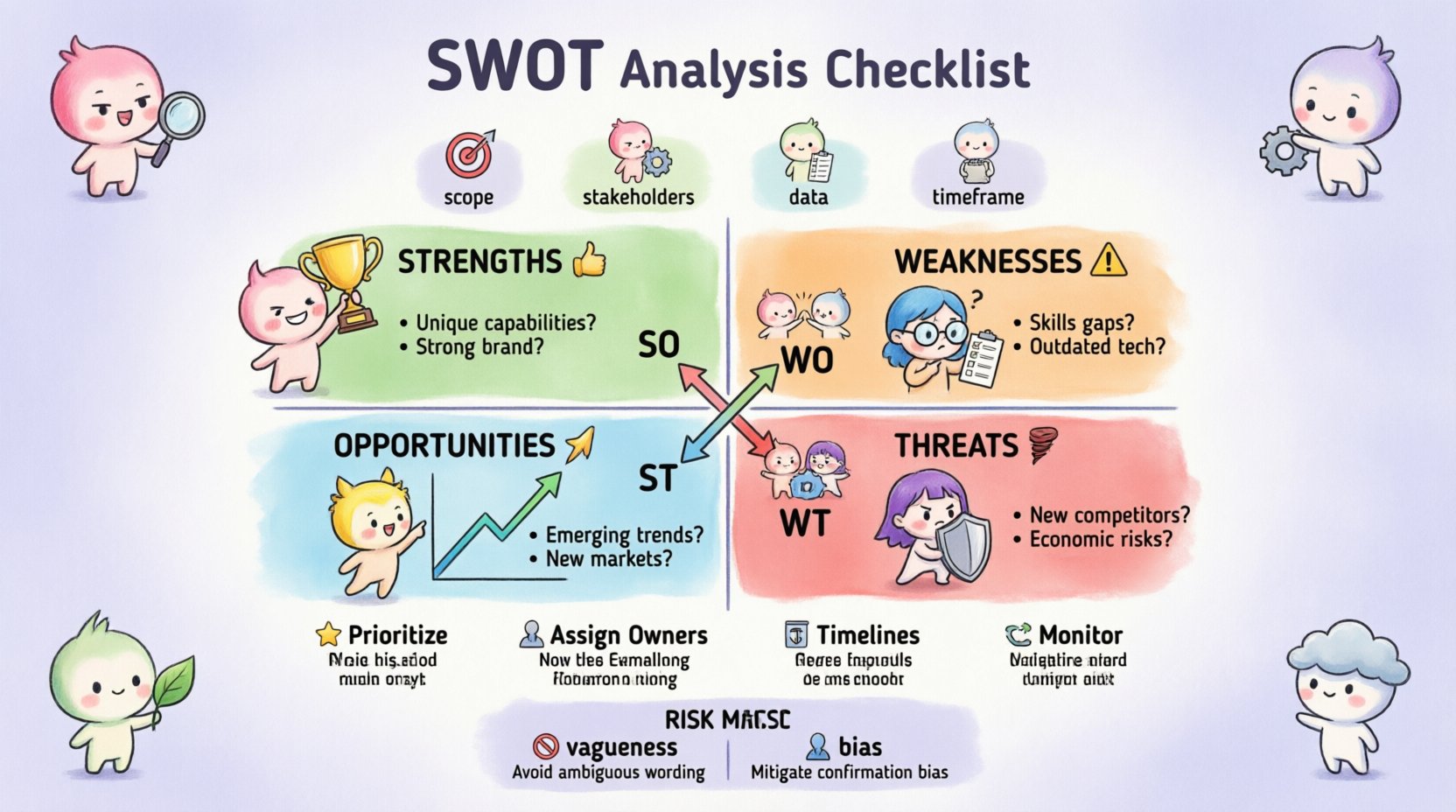
SWOT stands for Strengths, Weaknesses, Opportunities, and Threats. It is a matrix that divides factors into two dimensions: internal versus external. It also distinguishes between positive and negative influences.
Internal Factors: These are elements within your control. They include Strengths and Weaknesses.
External Factors: These are elements outside your control. They include Opportunities and Threats.
Using this matrix helps teams align on reality. It prevents assumptions from clouding judgment. When everyone sees the same data, collaboration becomes more effective.
Preparation Phase: Before You Begin 🛠️
Conducting a SWOT analysis without preparation leads to vague results. Preparation ensures the data is accurate and relevant. Follow these steps before filling out your checklist.
1. Define the Scope
What exactly are you analyzing? Is it the entire organization? A specific product line? A marketing campaign? A personal career goal? Define the objective clearly. A broad scope often results in superficial insights. A focused scope yields actionable data.
2. Gather the Right Stakeholders
Diverse perspectives are vital. Include team members from different departments. If you are working alone, seek external feedback. People who work in sales see different things than people in engineering. Finance sees costs, while marketing sees brand perception. Bring these viewpoints together.
3. Collect Data and Evidence
Avoid relying solely on memory. Look for hard numbers. Gather reports, customer feedback, market research, and financial statements. Evidence supports your claims. It moves the discussion from “I think” to “The data shows”.
4. Set a Timeframe
SWOT analysis is not static. Define the period you are analyzing. Are you looking at the past year? The next quarter? The next five years? Context matters. A strength today might be a weakness tomorrow. A threat today might be an opportunity in the future.
The Strengths Checklist: Internal Positive Factors 💪
Strengths are internal attributes that give you an advantage. They are things you do well or resources you possess. Identifying these helps you leverage them for growth.
Key Questions to Ask
What resources do we have that others lack?
Where do we perform better than the competition?
What unique capabilities does our team possess?
Do we have proprietary technology or intellectual property?
Is our brand reputation strong in the market?
Common Strength Categories
Category | Examples |
|---|---|
Human Resources | Skilled workforce, low turnover, strong leadership, diverse experience. |
Financial | Strong cash flow, access to capital, low debt, high profit margins. |
Operational | Efficient supply chain, advanced technology, proprietary processes. |
Market Position | High market share, loyal customer base, strong brand recognition. |
Do not confuse strengths with mere activities. Just because you do something does not make it a strength. It must be a comparative advantage. Ask yourself: Would a competitor find it difficult to copy this? If the answer is yes, it is likely a true strength.
The Weaknesses Checklist: Internal Negative Factors ⚠️
Weaknesses are internal limitations that hinder performance. They are areas where you are vulnerable. Identifying these allows you to address them before they cause failure. It requires honesty. Acknowledging a weakness is not a sign of failure; it is a sign of strategic awareness.
Key Questions to Ask
What do we lack that competitors have?
Where do we consistently underperform?
Are there gaps in our current skill sets?
Is our technology outdated compared to industry standards?
Are there bottlenecks in our processes?
Common Weakness Categories
Financial: High debt, poor cash flow, limited funding.
Operational: Inefficient workflows, lack of automation, poor logistics.
Human Resources: High turnover, lack of training, skills gaps.
Product/Service: Limited product range, poor quality control, slow innovation.
When listing weaknesses, be specific. “Poor marketing” is vague. “Low engagement on social media channels” is specific. Specificity leads to solutions. You cannot fix a problem you cannot define.
The Opportunities Checklist: External Positive Factors 🚀
Opportunities are external factors that you can exploit for growth. They are trends, changes, or gaps in the market. Unlike strengths, you cannot control these. You can only react to them and position yourself to benefit.
Key Questions to Ask
What emerging trends could we capitalize on?
Are there new markets we have not yet entered?
Has customer behavior changed in a way we can serve?
Are there regulatory changes that favor our business?
Can we form partnerships to expand our reach?
Common Opportunity Sources
Source | Examples |
|---|---|
Market Trends | Shift to remote work, sustainability demands, health consciousness. |
Technology | New software tools, AI integration, improved connectivity. |
Regulatory | Changes in tax law, new safety standards, trade agreements. |
Competitors | A competitor leaving the market, a competitor failing to innovate. |
Opportunities often require risk. Exploiting an opportunity means committing resources. Ensure you have the capacity to act when the window opens. Waiting too long can turn an opportunity into a threat.
The Threats Checklist: External Negative Factors 🌪️
Threats are external factors that could cause trouble. They are risks that could damage your position. You cannot stop these from happening, but you can prepare for them. Mitigation is key.
Key Questions to Ask
What new competitors are entering our space?
Could a change in technology make our product obsolete?
Are there economic downturns we should fear?
Is there a risk of supply chain disruption?
Could negative publicity impact our reputation?
Common Threat Categories
Market: Saturation, price wars, changing customer preferences.
Economic: Inflation, recession, currency fluctuations.
Technological: Rapid obsolescence, cybersecurity risks.
Legal: New regulations, lawsuits, compliance costs.
Threats are often invisible until it is too late. Regular monitoring is essential. Keep an eye on industry news and competitor moves. Early detection allows for strategic pivoting.
Cross-Analysis: Connecting the Dots (TOWS Matrix) 🔗
Filling out the four quadrants is only the first step. The real value comes from connecting them. This process is often called TOWS analysis. It matches internal factors with external factors to generate strategies.
1. SO Strategies (Maxi-Maxi)
Use Strengths to maximize Opportunities. This is growth strategy. You have the resources to take advantage of the market.
Example: Use strong cash flow (Strength) to acquire a new technology trend (Opportunity).
2. WO Strategies (Mini-Maxi)
Overcome Weaknesses by taking advantage of Opportunities. This is turnaround strategy. You need to fix internal issues to seize external chances.
Example: Hire new talent (Fix Weakness) to enter a new market (Opportunity).
3. ST Strategies (Maxi-Mini)
Use Strengths to minimize Threats. This is defense strategy. You use your advantages to protect yourself from risks.
Example: Use strong brand loyalty (Strength) to withstand a price war (Threat).
4. WT Strategies (Mini-Mini)
Minimize Weaknesses and avoid Threats. This is survival strategy. You need to cut losses and stabilize the situation.
Example: Reduce debt (Fix Weakness) to survive an economic recession (Threat).
Creating these strategies turns a list into a plan. It ensures your actions are logical and supported by your analysis.
Common Pitfalls to Avoid 🚫
Even with a checklist, errors can occur. Being aware of common mistakes helps you maintain accuracy.
Vagueness: Avoid generic statements. “Good service” is not a strength. “24/7 support with a 98% satisfaction rate” is.
Bias: Do not only focus on positives. Teams often ignore weaknesses to feel good. Be objective.
Confusing Internal and External: A new competitor is external. Losing a key employee is internal. Keep the lines clear.
Outdated Data: A market analysis from five years ago is useless. Ensure your information is current.
No Action Plan: An analysis without implementation is just a document. Every item should lead to a task.
Implementation: Turning Analysis into Action 🏃♂️
Once the analysis is complete, you must act. A strategy document that sits on a shelf is wasted effort.
1. Prioritize Items
You cannot fix everything at once. Rank your strengths, weaknesses, opportunities, and threats by impact and urgency. Focus on the high-impact items first.
2. Assign Owners
Who is responsible for addressing each point? Assign tasks to specific individuals. Accountability drives execution.
3. Set Timelines
When will this be done? Deadlines create momentum. Without a date, tasks often get pushed to the bottom of the list.
4. Monitor Progress
Review the analysis regularly. Markets change. Your strengths may become weaknesses. Update the SWOT analysis annually or when major shifts occur.
Frequently Asked Questions ❓
How often should a SWOT analysis be done?
It depends on the pace of your industry. Fast-moving sectors like technology may require quarterly reviews. Stable industries might review annually. Treat it as a living document.
Can a SWOT analysis be done for personal goals?
Yes. You can apply the same logic to your career. Your skills are strengths. Your lack of experience is a weakness. The job market is the external environment. Use it to plan your next move.
What if the results are negative?
It is better to know you are struggling than to be surprised. Negative results highlight areas needing immediate attention. They provide a clear roadmap for improvement. A negative SWOT is still valuable.
Is this tool suitable for non-profits?
Absolutely. Non-profits need to understand their funding strengths, volunteer weaknesses, community needs, and economic threats. The framework applies to any organization.
Final Thoughts on Strategic Clarity 🌟
Strategic planning is a discipline. It requires data, honesty, and follow-through. The SWOT analysis checklist provides the structure needed to organize your thoughts. It forces you to look at the hard truths. It highlights the possibilities.
By using this guide, you ensure no critical factor is left unchecked. You move from speculation to evidence-based planning. This clarity leads to better decisions. Better decisions lead to sustainable growth.
Start your analysis today. Gather your team. Look at the data. Build your plan. The future belongs to those who prepare for it.
Related posts:
 SWOT Analysis for Startups: A Beginner’s Step-by-Step Guide to Launching Strong
 The 5-Minute SWOT Analysis: Quick Start Framework for Freelancers and Sole Proprietors
 SWOT Analysis Breakdown: How to Decode Your Business Strengths and Weaknesses Today
 Real Startup Case Studies: What Happens When Founders Ignore SWOT Analysis Risks