


UX design has become a cornerstone of digital product development, yet the field remains shrouded in misconceptions. Professionals and stakeholders often operate under assumptions that hinder progress rather than accelerate it. These myths can lead to wasted resources, frustrated users, and products that fail to meet real-world needs. To build effective digital experiences, it is necessary to examine the prevailing narratives and replace them with evidence-based practices.
This guide addresses the most persistent myths surrounding user experience. By examining the reality behind these common beliefs, teams can make better decisions and create interfaces that truly serve their audience. We will explore the psychology of design, the necessity of research, and the importance of inclusivity.
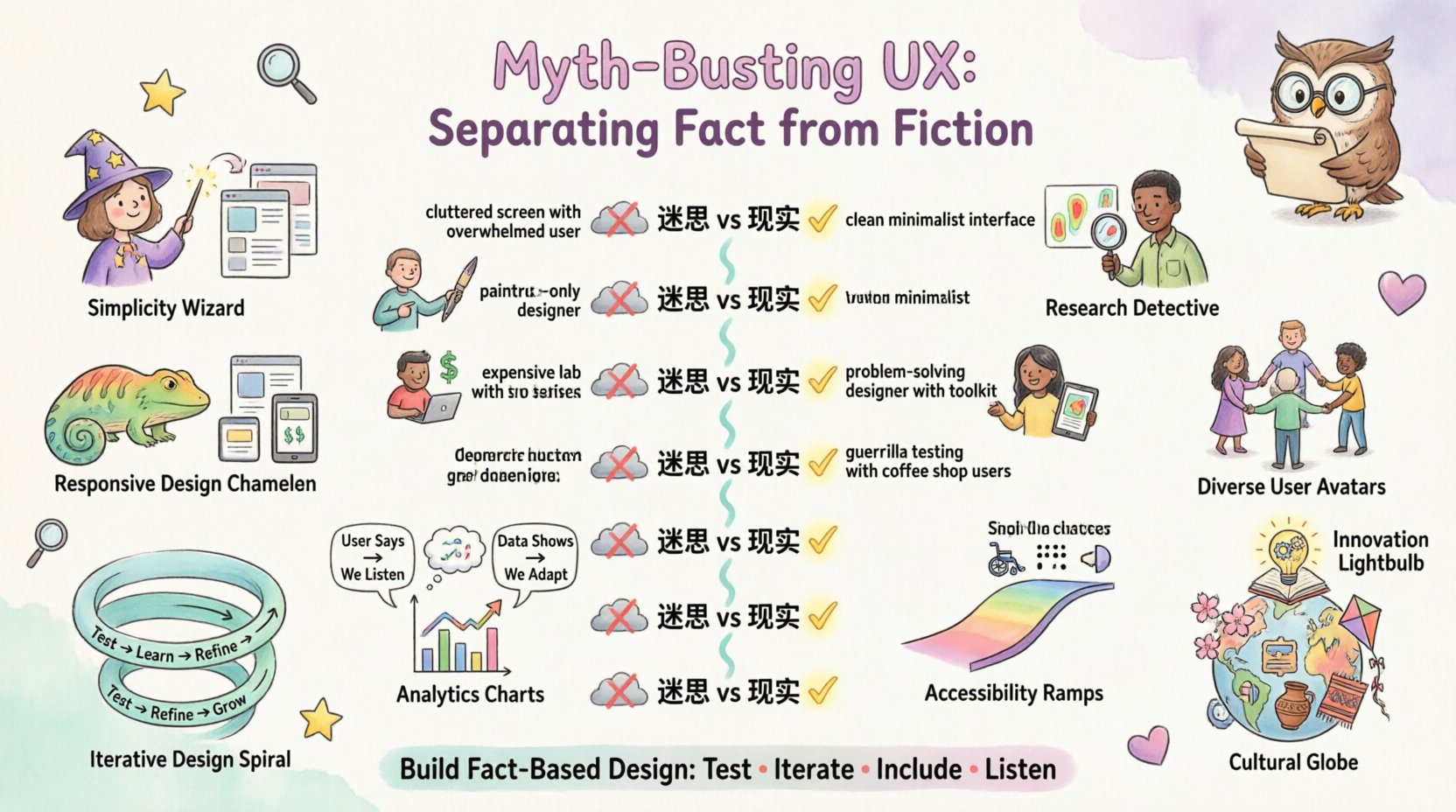
1. 🛑 Myth: More Features Equal a Better Experience
There is a pervasive belief that adding functionality makes a product superior. Teams often feel pressure to pack every possible tool into an interface to demonstrate value. This approach, known as feature creep, creates clutter and overwhelms the user. When a screen is crowded with options, cognitive load increases, and decision-making becomes difficult.
The Reality: Simplicity often drives higher engagement. Users prefer tools that solve their immediate problems efficiently. A streamlined interface allows users to find what they need without distraction. Removing features can actually improve retention rates by clarifying the core value proposition.
Complexity reduces efficiency: Every additional click or menu item adds friction to the workflow.
Focus drives adoption: Products that excel at a few core tasks often outperform suites with dozens of mediocre features.
Hidden options: Advanced features should be accessible via progressive disclosure, not displayed prominently to everyone.
2. 🎨 Myth: Design is Just About Making Things Look Good
Many stakeholders view design as a cosmetic layer applied after the functionality is built. They expect a “pretty” interface to solve usability issues. This perspective ignores the structural and functional work that happens behind the scenes. A beautiful layout that is impossible to navigate is a failure of design.
The Reality: Design is the practice of solving problems through visual and interaction strategies. It encompasses information architecture, typography, color theory, and user psychology. Good design is invisible; it guides the user naturally without them noticing the mechanics.
Visual hierarchy: Guides the eye to the most important elements first.
Consistency: Reduces learning time by establishing predictable patterns.
Feedback: Users need immediate confirmation when they interact with the system.
3. 🧪 Myth: User Testing Requires a Large Budget
It is a common assumption that valid user research requires expensive labs, large participant pools, and months of planning. Many teams delay testing until the end of the development cycle because they believe they cannot afford it earlier.
The Reality: Effective testing can be conducted with minimal resources. Guerrilla testing, remote unmoderated sessions, and even internal peer reviews can yield actionable insights. The goal is to identify major friction points, not to achieve statistical significance on every metric.
Research Method | Cost Level | Best Used For |
|---|---|---|
Heuristic Evaluation | Low | Identifying known usability issues |
Remote Unmoderated | Medium | Gathering feedback from diverse locations |
Contextual Inquiry | High | Understanding deep workflow behaviors |
Card Sorting | Low | Validating information architecture |
Starting research early prevents costly rework later. Discovering a fundamental navigation flaw during the wireframing stage is significantly cheaper than fixing it after code deployment.
4. 📱 Myth: Mobile First Means Mobile Only
As mobile device usage surpasses desktop, some teams assume mobile is the only platform that matters. They design exclusively for small screens and ignore the desktop experience entirely. This creates a fragmented experience for users who switch between devices.
The Reality: Mobile First is a strategy for prioritizing content and core functionality, not a restriction to a single viewport. It ensures the core value is delivered on the most constrained device. However, a responsive approach ensures the design scales gracefully to tablets and desktops.
Responsive Design: Layouts adapt to screen width using fluid grids.
Progressive Enhancement: Start with a baseline experience and add features for capable devices.
Input Methods: Desktop users rely on keyboards and mice, while mobile users rely on touch. Interactions must suit the input method.
5. 🧑 Myth: One Size Fits All Personas
Teams often create a single generic user profile to guide design decisions. They assume the “average” user represents the majority. This ignores the diverse needs, abilities, and contexts of the actual audience.
The Reality: User diversity is a fact of life. People have different goals, technical literacy, and physical capabilities. Designing for the extremes often benefits the middle. Accessibility standards are built on this principle.
Scenario-based design: Create specific scenarios for different user goals rather than static personas.
Accessibility: Ensure text is readable, contrast is sufficient, and navigation is keyboard-accessible.
Localization: Consider how language and culture impact interpretation of symbols and layouts.
6. 📊 Myth: Analytics Tell the Whole Story
Stakeholders often rely heavily on quantitative data, such as bounce rates and click counts. They assume the numbers explain the “why” behind user behavior. However, data tells you what happened, not why it happened.
The Reality: Quantitative data must be paired with qualitative insights. Surveys, interviews, and observation provide context that metrics cannot capture. A high exit rate might indicate a successful completion of a task, not a failure.
Heatmaps: Show where users click, but not their emotional response.
Session Recordings: Reveal where users get stuck or confused in real-time.
Surveys: Directly ask users about their satisfaction and intent.
7. ♿ Myth: Accessibility is an Afterthought
Many organizations treat accessibility as a compliance checkbox added at the end of the project. They believe it is only relevant for users with disabilities. This mindset leads to barriers that exclude significant portions of the population.
The Reality: Accessibility is a fundamental requirement for ethical and legal digital products. It benefits everyone, including users with temporary impairments or those in low-bandwidth environments. Designing for accessibility from the start reduces maintenance costs and expands market reach.
Screen Readers: Users rely on these tools to navigate text and images.
Color Contrast: Ensures readability for users with low vision.
Keyboard Navigation: Allows users who cannot use a mouse to complete tasks.
8. 🔄 Myth: Design Can Be Static
Some teams believe that once a design is launched, it is finished. They view the interface as a static document rather than a living system. This prevents teams from adapting to changing user behaviors and market conditions.
The Reality: Digital products are iterative. User needs evolve, technology changes, and competitors introduce new features. Continuous improvement is necessary to maintain relevance.
Continuous Discovery: Regularly engage with users to understand changing needs.
A/B Testing: Compare variations to determine what performs better.
Feedback Loops: Implement mechanisms for users to report issues or suggest improvements.
9. 🌐 Myth: Global Design is Universal
Teams often create a single global design that works everywhere. They assume cultural norms and language nuances are negligible. This approach can lead to confusion or offense in different regions.
The Reality: Culture influences how people interact with technology. Colors, icons, and reading patterns vary by region. A design that works in one country may fail in another.
Language Expansion: Text length varies significantly between languages.
Symbolism: Icons may have different meanings in different cultures.
Directionality: Right-to-left languages require mirrored layouts.
10. 💡 Myth: Innovation Requires Starting from Scratch
There is pressure to create something entirely unique to stand out. Teams often reinvent the wheel, ignoring established patterns that users already understand.
The Reality: Familiarity reduces learning curves. Users expect certain interactions, such as the hamburger menu or the shopping cart icon. Deviating from these standards without a compelling reason causes friction.
Standard Patterns: Use familiar layouts to reduce cognitive load.
Novelty vs. Utility: Innovation should serve a purpose, not just look new.
Learning Costs: Every new pattern requires time for users to learn.
Building a Fact-Based Design Culture
Shifting away from myths requires a commitment to evidence. Teams must prioritize data and user feedback over intuition and assumptions. This involves creating a culture where testing is encouraged and failure is viewed as a learning opportunity.
Collaboration: Involve developers, product managers, and designers in the research process.
Documentation: Record findings and share them across the organization.
Metrics: Define success criteria before starting the design phase.
By grounding decisions in reality, teams can build products that are usable, accessible, and valuable. The goal is not to follow rules blindly, but to understand the principles behind them. This approach leads to sustainable growth and happier users.
Final Thoughts
UX design is a complex discipline that requires nuance and critical thinking. The myths discussed here are common, but they are obstacles to success. Recognizing them allows teams to focus on what truly matters: the people using the product.
Continual learning and adaptation are essential. The digital landscape changes rapidly, and the strategies that worked yesterday may not work tomorrow. Staying informed and questioning assumptions is the best way to navigate this environment.
Focus on the user. Listen to their feedback. Test your assumptions. These are the foundations of effective design. By avoiding the pitfalls of common misconceptions, teams can deliver experiences that are robust, inclusive, and effective.
Related posts:
 Mastering the Art of User Experience Design: A Complete Guide for CS and HCI Students
 From Industrial Design to Digital: A UX Journey for Specialized Designers
 The Beginner’s Roadmap to UX Design: Quick Start Strategies for Tech Students
 UX Design: Deep Dive into Human-Computer Interaction: Principles and Practices for Undergraduates