

In the landscape of Object-Oriented Analysis and Design (OOAD), few concepts carry as much weight as the interface. It serves as the backbone of maintainable, scalable, and testable systems. While implementation details often shift over time, the contract defined by an interface remains a stable point of reference. This guide explores the mechanics, benefits, and strategic application of interfaces within software architecture.
🔍 Defining the Interface Contract
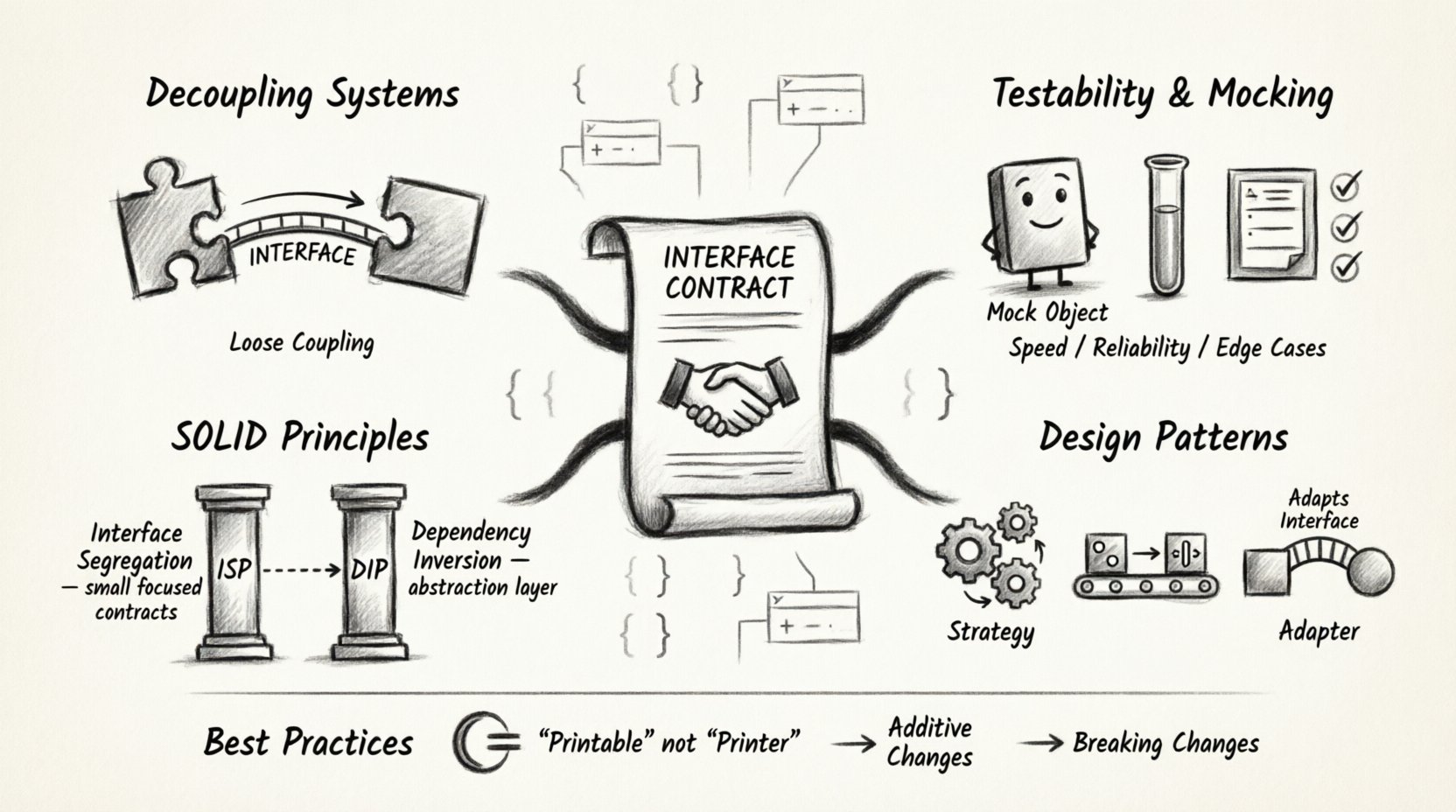
An interface represents a promise. It declares what a class can do without specifying how it does it. This separation of concerns is fundamental to robust engineering. When developers define an interface, they are establishing a set of methods and properties that any implementing class must adhere to. This creates a standardized way for different parts of a system to communicate.
- Contractual Obligation: An interface mandates specific behaviors.
- Abstraction: It hides the underlying complexity from the consumer.
- Flexibility: Multiple classes can implement the same interface differently.
Consider a scenario where a system needs to process data. Without an interface, the processing logic might be hard-coded into a specific class. With an interface, the processing engine only knows it needs an object that can process(). The engine does not care if the data comes from a file, a database, or a network stream, provided the object adheres to the interface.
🔗 Decoupling Systems through Abstraction
One of the primary advantages of using interfaces is the ability to decouple components. Tight coupling occurs when classes depend heavily on the concrete implementations of other classes. This creates fragility; changing one part of the system breaks another. Interfaces mitigate this by allowing classes to depend on abstractions rather than concretions.
When a module depends on an interface:
- It does not need to know the specific class name implementing the logic.
- It does not need to import the concrete class library.
- It can function with any implementation that satisfies the contract.
This architectural choice allows for significant flexibility during the development lifecycle. A developer can swap out a legacy data handler for a modern one without altering the code that consumes the data. The interface acts as a buffer, absorbing changes and protecting the rest of the system.
Benefits of Loose Coupling
- Reduced Impact of Change: Modifications in one module rarely ripple through others.
- Parallel Development: Teams can work on implementations while others design the interface.
- Modularity: Systems become collections of interchangeable parts.
- Reusability: Components become generic enough to fit various contexts.
🧪 Enhancing Testability and Mocking
Testing is a critical phase in software delivery, yet it becomes difficult when dependencies are hard-coded. Interfaces make unit testing feasible by allowing developers to replace real dependencies with mock objects. A mock object implements the interface but returns predefined data or simulates specific behaviors.
This approach ensures that tests remain isolated. If a test fails, it is likely due to the logic under test, not an external factor like a database connection or an API call.
- Speed: Mocks run faster than real external calls.
- Reliability: Tests are not subject to network outages or third-party downtime.
- Edge Case Simulation: It is easier to force error states via mocks than to reproduce them in a live environment.
- Focus: Tests verify logic, not infrastructure.
⚖️ Interfaces vs. Abstract Classes
While both interfaces and abstract classes provide a way to define structure, they serve different purposes. Choosing between them requires understanding the nuances of inheritance and state management. Abstract classes can contain state (variables) and concrete methods (implementation), whereas interfaces are typically limited to method signatures.
The following table outlines the key distinctions:
| Feature | Interface | Abstract Class |
|---|---|---|
| State | Cannot hold instance state (usually). | Can hold instance variables. |
| Implementation | Only method signatures (traditionally). | Can provide default implementations. |
| Inheritance | Multiple interfaces can be implemented. | Only single inheritance allowed. |
| Access Modifiers | Typically public. | Can use various access levels. |
| Use Case | Defining a capability or behavior. | Defining a common base with shared state. |
When to use which depends on the design goal. If the goal is to define a capability that multiple unrelated classes should share, an interface is the correct choice. If the goal is to share code and state among closely related classes, an abstract class is more appropriate.
📐 Aligning with SOLID Principles
Interfaces are central to the SOLID principles of object-oriented design. Adhering to these principles ensures that code remains flexible and maintainable over time. Two principles in particular rely heavily on the interface.
1. Interface Segregation Principle (ISP)
This principle states that no client should be forced to depend on methods it does not use. A “fat” interface that combines many unrelated responsibilities creates unnecessary dependencies. Developers should design multiple small, specific interfaces rather than one large general-purpose interface.
- Granularity: Break down large interfaces into smaller, focused ones.
- Relevance: Ensure every method in an interface is relevant to the consumer.
- Coupling: Reduces the impact of changes on implementing classes.
For example, a class that only prints documents should not be forced to implement a method for saving documents if it does not need to. This keeps the implementation clean and reduces confusion.
2. Dependency Inversion Principle (DIP)
DIP dictates that high-level modules should not depend on low-level modules. Both should depend on abstractions. Interfaces are the primary mechanism for creating these abstractions. By coding to an interface, high-level logic remains independent of the specific low-level details like database drivers or file system access.
- High-Level: Business logic and orchestration.
- Low-Level: Data access, hardware interaction, networking.
- Abstraction: The interface connecting them.
🧩 Practical Implementation Patterns
Several design patterns leverage interfaces to solve recurring problems. Understanding these patterns helps in applying interfaces effectively in real-world scenarios.
Strategy Pattern
This pattern allows a class to change its behavior at runtime. By defining a common interface for different algorithms, the context class can select which strategy to execute. This eliminates complex conditional statements and makes the code extensible.
- Flexibility: New algorithms can be added without modifying existing code.
- Clarity: The relationship between algorithms is explicit.
Factory Pattern
Factories are responsible for creating objects. They often return objects based on an interface. This hides the instantiation logic from the client. The client receives a product via the interface and knows how to use it without knowing how it was created.
- Decoupling: The client is not tied to a specific concrete class.
- Centralization: Creation logic is managed in one place.
Adapter Pattern
Sometimes, an existing class does not match the expected interface. An adapter class implements the required interface and wraps the existing class, translating calls from the interface to the method names of the existing class. This allows incompatible interfaces to work together.
- Integration: Bridges gaps between legacy and new systems.
- Preservation: Allows reuse of old code without rewriting.
⚠️ Common Pitfalls and Best Practices
While interfaces are powerful, misusing them can lead to brittle code. It is important to recognize common mistakes and follow established best practices to maintain system health.
Pitfalls to Avoid
- Over-Engineering: Creating interfaces for every single class creates unnecessary complexity. Use them where flexibility is actually required.
- God Interfaces: Interfaces that contain too many methods violate the Interface Segregation Principle.
- Hidden Dependencies: If an interface requires dependencies in its constructor, it becomes harder to test and use.
- Implementation Leakage: If an interface exposes too much implementation detail, it restricts future changes.
Best Practices
- Naming Conventions: Use clear names that describe the behavior, not the implementation (e.g., use
Printableinstead ofPrinter). - Minimalism: Keep interfaces small. If a class implements multiple interfaces, ensure they are cohesive.
- Documentation: Clearly document the expected behavior of methods to guide implementers.
- Consistency: Ensure all implementations of an interface behave consistently regarding exceptions and state.
🚀 Impact on Maintainability and Scalability
The long-term value of interfaces lies in maintainability. As a system grows, the cost of change increases. Interfaces act as guardrails that prevent the system from becoming too rigid. They allow teams to scale horizontally by adding new implementations without disrupting existing workflows.
Scalability is not just about handling more traffic; it is about handling more complexity. Interfaces allow complex systems to be broken down into manageable modules. Each module can evolve independently as long as it honors the interface contract.
- Onboarding: New developers can understand the system by reading interfaces first.
- Refactoring: Internal logic can be rewritten without changing the external contract.
- Migration: Systems can be migrated incrementally by swapping implementations behind the interface.
🛡️ Security and Validation
Interfaces also play a role in security and validation. By defining strict contracts, the system can enforce type safety and reduce the risk of unexpected data types entering critical paths. This is particularly important in distributed systems where components communicate over a network.
- Type Safety: Compilers and linters can verify that the contract is met.
- Input Validation: Interfaces can define validation methods that must be implemented.
- Access Control: Interfaces can define roles, limiting which classes can perform specific actions.
🔄 Evolving Interfaces
Interfaces are not static. As requirements change, interfaces must evolve. However, changing an interface has a cost because all implementations must be updated. This is why versioning strategies are important in some languages and frameworks.
When modifying an interface:
- Additive Changes: Adding a new method is usually safe if the language supports default implementations.
- Breaking Changes: Removing a method or changing a signature breaks all implementations.
- Versioning: Create new interfaces (e.g.,
ServiceV2) if backward compatibility is required.
Designing with evolution in mind reduces technical debt. It ensures that the system can adapt to new business requirements without requiring a complete rewrite.
📊 Summary of Architectural Value
The interface is more than a syntax feature; it is a design philosophy. It enforces the separation of what a system does and how it does it. By prioritizing interfaces in Object-Oriented Analysis and Design, architects build systems that are resilient to change, easier to test, and simpler to understand.
Key takeaways for implementation include:
- Use interfaces to define contracts and capabilities.
- Prefer interfaces over concrete classes for dependencies.
- Keep interfaces small and focused (ISP).
- Use interfaces to enable polymorphism and strategy patterns.
- Avoid tight coupling by relying on abstractions (DIP).
Adopting these practices leads to a codebase that is robust and ready for the future. The effort invested in defining clear interfaces pays dividends in reduced bugs, faster development cycles, and higher system reliability.