

Object-oriented analysis and design provide a structured approach to software construction. This methodology focuses on organizing code around data, or objects, rather than functions and logic. Understanding the fundamental building blocks is essential for creating maintainable, scalable, and robust systems. This guide details the core elements that constitute any object-oriented architecture.
🔍 The Foundation: Classes and Objects
At the base of this paradigm lie two distinct but related concepts: the class and the object. Confusing these two is a common pitfall during the initial design phase. It is vital to distinguish between the definition and the instance.
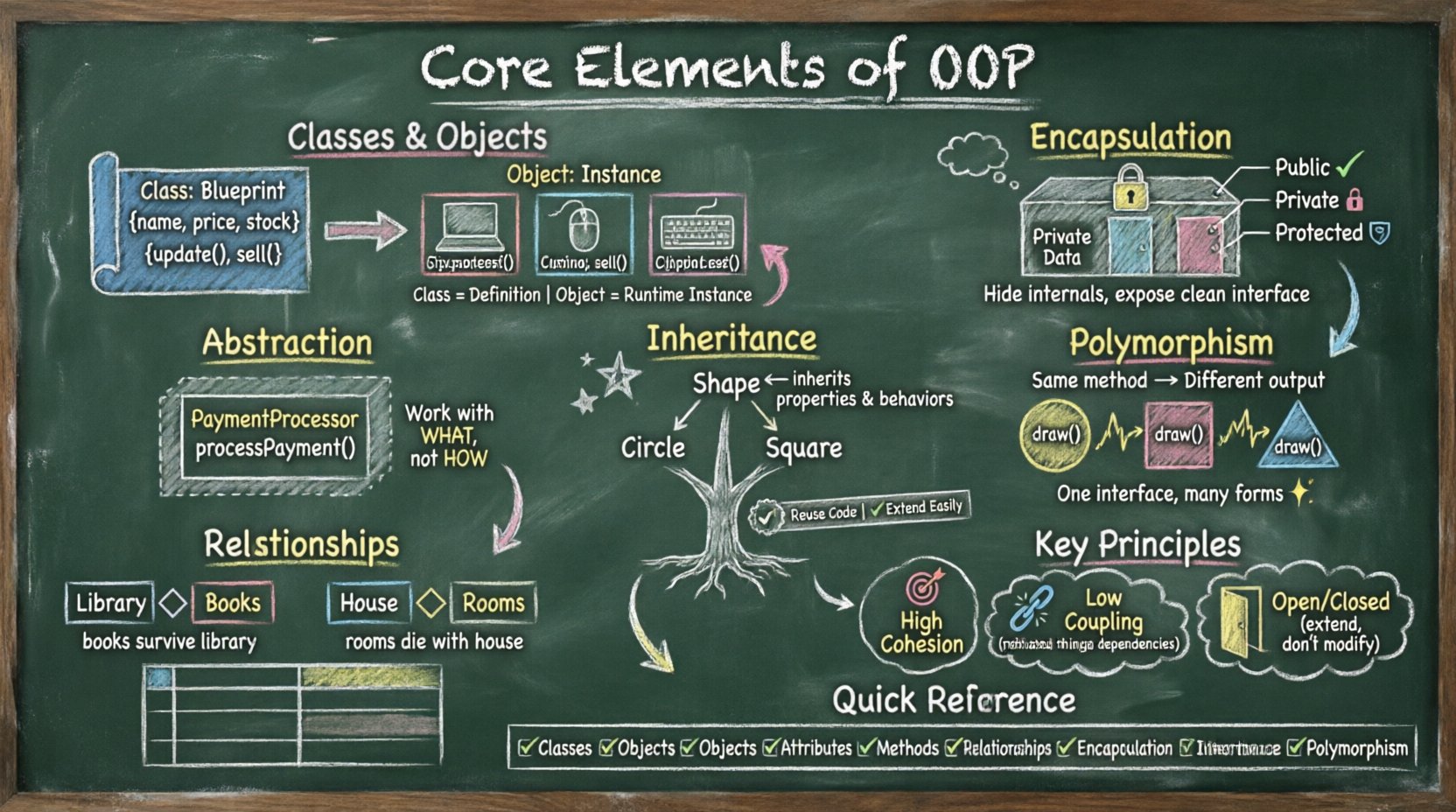
- Class: A blueprint or template. It defines the structure and behavior. It describes what attributes exist and what operations can be performed. It does not occupy memory in the same way an instance does until it is instantiated.
- Object: A concrete instance of a class. When a program runs, it creates objects based on the class definition. Each object holds its own state.
Consider a system managing digital inventory. The Product class defines what a product looks like: it has a name, a price, and a stock count. When the system loads data, it creates individual Product objects. One object might represent a specific laptop, while another represents a specific mouse. Both share the same structure but hold different data values.
Key Characteristics of Classes
- State: Data stored in variables, often called fields or attributes.
- Behavior: Logic executed through methods or functions.
- Identity: A unique way to distinguish one instance from another.
🛡️ Encapsulation: Protecting Data
Encapsulation is the mechanism that binds data and methods together while restricting direct access to some of an object’s components. It is the practice of hiding the internal state of an object and requiring all interaction to occur through a well-defined interface.
Why Encapsulation Matters
- Data Integrity: By controlling how data is modified, you prevent invalid states. For example, a bank account object should not allow the balance to become negative directly.
- Abstraction: Users of the object only need to know what the object does, not how it does it.
- Maintenance: If the internal implementation changes, external code does not break as long as the interface remains the same.
In practice, this is achieved through access modifiers. These keywords dictate the visibility of class members. Common visibility levels include public, private, and protected. Private members are accessible only within the class itself. Public members are accessible from anywhere. Protected members are accessible within the class and by subclasses.
🌳 Abstraction: Simplifying Complexity
Abstraction focuses on hiding complex implementation details and exposing only the necessary features. It allows developers to work with high-level concepts without getting bogged down in low-level details. This reduces cognitive load during the analysis phase.
Types of Abstraction
- Abstract Classes: These cannot be instantiated on their own. They are designed to be extended by other classes. They can contain both abstract methods (without implementation) and concrete methods (with implementation).
- Interfaces: A contract that specifies a set of methods that a class must implement. It does not define how the methods work, only that they exist.
Abstraction supports the separation of concerns. A user interacting with a PaymentProcessor does not need to know the specific encryption algorithm used. They simply call the processPayment method. This separation makes the system easier to reason about.
🔄 Inheritance: Reusing Code
Inheritance allows a new class to adopt the properties and behaviors of an existing class. The existing class is the parent or superclass. The new class is the child or subclass. This promotes code reusability and establishes a logical hierarchy.
Benefits of Inheritance
- Reduced Redundancy: Common logic is written once in the parent class.
- Extensibility: New types can be added without modifying existing code.
- Polymorphism: Inheritance enables polymorphic behavior, allowing different classes to be treated as instances of the same parent class.
However, inheritance must be used carefully. Deep hierarchies can become difficult to maintain. A tight coupling between parent and child classes can lead to issues when changes are required in the base class. Composition is often a preferred alternative for complex relationships.
🎭 Polymorphism: Flexibility in Action
Polymorphism allows objects of different classes to respond to the same method call in different ways. It enables a single interface to represent different underlying forms. This is crucial for creating flexible and extensible systems.
Forms of Polymorphism
- Compile-Time (Static): Achieved through method overloading. Multiple methods in the same class share the same name but have different parameter lists.
- Runtime (Dynamic): Achieved through method overriding. A subclass provides a specific implementation of a method that is already defined in its parent class.
Consider a graphic rendering system. You might have a Shape class with a draw method. Circle and Square classes inherit from Shape. When the rendering engine calls draw on a list of shapes, it does not need to know the specific type. Each shape knows how to draw itself. This decouples the renderer from the specific geometry types.
🔗 Relationships and Associations
Objects do not exist in isolation. They interact with one another. Defining these relationships clearly is a critical part of the design phase. The way objects relate to each other impacts coupling and cohesion.
Common Relationship Types
- Association: A structural relationship where one object uses another. It is often a many-to-many relationship.
- Aggregation: A specific type of association where the whole and parts can exist independently. For example, a
DepartmenthasEmployees. If the Department is removed, the Employees still exist. - Composition: A stronger form of aggregation. The parts cannot exist without the whole. If the
Houseis destroyed, theRoomobjects cease to exist. - Dependency: A relationship where one object depends on another to perform a task. It is usually temporary.
Comparison Table: Aggregation vs Composition
| Feature | Aggregation | Composition |
|---|---|---|
| Ownership | Weak ownership | Strong ownership |
| Lifecycle | Child exists independently | Child dies with parent |
| Example | Library and Books | House and Rooms |
| Implementation | Reference passed via constructor or setter | Created internally within the parent |
⚙️ Behavioral Mechanics: Methods and Messages
The interaction between objects occurs through messages. In this context, a message is a request for an object to perform an action. This action is implemented by a method.
The Method Lifecycle
- Invocation: The client sends a message to the server object.
- Execution: The server object runs the method code.
- Return: The method returns a result or a value to the client.
Effective design ensures that methods have a single responsibility. A method should do one thing well. If a method performs too many tasks, it becomes hard to test and maintain. This aligns with the Single Responsibility Principle, which suggests that a class should have only one reason to change.
🧩 Advanced Structural Concepts
Beyond the basics, several advanced concepts refine the structure of a system. These tools help manage complexity in large-scale applications.
Interfaces and Contracts
Interfaces define a contract. They specify a set of methods that implementing classes must provide. This allows different classes to be used interchangeably if they adhere to the same interface. It promotes loose coupling. Code that depends on an interface is less dependent on specific implementations.
Abstract Factories and Creational Patterns
Creating objects can be complex. Creational patterns provide a way to manage object creation. Instead of using new directly everywhere, a factory method or abstract factory handles instantiation. This centralizes the creation logic. It makes it easier to swap out implementations without changing the client code.
Design Principles in Action
Several principles guide the arrangement of these components. Applying them ensures the system remains stable over time.
- High Cohesion: Elements within a class should be strongly related. They should work together to fulfill a single purpose.
- Low Coupling: Dependencies between classes should be minimized. Changes in one class should not ripple through the system.
- Open/Closed Principle: Classes should be open for extension but closed for modification. You add new behavior by adding new classes, not by changing existing code.
📊 Managing State and Identity
State management is a critical aspect of object-oriented systems. Objects change state over time in response to messages. Tracking this state is vital for debugging and consistency.
State Consistency
- Immutability: Some objects are designed not to change state after creation. This simplifies reasoning about the code. It is particularly useful in concurrent environments.
- Encapsulation of State: State variables should be private. Accessors (getters) should be used to read state, and mutators (setters) should be used to change it. This ensures invariants are maintained.
Identity vs Equality
Understanding the difference between identity and equality is important. Identity refers to whether two references point to the exact same object in memory. Equality refers to whether two objects have the same content or value. Systems often need to check for equality based on data, not memory address.
🚀 Designing for Change
Requirements evolve. Systems must adapt. The core elements discussed here provide the flexibility needed for change. By using abstraction and interfaces, you isolate the parts of the system that change. By using encapsulation, you protect the internal logic from external interference.
When analyzing a system, start by identifying the nouns (classes) and verbs (methods). Then, define the relationships between them. Ensure that the hierarchy is logical and not overly deep. Prefer composition over inheritance where the relationship is not an is-a relationship.
Common Pitfalls to Avoid
- God Objects: Classes that know too much or do too much. Break these down into smaller, focused classes.
- Deep Inheritance Trees: This makes it hard to understand where a method is defined. Flatten the hierarchy where possible.
- Leaking Abstraction: Forcing the caller to understand implementation details. Keep the interface clean.
📝 Summary of Structural Elements
To recap, a robust object-oriented system relies on a careful balance of structure and behavior. The following list summarizes the essential components.
- Classes: The definitions of types.
- Objects: The runtime instances of types.
- Attributes: The state data held by objects.
- Methods: The behavior logic executed by objects.
- Interfaces: The contracts defining behavior.
- Relationships: The links connecting objects together.
- Encapsulation: The protection of internal state.
- Inheritance: The mechanism for code reuse.
- Polymorphism: The ability to treat objects uniformly.
Mastering these elements allows architects to build systems that are resilient to change. The focus should remain on clarity, maintainability, and correctness. When these core principles are applied consistently, the resulting architecture stands the test of time.