


In the modern business landscape, the tension between maintaining competitive advantage and pursuing disruptive innovation is constant. Traditional strategic frameworks, such as Michael Porter’s Five Forces model, were designed to analyze industry profitability and competitive positioning. However, the rapid pace of technological change and shifting consumer behaviors requires leaders to adapt these models to accommodate innovation strategy. This guide explores how to balance the structural pressures of an industry with the dynamic needs of innovation.
Understanding the interplay between established competitive forces and the drive for disruption is critical for sustainable growth. Organizations that ignore the Five Forces risk stagnation, while those that ignore innovation risk obsolescence. The goal is to integrate these perspectives into a cohesive strategy that protects margins while creating new value.
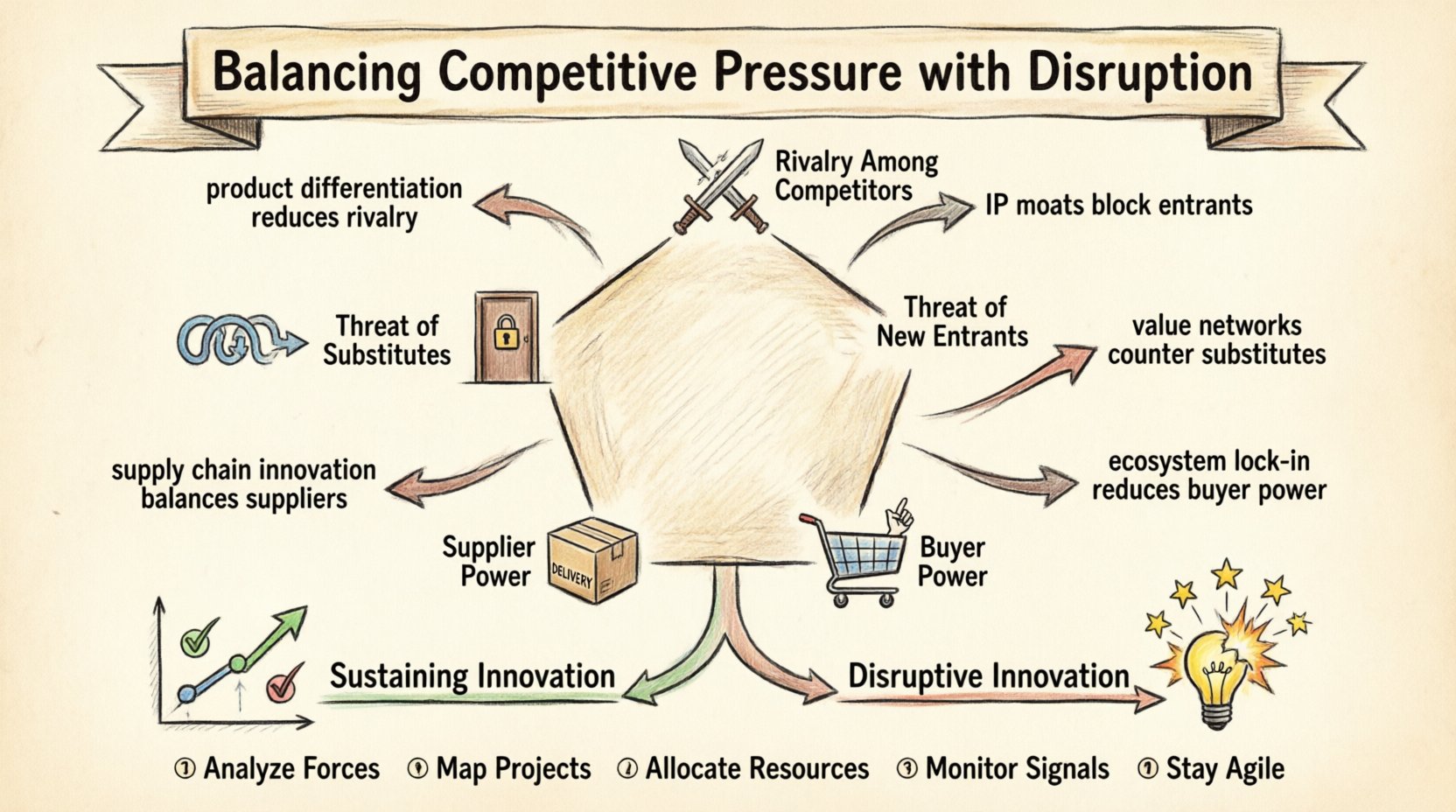
Understanding Porter’s Five Forces 🏛️
Porter’s Five Forces framework analyzes the intensity of competition in an industry. It moves beyond direct rivalry to examine the underlying economic forces that shape profitability. To apply this to innovation, one must understand how each force operates and how innovation can alter its dynamics.
- Rivalry Among Existing Competitors: This force measures how aggressively firms compete. High rivalry often leads to price wars and reduced margins. Innovation can shift this by differentiating products or creating entirely new categories.
- Threat of New Entrants: Barriers to entry protect incumbents. Innovation can lower these barriers for newcomers or raise them for others through proprietary technology.
- Threat of Substitute Products: Substitutes limit the price a company can charge. Disruptive innovation often creates substitutes for existing solutions, changing the rules of the game.
- Bargaining Power of Suppliers: Suppliers can squeeze profitability by raising prices. Innovation in supply chains or vertical integration can reduce this dependence.
- Bargaining Power of Buyers: Buyers demand better value. Innovation allows firms to increase switching costs or create unique value that reduces buyer leverage.
The Role of Innovation Strategy ⚙️
Innovation strategy is the plan for how an organization will generate value through new products, services, or processes. It is not merely about technology; it is about value creation. There are generally two types of innovation relevant to this discussion:
- Sustaining Innovation: Improvements to existing products that serve current customers better. This aligns well with the Five Forces framework as it reinforces existing market positions.
- Disruptive Innovation: Solutions that create new markets or value networks. These often ignore current competitive forces initially, rendering them irrelevant over time.
When balancing these, leaders must decide where to allocate resources. Sustaining innovation protects against current threats, while disruptive innovation prepares for future shifts. Ignoring either side creates vulnerability.
Integrating Forces with Innovation 🔄
The core challenge lies in the fact that the Five Forces model is static, while innovation is dynamic. A strategy must be fluid enough to adapt to changing forces. Here is how innovation impacts each force:
1. Rivalry and Differentiation 🥊
High rivalry exists when products are commoditized. Innovation strategy should focus on differentiation to reduce direct comparison. This involves branding, unique features, or superior customer experience. By creating a unique value proposition, a firm reduces the pressure to compete on price alone.
2. Barriers to Entry and Moats 🛡️
New entrants threaten incumbents. Innovation builds “moats” that protect market share. These moats can be technological (patents), structural (network effects), or brand-based. A strong innovation pipeline ensures that barriers remain high even as the industry evolves.
3. Substitutes and New Value Propositions 🔄
Substitutes often come from outside the industry. Innovation strategy must scan adjacent markets for potential threats. For example, a software company might face substitution from hardware solutions. Identifying these threats early allows for proactive pivots.
4. Supplier Power and Supply Chain Innovation 📦
Supplier power is high when there are few sources for critical inputs. Innovation in supply chain management or product design can reduce dependence on specific suppliers. This might involve designing products that use more common materials or developing in-house capabilities.
5. Buyer Power and Customer Lock-in 🔒
Buyers have power when switching costs are low. Innovation can increase switching costs through ecosystem integration. If a customer invests time and data into a platform, they are less likely to leave. This creates a defensive position against buyer leverage.
Strategic Analysis Matrix 📊
The following table outlines how specific innovation approaches interact with the Five Forces. This matrix helps leaders visualize the trade-offs involved in strategic decisions.
| Force | Innovation Approach | Strategic Impact |
|---|---|---|
| Rivalry | Product Differentiation | Reduces price sensitivity; increases perceived value. |
| Threat of Entry | Intellectual Property & Scale | Increases cost of entry; deters new competitors. |
| Threat of Substitutes | Value Network Integration | Creates dependencies that make switching difficult. |
| Supplier Power | Supply Chain Diversification | Reduces reliance on single points of failure. |
| Buyer Power | Service & Ecosystem Enhancement | Increases switching costs through data and connectivity. |
Implementation Steps for Leaders 📝
Integrating these concepts requires a structured approach. Leaders should follow a disciplined process to ensure innovation aligns with competitive realities.
- Conduct a Dynamic Force Analysis: Do not treat the Five Forces as a one-time exercise. Re-evaluate them quarterly. Industry structures shift rapidly due to technology and regulation.
- Map Innovation Projects to Forces: Categorize every innovation initiative. Does it reduce rivalry? Does it build barriers? If an initiative does not affect the competitive landscape, question its strategic value.
- Allocate Resources Based on Risk: Sustaining innovation should fund the core business. Disruptive innovation should be funded as a separate portfolio to avoid cannibalizing existing revenue streams prematurely.
- Monitor External Signals: Watch for changes in supplier markets, regulatory shifts, and technological breakthroughs. These are the leading indicators of force changes.
- Build Agile Capabilities: The ability to pivot is essential. If a force changes (e.g., a new substitute appears), the organization must be able to respond quickly.
Risks and Challenges ⚠️
Attempting to balance these forces introduces specific risks. Leaders must be aware of potential pitfalls.
- Cannibalization: New products may eat into sales of existing ones. This is a sign of disruption but can hurt short-term financials. It must be managed through clear product lifecycles.
- Resource Dilution: Spreading effort across too many innovation projects can weaken the core business. Focus is required.
- Strategic Drift: Chasing every new trend can lead to a loss of identity. Innovation must remain aligned with the company’s core competencies.
- Underestimating Substitutes: Competitors are not the only threat. Substitutes often come from unexpected sectors. Vigilance is required.
Measuring Success 📏
How do you know if the strategy is working? Traditional financial metrics are necessary but insufficient. A balanced scorecard approach is recommended.
- Market Share Trends: Are you gaining share in high-value segments?
- Profit Margins: Are margins stable or improving despite competitive pressure?
- Innovation Pipeline: Is there a steady stream of new ideas moving to execution?
- Customer Retention: Are customers staying despite competitive offers?
- Barrier Strength: Are competitors finding it harder to enter your space?
Case Context: The Digital Shift 📱
Consider the transition from physical media to digital streaming. Traditional competitors focused on sustaining innovation (better packaging, lower prices). Disruptors focused on substitution (access over ownership). The Five Forces shifted dramatically. Supplier power (artists) increased. Buyer power increased due to low switching costs. Rivalry intensified. Firms that understood these shifts adapted their innovation strategy to focus on exclusive content and user experience.
Another example involves the automotive industry. Electric vehicles (EVs) changed the supplier force (battery makers vs. engine makers) and the rivalry (tech companies vs. car makers). Traditional manufacturers had to innovate their supply chains and software capabilities to remain competitive.
Future Considerations 🔮
As artificial intelligence and automation advance, the Five Forces will continue to evolve. The barrier to entry may lower for some sectors while raising for others due to data requirements. The threat of substitutes will increase as digital solutions replace physical ones.
Leaders must remain vigilant. The framework is a tool, not a crystal ball. It provides structure for thinking about competition, but it does not predict the future. Innovation strategy fills that gap by actively shaping the future.
Combining the analytical depth of Porter’s model with the forward-looking nature of innovation strategy creates a robust approach. It allows organizations to defend their current position while building the foundations for the next phase of growth.
Final Thoughts 💡
The balance between competitive pressure and disruption is not a one-time decision. It is a continuous process of analysis and adaptation. By understanding the structural forces of the industry and applying innovation strategically, organizations can navigate uncertainty with confidence. The goal is not just to survive the forces, but to reshape them in favor of the organization.
Success requires discipline, clear vision, and the willingness to challenge conventional wisdom. Those who master this integration will define the future of their industries.
Related posts:
 Porter’s Five Forces Analysis: A Complete Framework Breakdown for Strategic Decision-Making
 How to Apply Porter’s Five Forces to Evaluate Industry Attractiveness and Profit Potential
 Porter’s Five Forces Explained: Key Concepts Every Business Leader Should Know
 Step-by-Step Guide to Conducting a Porter’s Five Forces Analysis from Scratch