


Strategic management courses often require teams to dissect complex market environments. One of the most enduring frameworks for this task is Porter’s Five Forces Analysis. While the theory is well-established, the execution within a group setting introduces unique challenges. Collaboration, data aggregation, and consensus building are just as critical as the analytical rigor itself.
This guide provides a structured approach for MBA cohorts working together on this assignment. It focuses on how to divide labor effectively, gather reliable data without relying on specific software tools, and synthesize findings into a cohesive strategic narrative.
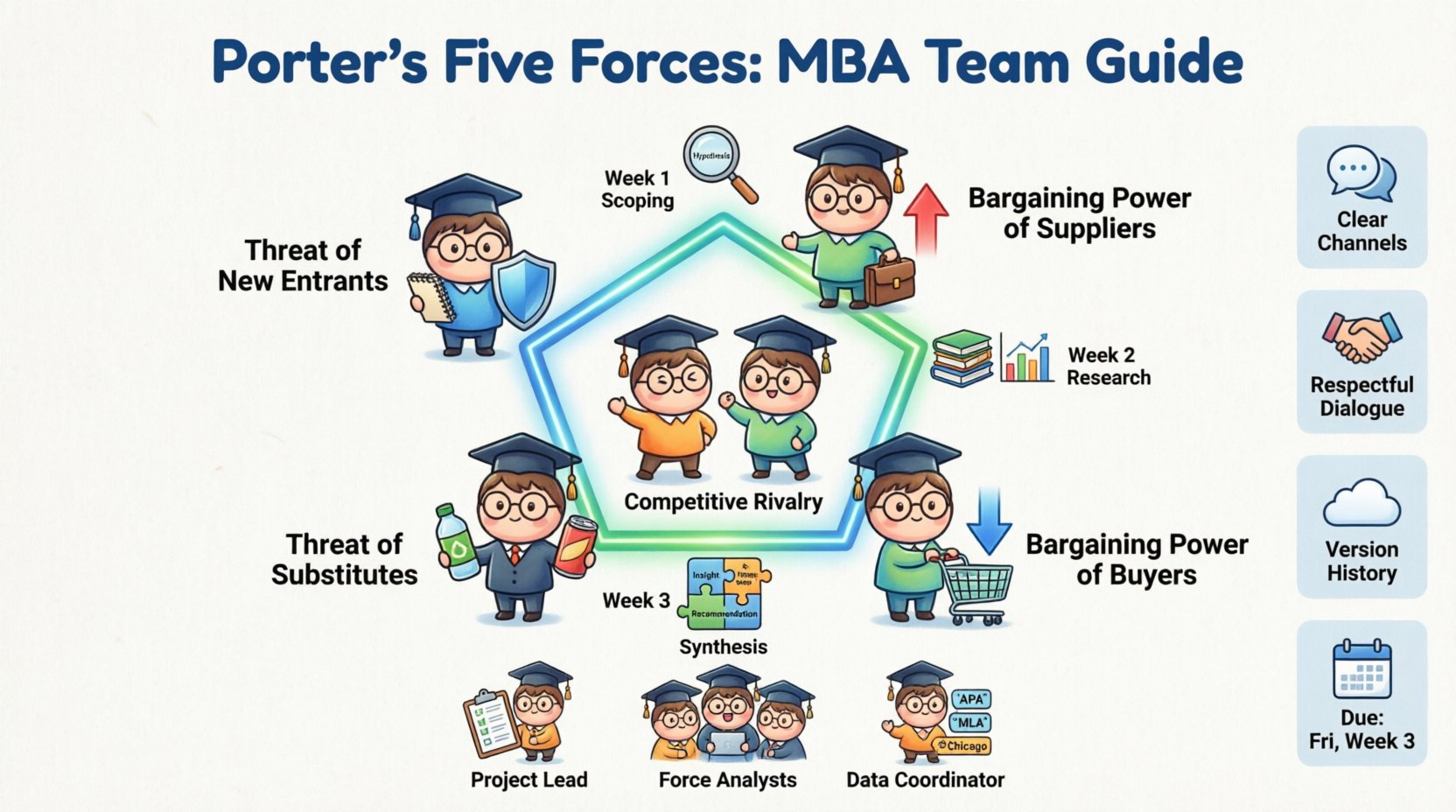
🧩 Understanding the Framework in a Group Context
Before splitting tasks, the entire team must agree on the scope. The Five Forces framework examines industry profitability through five distinct lenses. In a group project, each member often owns one force, but the synthesis requires the whole team.
- Threat of New Entrants: How easy is it for competitors to enter the market?
- Bargaining Power of Suppliers: Can suppliers drive up prices?
- Bargaining Power of Buyers: Can customers drive down prices?
- Threat of Substitute Products: Are there alternatives outside the industry?
- Rivalry Among Existing Competitors: How intense is the current competition?
Each member needs to understand how their specific force interacts with the others. A high threat from new entrants might increase rivalry. Strong supplier power might reduce buyer power. Understanding these interdependencies prevents the final report from feeling like five separate essays glued together.
👥 Defining Roles and Responsibilities
Clear role definition prevents duplication of effort and ensures accountability. Below is a suggested structure for a standard four-to-five person team.
| Role | Primary Focus | Key Deliverable |
|---|---|---|
| Project Lead | Timeline management, synthesis, final review | Executive Summary & Integration |
| Force Analyst 1 | Supplier & Buyer Power | Data on pricing dynamics |
| Force Analyst 2 | Entrants & Substitutes | Barriers to entry assessment |
| Force Analyst 3 | Competitive Rivalry | Competitor profiling |
| Data Coordinator | Validation & Citations | Bibliography & Evidence Log |
Note: In smaller teams, members may combine roles. For example, the Project Lead might also handle the Competitive Rivalry section. The key is that the Data Coordinator role is distinct to ensure the final output is backed by credible sources.
📊 Step-by-Step Collaborative Process
Success in this project depends on the workflow. A linear approach often leads to bottlenecks. Instead, use an iterative process.
Phase 1: Scoping and Hypothesis (Week 1)
- Select the Industry: Choose an industry that is neither too broad (e.g., “Technology”) nor too narrow (e.g., “Coffee shops in one zip code”).
- Define the Company: Pick a specific public company to analyze as a case study.
- Form Hypotheses: Before deep research, each member writes a one-sentence hypothesis about their force. Does supplier power seem high or low? Why?
- Share Sources: Create a shared document list of initial articles, annual reports, and market studies.
Phase 2: Independent Research (Week 2)
- Primary Sources: Review the target company’s annual reports (10-K, 10-Q) for financial data.
- Secondary Sources: Utilize academic databases, industry reports, and news archives.
- Qualitative Data: Look for regulatory changes, technology shifts, or consumer trend reports.
- No Assumptions: Do not rely on general knowledge. Every claim needs a citation.
Phase 3: Synthesis and Integration (Week 3)
- Team Workshop: Meet to discuss findings. Look for contradictions between forces.
- Weighting: Not all forces are equal. Decide which three are most critical for this specific industry.
- Drafting: Combine sections. Ensure tone and formatting are consistent.
- Review: Check for logical flow. Does the conclusion follow the evidence?
🔍 Deep Dive: Analyzing Each Force Collaboratively
Here is how teams can approach each force with specific analytical techniques.
1. Threat of New Entrants
- Focus: Barriers to entry.
- Team Task: Identify capital requirements, economies of scale, and regulatory hurdles.
- Question: If a new competitor entered tomorrow, what would stop them from taking market share?
2. Bargaining Power of Suppliers
- Focus: Concentration and switching costs.
- Team Task: Map out the supply chain. Are there few suppliers or many?
- Question: If one supplier raises prices, can the company easily switch to another?
3. Bargaining Power of Buyers
- Focus: Price sensitivity and concentration.
- Team Task: Analyze customer demographics. Are they individuals or large corporations?
- Question: Can customers easily compare prices and switch brands?
4. Threat of Substitute Products
- Focus: Alternative solutions outside the industry.
- Team Task: Look at adjacent industries. What solves the same customer problem differently?
- Question: Is the price-performance trade-off favorable for substitutes?
5. Rivalry Among Existing Competitors
- Focus: Industry growth and exit barriers.
- Team Task: Assess market growth rates and competitor count.
- Question: Is the industry growing slowly, forcing companies to fight for market share?
🤝 Overcoming Collaboration Challenges
Group projects often stall due to interpersonal or logistical issues. Here are strategies to maintain momentum.
- Establish Communication Norms: Decide on a primary channel for updates (e.g., email threads or scheduled calls). Avoid fragmented conversations.
- Conflict Resolution: If two members disagree on the severity of a force, do not vote. Instead, seek a third piece of evidence to settle the debate.
- Version Control: Maintain a single master document. Do not email attachments back and forth. Use a shared workspace to prevent version confusion.
- Deadlines: Set internal deadlines that are earlier than the actual submission date. This allows time for final editing.
📝 Data Gathering Strategies Without Specialized Tools
Research requires diligence, not expensive software. Teams can gather robust data using free and open resources.
- Public Filings: Government regulatory bodies publish company filings. These are primary sources for financial health.
- News Archives: Historical news articles provide context on past strategic moves by competitors.
- Academic Journals: Scholarly articles often provide theoretical backing for observed market behaviors.
- Government Statistics: Census data and industry reports from government agencies offer macroeconomic context.
Tip: Create a simple spreadsheet to track findings. Columns should include Source, Date, Key Finding, and Relevance to Specific Force.
🎨 Structuring the Final Deliverable
A well-structured document enhances readability and demonstrates professional rigor. Follow this outline.
- Executive Summary: A one-page overview of the main findings and strategic implications.
- Industry Overview: Brief context on the sector and the target company.
- Five Forces Analysis: Detailed breakdown of each force with evidence.
- Strategic Implications: What should the company do based on this analysis?
- Limitations: Acknowledge data gaps or timeframe constraints.
- References: Complete list of all citations.
⚠️ Common Pitfalls to Avoid
Avoid these mistakes to ensure a high-quality submission.
- Generic Descriptions: Do not write “Competition is high.” Explain why it is high. Is it price wars? Marketing spend? Innovation cycles?
- Ignoring Interconnectivity: Do not treat the forces as isolated silos. Explain how one force influences another.
- Outdated Data: Use the most recent annual reports available. Stale data undermines credibility.
- Lack of Visuals: Use charts or diagrams to represent relationships between forces. A simple matrix can clarify complex dynamics.
- Ignoring the Future: The analysis should look forward. What happens if trends continue? What if they reverse?
🗣️ Presentation and Defense
The written report is only half the battle. Teams must often present their findings.
- Know Your Audience: Are the professors interested in financial metrics or strategic theory? Adjust emphasis accordingly.
- Anticipate Questions: Prepare for challenges on your data sources. Be ready to justify your force rankings.
- Division of Labor: Each member should speak about their specific section to demonstrate ownership.
- Visual Aids: Create a slide deck that summarizes the key points without cluttering the screen with text.
🚀 Moving Forward with Strategic Insight
Completing a Five Forces analysis is more than an academic exercise. It builds a muscle for critical thinking about market dynamics. When teams collaborate effectively, they learn to balance diverse perspectives while maintaining analytical precision.
The value lies in the synthesis. A single member might identify a threat, but the team identifies the strategic response. By following a structured process, defining clear roles, and prioritizing evidence over assumption, MBA teams can produce work that stands up to rigorous scrutiny.
Focus on the logic of the argument. Ensure every claim supports the strategic conclusion. This approach ensures the project delivers genuine insight into the competitive landscape.
Related posts:
 Porter’s Five Forces Analysis: A Complete Framework Breakdown for Strategic Decision-Making
 How to Apply Porter’s Five Forces to Evaluate Industry Attractiveness and Profit Potential
 Porter’s Five Forces Explained: Key Concepts Every Business Leader Should Know
 Step-by-Step Guide to Conducting a Porter’s Five Forces Analysis from Scratch