


When navigating the complex landscape of business strategy, few frameworks hold as much weight as Porter’s Five Forces. Whether you are sitting for a rigorous academic examination or facing a high-stakes consulting interview, understanding this model is non-negotiable. It provides a structured method to assess the competitive intensity and attractiveness of a market. This guide breaks down the mechanics of the analysis, how to apply it under pressure, and the nuances that distinguish a strong answer from a mediocre one.
The objective is not merely to list the five forces but to synthesize them into a coherent narrative about profitability and strategic positioning. In an interview setting, interviewers are looking for your ability to deconstruct a problem, identify key drivers, and recommend actionable steps. This document serves as a comprehensive resource to guide your preparation.
🔍 The Core Framework Explained
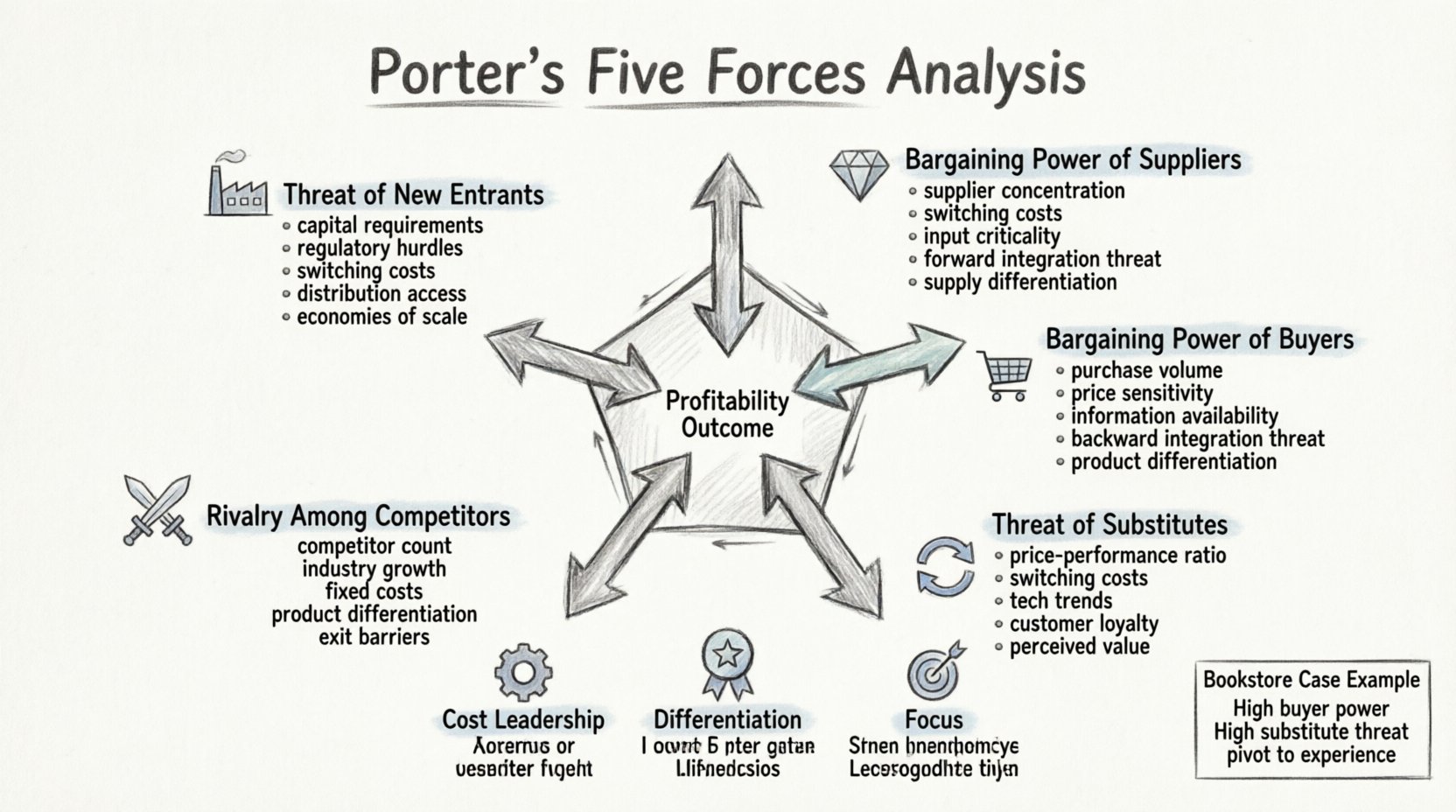
Developed by Michael Porter in 1979, this framework evaluates the competitive environment of an industry. It moves beyond simple competitor analysis to look at the broader economic forces that shape the industry’s profit potential. The central thesis is that the structure of the industry determines its long-run profitability. Below, we dissect each force with specific focus on what to look for during an analysis.
1. Threat of New Entrants 🏗️
This force assesses how easy or difficult it is for new competitors to enter the market. If entry is easy, existing companies face pressure to keep prices low to deter newcomers. High barriers to entry protect incumbents and allow for higher margins.
- Capital Requirements: Does the industry require massive investment? For example, manufacturing plants or heavy infrastructure create a high barrier.
- Regulatory Hurdles: Licenses, patents, and government policies can block new players.
- Switching Costs: If customers find it costly to switch to a new provider, new entrants struggle to gain traction.
- Access to Distribution Channels: If existing players control the best retail space or supply lines, newcomers are blocked.
- economies of Scale: If larger producers have lower per-unit costs, new small entrants cannot compete on price.
When analyzing this for an exam, ask: “What stops a well-funded startup from entering tomorrow?” If the answer is nothing, the threat is high.
2. Bargaining Power of Suppliers 💎
Suppliers can squeeze profitability by raising prices or reducing the quality of purchased goods and services. This force is strong when suppliers are concentrated or when the product they provide is unique.
- Concentration of Suppliers: Few suppliers mean more power. If there is only one source for a critical component, they dictate terms.
- Switching Costs: If it is expensive to change suppliers, the incumbent supplier holds leverage.
- Criticality of Input: If the input is a key differentiator for the final product, the supplier is powerful.
- Threat of Forward Integration: Can the supplier make the product themselves? If they can, they have leverage over the buyer.
- Differentiation of Supplies: If the materials are commoditized, supplier power is low.
In an interview, consider the supply chain dynamics. Are raw materials volatile in price? Is the supply chain fragile? These factors directly impact the bottom line.
3. Bargaining Power of Buyers 🛒
Buyers exert pressure by demanding lower prices, higher quality, or more services. When buyer power is high, profits are squeezed. This force is particularly relevant in B2B or B2C markets where customers are few or well-informed.
- Volume of Purchases: Large buyers who purchase a significant portion of the industry’s output have more leverage.
- Price Sensitivity: If the product is a small portion of the buyer’s total cost, they are less price-sensitive.
- Availability of Information: When buyers know exactly what competitors charge, they can play companies against each other.
- Threat of Backward Integration: Can the buyer make the product themselves? If yes, they can negotiate harder.
- Product Differentiation: If the product is unique, buyers have fewer alternatives and less power.
For strategy exams, analyze the customer base. Is it fragmented (many small buyers) or concentrated (few large buyers)? Concentrated buyers usually drive the analysis.
4. Threat of Substitute Products 🔄
Substitutes are products from outside the industry that satisfy the same need. For instance, tea substitutes coffee. This force limits the price ceiling of an industry. If a substitute is cheaper or better, demand is capped.
- Price-Performance Ratio: If a substitute offers better value for money, it poses a high threat.
- Switching Costs: Low costs for customers to switch to the substitute increase the threat.
- Trends and Technology: Technological advancements often create new substitutes (e.g., streaming vs. cable TV).
- Customer Loyalty: Strong brand loyalty can mitigate the threat of substitutes.
- Perceived Value: If customers perceive the substitute as inferior, the threat is lower.
When discussing this in an interview, think laterally. Look beyond direct competitors to adjacent industries that solve the same problem.
5. Rivalry Among Existing Competitors ⚔️
This is the most visible force. It involves the intensity of competition among existing firms. High rivalry leads to price wars, advertising battles, and innovation races, all of which reduce profitability.
- Number of Competitors: Many competitors of similar size often lead to aggressive competition.
- Industry Growth Rate: In a stagnant market, companies fight for market share. In a growing market, they fight for expansion.
- Fixed Costs: High fixed costs encourage firms to cut prices to fill capacity.
- Product Differentiation: If products are identical, competition is based purely on price.
- Exit Barriers: If it is hard to leave the industry (due to specialized assets), firms stay and fight, increasing rivalry.
Assess the current state of the industry. Are companies cutting prices? Is there a lot of marketing spend? These are indicators of intense rivalry.
📋 Force Analysis Matrix
To organize your thoughts during an exam or interview, use a structured approach. The following table summarizes the key drivers for each force to help you structure your mental model.
| Force | Key Question | High Power Indicator | Low Power Indicator |
|---|---|---|---|
| Threat of New Entrants | How easy is it to enter? | Low barriers, low capital req. | High regulations, high capital req. |
| Bargaining Power of Suppliers | Can suppliers raise prices? | Few suppliers, unique input. | Many suppliers, commoditized input. |
| Bargaining Power of Buyers | Can buyers demand lower prices? | Few buyers, high volume. | Many buyers, low volume. |
| Threat of Substitutes | Can customers switch easily? | Low switching cost, cheaper option. | High switching cost, unique value. |
| Rivalry Among Competitors | How aggressive is the competition? | Slow growth, high fixed costs. | Fast growth, high differentiation. |
🎓 Applying the Framework in Case Interviews
In a consulting interview, you will often be asked to analyze an industry or a company’s strategic position. The Five Forces framework is the standard tool for this. However, merely listing the forces is insufficient. You must synthesize the findings to answer the specific question posed.
Step 1: Define the Industry Boundaries
Before analyzing, clarify what constitutes the industry. Is it “Soft Drinks” or “Beverages”? Is it “Air Travel” or “Long-distance Transportation”? The boundaries change the analysis significantly. A broader definition might reduce the perceived rivalry. A narrower definition might increase the threat of substitutes.
Step 2: Prioritize the Forces
Not all forces are equal in every context. In some industries, supplier power is the dominant driver. In others, rivalry is the main issue. Do not treat them as a checklist. Identify the two or three most critical forces and focus your energy there.
Step 3: Connect to Profitability
Every force analysis must link back to financial performance. If the threat of new entrants is high, explain how this caps prices. If buyer power is strong, explain how it reduces margins. The examiner wants to see the logical chain from industry structure to financial outcome.
Step 4: Formulate Recommendations
Once the analysis is complete, propose strategic moves. These should directly address the forces you identified. For example, if supplier power is high, recommend backward integration or diversifying the supplier base. If rivalry is high, recommend differentiation to reduce price sensitivity.
🚫 Common Pitfalls to Avoid
Even experienced candidates stumble when applying this framework. Recognizing these pitfalls can save you from losing points in an exam or failing a case round.
- Generic Analysis: Do not say “Technology is changing.” Be specific. “5G networks allow faster data transfer, reducing the need for physical infrastructure.”
- Ignoring the Context: An analysis for a mature industry differs from one for a startup. A high threat of new entrants might be good for a startup (indicating a hot market) but bad for an incumbent.
- Forgetting the Time Horizon: Some forces are static, while others change rapidly. Mention whether the forces are increasing or decreasing over time.
- Overlooking Synergies: In conglomerates, different business units might share resources. This can reduce the power of suppliers or buyers across the board.
- Lack of Evidence: If you claim supplier power is high, provide a reason. “There are only three major chip manufacturers globally.”
🧠 Strategic Implications & Recommendations
Once the analysis is complete, the goal is to determine the strategic direction. Porter suggested three generic strategies that align with the industry structure.
Cost Leadership
If the industry is price-sensitive and rivalry is high, becoming the lowest-cost producer is a viable path. This requires efficiency, economies of scale, and tight cost control. It works well when supplier power is low and buyer power is high.
Differentiation
If customers value unique features, differentiation allows a company to charge a premium. This reduces the threat of substitutes and lowers buyer power. It requires strong R&D, branding, and customer service.
Focus
Targeting a specific niche allows a company to serve a segment better than broad competitors. This can mitigate rivalry by avoiding direct competition with large players.
📝 Sample Case Walkthrough
Imagine a case involving a traditional brick-and-mortar bookstore facing a decline in revenue. Here is how to apply the forces.
- Threat of New Entrants: Low. Physical stores require capital. However, digital platforms have low entry barriers.
- Supplier Power: Moderate. Publishers have consolidated, giving them leverage.
- Buyer Power: High. Customers can easily switch to Amazon or e-readers.
- Threat of Substitutes: High. E-books, audiobooks, and streaming content substitute reading.
- Rivalry: Moderate. Competing with other chains and online giants.
Strategic Recommendation: The physical store cannot compete on price. It must pivot to experience. Create a community hub, host events, and sell niche items that cannot be bought online. This addresses the high buyer power and substitute threat by offering unique value.
📚 Preparation Tips for Candidates
Success in exams and interviews comes from preparation and practice. Here are actionable steps to refine your skills.
- Memorize the Drivers: Know the specific drivers for each force by heart. Do not spend time recalling them during the case.
- Practice with Real Data: Read annual reports of public companies. Look at their risk factors section. This is often where they disclose the forces at play.
- Time Yourself: In an interview, you have limited time. Practice delivering a full Five Forces analysis within 10 minutes.
- Review Past Cases: Study solved case studies to see how top candidates structured their arguments.
- Understand the Industry: Have a baseline knowledge of major industries (Tech, Healthcare, Automotive, Retail). Each has unique dynamics.
🔗 Synthesizing the Analysis
The true power of the framework lies in synthesis. It is not enough to say “Supplier power is high.” You must explain what that means for the company. Does it mean margins will shrink? Does it mean prices will rise? Does it mean the company should invest in R&D to reduce dependency?
When presenting your findings, use a clear structure. Start with the overall industry attractiveness. Then detail the forces. Finally, conclude with the strategic implication. This flow helps the interviewer follow your logic without getting lost in details.
🌟 Final Thoughts on Strategic Thinking
Mastering this framework requires more than memorization. It requires a mindset that constantly asks, “What drives value in this industry?” and “Who holds the leverage?” When you walk into an exam room or a conference room, you are not just analyzing a chart; you are evaluating the economic reality of a business.
By grounding your arguments in these forces, you demonstrate a deep understanding of market dynamics. This credibility is what leads to high scores in academic settings and offers in consulting firms. Remember, the goal is to provide clarity in a complex environment. Use this tool to cut through the noise and identify the critical factors that determine success.
Keep practicing, keep questioning, and keep refining your ability to see the structure behind the strategy. The market is always changing, but the principles of competitive analysis remain a constant foundation for sound decision-making.
Related posts:
 Porter’s Five Forces Analysis: A Complete Framework Breakdown for Strategic Decision-Making
 How to Apply Porter’s Five Forces to Evaluate Industry Attractiveness and Profit Potential
 Porter’s Five Forces Explained: Key Concepts Every Business Leader Should Know
 Step-by-Step Guide to Conducting a Porter’s Five Forces Analysis from Scratch