

Organizations today face constant shifts. Market conditions evolve, technology advances, and internal structures require updates. Navigating these shifts without a clear framework often leads to confusion and resistance. This is where the Business Motivation Model (BMM) becomes essential. It provides a structured way to understand why an organization acts, which is the foundation of effective change management.
Change management is not just about executing tasks. It is about aligning people, goals, and resources. By applying the BMM approach, leaders can map the motivations behind change initiatives. This guide explores how to leverage BMM for strategic alignment, stakeholder engagement, and sustainable transformation.
🧩 Understanding the Core of Business Motivation Model
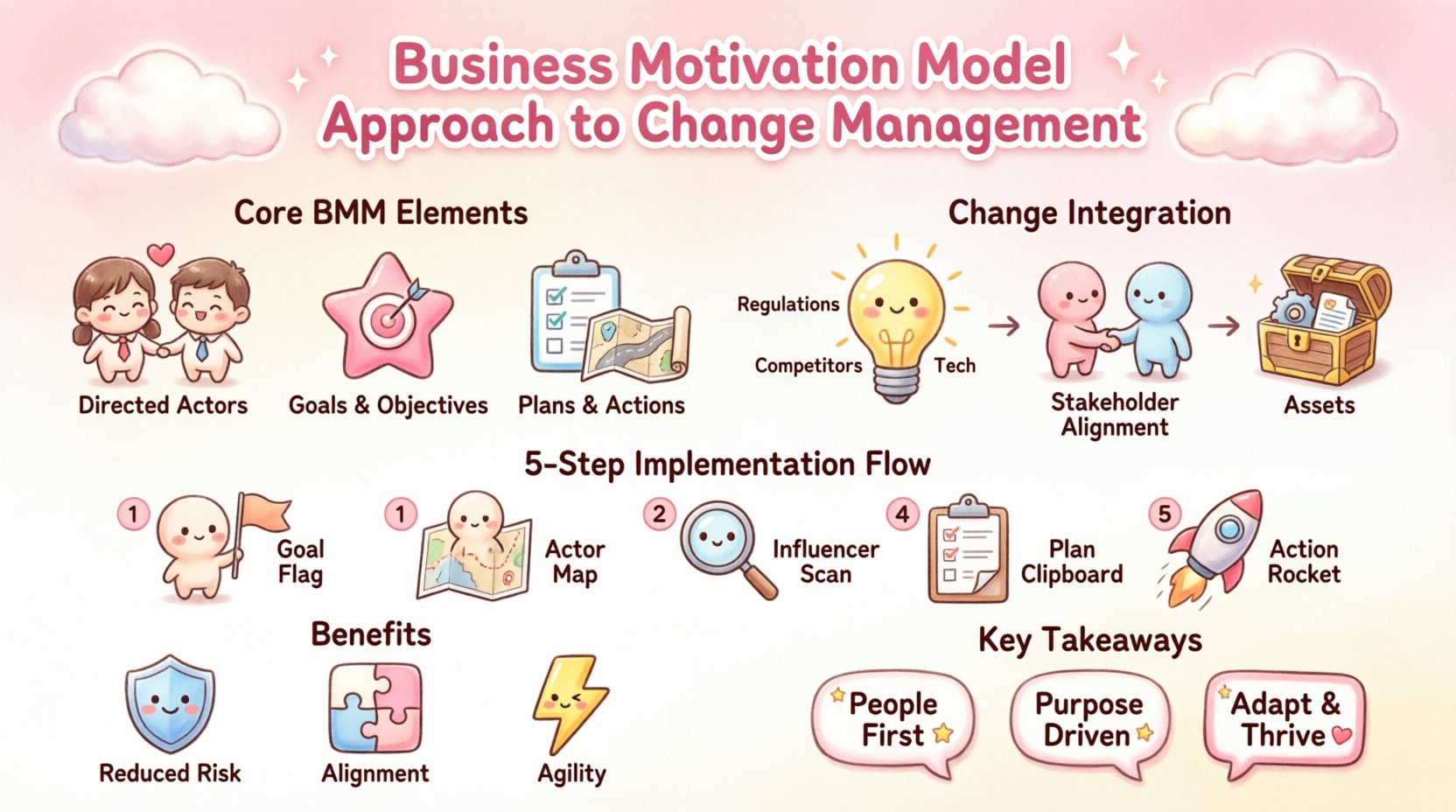
The Business Motivation Model is a standard developed by the Object Management Group (OMG). It focuses on the intent behind business activities. Instead of just looking at processes or systems, it looks at the drivers. In the context of change, understanding these drivers is critical.
🎯 Directed Actors
Change does not happen in a vacuum. It happens because of people or groups. Directed Actors represent the entities that take action or are affected by the organization’s activities.
- Internal Actors: Employees, managers, and teams within the organization.
- External Actors: Customers, suppliers, regulators, and partners.
When managing change, identifying the Directed Actors helps determine who needs to be influenced. Resistance often comes from actors who do not see the value in the proposed change. BMM clarifies who these actors are and what they value.
🏆 Goals and Objectives
Goals are high-level statements of intent. Objectives are specific, measurable targets that support a goal. In change management, these terms are often used interchangeably, but BMM distinguishes them clearly.
- Strategic Goals: Long-term aspirations (e.g., “Become the market leader in sustainability.”).
- Tactical Objectives: Short-term milestones (e.g., “Reduce carbon footprint by 10% this year.”).
Using BMM ensures that every change initiative links back to a strategic goal. If a project does not support a goal, it should be questioned. This prevents resource waste on initiatives that do not drive the organization forward.
📈 Plans and Actions
Plans are sequences of actions designed to achieve objectives. Actions are the specific steps taken. BMM separates the planning layer from the execution layer.
In a change scenario:
- Plan: The roadmap for the transformation.
- Action: The training sessions, software rollouts, or policy updates.
This distinction allows leaders to adjust actions without losing sight of the overall plan. If an action fails, the plan can be modified while keeping the goal intact.
🔄 Integrating Change Management with BMM
Traditional change management often focuses on communication and training. While important, these are tactics. The BMM approach is strategic. It looks at the underlying motivations. Here is how the two disciplines intersect.
🚀 The Change Catalyst
Every change begins with a catalyst. In BMM, this is often an Influencer. An influencer is something that impacts the achievement of a goal.
Common Influencers in change scenarios include:
- Regulatory changes requiring compliance updates.
- New competitors entering the market.
- Internal inefficiencies discovered through audits.
- Technological advancements that offer efficiency.
By cataloging Influencers, organizations can see the external and internal pressures driving the need for change. This provides a factual basis for the change initiative rather than relying on intuition.
🤝 Aligning Stakeholder Motivations
Stakeholder resistance is a major hurdle in transformation. BMM addresses this by explicitly modeling motivations.
- Identify the Actor: Who is being asked to change?
- Identify the Goal: What is the organization trying to achieve?
- Identify the Conflict: Does the Actor’s personal goal align with the Organizational Goal?
If there is a conflict, the change management plan must address it. This might involve modifying the Objective, adjusting the Plan, or engaging in dialogue with the Actor to find a mutual benefit. BMM makes this conflict visible early in the process.
💡 The Role of Assets
Change requires resources. Directed Assets represent the resources an actor can use. These include financial capital, physical infrastructure, intellectual property, and human skills.
In change management, you must ensure that the Directed Assets are sufficient to achieve the new objectives. A common failure point is setting a Goal without verifying the Asset availability. BMM forces a check on resource constraints before the plan is finalized.
📊 Traditional vs. BMM Change Approach
To understand the value of this model, compare it with standard practices.
| Aspect | Traditional Change Management | BMM Approach |
|---|---|---|
| Focus | Process and people adoption | Intent and strategic alignment |
| Driver | Problem identification | Influencer and Goal modeling |
| Structure | Linear phases (Unfreeze, Change, Refreeze) | Network of Goals, Plans, and Actors |
| Success Metric | Adoption rate | Goal achievement and Actor satisfaction |
| Flexibility | Often rigid once the plan is set | Adaptable based on Influencer changes |
The BMM approach offers greater visibility into the why. This transparency often leads to higher buy-in from Directed Actors because they understand the strategic reasoning.
🛠️ Implementation Steps for BMM in Change
Applying this model requires a disciplined approach. Follow these steps to integrate BMM into your change management lifecycle.
Step 1: Define the Strategic Goal
Start with the end in mind. What is the desired future state? Document this as a Goal. Ensure it is specific enough to be measured but broad enough to guide decision-making.
- Check: Is this goal aligned with the organization’s vision?
- Check: Is it understandable by all Directed Actors?
Step 2: Map the Directed Actors
Identify everyone involved in the change. Categorize them by their level of influence and their impact on the goal.
- Primary Actors: Those executing the change.
- Secondary Actors: Those supporting or affected by the change.
For each Actor, determine their current motivation. Are they motivated to support the change, or do they fear it?
Step 3: Identify Influencers
List the factors driving the change. These could be market trends, technology shifts, or internal performance gaps.
- Positive Influencers: Opportunities that accelerate the goal.
- Negative Influencers: Barriers that hinder the goal.
Documenting these helps in risk management. You can plan specific actions to mitigate negative influencers.
Step 4: Establish Objectives and Plans
Break the Goal down into Objectives. Each Objective should have a corresponding Plan.
- Objective: “Implement new workflow by Q3”.
- Plan: “Phase 1: Training, Phase 2: Pilot, Phase 3: Rollout”.
Ensure that the Plan is realistic given the Directed Assets available. If the Plan exceeds the Assets, you must either acquire more resources or reduce the Objective scope.
Step 5: Execute Actions and Monitor
Actions are the daily tasks. Monitor them against the Plan. In BMM, monitoring is not just about tracking progress; it is about tracking motivation.
- Is the Actor still motivated?
- Has a new Influencer emerged that changes the Goal?
- Are the Assets still sufficient?
If the motivation drops, the plan may need adjustment. This flexibility is a key advantage of the model.
🧩 Handling Resistance with BMM
Resistance is often a symptom of misaligned motivations. BMM provides a framework to diagnose and resolve this.
🔍 Diagnose the Root Cause
When an Actor resists, ask questions based on the BMM structure:
- Do they understand the Goal? Communication gap.
- Do they believe the Goal is achievable? Confidence gap.
- Do they benefit from the Goal? Value gap.
- Do they have the Assets to succeed? Capability gap.
🛠️ Resolve the Conflict
Once diagnosed, apply specific remedies:
- Communication: Clarify the Goal and its benefits.
- Training: Provide the Assets (skills) needed to achieve the Objective.
- Incentives: Align the Actor’s personal goals with the Organizational Goal.
- Process Adjustment: Modify the Plan to reduce friction.
This systematic approach prevents ad-hoc fixes that often fail to address the real issue.
📈 Measuring Success and Achievements
In BMM, success is defined as Achievement. An Achievement occurs when an Actor successfully completes an Action to achieve an Objective.
For change management, this means defining clear milestones. Instead of vague success metrics like “improved efficiency,” use BMM-style metrics:
- Goal Achievement: Did we reach the strategic target?
- Objective Completion: Did we finish the planned phases?
- Action Completion: Did the specific tasks get done on time?
Tracking these layers provides a granular view of performance. If an Objective is missed, you can trace it back to a specific Action failure or an Actor motivation issue.
⚠️ Common Pitfalls to Avoid
While powerful, the BMM approach requires discipline. Avoid these common mistakes.
- Over-complicating the Model: Do not create a model that is too detailed. Keep it focused on the change initiative. Too many nodes can confuse stakeholders.
- Ignoring External Influencers: Do not focus only on internal goals. Market changes can render a Goal obsolete quickly.
- Static Modeling: BMM is not a one-time exercise. Update the model as the change evolves. Influencers change, and so should the plans.
- Neglecting the Human Element: BMM is structural, but change is human. Ensure Directed Actors are consulted during the modeling phase.
🚀 Long-term Benefits of BMM Integration
Using the Business Motivation Model for change management yields benefits beyond the immediate project.
🔗 Improved Strategic Alignment
Every project can be traced back to a Goal. This ensures that resources are not wasted on initiatives that do not support the organization’s direction. It creates a clear line of sight from daily actions to strategic vision.
📉 Reduced Risk
By identifying Influencers and Assets upfront, you can anticipate risks. If an Influencer is volatile, you can build contingency plans into your objectives. This proactive stance reduces the likelihood of project failure.
🤝 Enhanced Stakeholder Engagement
When stakeholders see how their work contributes to the Goal, engagement increases. BMM makes the contribution visible. It answers the question, “What is in it for me?” by linking personal actions to organizational success.
🔄 Greater Agility
Change is constant. With a BMM framework, adapting to new circumstances is easier. You can update the Plan or Action without breaking the Goal. This modularity supports agile methodologies within a structured framework.
🧭 Final Thoughts on Strategic Change
Managing change effectively requires more than just a timeline. It requires a deep understanding of the motivations driving the organization. The Business Motivation Model offers a proven structure for this understanding.
By focusing on Directed Actors, Goals, and Influencers, leaders can navigate complexity with clarity. This approach transforms change management from a reactive process into a strategic discipline. It ensures that every step taken is purposeful and aligned with the long-term vision.
Organizations that adopt this mindset are better equipped to handle uncertainty. They build resilience by understanding not just what they need to do, but why they are doing it. This clarity is the key to sustainable success in a dynamic environment.
📝 Key Takeaways
- Start with Intent: Always define the Goal before the Plan.
- Know Your Actors: Understand the motivations of the people involved.
- Track Influencers: Monitor external and internal drivers of change.
- Validate Assets: Ensure resources match the ambition.
- Iterate: Update the model as the environment changes.
Implementing the BMM approach takes effort, but the return on investment in clarity and alignment is significant. It provides the scaffolding needed to support complex transformations. With this foundation, organizations can move forward with confidence.