

Strategic alignment is often the hardest part of enterprise management. Organizations frequently draft high-level documents that sit on a shelf, disconnected from daily operations. The gap between what an organization wants to achieve (Vision) and how it intends to do it (Mission) often leads to confusion, wasted resources, and stalled initiatives. To bridge this divide effectively, a structured approach is required. This is where the Business Motivation Model (BMM) provides significant value. By offering a standardized framework, BMM allows stakeholders to visualize the relationships between strategic intent and operational execution.
This guide explores how to utilize the Business Motivation Model to connect Vision and Mission. We will examine the core elements, the structural relationships, and the practical steps needed to implement this framework without relying on proprietary software tools. The goal is to create a living map of business intent that guides decision-making at every level.
🧩 Understanding the Business Motivation Model
The Business Motivation Model is an OMG standard that provides a common vocabulary for describing business structures. It does not dictate specific processes but rather offers a way to model the drivers and capabilities of an organization. Think of it as a blueprint for understanding why a business exists and how it operates.
Core Distinctions in the Framework
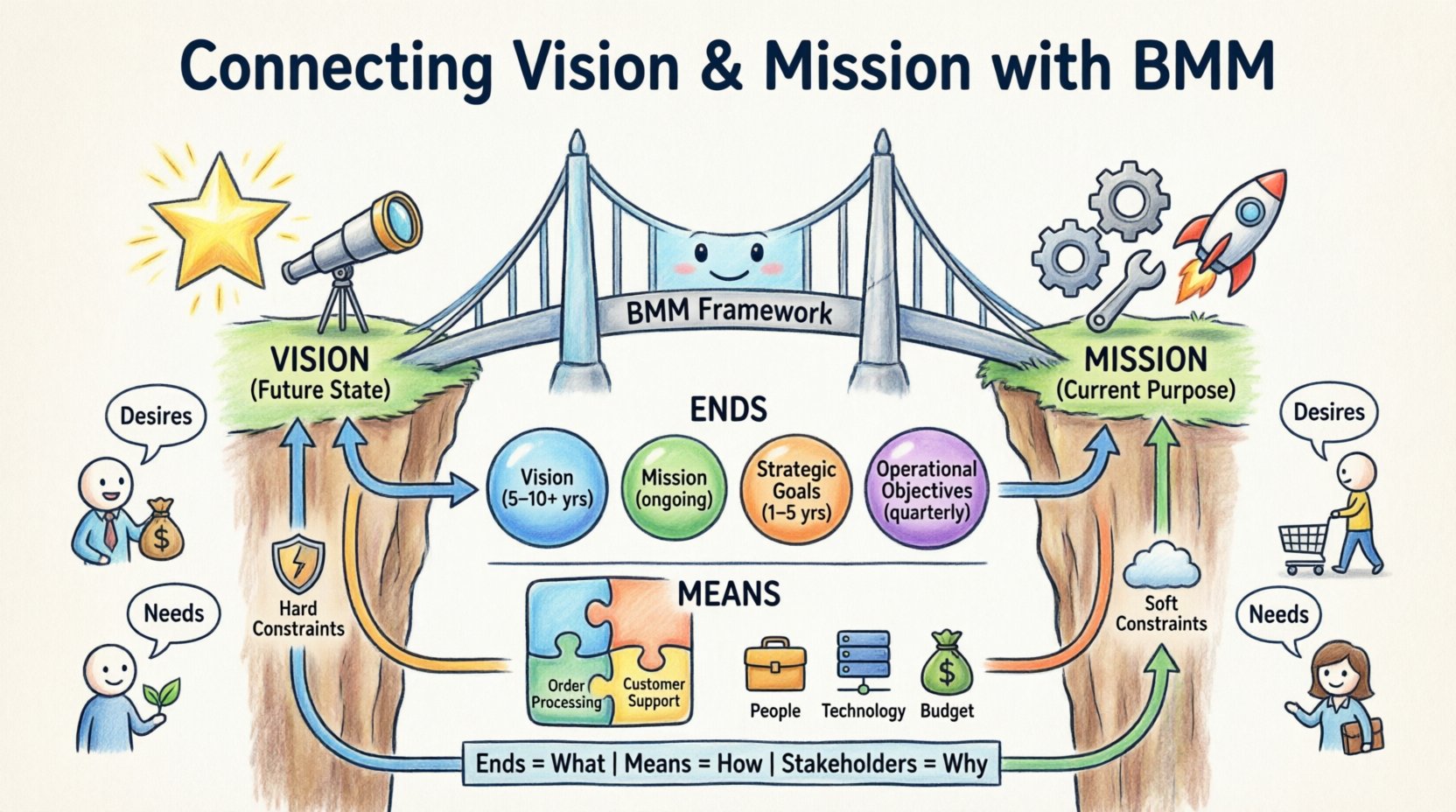
At the heart of BMM is the distinction between Ends and Means. This binary classification helps clarify the hierarchy of business goals.
- Ends: These represent what the business wants to achieve. They include Vision, Mission, Goals, and Objectives.
- Means: These represent how the business achieves the Ends. They include Business Capabilities and Business Resources.
By separating Ends from Means, organizations can focus on the outcome first, ensuring that capabilities and resources are acquired specifically to support that outcome. This prevents the common pitfall of building capabilities that do not align with strategic direction.
🎯 Defining Vision and Mission Within BMM
Vision and Mission are the primary Ends that drive the organization. However, they are often used interchangeably or defined vaguely. BMM requires precise definitions to function correctly.
The Vision Statement
A Vision statement describes the future state of the organization. It is aspirational and long-term. In BMM terms, the Vision acts as the ultimate goal that guides all other motivations.
- Characteristics: Inspiring, future-oriented, broad.
- Example: To be the global leader in sustainable energy solutions by 2030.
The Mission Statement
A Mission statement describes the current purpose of the organization. It explains why the business exists today and what it does to fulfill its Vision.
- Characteristics: Action-oriented, present tense, specific.
- Example: Developing and deploying innovative renewable energy systems for residential and commercial clients.
Distinguishing Ends from Goals
While Vision and Mission are high-level, Goals and Objectives provide the measurable steps. BMM treats these as a hierarchy.
| Element | Definition | Timeframe |
|---|---|---|
| Vision | The desired future state | 5-10+ Years |
| Mission | The current purpose and scope | Ongoing |
| Strategic Goal | High-level outcomes supporting Mission | 1-5 Years |
| Operational Objective | Specific, measurable targets | Quarterly/Yearly |
When modeling this in BMM, you link these elements using Directed Relationships. This creates a traceability chain from the daily tasks up to the Vision. If a task cannot trace back to a Goal, and that Goal to a Mission, and that Mission to a Vision, it may be a candidate for elimination.
🤝 Mapping Stakeholders and Motivation
Business Motivation is not just about abstract concepts; it is about people. BMM introduces the concept of the Stakeholder. A Stakeholder is anyone who influences or is influenced by the business.
The Role of Stakeholders
Every Vision and Mission must satisfy the needs of specific Stakeholders. These could be shareholders, customers, employees, or regulators. BMM requires you to identify who these are and what they want.
- Shareholders: Often motivated by profit, growth, and stability.
- Customers: Motivated by value, quality, and service.
- Employees: Motivated by growth, compensation, and culture.
Expressing Motivation
Once Stakeholders are identified, you must define their Motivation. In BMM, Motivation is expressed as a relationship between the Stakeholder and the Business Ends.
There are two primary types of motivation:
- Desires: What the Stakeholder wants the business to achieve. (e.g., “I want the company to grow.”)
- Needs: What the Stakeholder believes the business must do. (e.g., “The company must comply with regulations.”)
By mapping these, you ensure that the Vision and Mission are not just internal aspirations but are aligned with external and internal demands. This creates a robust foundation for strategic planning.
⚙️ Means: Capabilities and Resources
If Ends are what you want, Means are what you need. BMM splits Means into two categories: Business Capabilities and Business Resources.
Business Capabilities
Capabilities are the abilities required to perform the business. They are often functional in nature. Examples include “Order Processing,” “Customer Support,” or “Software Development.”
- Dynamic: Capabilities can be built, bought, or outsourced.
- Supportive: They are linked to Goals and Objectives.
- Traceable: A Capability should only exist to support a Goal.
Business Resources
Resources are the assets used to deliver Capabilities. These include people, technology, facilities, and financial capital.
- Static: Resources are the inputs.
- Shared: Resources are often shared across multiple Capabilities.
- Valued: Understanding the cost of resources helps in prioritizing goals.
🔗 Bridging the Gap: Connecting Ends and Means
The core value of BMM lies in the connections between Ends and Means. This is where the Vision and Mission become actionable.
Strategic Alignment
To connect Vision to Operations, you must establish a clear dependency chain. This is often visualized as a directed graph.
- Start with the Vision: Define the ultimate future state.
- Define the Mission: State the purpose required to reach the Vision.
- Identify Goals: Break the Mission into high-level outcomes.
- Define Capabilities: Determine what abilities are needed to achieve the Goals.
- Assign Resources: Allocate the assets needed to exercise the Capabilities.
When this chain is complete, every resource deployed can be traced back to the Vision. This eliminates waste and ensures that every investment contributes to the strategic direction.
The Role of Constraints
BMM also accounts for Constraints. Constraints are limitations on the business, such as budget limits, regulatory requirements, or technological barriers.
- Hard Constraints: Must be satisfied (e.g., legal compliance).
- Soft Constraints: Should be satisfied if possible (e.g., performance targets).
When modeling, Constraints act as filters. A Goal cannot be achieved if a Hard Constraint prevents it. This helps in realistic planning and risk management.
🛠️ Practical Implementation Steps
Implementing BMM requires discipline and collaboration. It is not a one-time event but an ongoing practice. Follow these steps to integrate the model into your organization.
1. Assemble the Modeling Team
Do not attempt this in isolation. You need representatives from Strategy, Operations, and IT. Their perspectives ensure that the Vision is practical and the Means are feasible.
2. Document the Ends
Start by writing down the current Vision and Mission. Then, interview stakeholders to understand their Desires and Needs. Refine the statements until they are clear and unambiguous. Avoid jargon. If a statement cannot be understood by a new hire, it is not clear enough.
3. Identify Capabilities
List the current capabilities of the organization. Categorize them as Core (essential), Support (necessary), or Peripheral (nice to have). Link each Core Capability to at least one Goal. If a Capability has no Goal, it may be a candidate for reduction.
4. Map Resources
Inventory your resources. Determine which resources support which Capabilities. Identify bottlenecks where a single resource is required for too many Capabilities. This often reveals operational risks.
5. Validate the Model
Walk through the model with stakeholders. Ask critical questions:
- Does this Goal support the Mission?
- Do we have the Capability to achieve this Goal?
- Is the Resource sufficient to support the Capability?
Iterate based on feedback. The model is a tool for thinking, not just a document for filing.
⚠️ Common Challenges and Solutions
Implementing a Business Motivation Model is not without obstacles. Recognizing these early helps in mitigating risks.
Challenge: Static Documentation
Issue: The model is created once and never updated. It becomes obsolete quickly.
Solution: Treat the model as a living artifact. Schedule regular reviews (e.g., quarterly) to update Goals and Capabilities based on market changes.
Challenge: Over-Complexity
Issue: The model becomes too detailed, making it impossible to read or use.
Solution: Focus on the hierarchy. Do not model every single task. Keep the focus on strategic Goals and high-level Capabilities. Drill down only when necessary for specific projects.
Challenge: Lack of Ownership
Issue: No one feels responsible for maintaining the model.
Solution: Assign a Model Owner. This role is responsible for ensuring the model remains accurate and accessible. This person does not need to be a senior executive but must have the authority to request updates.
📊 Measuring Success and Adaptation
How do you know if the connection between Vision and Mission is working? You need metrics that reflect the health of the model itself, not just business outcomes.
Alignment Metrics
- Traceability Rate: What percentage of active projects link back to a Strategic Goal?
- Capability Utilization: Are Capabilities being used effectively or is there idle capacity?
- Stakeholder Satisfaction: Are Stakeholders feeling that their Needs are being addressed by the Mission?
Adaptation Cycles
The business environment changes. A Vision set five years ago may no longer be relevant. BMM supports adaptation by allowing you to modify the Ends without breaking the Means.
If the Vision changes, you do not need to rebuild the entire model. You update the top-level Ends and re-evaluate the Goals. The Capabilities and Resources remain relevant unless they are no longer needed for the new direction.
🔍 Deep Dive: The Relationship Between Stakeholders and Goals
One of the most powerful aspects of BMM is the explicit link between Stakeholders and Goals. This moves strategy beyond abstract concepts into human motivation.
Direct vs. Indirect Influence
Not all Stakeholders influence all Goals. Some have a direct impact, while others are indirectly affected.
- Direct Influence: A regulator requires a specific compliance Goal.
- Indirect Influence: A customer base affects the revenue Goal, but does not dictate the technical Goal directly.
Mapping these relationships helps in prioritization. If a Stakeholder has high influence and high motivation, their Needs must be addressed first. If a Stakeholder has low influence and low motivation, their Needs can be monitored but not prioritized.
Conflict Resolution
Stakeholder Needs often conflict. Shareholders want profit; Employees want higher wages. BMM does not solve this for you, but it highlights the conflict clearly.
- Identify the Conflict: Use the model to show where Needs clash.
- Trade-off Analysis: Evaluate the impact of satisfying one Need over another.
- Document the Decision: Record the rationale for the decision. This ensures transparency and accountability.
🌐 Integrating BMM with Other Frameworks
BMM does not exist in a vacuum. It often complements other architectural frameworks like TOGAF or Zachman.
Complementary Roles
While TOGAF focuses on the architecture of the enterprise, BMM focuses on the motivation behind it. You can use TOGAF to design the system and BMM to define why the system is being built.
- TOGAF: Focuses on processes, data, and applications.
- BMM: Focuses on goals, capabilities, and stakeholders.
By integrating them, you ensure that the technical architecture supports the business motivation. This prevents the common issue of building systems that are technically sound but strategically irrelevant.
🏁 Sustaining the Connection
Connecting Vision and Mission is not a project with an end date. It is a discipline. It requires continuous attention to ensure that the organization remains focused on its core purpose.
Communication is Key
The model must be communicated effectively. Do not hide it in a technical repository. Use visualizations to show how daily work connects to the Vision. When employees see the connection, engagement increases.
Regular Audits
Conduct regular audits of the model. Check for orphaned Goals, unused Capabilities, and outdated Resources. Clean up the model to keep it lean and effective.
Culture of Alignment
Finally, foster a culture where alignment is valued. Reward decisions that support the Vision. Discourage actions that deviate from the Mission. This cultural shift is often more important than the model itself.
📝 Summary of Key Concepts
- Vision and Mission: The primary Ends that define purpose and future state.
- Stakeholders: The people who drive the motivation behind the business.
- Capabilities and Resources: The Means required to achieve the Ends.
- Directed Relationships: The links that create traceability between all elements.
- Constraints: The limitations that shape what is possible.
By adhering to these principles, organizations can create a robust strategic framework. The Business Motivation Model provides the structure needed to ensure that every action taken is in service of the Vision. This alignment leads to efficiency, clarity, and long-term success.