


In the evolving landscape of systems engineering and business analysis, the transition from manual drafting to intelligent automation is no longer a luxury—it is a necessity. For decades, professionals have wrestled with the tedious mechanics of drag-and-drop interfaces, spending more time managing connectors and layout alignment than refining the actual logic of their systems. The Visual Paradigm AI Chatbot represents a significant leap forward, functioning not merely as a drawing tool, but as the world’s first AI co-pilot dedicated to rigorous visual modeling.

Beyond Drawing: The Era of Modeling Intelligence
To understand the significance of this tool, one must distinguish between drawing and modeling. A useful analogy is the difference between a general illustrator and a master architect. If you ask a generic AI image generator to “sketch a house,” it will produce an image that looks like a home, but it may lack the structural integrity required for construction. It focuses on pixels and aesthetics.
Conversely, using the Visual Paradigm AI Chatbot is akin to working with a master architect. It does not just sketch a vision; it ensures the resulting “blueprints” adhere to engineering codes and standards. This tool utilizes a semantic constraint engine that enforces metamodel compliance, ensuring that every output is not only visually coherent but conceptually accurate and production-ready.
Core Capabilities and Workflow Optimization
Designed to supercharge workflows for software engineers, business analysts, and project managers, the chatbot offers features that purportedly deliver up to 90% time savings. By bridging the gap between complex mental models and visual clarity, it addresses several critical pain points:
- Instant Diagram Generation: Users can transform natural language prompts into standards-compliant visuals in seconds. Whether prototyping a C4 system architecture or mapping strategic SWOT risks, the conversion from text to model is immediate.
- Conversational Refinement: Unlike static generation tools, this AI supports iterative development. If requirements change, users do not need to restart. Commands such as “Add an actor” or “Make the activity loop tighter” allow the model to evolve live, mirroring the dynamic nature of brainstorming sessions.
- Multilingual Excellence: Recognizing the global nature of development teams, the tool supports brainstorming and documentation in native languages, including Español, Français, Japanese, and Chinese.
Unmatched Structural Fidelity and Standards
The market is currently flooded with generic text-to-image generators that often produce results that are syntactically plausible but semantically flawed. Common issues include invalid ArchiMate relationships or misplaced UML lifelines that violate logic.
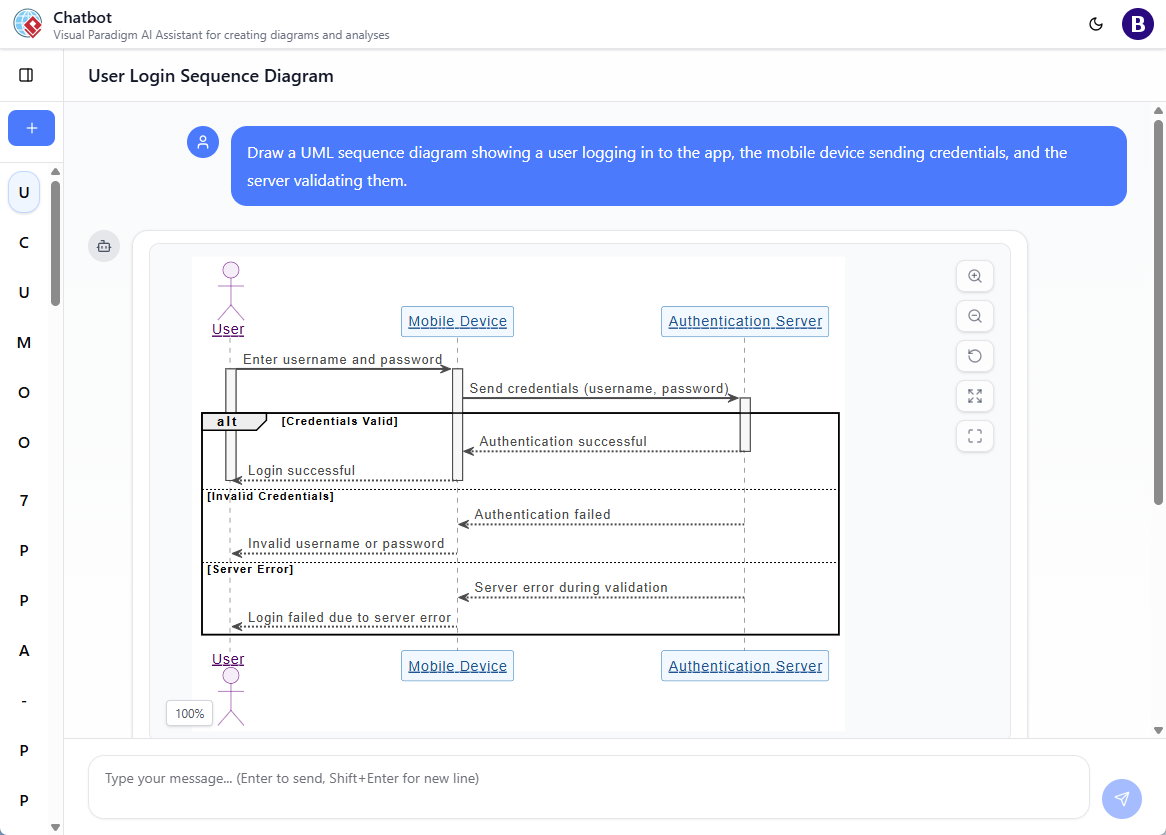
Visual Paradigm differentiates itself through Professional Modeling Rigor. The AI is specifically trained on OMG UML, SysML, and ArchiMate standards. This training ensures that the diagrams generated are true engineering blueprints rather than mere illustrations. It understands the underlying semantics of business logic, ensuring that relationships between entities obey the strict rules of the chosen modeling language.
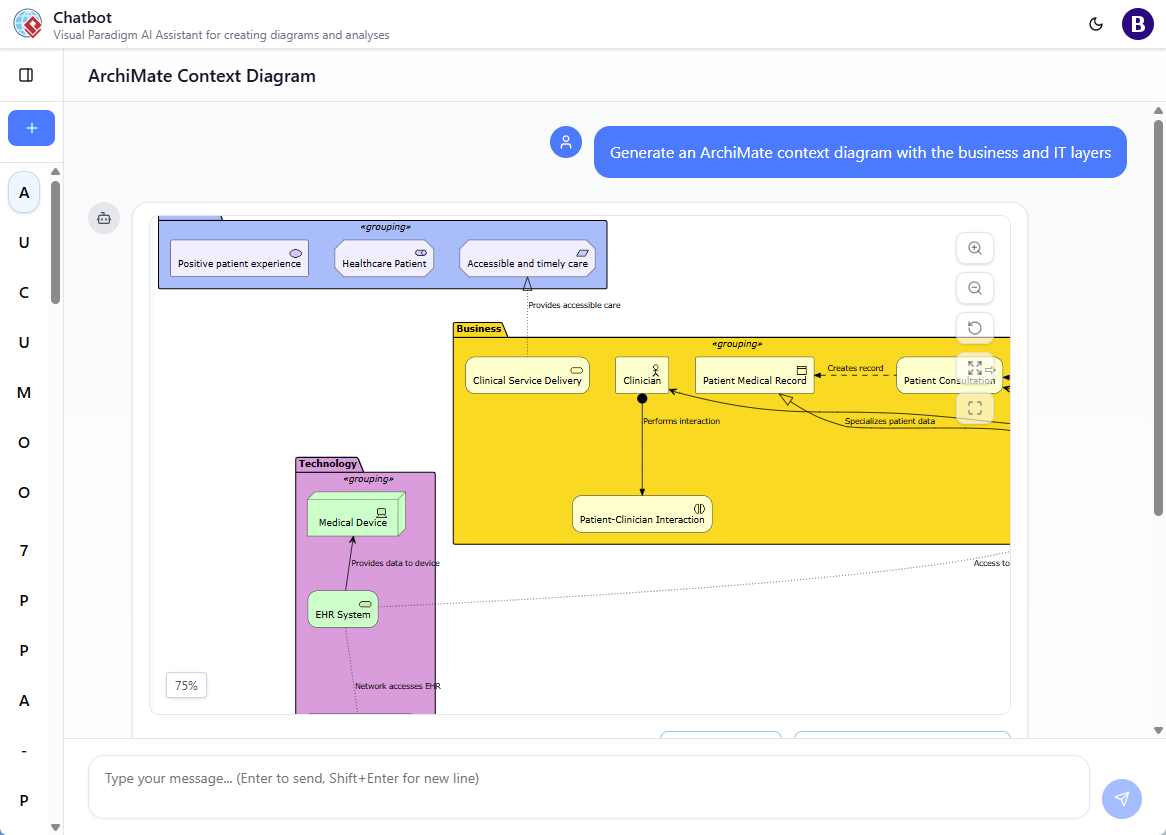
Deep Ecosystem Integration and Unified Workspace
For professional users, the true power of the Visual Paradigm AI Chatbot lies in its integration with the broader modeling ecosystem. Diagrams generated within the chat interface are not static images; they are generated as first-class modeling objects.
From Prototype to Production
This “Unified Workspace Integration” allows teams to import AI-generated prototypes directly into Visual Paradigm Desktop. Once imported, these models can undergo advanced engineering tasks, including:
- Simulation: Testing the timing and logic flows of the system.
- Traceability Management: Linking requirements to model elements to ensure full coverage.
- High-Precision Editing: Refining the model with granular control unavailable in standard chat interfaces.
Proactive Reasoning: The AI as a Consultant
Perhaps the most transformative aspect of this tool is its ability to function as a proactive “Creative Co-Pilot.” It moves beyond reactive generation to offer active reasoning and analysis. Users can request the AI to analyze their designs to identify single points of failure in an architecture or suggest refactoring opportunities to reduce coupling.
Furthermore, the tool streamlines the documentation process. It can generate technical specifications directly from the model, ensuring that stakeholders remain aligned without the need for hours of manual technical writing. This democratizes architectural thinking, allowing participants without years of specialized modeling expertise to engage in high-level design conversations effectively.
Comparison: Generic AI vs. Visual Paradigm AI
The following table illustrates the fundamental differences between using a general-purpose AI and the specialized Visual Paradigm AI Chatbot:
| Feature | Generic AI (Image Generators) | Visual Paradigm AI Chatbot |
|---|---|---|
| Output Format | Static Raster Images (Pixels) | Editable Modeling Objects |
| Standard Compliance | Visual approximation (Hallucinates syntax) | Strict adherence to UML, SysML, ArchiMate |
| Iterative Editing | Difficult (Often requires regeneration) | Conversational (e.g., “Add a loop here”) |
| Integration | None (Standalone images) | Full import to Desktop for simulation/coding |
| Logic Awareness | None (Visual pattern matching) | Semantic constraint engine |
Conclusion
Visual Paradigm has successfully moved automated design beyond heuristic automation toward intelligent, standards-based reasoning. For researchers, consultants, and developers, the AI Chatbot offers a path to stop wrestling with tools and start focusing on modeling complex ideas. By combining the speed of AI with the rigor of engineering standards, it acts as a bridge between intent and insight.