


Running a small business involves constant decision-making under pressure. Many owners find themselves staring at a blank page when it comes to strategic planning. The SWOT analysis is a classic tool, yet confusion often surrounds its practical application. You may know the acronym, but do you know how to apply it without generating vague noise? This guide addresses the specific questions business owners ask when they are trying to make sense of their competitive landscape.
Understanding your internal capabilities and external environment is not about predicting the future with certainty. It is about reducing uncertainty. By breaking down complex business realities into four distinct categories, you create a foundation for realistic strategy. This document answers the most common inquiries regarding the process, ensuring you move from confusion to clarity.
What Exactly Is a SWOT Analysis? 🔍
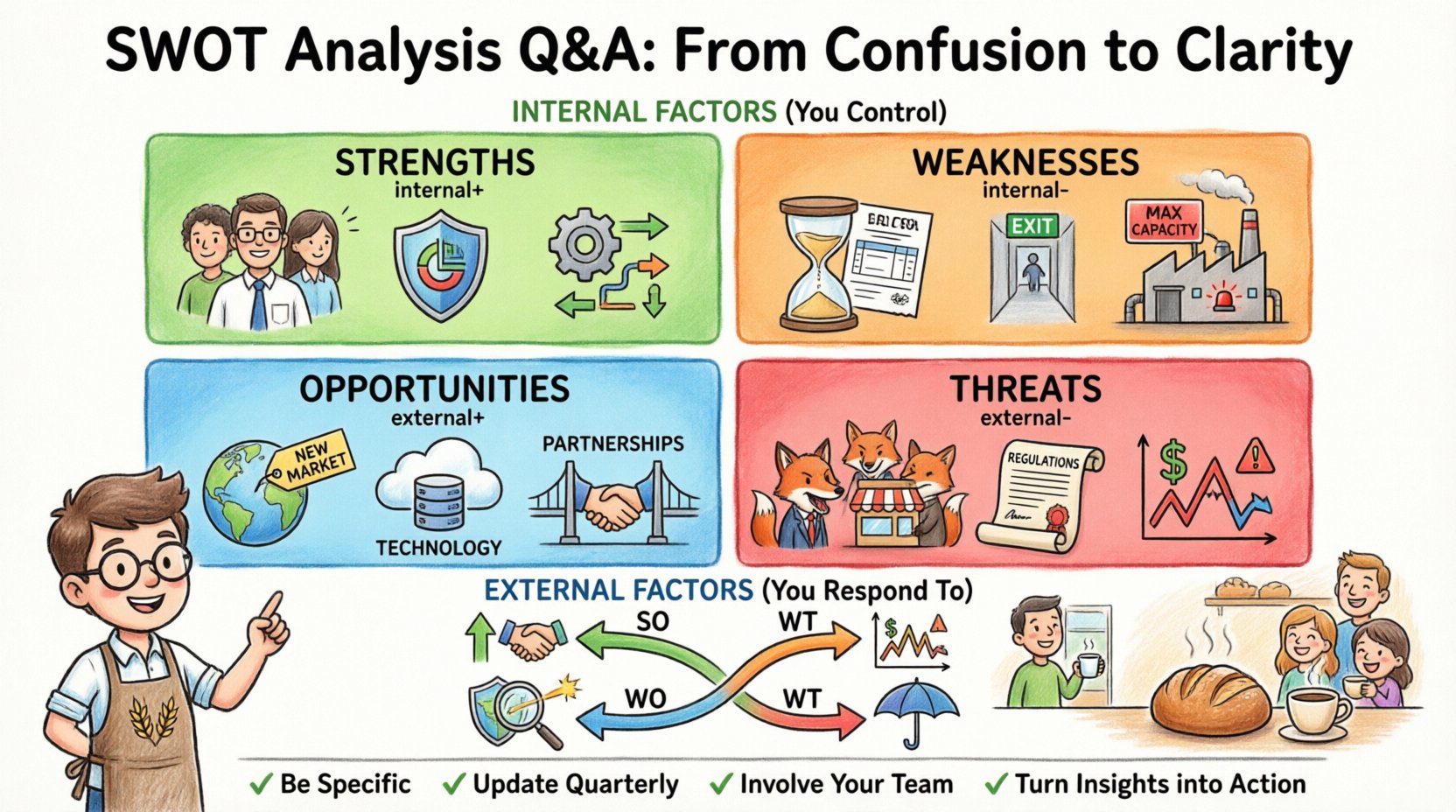
Before diving into the questions, we must establish a shared definition. SWOT stands for Strengths, Weaknesses, Opportunities, and Threats. It is a framework used to evaluate these four elements regarding a project, business venture, or specific business entity.
- Strengths: Internal attributes that give the business an advantage over others.
- Weaknesses: Internal attributes that place the business at a disadvantage relative to others.
- Opportunities: External chances to make greater profits or grow the business.
- Threats: External elements that could cause trouble for the business.
The power of this tool lies in the intersection of internal and external factors. Many owners fail because they mix internal issues with external market conditions. Keeping these distinct is the first rule of effective analysis.
Q1: How Do I Identify Internal Factors Versus External Factors? 🧱
This is the most frequent point of confusion. Internal factors are things you control. External factors are things you cannot control but must respond to.
Internal Factors (Strengths & Weaknesses)
These reside within your organization. You can change them directly.
- Staff: Do you have skilled employees? Is turnover high?
- Finances: Is cash flow stable? Do you have access to credit?
- Location: Is your physical space convenient for clients?
- Processes: Are your workflows efficient or bogged down by bureaucracy?
- Brand: Do customers recognize and trust your name?
External Factors (Opportunities & Threats)
These exist in the market or industry. You influence them only indirectly.
- Economic Trends: Is the economy growing or contracting?
- Competitors: Are new players entering your niche?
- Regulations: Are there new laws affecting your industry?
- Technology: Is there a new tool that could disrupt your workflow?
- Consumer Behavior: Are customers shifting toward digital or physical experiences?
If you list a competitor’s price cut as a weakness, you are mistaken. That is a threat. If you list your inability to lower prices as a weakness, that is correct.
Q2: What If I Don’t Know What My Strengths Are? 🤔
Many small business owners struggle to see their own value. They focus on the daily grind and assume everyone else knows what they do. To identify strengths, you need external data.
- Ask Customers: Send a survey asking why they chose you over others. Their answers reveal your perceived strengths.
- Review Feedback: Look at testimonials, Google reviews, and support tickets. What compliments appear repeatedly?
- Analyze Profit Margins: Which services or products generate the most revenue with the least effort? That is a strength.
- Look at Retention: Who comes back? High retention indicates reliability and quality.
Avoid generic statements like “we work hard.” This is not a strength; it is a baseline expectation. Specific strengths sound like “we have a 24-hour response time” or “we source 100% locally.” Specificity creates trust.
Q3: How Do I List Weaknesses Without Feeling Defeated? 💔
Admitting weaknesses feels vulnerable. However, identifying them is an act of courage that protects the business. The goal is not to shame yourself, but to manage risk.
- Be Honest: If you cannot fulfill orders on time, write that down. Hiding it only delays the solution.
- Focus on Fixable Issues: Distinguish between permanent limitations and temporary gaps. A lack of funding is a weakness, but one that can be solved with a loan or revenue growth.
- Separate Emotion from Fact: “I hate admin work” is not a weakness. “We lack a system for tracking invoices” is a factual weakness.
Weaknesses are simply areas requiring investment. They are not character flaws; they are operational gaps.
Q4: How Do I Differentiate Between an Opportunity and a Threat? 🚦
External factors can be both. The same market change can be a threat to one business and an opportunity for another. It depends on your readiness.
| Factor | Opportunity | Threat |
|---|---|---|
| New Technology | You adopt it early to gain efficiency. | You cannot afford to upgrade and lose customers. |
| Economic Downturn | You offer lower-cost alternatives. | Your customers cut their budgets. |
| New Competitor | You differentiate through superior service. | They steal your market share. |
| Regulatory Change | You become the compliance expert. | You must spend heavily to comply. |
Context is everything. An opportunity is a favorable condition you can exploit. A threat is a condition that could cause harm.
Q5: How Often Should I Update My SWOT Analysis? 📅
Strategy is not static. A SWOT analysis created two years ago is likely obsolete. The market moves faster than annual planning cycles.
- Quarterly Reviews: For fast-moving industries, check in every three months.
- Annual Deep Dive: Once a year, conduct a comprehensive review with all stakeholders.
- Milestone Triggers: Update the analysis after major events like launching a new product, hiring key staff, or experiencing a significant loss.
If you wait too long, the data loses its predictive value. Treat this as a living document, not a one-time assignment for a business plan.
Q6: Who Should Be Involved in the Process? 👥
It is tempting to do this alone in an office. This creates blind spots. You need diverse perspectives to see the full picture.
- Founders: Provide vision and historical context.
- Managers: Know the operational bottlenecks and team morale.
- Frontline Staff: Hear the customer complaints and desires daily.
- Key Clients (Optional): Sometimes an advisory board or trusted client can provide unbiased feedback.
Facilitate a workshop environment. Do not let one person dominate the conversation. Use anonymous voting or sticky notes to ensure honest input regarding weaknesses.
Q7: What If the List Is Too Long? 📝
Brainstorming sessions often produce long lists. A SWOT with 50 items in each category is unusable. You need prioritization.
Use a scoring system to rank items.
- Impact: How much does this factor affect the business?
- Urgency: Does this need immediate attention?
- Feasibility: Can we actually do something about this?
Select the top 3 to 5 items for each quadrant. If you cannot prioritize, you cannot execute. Cut the rest to a secondary list for future review.
Q8: How Do I Turn This Analysis Into Action? ⚙️
A SWOT document that sits on a shelf is useless. The goal is strategy formulation. You need to cross-reference the quadrants to create strategies.
Consider these four strategic approaches:
1. SO Strategies (Maxi-Maxi)
Use your Strengths to take advantage of Opportunities.
- Example: Use your strong brand reputation (Strength) to launch a premium product line (Opportunity).
2. WO Strategies (Mini-Maxi)
Overcome Weaknesses by taking advantage of Opportunities.
- Example: Invest in automation software (fixing Weakness) to enter a new digital market (Opportunity).
3. ST Strategies (Maxi-Mini)
Use Strengths to avoid Threats.
- Example: Leverage your loyal customer base (Strength) to defend against a competitor’s price war (Threat).
4. WT Strategies (Mini-Mini)
Minimize Weaknesses to avoid Threats.
- Example: Reduce overhead costs (Weakness) to survive an economic recession (Threat).
Q9: Common Mistakes to Avoid 🚫
Even experienced owners make errors. Recognizing these pitfalls will save you time.
- Vague Language: “Good customer service” is not specific. “95% customer satisfaction rate” is measurable.
- Ignoring Data: Relying on feelings rather than sales data or market reports.
- Confusing Means with Ends: “Hiring a new manager” is an action, not a strength. The strength is “access to skilled leadership.”
- Ignoring Competitors: A SWOT is not just about you. You must understand what others are doing to identify threats and opportunities accurately.
- One-Off Exercise: Treating it as a checkbox rather than a strategic tool.
Q10: Can This Help with Cash Flow Issues? 💸
Yes. Cash flow is often a symptom of deeper structural issues. A SWOT can reveal the root cause.
Consider a scenario where cash is tight.
- Strength: High demand for services.
- Weakness: Slow invoicing process.
- Opportunity: New payment gateway integration.
- Threat: Rising material costs.
The analysis might show that the problem is not the market (Opportunity/Threat) but the internal process (Weakness). The solution is not to sell more, but to bill faster.
Practical Example: A Local Bakery 🥐
Let us apply this to a real-world scenario. Imagine a local bakery struggling with profitability.
Strengths
- Unique sourdough recipe.
- Prime location near offices.
- Loyal regular customers.
Weaknesses
- Limited seating capacity.
- High staff turnover.
- Dependence on a single supplier.
Opportunities
- Corporate catering contracts.
- Online ordering for delivery.
- Seasonal holiday product lines.
Threats
- New chain bakery opening nearby.
- Rising flour costs.
- Changing health regulations.
Strategy Formulation:
The bakery can use its unique recipe (Strength) to launch a premium subscription box (Opportunity). This generates recurring revenue and mitigates the risk of the new chain competitor (Threat).
Final Thoughts on Strategic Clarity 🧭
Business planning does not require a crystal ball. It requires clarity on where you stand and where the wind is blowing. The SWOT analysis provides a structured way to look at that reality.
It forces you to confront uncomfortable truths about your internal operations while remaining alert to external shifts. When you separate what you can control from what you cannot, you reduce anxiety and increase focus.
Remember that this is a starting point. The value comes from the conversation it sparks among your team and the actions you take afterward. Regularly revisit your list. Update it as conditions change. Treat it as a compass, not a map.
By answering these questions honestly and systematically, you build a resilient business structure. You move from reacting to events to shaping your future. This is the essence of sustainable growth.