


You have gathered the team. You have a whiteboard. You have a grid with four boxes. Yet, staring at the completed document, a sinking feeling arises. The Strengths read like generic compliments. The Threats feel like common sense. The Opportunities are too broad to act on. The Weaknesses are obvious but unaddressed. This is a common scenario where strategic planning stalls before it begins. When a SWOT analysis feels vague or useless, it is not a failure of the framework itself, but a failure of execution and depth.
This guide addresses the specific mechanics of diagnosing and repairing a weak strategic assessment. We will move beyond the basic definitions to explore the data gathering, cognitive checks, and prioritization methods required to transform a static list into a dynamic strategic engine. If your current strategy documents do not inspire clear action, you must troubleshoot the inputs, the process, and the interpretation.
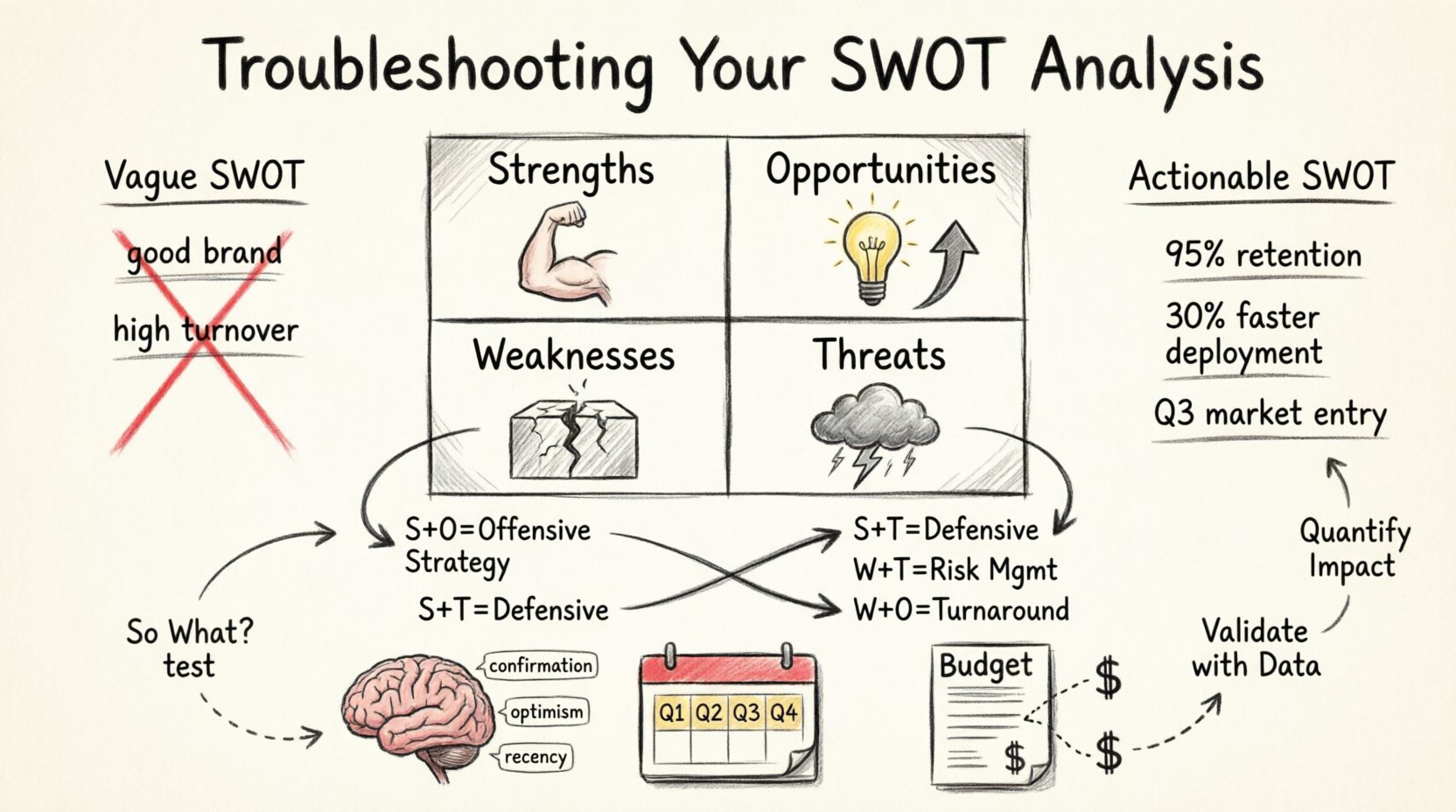
Why Your SWOT Analysis Falls Flat 🔍
Before fixing a problem, you must understand its root cause. A vague SWOT analysis usually stems from three primary sources: superficial data, groupthink, and a lack of context. Many organizations treat this exercise as a compliance task rather than an investigative one. They fill the boxes with statements that everyone agrees with but no one can measure.
- Superficial Data: Relying on gut feelings or high-level marketing slogans instead of hard metrics. For example, listing “Good Brand Reputation” as a strength without citing market share data, customer retention rates, or sentiment analysis.
- Groupthink: When a diverse group converges on the same generic points to maintain harmony. Critical weaknesses are swept under the rug to avoid conflict.
- Lack of Context: An analysis that exists in a vacuum. It fails to account for current market volatility, regulatory shifts, or internal resource constraints.
When the output lacks specificity, the subsequent strategy becomes a wish list rather than a plan. You cannot allocate resources to a “Weakness” if you do not know exactly which process is failing or why. You cannot seize an “Opportunity” if you do not understand the timeline or the cost of entry.
Diagnosing the Vagueness: A Diagnostic Table 📋
To determine the severity of the issue, compare your current analysis against the criteria below. This table helps identify specific symptoms that indicate a need for deeper investigation.
| Characteristic | Vague / Useless SWOT | Actionable / Robust SWOT |
|---|---|---|
| Specificity | Uses broad terms like “strong,” “weak,” “good,” “bad.” | Uses metrics like “40% churn rate,” “$2M deficit,” “Q3 market entry.” |
| Attribution | No source cited for the claim. | References specific reports, interviews, or data points. |
| External Focus | Internal weaknesses dominate; external threats are generic. | Threats and Opportunities are tied to competitor moves and market trends. |
| Actionability | Lists problems without linking to solutions. | Links weaknesses directly to mitigation plans or resource needs. |
| Time Sensitivity | Static; looks the same next year. | Includes time-bound assumptions or review dates. |
If you find more than two “Vague” characteristics in your assessment, the document requires a complete overhaul. Do not attempt to work with the existing data. Reset the process.
Fixing the Internal Quadrant: Strengths & Weaknesses 💪
The internal quadrants are often the easiest to fill with fluff because they are within your control. However, true internal analysis requires brutal honesty. This is where you identify the assets that drive value and the liabilities that drain it.
Elevating Strengths: From Claims to Evidence
A strength is not a feeling; it is a competitive advantage that is difficult for others to replicate. To fix vague strength statements, apply the “So What?” test. If you say “We have a skilled team,” ask “So what?” The answer must lead to a tangible outcome.
- Bad: “Highly skilled engineering team.”
- Fix: “Engineering team delivers 30% faster deployment cycles than industry average due to automated CI/CD pipelines.”
- Bad: “Strong brand loyalty.”
- Fix: “Customer retention rate of 95% over the last fiscal year, with a Net Promoter Score of 72.”
When documenting strengths, focus on what makes your organization unique. Is it proprietary technology? Exclusive supply chain partnerships? Lower cost structure? Documenting these requires data collection from finance, operations, and HR.
Confronting Weaknesses: The Cost of Ignorance
Weaknesses are often hidden because admitting them feels like a failure. However, a strategy that ignores internal deficits is a house built on sand. A weak analysis often lists “High employee turnover” without noting the cost or the specific departments affected.
- Identify the Root: Do not just list “High turnover.” Identify if it is driven by compensation, management style, or lack of career progression.
- Quantify the Impact: Calculate the cost of recruitment and lost productivity associated with the turnover. This turns a people problem into a financial risk.
- Resource Gaps: Admit where you lack budget, talent, or time. A strategy cannot succeed if it assumes resources that do not exist.
When you fix the internal quadrant, you move from a list of complaints to a resource audit. This allows leadership to see exactly where capital and attention must be injected to stabilize the foundation.
Fixing the External Quadrant: Opportunities & Threats 🌍
External factors are dynamic. They change faster than internal processes. A vague SWOT often treats the market as a constant, ignoring the velocity of change. To fix this, you must look outside the organization and track specific signals.
Validating Opportunities
Opportunities are not just “things that could happen.” They are favorable conditions that your organization is positioned to exploit. Vague opportunities often look like “Expand into new markets.” This is insufficient.
- Market Trends: Look for regulatory changes, technological shifts, or demographic movements. For example, “New privacy regulations allow us to offer enhanced security features as a premium upsell.”
- Competitor Gaps: Identify where competitors are failing to meet customer needs. “Competitor X has poor customer support response times, creating an opening for a service-first strategy.”
- Unmet Demand: Validate demand through surveys, pilot programs, or pre-orders before declaring it an opportunity.
Every opportunity listed must have a corresponding capability. If you identify a market opportunity but lack the operational capacity to serve it, it is not a strategic opportunity; it is a distraction.
Assessing Threats
Threats are often downplayed because they are uncomfortable. A useful analysis acknowledges risks that could derail the plan. Generic threats include “Economic downturn” or “New competitors.” These are too broad to plan against.
- Specific Risks: “Competitor Y is launching a lower-cost product in Q4,” or “Key supplier Z is facing bankruptcy risks.”
- Impact Analysis: For each threat, estimate the probability and the impact. If the probability is low but the impact is catastrophic, it requires a contingency plan.
- Regulatory Compliance: Track changes in laws that could affect operations, taxes, or product viability.
By making the external quadrant specific, you shift from anxiety to preparation. You stop worrying about “the economy” and start planning for specific market shifts.
Bridging the Gap: Turning Insights into Strategy 🧩
Completing the four quadrants is only the first step. The real work begins when you cross-reference them. This process is often called a TOWS analysis or cross-impact analysis. It answers the question: “How do we use our internal capabilities to address external conditions?”
Matching Strengths to Opportunities
This is the offensive strategy. How can your Strengths help you capture the Opportunities? If you have a strong R&D team (Strength) and a new technology trend is emerging (Opportunity), your strategy is to lead the market with a new product.
- Action: Allocate R&D budget specifically to this technology.
- Action: Hire specialized talent to support this initiative.
Using Strengths to Mitigate Threats
This is the defensive strategy. How can your internal assets protect you from external risks? If you have a strong cash reserve (Strength) and a potential recession (Threat), your strategy is to acquire market share while competitors are struggling.
- Action: Review cash flow to ensure liquidity for acquisitions.
- Action: Delay non-essential spending to preserve capital.
Addressing Weaknesses to Prevent Threats
This is the risk management quadrant. Fix internal issues before they are exploited by external forces. If you have outdated IT infrastructure (Weakness) and a rise in cyberattacks (Threat), you must upgrade security immediately.
- Action: Prioritize IT security spending.
- Action: Conduct vulnerability assessments.
Overcoming Weaknesses to Seize Opportunities
This is the turnaround quadrant. Sometimes you need to fix internal problems to take advantage of an external chance. If you want to enter a new region (Opportunity) but lack local knowledge (Weakness), you must partner or hire locally.
- Action: Initiate partnership discussions.
- Action: Budget for local market research.
Without this cross-analysis, your SWOT remains a static list. With it, you generate specific strategic initiatives. These initiatives become the projects, budgets, and KPIs for the upcoming fiscal period.
Avoiding Common Cognitive Biases 🧠
Even with the right framework, human psychology can corrupt the data. Recognizing these biases is essential for maintaining the integrity of your strategy.
- Confirmation Bias: We tend to look for information that confirms what we already believe. If leadership wants to launch a product, they will only list strengths that support it and ignore weaknesses. Solution: Assign a “devil’s advocate” role in the meeting to challenge assumptions.
- Optimism Bias: Overestimating the benefits and underestimating the risks. This leads to aggressive targets that are impossible to meet. Solution: Use historical data to calibrate expectations.
- Recency Bias: Focusing too heavily on recent events. A recent success might be mistaken for a trend. A recent failure might be mistaken for a permanent state. Solution: Review data from at least the last three years.
- Groupthink: The desire for harmony in a group results in irrational decision-making. Dissenting opinions are suppressed. Solution: Conduct anonymous surveys before the meeting to gather honest feedback.
Addressing these biases requires a structured process. Do not rely on a single meeting. Use a phased approach where data is gathered, analyzed, and then discussed. This separation of data collection from interpretation reduces the emotional influence on the results.
Making It a Living Document 🔄
One of the most common failures is treating the SWOT analysis as a one-time event. Once the document is printed or saved, it is rarely revisited. This makes the strategy obsolete as soon as the market shifts.
- Quarterly Reviews: Schedule a review of the SWOT every quarter. Do the Strengths still hold? Have the Threats materialized?
- Trigger Points: Define specific events that require an immediate review. A major competitor launch, a regulatory change, or a financial shortfall should trigger a re-evaluation.
- Feedback Loops: Ensure the people executing the strategy provide feedback on the accuracy of the initial analysis. If the team says the “Opportunities” were unrealistic, adjust the data for the next cycle.
Strategy is not a destination; it is a navigation process. A living SWOT acts as a compass, constantly recalibrating based on the terrain. When you maintain the document, you maintain the relevance of the strategy.
Final Steps for Implementation
If you have followed this troubleshooting guide, you should now have a document that is specific, data-driven, and actionable. The next phase is communication. Share the findings with the broader organization. Ensure every team member understands their role in the strengths, weaknesses, opportunities, and threats.
Do not hide the weaknesses. Transparency builds trust. When the team understands the threats, they are better equipped to spot them early. When they understand the strengths, they know where to focus their energy.
Finally, link the analysis to the budget. If a weakness is a priority, allocate funds to fix it. If an opportunity is a priority, allocate resources to pursue it. A strategy without budget allocation is merely a suggestion. By grounding your SWOT in financial reality, you ensure that the strategic intent translates into operational execution.
Review this process regularly. The business environment will change, and your analysis must evolve with it. This is the only way to ensure long-term viability and sustained performance.
Related posts:
 SWOT Analysis for Startups: A Beginner’s Step-by-Step Guide to Launching Strong
 The 5-Minute SWOT Analysis: Quick Start Framework for Freelancers and Sole Proprietors
 SWOT Analysis Breakdown: How to Decode Your Business Strengths and Weaknesses Today
 Real Startup Case Studies: What Happens When Founders Ignore SWOT Analysis Risks