


Strategic planning often feels like a box to check before launching a pitch deck. However, the Strategic Plan for Success is not a document; it is a survival mechanism. When founders skip the rigorous application of a SWOT Analysis, they are not merely skipping a step—they are walking into a minefield blindfolded. This guide examines real-world scenarios where neglecting specific quadrants of risk assessment led to critical business failures.
The goal here is not to sell a methodology, but to expose the silent killers of early-stage growth. We will look at how ignoring internal weaknesses and external threats creates a fragile foundation. We will also explore how overlooking strengths and opportunities leads to stagnation.
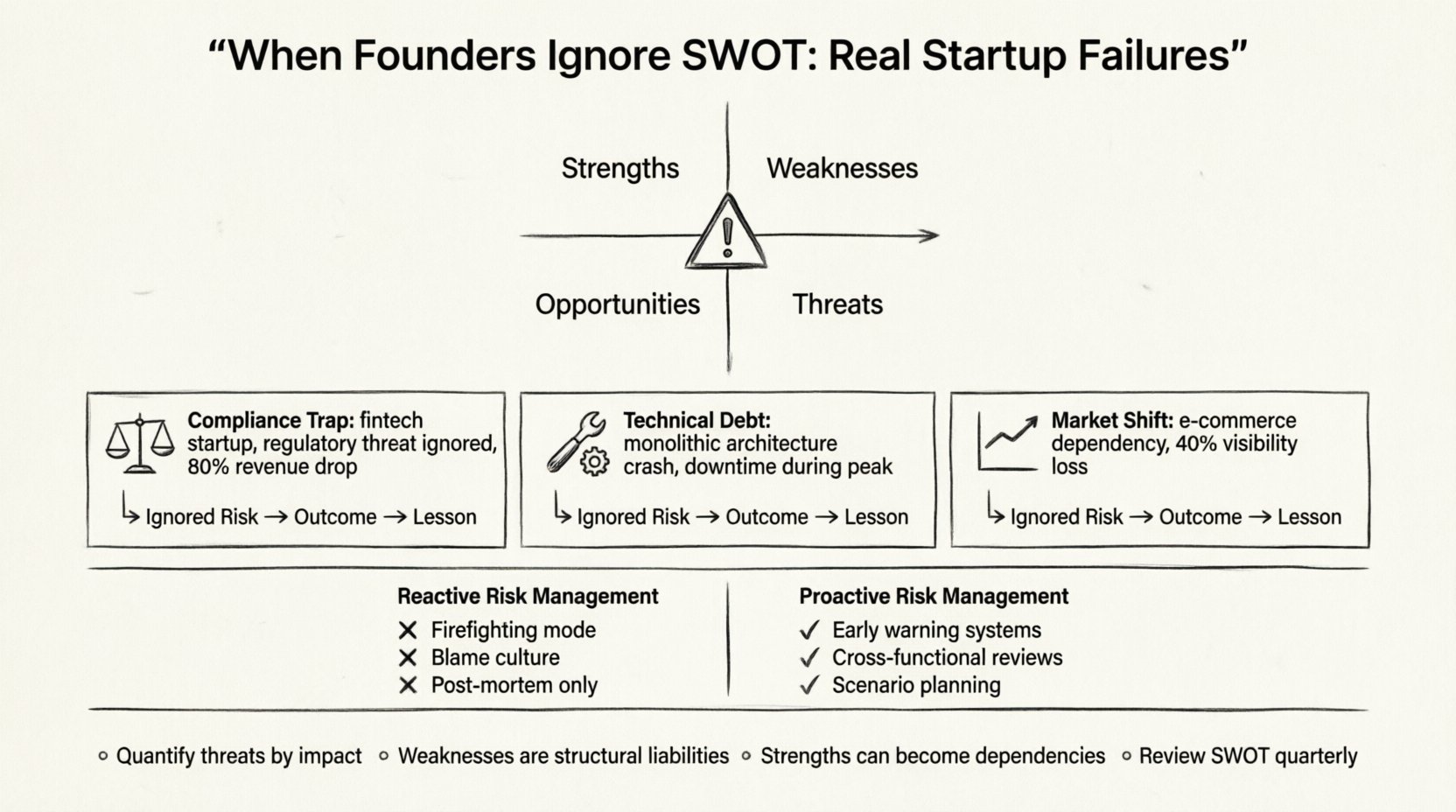
Why SWOT Analysis Gets Misused 🧠
Many teams treat SWOT as a brainstorming session that happens once at the beginning of the fiscal year. This approach is fundamentally flawed. The market changes weekly. The competitive landscape shifts daily. A static document provides a false sense of security.
Here are the common pitfalls found in early-stage ventures:
- Checkbox Mentality: Completing the exercise to satisfy investors rather than to inform strategy.
- Optimism Bias: Listing strengths but downplaying their sustainability.
- Blind Spots: Focusing heavily on Opportunities while ignoring Threats.
- Static Data: Using data from six months ago to predict next quarter’s performance.
When these errors occur, the risk assessment becomes noise. The signal is lost. Founders miss the warning signs until the damage is irreversible.
Case Study 1: The Compliance Trap (Ignoring Threats) ⚖️
Company Profile: A fintech startup focused on cross-border payments for freelancers.
Timeline: 18 months to 36 months of operation.
The Failure Point: Regulatory Compliance.
The Scenario
The founding team possessed a strong technology stack and a clear value proposition. In their initial SWOT Analysis, they listed “Regulatory Compliance” under Threats. However, they categorized it as a low probability risk. They assumed that because they were operating in a gray area, regulators would not act immediately.
The Ignored Risk
The team ignored the Weakness in their internal legal infrastructure. They had no dedicated compliance officer. They relied on external counsel only when invoices came due. They also ignored the Threat of tightening international banking laws.
The Outcome
- At month 24, a new regulation was passed affecting their primary transaction model.
- Because no internal audit was conducted based on the SWOT data, they were unprepared.
- Banking partners froze funds pending review.
- Revenue dropped by 80% in three weeks.
- They were forced to pivot to a different model, burning 6 months of runway.
Lesson Learned: Threats must be quantified by impact, not just probability. A low probability threat with catastrophic impact requires a mitigation plan immediately.
Case Study 2: The Technical Debt Crisis (Ignoring Weaknesses) 🛠️
Company Profile: A B2B SaaS platform for supply chain management.
Timeline: Series A to Series B.
The Failure Point: Scalability and Architecture.
The Scenario
The company had achieved product-market fit rapidly. Their Strengths were listed as “Innovative UI” and “Fast Customer Support.” During the SWOT review, the engineering lead noted that the codebase was monolithic and hard to scale. This was listed under Weaknesses.
The Ignored Risk
Leadership dismissed the weakness. They believed they would refactor the code once they raised more capital. They treated the technical debt as a future problem, not a current operational risk. They continued to prioritize feature velocity over system stability.
The Outcome
- During a marketing push, server loads spiked unexpectedly.
- The monolithic architecture could not handle the load without crashing.
- Downtime occurred during peak sales hours.
- Refactoring took twice as long as anticipated due to accumulated complexity.
- Investors questioned the technical due diligence during the next funding round.
Lesson Learned: Weaknesses are not just gaps; they are structural liabilities. Ignoring them while scaling amplifies them exponentially.
Case Study 3: The Market Shift Blindspot (Ignoring Opportunities) 📈
Company Profile: An e-commerce brand selling physical goods.
Timeline: 3 years to 5 years of operation.
The Failure Point: Channel Diversification.
The Scenario
The brand dominated its niche on a single major marketplace. Their SWOT Analysis highlighted this channel as a Strength. They did not invest enough time analyzing Opportunities for direct-to-consumer growth or expansion into emerging platforms.
The Ignored Risk
They assumed their dominance on the marketplace was permanent. They ignored the Threat of platform policy changes and the Opportunity of building a proprietary customer database.
The Outcome
- The marketplace changed its algorithm, reducing organic visibility by 40%.
- Because they had not built a direct channel, they lost that traffic entirely.
- Customer acquisition costs skyrocketed as they tried to find new ways to reach users.
- The company was forced to sell at a discount to clear inventory, eroding margins.
Lesson Learned: Strengths can become dependencies. Opportunities must be pursued before the window closes.
Comparing Reactive vs. Proactive Risk Management 📊
To understand the divergence in outcomes, consider the following comparison of how teams handle SWOT data differently.
| Factor | Reactive Approach (Ignored Risks) | Proactive Approach (Leveraged SWOT) |
|---|---|---|
| Frequency of Review | Once a year or never | Quarterly or monthly |
| Weakness Handling | Deferred to future budget | Immediate resource allocation |
| Threat Assessment | Based on gut feeling | Based on data and trends |
| Opportunity Capture | Held back due to risk aversion | Tested via small pilots |
| Team Alignment | Leadership only | Department-wide visibility |
| Outcome | Crises and pivots | Stabilized growth |
The Psychology of Ignoring Risks 🧩
Why do founders ignore the data they collected? It is rarely malicious. It is usually psychological.
1. The Sunk Cost Fallacy
Founders have invested years into a specific path. Acknowledging a Weakness feels like admitting failure. They continue to pour resources into a failing strategy hoping it will turn around.
2. Confirmation Bias
Teams look for information that supports their vision. If the SWOT Analysis shows a Threat, they assume it is an outlier. If it shows a Strength, they assume it is a guarantee.
3. Fear of Paralysis
Some leaders fear that identifying too many risks will make the team anxious. They choose to ignore the negatives to keep morale high. This is a short-term fix that leads to long-term instability.
How to Audit Your Current SWOT Analysis 🔍
If you have a SWOT Analysis document, do not just file it away. Subject it to a rigorous audit. Here is the process.
- Verify Data Sources: Is the information current? If you are looking at market trends from two years ago, discard them.
- Challenge the Strengths: Ask, “What if this strength disappears tomorrow?” If you have no backup, it is a dependency, not a strength.
- Stress Test Weaknesses: Assign a cost to each weakness. If the technical debt costs $50,000 per month in inefficiency, that is a real number to work with.
- Map Threats to Mitigation: For every Threat listed, there must be a corresponding action plan. If there is no plan, the threat is ignored.
- Identify Opportunities Early: Do not wait for a crisis to look for new markets. Look for adjacent markets now.
The Cost of Inaction 💸
When risks are ignored, the cost is rarely just financial. It compounds into operational and cultural debt.
Financial Drain
Crisis management is expensive. Emergency hiring, legal fees, and rapid pivots cost significantly more than preventive planning. The capital burned fixing a problem that could have been avoided is capital lost forever.
Team Morale
Employees notice when leadership ignores warning signs. When a crisis hits because a weakness was hidden, trust erodes. Retention rates drop as talented individuals leave for more stable environments.
Market Position
Competitors who do their homework will seize the gaps you ignored. If you ignore a Threat from a new competitor, they will capture your customers. Once lost, customer acquisition becomes much harder.
Integrating SWOT into Daily Operations 🔄
To prevent the analysis from becoming obsolete, it must be integrated into daily workflows.
- Weekly Check-ins: Include one agenda item dedicated to reviewing current SWOT quadrants.
- Decision Logs: When making a major decision, reference the SWOT. Does this decision exploit a Strength? Does it mitigate a Weakness?
- External Feedback: Bring in outside advisors to review your SWOT. They will see threats you are too close to notice.
- Customer Interviews: Regularly ask customers what they like and dislike. This feeds the Strengths and Weaknesses sections directly.
Building a Culture of Strategic Awareness 🏗️
Strategic planning is not just for the CEO. It requires a culture where risks can be discussed openly without fear of retribution.
Encourage team members to flag potential Threats they see in their daily work. A customer support agent might hear about a feature request that indicates a market shift. A developer might see a security vulnerability that constitutes a Threat.
When everyone understands the SWOT framework, the organization becomes more resilient. It is no longer a top-down directive but a shared understanding of the landscape.
Final Thoughts on Risk and Growth 🌱
Growth without safety is a gamble. Founders who rely on luck rather than analysis are betting against the house. The case studies above demonstrate that the difference between success and failure often lies in how well risks are identified and managed.
A SWOT Analysis is a tool for clarity, not a document for vanity. It reveals where the cracks are in the foundation. It shows where the wind is blowing. It highlights where the competitors are hiding.
Use it to guide your decisions. Use it to allocate your resources. Use it to prepare your team. Do not let the analysis sit in a drawer. Let it drive the engine of your business forward.
When you respect the risks, you build a business that can withstand the storms. When you ignore them, you build a house on sand. The choice is yours.