


Every organization stands at a crossroads where strategic decisions determine future success. To navigate this landscape effectively, leaders require a clear view of their current position and potential trajectory. The SWOT analysis framework provides this clarity by systematically evaluating internal capabilities and external market conditions. This method remains a cornerstone of strategic planning across industries, from startups to established corporations. Understanding how to decode business strengths and weaknesses is not just an academic exercise; it is a practical necessity for sustainable growth.
This guide offers a comprehensive look at the SWOT framework. We will explore each quadrant in detail, examine how to conduct the analysis without relying on specific tools, and discuss how to translate findings into actionable strategies. By the end of this article, you will possess the knowledge to assess your organization’s standing objectively and plan for the future with confidence.
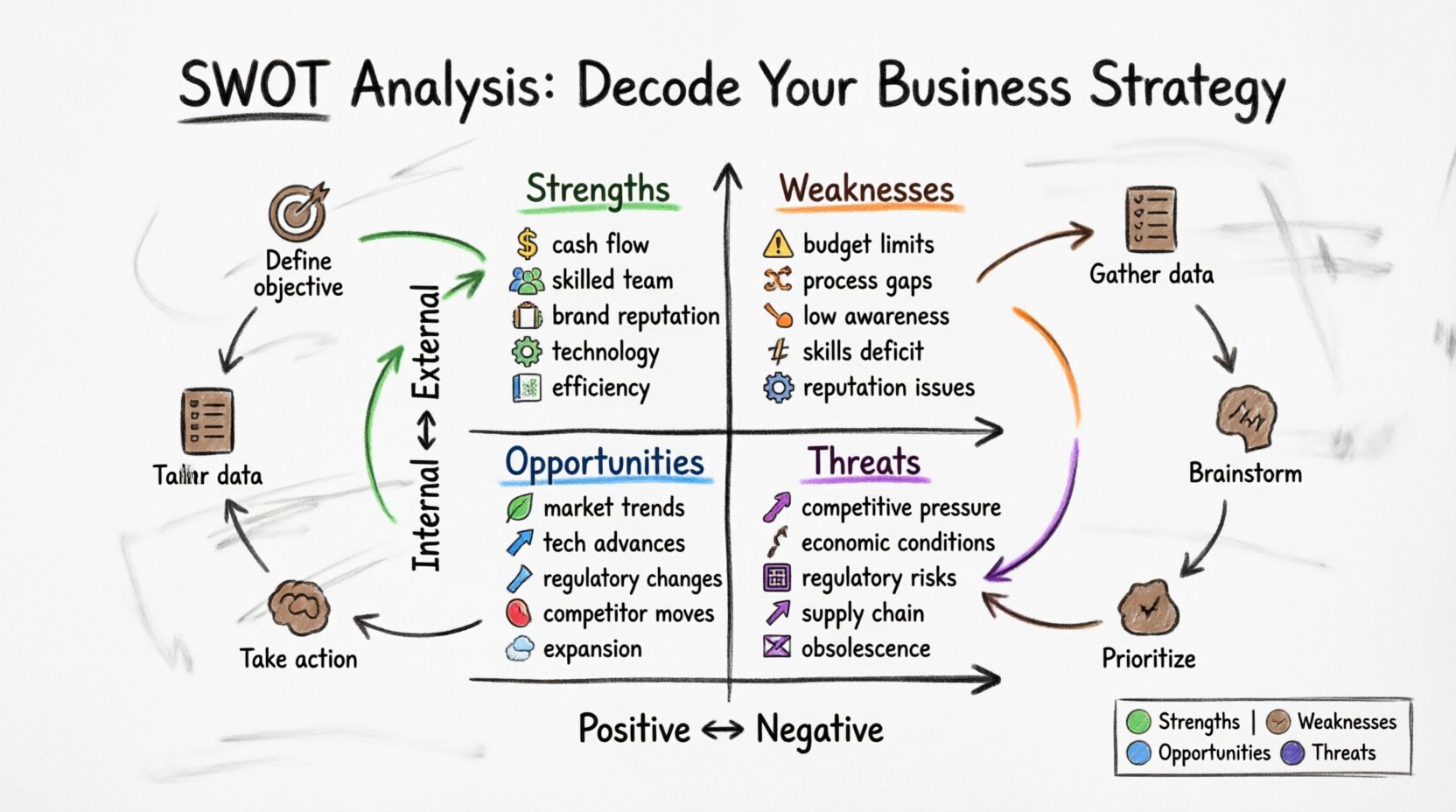
Understanding the Four Pillars of Strategic Planning 🔍
At its core, the SWOT analysis categorizes factors into two dimensions: internal and external. The internal factors are under your control, while external factors exist outside your direct influence. Combining these dimensions creates four distinct categories that must be analyzed together.
1. Strengths (Internal & Positive) 💪
Strengths represent the attributes that give your organization an advantage over others. These are resources or capabilities you possess that allow you to achieve your goals more effectively than competitors. Identifying strengths requires an honest assessment of what you do well.
- Financial Resources: Cash flow, access to capital, and profitability margins.
- Human Capital: Skilled workforce, leadership experience, and employee retention rates.
- Brand Reputation: Customer loyalty, market recognition, and trust.
- Technology: Proprietary software, patents, or efficient production systems.
- Operational Efficiency: Streamlined processes, low overhead costs, or superior supply chain management.
When listing strengths, focus on tangible evidence. Avoid vague statements like “we are good.” Instead, use data such as “we hold a 40% market share in the regional sector” or “our response time is 50% faster than the industry average.”
2. Weaknesses (Internal & Negative) ⚠️
Weaknesses are internal factors that hinder your performance or put you at a disadvantage compared to competitors. These are areas where you lack resources, capabilities, or market presence. Acknowledging weaknesses is difficult but essential for improvement.
- Resource Limitations: Budget constraints, outdated technology, or insufficient staffing.
- Process Gaps: Inefficient workflows, high error rates, or slow decision-making cycles.
- Market Position: Low brand awareness, poor customer service ratings, or limited distribution channels.
- Skills Deficit: Lack of expertise in emerging technologies or key functional areas.
- Reputation Issues: Past failures, negative public perception, or legal liabilities.
Addressing weaknesses does not always mean fixing everything immediately. It means understanding where you are vulnerable and mitigating risks associated with those vulnerabilities.
3. Opportunities (External & Positive) 🌱
Opportunities are external factors that your organization can exploit to its advantage. These are trends, changes, or gaps in the market that align with your strengths. While you cannot control these factors, you can position yourself to take advantage of them.
- Market Trends: Shifts in consumer behavior, demographic changes, or rising demand for specific services.
- Technological Advances: New tools that improve efficiency or create new product categories.
- Regulatory Changes: New laws that remove barriers to entry or favor specific business models.
- Competitor Moves: A rival exiting the market, a competitor facing a scandal, or a partner withdrawing from an alliance.
- Global Expansion: Entering new geographic markets or diversifying product lines.
Opportunities often require investment to capture. The key is to match them with your existing strengths to minimize risk.
4. Threats (External & Negative) 🌪️
Threats are external elements that could cause trouble for your business. These are challenges that exist outside your control but could impact your operations or profitability. Preparing for threats allows you to build resilience.
- Competitive Pressure: New entrants, price wars, or aggressive marketing campaigns by rivals.
- Economic Conditions: Inflation, recession, or fluctuating exchange rates.
- Regulatory Risks: Changes in compliance requirements, tax laws, or safety standards.
- Supply Chain Disruptions: Dependence on single suppliers, geopolitical instability, or logistical bottlenecks.
- Technological Obsolescence: Rapid innovation rendering current products or services obsolete.
Internal vs. External Factors: A Structured View 🏗️
To ensure clarity during the analysis, it is helpful to visualize the relationship between what you control and what you must adapt to. The table below summarizes the distinction between these two categories.
| Category | Control Level | Focus Area | Example |
|---|---|---|---|
| Strengths | Internal (High) | Capabilities | Proprietary technology |
| Weaknesses | Internal (High) | Gaps | Limited marketing budget |
| Opportunities | External (Low) | Market Trends | Emerging demographic demand |
| Threats | External (Low) | Environment | New regulatory compliance |
Understanding this matrix prevents confusion. For instance, a “new competitor” is not a weakness; it is a threat. A “lack of marketing staff” is not an opportunity; it is a weakness. Clear classification ensures the strategy derived from the analysis is logical.
How to Conduct a SWOT Analysis Step-by-Step 🛠️
Executing a SWOT analysis requires discipline and a structured approach. Rushing through the steps often leads to superficial results. Follow this process to ensure depth and accuracy.
Step 1: Define Your Objective 🎯
Before gathering data, establish what you are trying to achieve. Are you planning a new product launch? Evaluating a merger? Assessing annual performance? The scope of the analysis depends on the goal. A narrow focus yields more specific insights than a broad, vague assessment.
Step 2: Gather Relevant Data 📋
Reliable analysis requires accurate information. Avoid speculation. Collect data from multiple sources to validate your findings.
- Internal Records: Financial reports, customer feedback, HR reviews, and operational metrics.
- External Research: Industry reports, news articles, competitor websites, and government statistics.
- Stakeholder Interviews: Conversations with employees, customers, suppliers, and partners.
Step 3: Brainstorm and List Factors 🧠
Bring key team members together to populate the four quadrants. Encourage open discussion. Ensure that every point listed is specific and backed by the data collected in Step 2. Avoid duplicates. If two points are essentially the same, merge them.
Step 4: Prioritize the Findings 🔢
You may end up with a long list of items. Not all factors carry equal weight. Identify the top three to five items for each quadrant. Consider the impact and the probability of occurrence. Focus your energy on the factors that will drive the most significant change.
Step 5: Develop Strategic Actions 🚀
The analysis is useless without action. Use the TOWS matrix approach to connect the dots. How can you use your strengths to seize opportunities? How can you use strengths to mitigate threats? How must you fix weaknesses to avoid threats? How must you fix weaknesses to seize opportunities?
Industry Specific Considerations 🌍
Different sectors face unique challenges and advantages. A generic SWOT analysis often misses nuances specific to an industry. Tailoring your approach ensures relevance.
Service-Based Businesses 💼
For service providers, human capital is often the primary strength or weakness. Client relationships, employee expertise, and service delivery speed are critical metrics. External threats often involve market saturation or automation replacing human labor.
Manufacturing and Production 🏭
Operational efficiency and supply chain stability are paramount. Strengths often include proprietary machinery or cost-effective production methods. Weaknesses might involve high maintenance costs or reliance on single-source vendors. Opportunities often lie in automation or new material technologies.
Retail and E-Commerce 🛒
Customer experience and logistics drive performance. Strengths include a loyal customer base or a robust distribution network. Weaknesses often relate to inventory management or website usability. Opportunities frequently arise from new sales channels or changing consumer shopping habits.
Common Pitfalls to Avoid ⚠️
Even experienced strategists make mistakes when using this framework. Being aware of these common errors helps maintain the integrity of your analysis.
1. Confusing Internal and External Factors
Placing a market trend inside the “Strengths” section is a fundamental error. Ensure you are strictly categorizing based on control. If you cannot control it, it belongs in Opportunities or Threats.
2. Being Too Vague
Statements like “poor marketing” or “good reputation” are too broad. They do not lead to specific actions. Instead, specify “low social media engagement” or “high Net Promoter Score among repeat customers.”
3. Ignoring the Data
It is easy to let bias influence the results. You might overstate strengths due to optimism or downplay weaknesses to avoid discomfort. Rely on hard data to correct these tendencies.
4. Stopping at the List
Creating the chart is only the first step. The value comes from the strategy built upon it. If the analysis sits on a shelf, it is wasted effort.
5. Overlooking the Competition
Your strengths are only relative to others. If your competitor has a similar strength, it is not a differentiator. Ensure you are analyzing your position relative to the market landscape.
Turning Insights into Actionable Strategy 📈
The final phase involves converting the SWOT findings into a coherent plan. This requires cross-referencing the quadrants to generate strategic options.
SO Strategies (Maxi-Maxi)
Use strengths to maximize opportunities. This is the growth phase. If you have a strong brand (Strength) and a new market trend is emerging (Opportunity), leverage the brand to capture that market immediately.
WO Strategies (Mini-Maxi)
Overcome weaknesses by taking advantage of opportunities. This is the turnaround phase. If you lack technology (Weakness) but a new partnership is available (Opportunity), use the partnership to access the technology you need.
ST Strategies (Maxi-Mini)
Use strengths to minimize threats. This is the defense phase. If you have strong cash reserves (Strength) and a recession is looming (Threat), use the cash to acquire competitors or weather the storm while others fail.
WT Strategies (Mini-Mini)
Minimize weaknesses and avoid threats. This is the survival phase. If you have high debt (Weakness) and interest rates are rising (Threat), you must restructure debt immediately to avoid insolvency.
Measuring Success Post-Analysis 📉
Once the strategy is implemented, you must track progress. Define key performance indicators (KPIs) that align with your SWOT goals. Regular reviews ensure the analysis remains relevant as the business environment shifts.
- Quarterly Reviews: Check if the identified threats have materialized or if opportunities have been captured.
- Annual Updates: Conduct a full SWOT refresh to account for major changes in the business or market.
- Milestone Tracking: Measure specific outcomes against the action plans derived from the analysis.
Frequently Asked Questions ❓
How often should a business perform a SWOT analysis?
There is no fixed rule, but annual reviews are standard. However, significant changes in the market, leadership, or product line should trigger an immediate re-evaluation.
Can a SWOT analysis be used for personal development?
Yes. The framework applies to individuals planning their careers. You can assess your skills, education, job market trends, and potential career obstacles.
What if we have more strengths than weaknesses?
This is ideal, but not always realistic. If this happens, focus on how to leverage those strengths to prevent complacency. Even strong organizations face threats.
Is digital software required for SWOT?
No. The method relies on critical thinking and collaboration. While digital tools can organize data, the value comes from the discussion and insight generation, not the medium used to record it.
Final Thoughts on Strategic Clarity ✨
Decoding your business strengths and weaknesses is a continuous process. It requires honesty, data, and a willingness to adapt. The SWOT analysis provides the structure needed to organize complex information into a clear picture. By systematically evaluating internal and external factors, you reduce uncertainty and increase the likelihood of successful outcomes.
Remember that the goal is not perfection, but clarity. A well-executed analysis does not guarantee success, but it significantly improves the odds by ensuring you are making decisions based on reality rather than assumptions. Start the conversation today, gather your team, and begin the work of building a resilient strategy.