
Mastering BPMN Message Flows: A Guide to Inter-Organizational Communication
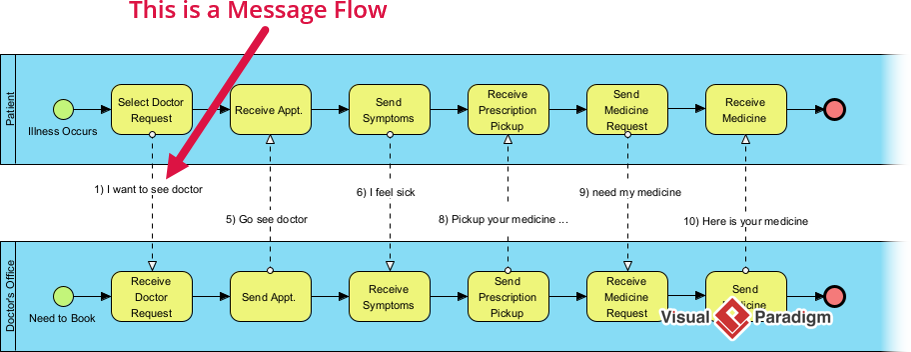
In the complex world of Business Process Management (BPM), clarity is king. When modeling processes that span across different organizations, departments, or systems, standard internal logic often isn’t enough. You need to visualize the actual exchange of information. This is where the Message Flow comes into play.
Today, we will dive deep into the architecture of collaborative processes, using the example of a “Patient vs. Doctor” interaction to understand how to model the vital handoffs between distinct entities.
What is a Message Flow?
Unlike the standard arrows used to dictate the order of steps within a single process, a Message Flow represents communication. It illustrates the transfer of information between two distinct participants. In BPMN (Business Process Model and Notation) terms, it is the bridge that connects separate worlds.
Think of it this way:
- Sequence Flow: Tells the system what to do next (e.g., “After filling the form, click submit”).
- Message Flow: Tells the system that information has been sent (e.g., “The email was received by the server”).
Visualizing Collaboration: The Patient & Doctor Scenario
To understand this concept, let’s look at a classic healthcare scenario. Imagine a process involving two distinct “Pools”:
- The Patient Pool: Represents the individual seeking care.
- The Doctor’s Office Pool: Represents the medical organization providing care.
These two pools are independent. The Patient cannot simply “walk” into the Doctor’s internal logic without crossing a boundary. That boundary crossing is defined by the Message Flow.
Breaking Down the Interaction
Let’s trace the lifecycle of a medical visit using the diagram’s logic:
1. The Initiation (Patient → Doctor)
The process begins when a patient becomes ill. This triggers an internal sequence within the Patient Pool to “Select Doctor Request.” However, this is just a local thought process. To make it real, the patient must send a Request to the doctor. In our diagram, this is represented by a dashed arrow pointing from the Patient’s pool to the Doctor’s pool. This is the first Message Flow.
2. The Response (Doctor → Patient)
Once the Doctor’s Office receives the request, their internal logic kicks in to “Send Appt.” (Send Appointment). The doctor cannot just “know” the appointment is set; the patient must receive the confirmation. A return Message Flow sends the “Appointment” details back to the Patient.
3. The Consultation Loop
This pattern continues as the patient sends “Symptoms” and the doctor sends back a “Prescription.” Finally, the patient requests the medicine, and the doctor sends it. Every single one of these exchanges is a Message Flow.
Key Modeling Rules & Architecture
When using tools like Visual Paradigm to build these diagrams, you must adhere to strict architectural rules to ensure the model is valid:
- Boundary Crossing: A Message Flow must connect two separate Pools or elements inside different pools. You cannot draw a Message Flow between two tasks within the same pool; that is a Sequence Flow.
- No Process Token: This is a critical technical distinction. Sequence Flows carry a “token” (a virtual object that says “the process is here”). Message Flows do not carry a token. They signify the transmission of data. One side sends, the other receives, but the flow itself is not a “traveling agent.”
- Event-Based Communication: Message Flows are almost always attached to events (like Start Events or Message Intermediate Events) rather than just tasks. This emphasizes that the interaction is triggered by a specific message.
AI-Assisted Modeling: Getting It Right
With the rise of AI in software engineering, you might be tempted to ask an AI to generate a BPMN diagram for you. However, AI can often confuse internal logic with external communication. To get the correct architecture, your prompt must be specific.
Instead of asking “Create a doctor appointment process,” use this precise prompt structure:
"Include Message Flows between the Customer Pool and the Vendor Pool to show order requests and confirmations."
By explicitly requesting “Message Flows,” you force the AI to distinguish between internal logic (Sequence Flows) and the external communication required for a collaborative process.
Conclusion
Mastering Message Flows is essential for anyone modeling real-world business scenarios. It moves your diagrams from simple flowcharts to accurate representations of collaborative ecosystems. Whether you are modeling a supply chain, a customer service ticket, or a medical appointment, remember: if it crosses a boundary, it’s a Message Flow.