
AI Enterprise Solution: Mastering Visual Paradigm’s Tripartite Support Framework
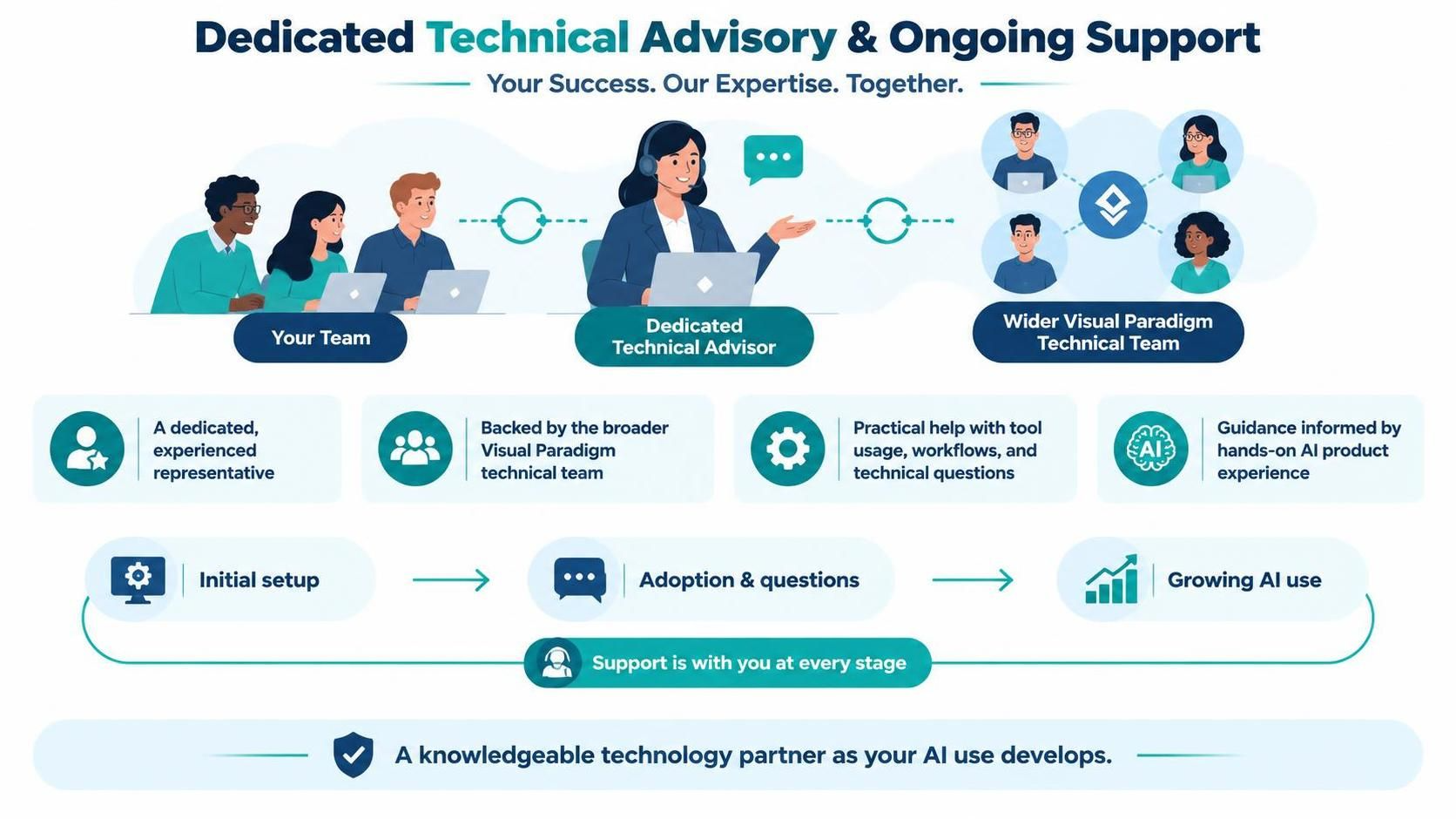
In the rapidly evolving landscape of enterprise technology, the difference between a successful AI implementation and a costly failure often lies not in the software license itself, but in the quality of the support infrastructure surrounding it. As organizations transition from theoretical AI concepts to practical, deployed workflows, the complexity of technical integration, model governance, and user adoption becomes a significant hurdle.
This tutorial explores the architectural philosophy behind Visual Paradigm’s support ecosystem. We will move beyond simple definitions to understand how the “Dedicated Technical Advisory & Ongoing Support” model functions as a critical system component. By analyzing the interaction between the Your Team, the Dedicated Technical Advisor, and the Wider Visual Paradigm Technical Team, we can map out a robust framework for AI adoption.
The Tripartite Support Architecture
Visual Paradigm has designed a support model that mirrors the three-tier architecture often used in scalable software systems. This ensures that the client (Your Team) has a single point of contact that is backed by deep, specialized resources. This structure prevents the “black box” syndrome where users feel isolated after purchasing a tool.
1. The Client Layer: Your Team
At the apex of the engagement is the client organization. This layer represents the business stakeholders, developers, and analysts who are directly responsible for leveraging AI tools. In the Visual Paradigm ecosystem, the goal is to provide these users with a “No-Code” or low-code environment where they can focus on business logic and modeling rather than getting bogged down in infrastructure management.
2. The Bridge Layer: Dedicated Technical Advisor
The core of this architecture is the Dedicated Technical Advisor. Think of this role not merely as a helpdesk agent, but as a system architect and change manager. This representative acts as the bridge between the client’s specific business needs and the technical capabilities of the platform.
- Role Definition: A dedicated, experienced representative who understands the client’s unique context.
- Function: To translate technical constraints into business solutions and vice versa.
- Value Proposition: Reduces the learning curve by providing guidance informed by hands-on AI product experience.
3. The Core Layer: Wider Visual Paradigm Technical Team
Backing the dedicated advisor is the broader technical team. This layer functions as the “backend” infrastructure of the support system. When the dedicated advisor encounters a novel edge case, a deep-level configuration issue, or a request for a specific workflow customization, they draw upon the collective knowledge and engineering resources of the wider team.
This ensures that the support provided is not limited to a single individual’s knowledge but is resilient and backed by the collective expertise of the Visual Paradigm engineering organization.
Mapping the Lifecycle: From Setup to Scale
The interaction between these layers is not static; it evolves dynamically as the organization moves through the AI adoption lifecycle. The following diagrammatic flow illustrates the progression of support needs and how the ecosystem adapts to them.
graph LR
    subgraph Lifecycle_Stages
    S[Initial Setup] --> A[Adoption & Questions]
    A --> G[Growing AI Use]
    end

    subgraph Support_Engine
    Advisor[Dedicated Advisor] <--> Client[Your Team]
    Advisor <--> Core[VP Technical Team]
    end

    Client -.->|Needs Guidance| Advisor
    Advisor -.->|Escalates/Consults| Core
    Core -.->|Knowledge Base| Advisor
    end

    subgraph Outcome
    O[Knowledgeable Partner]
    end

    Support_Engine -.-> O
Phase 1: Initial Setup
The journey begins with the “Initial Setup” phase. This is the most critical period for system stability. During this stage, the Dedicated Technical Advisor works closely with the client to ensure that the Visual Paradigm ecosystem is correctly configured. This involves:
- Setting up the visual modeling environment.
- Configuring AI core components for seamless integration.
- Establishing the initial data pipelines for knowledge management.
At this stage, the support is heavy on technical configuration and environment validation to ensure a solid foundation.
Phase 2: Adoption & Questions
Once the system is live, the focus shifts to “Adoption & Questions.” This is where the “No-Code” philosophy shines. Users begin to explore different workflows, asking practical questions about how to use the tools effectively. The Dedicated Advisor acts as a tutor here, helping teams navigate technical issues that arise during the trial and error of adoption.
Phase 3: Growing AI Use
The final stage depicted is “Growing AI Use.” This represents the maturity phase where the organization begins to scale their AI initiatives. The support model ensures that as the complexity of AI models grows, the support infrastructure grows with it. The goal is to establish a long-term relationship where the client views the support team as a knowledgeable technology partner rather than just a vendor.
Strategic Benefits of the Advisory Model
Why is this specific architecture superior to standard “ticket-based” support? The answer lies in the concept of Continuity of Knowledge.
In many software deployments, support is fragmented. A user might get a different answer from different agents. In the Visual Paradigm model, the Dedicated Technical Advisor maintains a continuous thread of knowledge regarding the client’s history, specific pain points, and strategic goals. This continuity allows for:
- Proactive Problem Solving: The advisor can anticipate issues based on the client’s growth trajectory.
- Context-Aware Advice: Solutions are not generic; they are tailored to the client’s specific industry and technical constraints.
- Reduced Downtime: By having a direct line to the broader technical team, issues are resolved faster than waiting for general queue processing.
Conclusion: Building a Sustainable AI Future
The transition to AI is not a one-time event but a continuous journey of adaptation and learning. The “Dedicated Technical Advisory & Ongoing Support” model provided by Visual Paradigm is designed to be the constant companion throughout this journey. By combining a dedicated point of contact with the power of a wider technical team, organizations are empowered to focus on innovation rather than infrastructure management.
Whether you are an SME looking to implement your first AI model or an Enterprise scaling across multiple departments, this ecosystem provides the necessary safety net to ensure that your AI investments deliver tangible, lasting value.