
From AI Draft to VP Architecture: Agile Microservices with VP AI Ecosystem
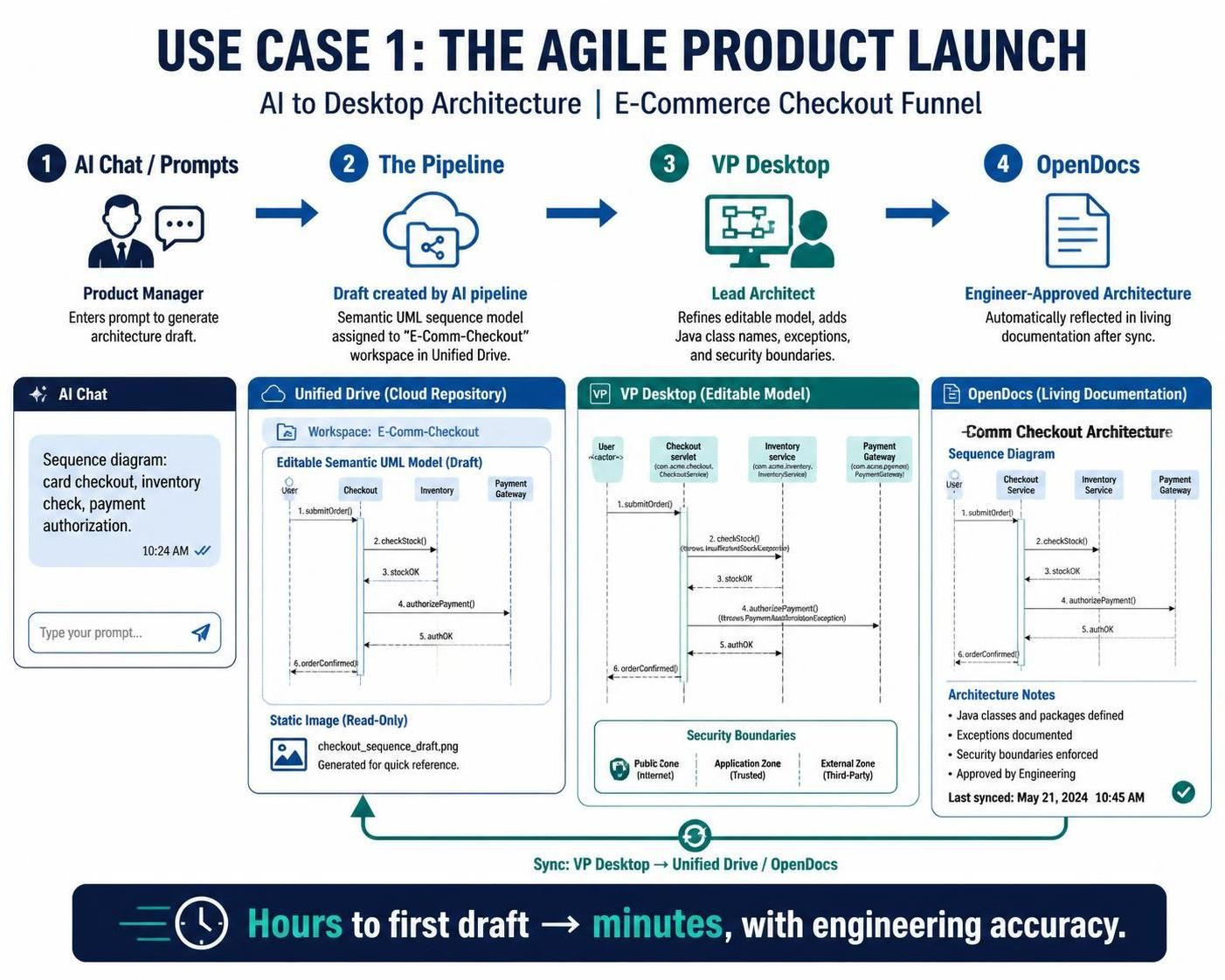
In modern software engineering, the gap between high-level product requirements and low-level implementation details is often bridged by a tedious documentation process. However, with the advent of AI-driven modeling integrated into desktop environments, this gap is collapsing. This tutorial explores Use Case 1: The Agile Product Launch, a workflow designed to accelerate the creation of a microservices-based E-Commerce checkout funnel.
We will walk through the four distinct stages of this architecture, moving from an AI-generated draft to a fully synchronized, engineer-approved living documentation system.
The Workflow Architecture
The process is defined by a seamless hand-off between four specific tools: AI Chat, The Pipeline (Unified Drive), VP Desktop, and OpenDocs. This “AI to Desktop” architecture ensures that speed never compromises technical accuracy.
Phase 1: AI Chat / Prompts (The Spark)
The journey begins with the Product Manager. Instead of manually drawing boxes and arrows, they utilize natural language processing. The goal is to define the scope of the “E-Commerce Checkout Funnel” quickly.
- The Input: The PM inputs a prompt into the AI Visual Modeling Engine: “Generate a UML Sequence Diagram for a user checking out with a credit card, including inventory checks and payment gateway authorization.”
- The Output: The AI generates a draft sequence diagram. This serves as the initial “mental model” visualization.
Phase 2: The Pipeline (The Repository)
Once the draft is generated, the system moves the data into the Unified Drive. This is a crucial step that differentiates this workflow from standard AI tools.
- Workspace Assignment: The diagram is assigned to a specific workspace (e.g., “E-Comm-Checkout”).
- Storage Format: Initially, the pipeline might store a static image (Read-Only) for quick reference, but the critical data is preserved as a Semantic UML Model. This ensures the diagram is not just a flat image but a structured data object that can be manipulated later.
Phase 3: VP Desktop (The Refinement)
This is the core technical phase. The Lead Architect opens Visual Paradigm (VP) Desktop and connects to the Unified Platform. They pull the diagram from the pipeline.
- Importing the Model: Because the data was sent via the pipeline, it imports as a fully editable, semantic model. The architect does not need to redraw the boxes; they are already there.
- Technical Mapping: The architect enriches the AI draft with real-world constraints. This includes mapping exact Java class names, defining exception handling logic, and drawing security boundaries.
- Security: As shown in the diagram, the architect defines zones (Public, Application, External) to ensure the checkout process adheres to security protocols.
Phase 4: OpenDocs (The Living Documentation)
The final step is synchronization. The architect clicks “Sync” to publish the refined model back to the Unified Drive.
- Automated Updates: The OpenDocs page, which serves as the central documentation hub, instantly reflects these changes.
- Engineer-Approved: The architecture is now tagged as “Approved by Engineering.” It is no longer a draft; it is the source of truth for the development team.
Understanding the Sequence Diagram Logic
The core of this use case is the UML Sequence Diagram. It visualizes the interaction between four key actors in the E-Commerce system: User, Checkout Service, Inventory Service, and Payment Gateway. Below is the logical flow of the messages exchanged during a successful transaction.
@startuml
autonumber
participant User
participant Checkout as "Checkout Service"
participant Inventory as "Inventory Service"
participant Payment as "Payment Gateway"

User -> Checkout : 1. submitOrder()
activate Checkout
Checkout -> Inventory : 2. checkStock()
activate Inventory
Inventory --> Checkout : 3. stockOK
deactivate Inventory
Checkout -> Payment : 4. authorizePayment()
activate Payment
Payment --> Checkout : 5. authOK
deactivate Payment
Checkout --> User : 6. orderConfirmed()
deactivate Checkout
@enduml
Key Logic Notes:
- Sequential Flow: The order is submitted to the checkout service first.
- Inventory Check: Before payment, the system verifies stock availability.
- Authorization: The payment gateway validates the credit card.
- Confirmation: Only after all checks pass is the order confirmed to the user.
Conclusion
This workflow demonstrates a paradigm shift in software design. By combining the speed of AI Chat with the precision of VP Desktop and the accessibility of OpenDocs, teams can reduce the time-to-first-draft from hours to minutes. The result is a high-fidelity architecture that is both technically accurate and instantly available to the entire organization.